Cats & Dogs
Pet Home Systems, Cleanup, and Travel Gear for Cats and Dogs (2026 Guide)
What the spec sheet does not tell you about litter boxes, carriers, crash-tested restraints, pet cameras, microchip feeders, and travel rules — distilled from federal, veterinary, and welfare guidance.
By Nick Miles · Updated May 5, 2026 · 16 min read
PetPalHQ is reader-supported. We may earn a commission from qualifying Amazon purchases at no extra cost to you.
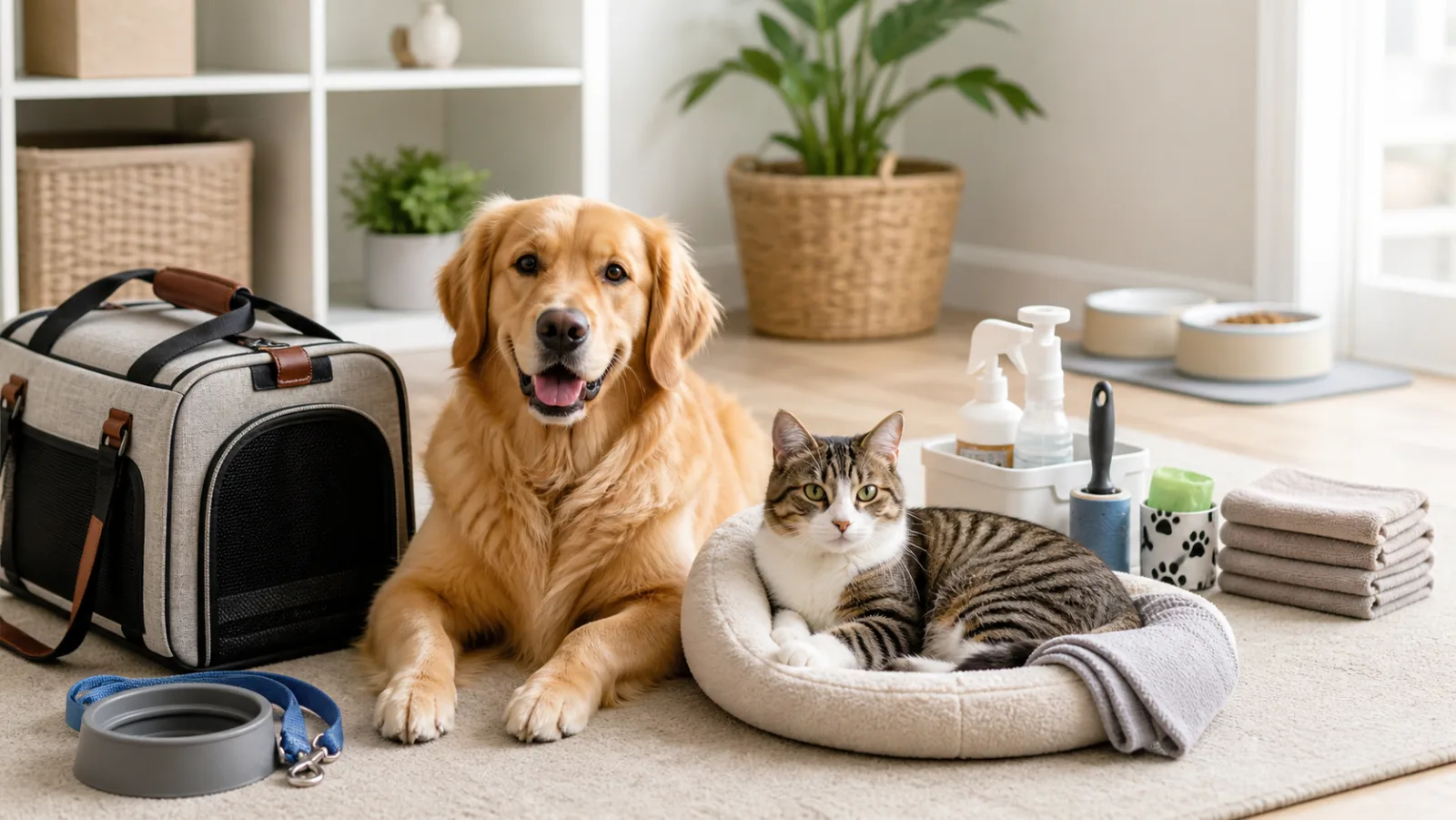
Every product on this list has been scored against the PetPal Gear Score, a weighted composite of expert consensus, observed effectiveness, animal safety, long-term durability, and value. Review method: Editorial synthesis of federal travel rules, veterinary and welfare guidance, and manufacturer documentation — ASPCA, AAFP/ISFM, FAA, TSA, USDOT, USDA APHIS, CDC, IATA, AVMA, AAHA, Merck Veterinary Manual, Cornell University College of Veterinary Medicine, Center for Pet Safety, Fear Free, and AVSAB.. Synthesized from 17+ expert sources.
The right pet home system is not the one with the longest feature list. Expert consensus from the ASPCA, the American Association of Feline Practitioners and International Society of Feline Medicine (AAFP/ISFM), the Federal Aviation Administration (FAA), the Transportation Security Administration (TSA), the U.S. Department of Transportation (USDOT), the Centers for Disease Control and Prevention (CDC), the U.S. Department of Agriculture's Animal and Plant Health Inspection Service (USDA APHIS), the International Air Transport Association (IATA), the American Veterinary Medical Association (AVMA), the Merck Veterinary Manual, the American Animal Hospital Association (AAHA), and the Center for Pet Safety converges on a much simpler rule: the right system is the one that is safe for the animal's body and behavior, easy to sanitize, realistic for the owner to maintain, and backed by a fallback plan when the tech fails or travel rules change.
This hub explains what those sources actually say about home setup zones, cleanup hardware, monitoring and automation, and U.S. travel rules — with sources cited by name throughout. PetPalHQ does not run a testing lab; the recommendations below are editorial synthesis of expert and regulatory guidance.
What are the universal rules to check before buying any pet home system or travel product?
Six rules hold regardless of which carrier, litter box, feeder, or camera you eventually choose. They come directly from primary sources — the ASPCA, AAFP/ISFM, FAA, FDA, AVMA, Merck Veterinary Manual, Whisker, and PetSafe — and none of them appear in typical product listings. Getting these wrong is the most common reason a technically adequate product fails in practice.
- Protect access and choice. AAFP/ISFM's Feline Environmental Needs Guidelines say cats should have multiple, separated key resources — toileting, feeding, water, scratching, play, and resting areas — and at least two of each in many homes. The ASPCA's litter guidance adds that boxes should be quiet, accessible, and numerous enough for the household layout.
- Match the system to the animal's body. The ASPCA notes that older or mobility-limited cats may struggle with top-entry boxes or high sides; FAA cabin rules and IATA container standards make carrier size and fit non-negotiable for air travel.
- Default to fail-safe automation. Manufacturer documentation from Whisker (Litter-Robot 4 manual) and PetSafe (ScoopFree manual) shows that sensor logic, weight minimums, placement requirements, and interrupted-cycle behavior matter as much as the marketing feature list.
- Train before you travel. ASPCA, AKC, AAHA, AAFP, and the Merck Veterinary Manual all converge on gradual carrier acclimation rather than first-use-on-travel-day.
- Do not default to sedatives. The FDA, AVMA, and Merck Veterinary Manual all caution against casual pre-trip sedation and frame medication as a veterinarian-guided decision, not a routine hack.
- Check travel rules before you buy gear. FAA cabin stowage rules, TSA checkpoint procedures, USDOT airline restrictions, CDC dog-import requirements, USDA APHIS state-by-state guidance, and IATA container standards can all change independently of any specific product.
How should you organize home setup zones for eating, sleeping, playing, and elimination?
The AAFP/ISFM Feline Environmental Needs Guidelines describe a healthy home as a layout with separated, redundant resources — not a single feeding-and-toileting corner. The same logic transfers usefully to dogs in multi-pet homes: when food, water, sleep, and elimination zones overlap, behavior problems follow.
Eat. AAFP/ISFM recommends physically separate feeding stations in multi-pet homes, with food and water bowls separated from one another and ample distance from toileting areas. Sure Petcare's microchip pet feeder documentation describes the device as designed to stop food stealing and protect prescription or weight-management diets — a common bottleneck in multi-cat and mixed-species homes that no amount of training fully solves. Standard bowls remain perfectly appropriate for single-pet households where resource theft is not in play.
Sleep and rest. The ASPCA's home-safety and moving guidance recommends a quiet, low-stimulation room when pets arrive in a new home, and AAFP/ISFM names resting areas as one of the five core feline resource categories. Practical translation: a bed in every room your pet uses regularly, plus at least one elevated and one enclosed option per cat.
Play. AAFP/ISFM treats play as a core resource, not an optional extra. AVSAB's position on humane behavior modification reinforces the point: enrichment that lets a pet perform species-typical behavior reduces the secondary problems — destructive scratching, inappropriate elimination, separation distress — that owners often try to solve with hardware first.
Eliminate. The ASPCA's litter guidance is the anchor: scoop at least daily, wash and refill at least weekly, and keep boxes in accessible, quiet locations. The common baseline is one box per cat plus one extra. In multilevel homes, the ASPCA recommends one box per floor. AAFP/ISFM's framing — separated resources by social subgroup — explains why two boxes side-by-side in one bathroom often fails in homes with two or more cats: spatially they count as one resource.
What should you know about cleanup hardware for litter boxes, waste systems, and odor control?
The cleanup half of the home is where the gap between marketing claims and manufacturer manuals is widest. The ASPCA's litter guidance and the product manuals from Whisker and PetSafe provide the most reliable framework for evaluating any product class — and the specs that matter most rarely appear in the listing.
Traditional litter boxes. Still the most flexible option, especially for senior cats, kittens, multi-cat ambush situations, or homes that want a definite fallback if a smart box fails. The ASPCA notes that covered or top-entry boxes can be inappropriate for older or arthritic cats; low-sided open pans solve that with no electronics required.
Self-cleaning and robotic litter boxes. The Whisker Litter-Robot 4 manual specifies that cats must weigh at least 3 lb for automatic mode, the unit must sit on a firm level surface away from walls, and the cat-sensing system combines optical, weight, and motion sensing to interrupt cycles. PetSafe's ScoopFree manual specifies that the cleaning rake begins 20 minutes after the cat leaves, the model is best for cats under 15 lb, more than one box is recommended for more than two cats, and kittens under six months should use the unit unplugged. Translation: automation is appropriate for some households when size, weight, placement, and fallback rules are honored — not as a universal upgrade. The ASPCA's litter guidance is explicit that strategy should change if elimination problems begin; that means keeping a conventional backup box even after switching to automation.
Litter mats and odor control. The ASPCA's poison-control guidance reminds owners that "pet-safe" is not the same as casual handling; undiluted bleach can injure the mouth and esophagus, and most cleaning products are safe only when used according to label directions. For accidents, the ASPCA recommends enzymatic cleaners that neutralize the odor source rather than masking it with strong fragrance — a point that matters because cats often dislike strong scents and may avoid an over-perfumed cleanup zone.
Vacuums and dander management. No regulatory body publishes a recommended vacuum spec, but two practical synthesis points come straight from the ASPCA's home-safety pages: keep cords tucked and out of chew range, and avoid leaving robotic vacuums running unattended near loose cords, food spills, or solid pet waste they may smear. Treat any vacuum, robotic or upright, as cleanup gear with handling rules — not a one-button solution.
How do pet cameras, smart feeders, and automated litter boxes actually work — and what can they not do?
Pet cameras and smart feeders are observation and resource-control tools, not behavior treatments. Fear Free and the American Veterinary Society of Animal Behavior both treat video monitoring as useful for documenting distress during absences — but observation is not treatment. Furbo's help-center confirms that alert sensitivity, false detections from external noise, and subscription-dependent features are real operational considerations rarely surfaced in product listings. The right framing: useful for observation, not a fix for separation distress.
Sure Petcare's microchip pet feeder documentation describes the device as designed for multi-pet homes, prescription-food control, and weight-management diets. The microchip pet door pages emphasize intruder blocking and curfew mode. These are good examples of technology that solves a specific bottleneck — resource theft, prescription diet protection, or unwanted intruder access — without changing the underlying behavioral need. They are not substitutes for separated feeding stations or for the cat's choice in when to access outdoor space.
Smart litter boxes belong in this category too. The Whisker manual's documented sensor stack — optical plus weight plus motion, with cycle interruption — is doing real safety work, but only when the unit sits on a firm level surface away from walls and the cat clears the weight minimum.
What do TSA, FAA, USDOT, CDC, USDA APHIS, and IATA each require for pet travel?
Reading the regulator instead of the brand matters most here. Five U.S. agencies plus IATA each control a different slice of the pet-travel problem, and they update their rules independently of any product on the market. Buying gear before checking all applicable rules is the single most common travel planning mistake for pet owners.
TSA — checkpoint screening. The Transportation Security Administration's published pet rules say small pets may go through the checkpoint if removed from the carrier; the carrier is screened separately on the X-ray belt. Wet pet food in carry-on follows the standard 3-1-1 liquids rule with no prescription-food exemption per TSA's published guidance. The AVMA's travel brochure repeats the "remove pet before X-ray" instruction. TSA notes that travelers with anxious cats can request private screening. Practical implication: practice harness fit and at-home carrier removal before you ever stand at a checkpoint.
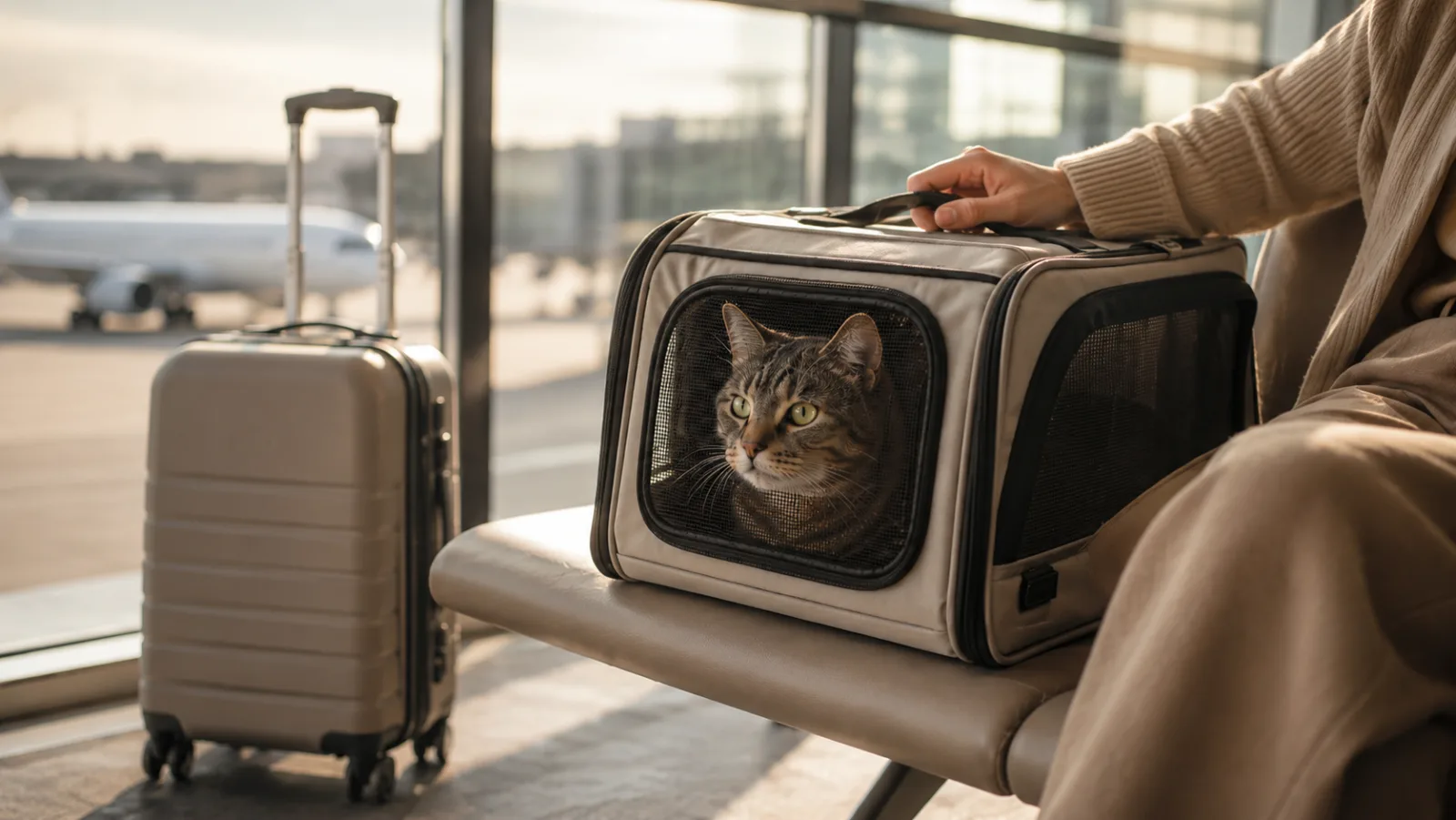
FAA — cabin stowage and aircraft movement. The FAA's Flying with Pets and Cabin Safety – Pets FAQ state that cabin pet containers count as carry-on baggage, must fit under the seat in front of you, must remain properly stowed during aircraft movement, and must follow crew instructions. The FAA does not certify specific carriers — that is on the airline.
USDOT — airline-specific restrictions. USDOT's Flying with a Pet page (Sep. 26, 2025) confirms that airlines may impose additional size, behavior, case, and breed restrictions, including on brachycephalic (snub-nosed) animals. That is why "airline-approved carrier" is a per-carrier, per-airline check — not a universal label.
CDC — dog imports into the U.S. As of the CDC's Frequently Asked Questions on Dog Importations page (revised Mar. 17, 2026), all dogs entering or returning to the U.S. must have a CDC Dog Import Form receipt, and dogs from rabies-free or low-risk countries must still appear healthy, be microchipped, and be at least six months old. This is a high-priority current rule for any owner planning international travel.
USDA APHIS — interstate movement. APHIS's Take a Pet from One U.S. State or Territory to Another page (Aug. 27, 2025) is explicit: APHIS does not regulate interstate movement of pets by their owners; domestic movement rules are set by the receiving state or territory. The FDA's pet-travel guidance highlights Hawaii as the only rabies-free state, with stricter entry requirements than the rest of the country.
IATA — container standards for hold travel. IATA's Traveler's Pet Corner spells out the container math: snub-nosed breeds typically require a container 10% larger, animals over 14 kg are usually crated individually, and container formulas are based on the animal's actual nose-to-tail and shoulder-height dimensions. Even when an airline accepts a smaller container, IATA's standards are the safer reference for the animal.
Travel mode comparison
| Travel mode | Primary container or restraint | Key rule constraint | Biggest avoidable mistake |
|---|---|---|---|
| Car (short trip) | Crate, harness, or travel barrier in back seat or cargo | ASPCA, AKC, AAHA, Merck: never leave pets unattended in a parked car | Riding loose in lap or front seat |
| Car (road trip) | Crash-tested harness or travel crate per Center for Pet Safety certification | AVMA: avoid front airbag zones; plan rest stops | Skipping acclimation drives before the trip |
| Air cabin | Soft- or hard-sided under-seat carrier per airline spec | FAA: must stow under seat and remain stowed during aircraft movement | Buying a carrier without checking the specific airline's under-seat dimensions |
| Air cargo / hold | IATA-spec hard-sided container | IATA: snub-nosed breeds need a container 10% larger; many airlines have heat embargoes | Booking before confirming both airline and weather/route restrictions |
| Interstate (U.S.) | Receiving state's rules govern | APHIS: domestic rules set by destination state; Hawaii is rabies-free with stricter entry | Checking origin state instead of destination state |
| International (into U.S.) | Per CDC, USDA APHIS, and destination country | CDC: Dog Import Form receipt required for all dogs entering or returning to U.S. | Booking before securing destination country's import paperwork |
Sources for the table: ASPCA, AKC, AAHA, AVMA, Merck Veterinary Manual, FAA, USDOT, TSA, CDC, USDA APHIS, IATA, and Center for Pet Safety.
How do you verify carrier safety and what does crash-test certification actually mean?
The Center for Pet Safety publishes an independent crash-test certification program for harnesses, carriers, and travel crates. The American Kennel Club's dog car-safety guidance specifically warns that "crash tested" wording from a manufacturer is not the same as independent certification by a third party — look for the certifying body by name. ASPCA, AKC, AAHA, and Merck all converge on three car-travel rules: restraint in the back seat, no front airbag zone, and no pet unattended in a parked car.
For carriers used in cabin air travel, FAA stowage rules and per-airline under-seat dimensions are the sizing constraint. For carriers used in cargo, IATA's container math is the safer reference because it accounts for the animal's own dimensions rather than a single external box size. The AVMA's travel brochure adds the practical step that cabin carriers should be familiar to the pet — which means at-home setup and acclimation in the weeks before the trip, not the night before.
Carrier sizing quick reference
| Animal profile | Sizing reference | Key caveat |
|---|---|---|
| Small dog or cat in cabin | Airline's published under-seat dimensions | Confirm with the specific airline; FAA does not set a universal cabin carrier size |
| Snub-nosed (brachycephalic) breed | IATA: container 10% larger than standard | Airline may also restrict or refuse brachycephalic breeds (per USDOT) |
| Dog over 14 kg | IATA: typically crated individually | Confirm route, weather embargoes, and airline policy before booking |
| Senior cat | Low-entry, easy turnaround space | ASPCA: avoid top-entry or high-sided designs for arthritic cats |
| Car restraint (dog) | Center for Pet Safety crash-test certification | AKC: independent certification, not manufacturer self-claim |
Sources: FAA, USDOT, IATA, ASPCA, AKC, Center for Pet Safety.
How do you manage motion sickness, anxiety, and carrier acclimation before travel?
The FDA, the AVMA, and the Merck Veterinary Manual all agree on the starting point: do not sedate by default. Sedatives can interact poorly with the cardiovascular changes of air travel and reduce a pet's ability to right itself in a crate. Any medication decision — including anti-nausea support or anxiolytics — belongs in a veterinarian conversation, not a product aisle.
Cornell University College of Veterinary Medicine's dog-travel guidance acknowledges that anxious or motion-sick dogs may genuinely benefit from veterinarian-guided medication — typically anti-nausea support, anxiolytics distinct from blunt sedatives, or a referral to a veterinary behaviorist — but the framing is "ask your veterinarian to distinguish between options," not "pick something on your own."
ASPCA, AKC, AAHA, AAFP, and Merck all recommend the same acclimation pattern: leave the carrier or crate out and open in the home for weeks, feed treats inside, take short carrier-only handling sessions, then short drives, then longer ones. Fear Free's carrier guidance reframes the carrier as a safe place rather than an emergency-only object. AVMA's travel brochure adds the airport-specific step of practicing harness fit and removal-from-carrier handling before the day of travel.
How do you prevent resource conflict in multi-pet homes?
AAFP/ISFM's framing — multiple, separated key resources, distributed by social subgroup — predicts most multi-pet conflict before it shows up as a behavior problem. The ASPCA's litter guidance translates the same idea into specifics: one box per cat plus one extra, one box per floor in multilevel homes, accessible placement, daily scooping, weekly wash-out. AVSAB's position statements are clear that punishment-based "fixes" are not a substitute for environmental management.
Sure Petcare's microchip feeder documentation is a useful example of when hardware is the right answer: prescription diets, weight-management programs, and chronic food stealing in households where physical separation is hard to enforce. The microchip pet door is a parallel example for managing intruder cats and curfew rules. Cameras and smart litter boxes can document patterns — Furbo's help center notes that barking and meowing alerts are adjustable but susceptible to false detection from external noise — but observation tools are not behavior treatments, a point Fear Free and AVSAB both make explicitly.
What are the most common mistakes with pet home systems, cleanup hardware, and travel gear?
Most home-system failures map onto the same cluster of mistakes that the primary sources — ASPCA, Merck Veterinary Manual, AKC, FAA, CDC, and manufacturer manuals from Whisker and PetSafe — name repeatedly. Nearly all of them come down to reading the listing instead of the manual, buying gear before verifying rules, or treating an observation tool as a behavior treatment.
Reading the listing instead of the manual. Whisker's Litter-Robot 4 manual documents weight minimums, floor and wall-clearance rules, and sensor behavior. PetSafe's ScoopFree manual documents the 20-minute post-use rake delay, weight cap, kitten exclusion, and recommended box count for more than two cats. Neither set of constraints fits into a marketing bullet point — and missing them is the most common automatic-litter-box complaint pattern.
Treating "crash tested" as a certification. AKC's dog car-safety guidance and the Center for Pet Safety's program both make the point that manufacturer wording is not equivalent to independent third-party certification. Look for the certifying body by name.
Buying a cabin carrier on external dimensions alone. FAA stowage rules require the carrier to fit under the seat in front of you, and USDOT confirms that airlines may impose additional size, behavior, case, and breed restrictions. Cabin carrier shopping is a per-airline check, not a universal one.
Letting strong scent masking stand in for cleanup. The ASPCA recommends enzymatic cleaners that neutralize the odor source. Strong fragrance can drive cats away from a previously well-used location and does not address the underlying compound.
Sedating before consulting a veterinarian. The FDA, AVMA, and Merck Veterinary Manual all caution against routine pre-trip sedation. Cornell notes that veterinarian-guided anti-nausea or anxiolytic support is appropriate for some dogs, but only as a clinical decision.
Checking travel paperwork the night before. APHIS sets domestic movement rules at the destination state level; the CDC requires a Dog Import Form receipt for all dogs entering or returning to the U.S. as of Mar. 17, 2026; FAA cabin rules and USDOT airline-specific restrictions apply on top of one another. Verify all of them at the booking stage, not the morning of.
Frequently Asked Questions
- Are automatic litter boxes safe for cats?
- They can be appropriate for some cats and households when fail-safe design, size and weight minimums, cleaning burden, and fallback options are honored. The Whisker Litter-Robot 4 manual specifies a 3 lb minimum for automatic mode and combined optical-weight-motion sensing to interrupt cycles. PetSafe's ScoopFree manual specifies a 15 lb upper guideline, a 20-minute delay before raking, and that kittens under six months should use the unit unplugged. The ASPCA's litter guidance also says strategy should change if elimination problems begin. Keep a conventional backup box even after switching to automation.
- How many litter boxes do I need for two or more cats?
- Start with the ASPCA's baseline of one box per cat plus one extra. Distribute by floor and social subgroup as AAFP/ISFM's environmental guidelines recommend. If access or ambush issues remain, add boxes before changing litter type.
- What is the safest way for a dog to ride in a car?
- Secure restraint in the back seat. Use either a properly sized travel crate or a harness independently certified by the Center for Pet Safety. ASPCA, AKC, AAHA, and Merck Veterinary Manual all support this approach. AKC specifically warns that "crash tested" manufacturer wording is not the same as independent certification.
- Can I sedate my pet for a road trip or flight?
- Not by default. The FDA, AVMA, and Merck Veterinary Manual all caution against routine pre-trip sedation. Cornell University College of Veterinary Medicine notes that anxious or motion-sick dogs may benefit from veterinarian-guided medication, including anti-nausea support. That is a clinical decision, not a routine hack.
- What happens at TSA with a cat or dog?
- TSA's published pet rules say small pets must be removed from the carrier. The carrier is screened separately on the X-ray belt. The AVMA's travel brochure repeats the "remove pet before X-ray" instruction, and TSA notes that travelers with anxious cats can request private screening. Practice harness fit and at-home carrier removal in the weeks before the trip.
- Can I bring wet pet food through airport security?
- Per TSA, wet pet food in carry-on follows the standard 3-1-1 liquids rule, with no prescription-food exemption. Pack only what you need for the trip and stow larger quantities in checked baggage where allowed by your airline.
- What paperwork do I need to travel between U.S. states with a pet?
- USDA APHIS is explicit that it does not regulate interstate movement of pets by their owners. Domestic movement rules are set by the receiving state or territory. Check the destination state's rules well ahead of travel. The FDA's pet-travel guidance flags Hawaii as the only rabies-free state, with stricter entry requirements than the rest of the country.
- What changed for dogs entering the U.S.?
- The CDC's Frequently Asked Questions on Dog Importations (revised Mar. 17, 2026) requires that all dogs entering or returning to the U.S. have a CDC Dog Import Form receipt. Dogs from rabies-free or low-risk countries must still appear healthy, be microchipped, and be at least six months old.
- Can a pet camera help with separation anxiety?
- It can help observe and document behavior during absences. Both Fear Free and AVSAB treat video monitoring as a useful observation tool — but it is not the treatment itself. Furbo's help center explicitly notes that barking and meowing alerts are adjustable but susceptible to false detection from external noise. Pair the camera with a veterinarian or veterinary behaviorist if separation distress is suspected.
Bottom Line
Match the system to the animal, not the room. ASPCA notes older or mobility-limited cats may struggle with top-entry boxes or high sides. AAFP/ISFM organizes feline home setup around multiple, separated key resources rather than feature lists.
Automation must fail safe. Whisker's Litter-Robot 4 manual and PetSafe's ScoopFree manual both document weight minimums, placement rules, and interrupted-cycle behavior — read the manual, not just the listing.
Train the carrier before you need it. ASPCA, AKC, AAHA, AAFP, and Merck Veterinary Manual all converge on gradual acclimation rather than treating the carrier as a travel-day-only object.
Do not sedate by default. The FDA, AVMA, and Merck Veterinary Manual all caution against routine pre-trip sedation and frame any medication as a veterinarian-guided decision.
Check travel rules before you buy gear. FAA cabin stowage rules, TSA checkpoint procedures, USDOT airline restrictions, CDC dog-import requirements, and IATA container standards can change independently of any product.
All articles in this guide
Automatic & Self-Cleaning Litter Box Systems: 2026 Buyer's Guide
What the spec sheet does not tell you about automatic litter boxes — box count, multi-cat capacity, the subscription paywall, and the safe-exit sensors that keep kittens and large cats safe.
8 min read
Best Auto-Replenishing Pet Care Station: Litter, Feeding & Water (2026)
The Litter-Robot 4 Supply Bundle anchors the station; a PETLIBRO feeder pairs with Subscribe & Save food; a PetSafe fountain runs on cheap replacement filters. The recurring cost, not the sticker, decides the build.
15 min read
Best Pet Cameras for Dogs and Cats: Monitoring, Treat-Toss, and Subscription-Free Picks (2026)
Pet cameras are monitoring and enrichment tools, not separation-anxiety treatments. The Furbo 360 standalone is the synthesis pick for treat-toss interaction; Wyze Cam Pan v3 is the honest budget answer for owners who just need room visibility. Furbo also lists a subscription-required bundle that looks almost like the standalone; it was out of stock at our September 3, 2026 check, and it binds you to a paid plan when it is available.
14 min read
Best Smart Pet Feeders for Multi-Pet Homes: Microchip, RFID, and Wet-Food Picks (2026)
For multi-pet homes with prescription diets, food theft, or weight-management splits, an implanted-microchip feeder solves a problem no camera or schedule-only feeder can. The Sure Petcare SureFeed Microchip Pet Feeder is the synthesis pick; the SureFeed Connect adds app-linked monitoring; PETLIBRO One RFID is the collar-tag alternative; the PETLIBRO Polar covers the wet-food angle that hopper feeders ignore.
12 min read
Best Crash-Tested Dog Car Harnesses and Carriers (2026)
The safest restraint is the one a third party has actually crash-tested, and that filter cuts this category hard. Sleepypod's CPS-certified Mobile Pet Bed and the enclosed Pawsincar car seat cover cats and small dogs; Kurgo's Tru-Fit and Impact carry manufacturer-declared FMVSS 213-style testing for dogs up to 108 lb. Where the evidence is a maker's own declaration rather than independent certification, this guide says so in the pick.
13 min read
Best Airline-Approved Pet Carriers for In-Cabin Travel (2026)
There is no universally airline-approved bag — FAA defers to airlines, TSA controls the checkpoint, and IATA sets ventilation and movement standards. The Sleepypod Air is the top-scoring pick as the only CPS-certified dual-use carrier, the Sherpa Original Deluxe is the value default with its Guaranteed On Board program, and the Petmate Sky Kennel handles IATA-compliant cargo travel.
14 min read
Best Pet Odor Removers and Enzyme Cleaners (2026)
Rocco & Roxie Stain & Odor Eliminator is the synthesis pick for everyday pet accidents; Nature's Miracle Urine Destroyer Plus is the cat-specific answer; Anti Icky Poo is the professional-grade option. Skip every product on this list and call your veterinarian if your pet is repeatedly soiling indoors. Merck and the Cornell Feline Health Center both treat persistent house-soiling as a medical and behavioral workup, not a cleaning problem.
11 min read
The Best Travel Setup for Dog Owners: Crash-Tested Restraints, Crates, and Carriers (2026)
What a travelling dog household actually needs, ordered by the strength of the evidence behind it rather than by how the box is marketed.
13 min
How to Get Rid of Dog & Cat Urine Smell Permanently (2026)
This is not a product roundup — it is the removal protocol. Odor that keeps coming back was never fully removed: ordinary soaps lift the visible mess but leave the uric acid crystals a cat's or dog's nose still reads as a bathroom. Permanent removal means finding every deposit under a UV light, breaking down the uric acid with enzymes at each site, extracting what soaked into carpet and pad, and only then layering scent. If the soiling is sudden or spreading, stop cleaning and call your veterinarian — ASPCA, Cornell, and the Merck Veterinary Manual all treat house-soiling as a medical workup first.
13 min read
Reducing Pet Allergies and Dander at Home (2026)
This is not another air-purifier ranking. Pet dander is produced continuously, so no single device fixes pet allergies — relief comes from stacking source, surface, and air controls, and an air purifier bought alone is the most common half-measure. The picks below are a layered system: cut the dander at its source with grooming, pull it off surfaces with a sealed-HEPA vacuum, capture what goes airborne with a whole-room HEPA unit, and catch the rest at your furnace. For the allergy symptoms themselves — the sneezing, the wheeze, the itch — your own physician or allergist is the authority, not a shopping page. Some people stay allergic no matter how clean the air is; this guide lowers the household allergen load, and it says plainly when the honest answer is a doctor rather than a device.
12 min read
Best Heavy-Duty Outdoor Dog Kennels and Runs (2026)
The welded Lucky Dog kennel and the 10-gauge ALEKO Luna are the documented-heavy-steel picks here. The rest trade some proven construction for space, height, a roof, or a lower price.
~11 min read
Best Crash-Tested Travel Dog Crates (2026)
Only one crate here carries an independent Center for Pet Safety crash certification — the Lucky Dog kennel. The rest are travel-grade aluminum and rotomolded crates rated on crash-safety potential, with the certification gap disclosed for every pick.
~12 min read
Best Electronic & Automatic Dog Doors for Large Dogs (2026)
Collar-activated and fully motorized dog doors sized for large breeds up to 100 lb — with the install, weatherproofing, and reliability caveats the listings leave out, and an honest answer on when a plain manual flap beats every electronic door here.
~12 min read
Sources & Methodology
Expert review sources
- ASPCA — General Cat Care; Litter Box Problems; Travel Safety Tips; Moving With Your Pet; Toxic and Non-Toxic Plants; Poisonous Household Products
- American Association of Feline Practitioners and International Society of Feline Medicine — Feline Environmental Needs Guidelines (2013)
- American Kennel Club — The Complete Guide to Traveling With Your Dog; Dog Car Safety
- American Animal Hospital Association — Traveling Safely With Your Pet (updated Nov. 25, 2025)
- American Veterinary Medical Association — Traveling With Your Pet (2023 brochure)
- Merck Veterinary Manual — Traveling by Car With Pets (reviewed June 2025); Traveling by Air With Pets
- Cornell University College of Veterinary Medicine — Travel With Your Dog guidance
- Federal Aviation Administration — Flying with Pets; Cabin Safety – Pets FAQ (updated Sep. 6, 2024)
- Transportation Security Administration — Small Pets; Pet Food (Wet)
- U.S. Department of Transportation — Flying with a Pet (Sep. 26, 2025)
- Centers for Disease Control and Prevention — Frequently Asked Questions on Dog Importations (Mar. 17, 2026)
- U.S. Department of Agriculture APHIS — Take a Pet from One U.S. State or Territory to Another (Aug. 27, 2025); Pet Travel
- International Air Transport Association — Traveler's Pet Corner; Live Animals Regulations container requirements
- U.S. Food and Drug Administration — Travel Training for You and Your Pets
- Center for Pet Safety — Crash-test certification program for harnesses, carriers, and travel crates
- Fear Free Pets — Carrier acclimation and absence-monitoring guidance
- American Veterinary Society of Animal Behavior — Position statements on humane behavior modification and observation tools
Community sources
- Whisker — Litter-Robot 4 Manual (documentation checked 2026-05-04)
- PetSafe — ScoopFree Self-Cleaning Litter Box Product Manual (documentation checked 2026-05-04)
- Sure Petcare — Microchip Pet Feeder; Microchip Pet Door product pages (documentation checked 2026-05-04)
- Furbo Help Center — Set Barking/Meowing Alert; Basic Features without Furbo Nanny (documentation checked 2026-05-04)
Prices and specs verified May 4, 2026.
About the author
Nick Miles is the chief editor of PetPalHQ. PetPalHQ does not run a testing lab — every claim on this page is synthesized from federal travel rules, veterinary references, welfare-organization guidance, and manufacturer documentation. Sources are cited by name in body prose; the bibliography above lists every primary source consulted for this hub.
PetPalHQ is a participant in the Amazon Services LLC Associates Program. We may earn commissions from qualifying purchases — at no extra cost to you.
More Guides
Cats & Dogs
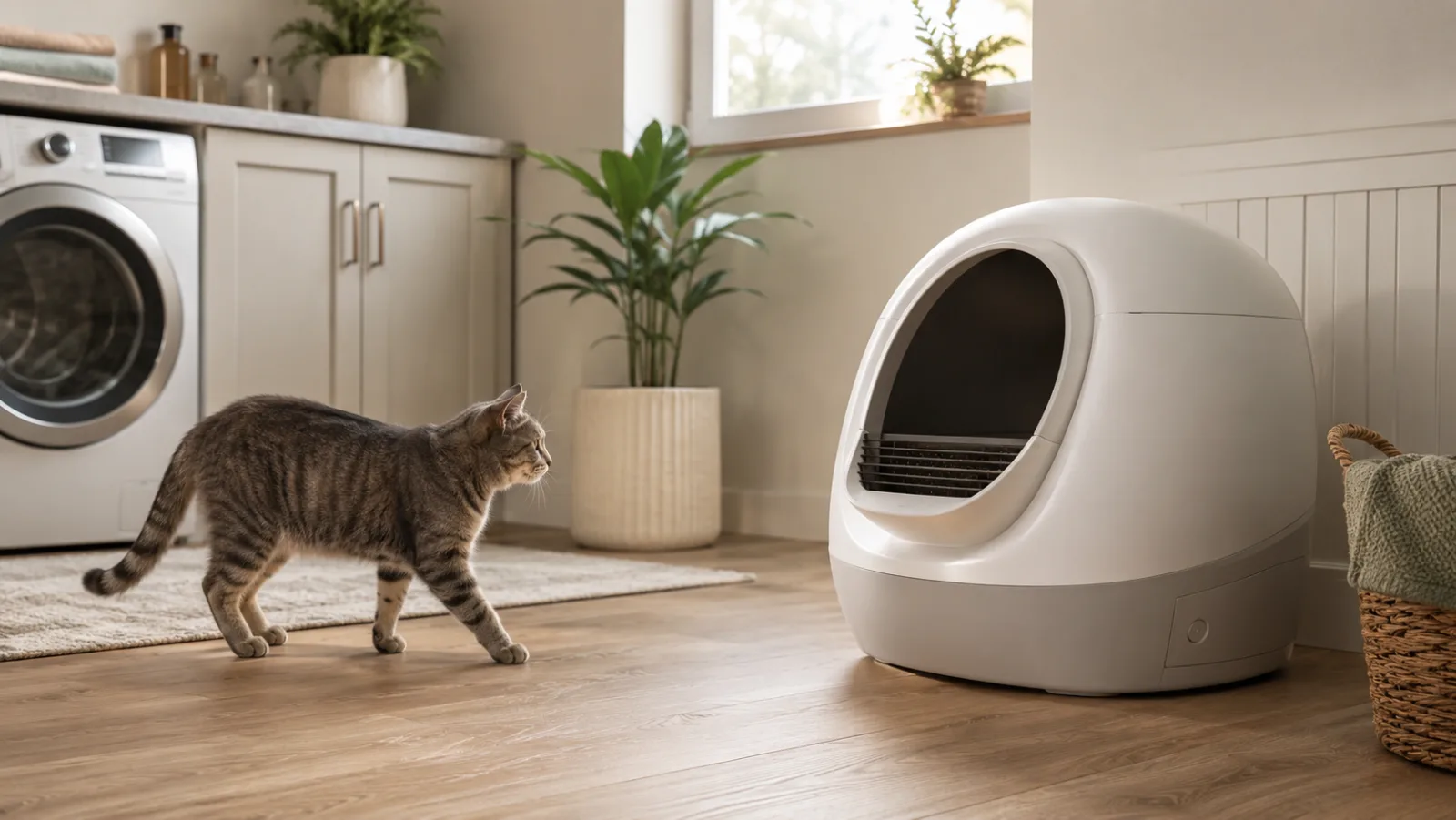
Best Automatic Litter Boxes for Cats (2026)

Cats & Dogs
Best Pet Cameras for Dogs and Cats: Monitoring, Treat-Toss, and Subscription-Free Picks (2026)
Cats & Dogs
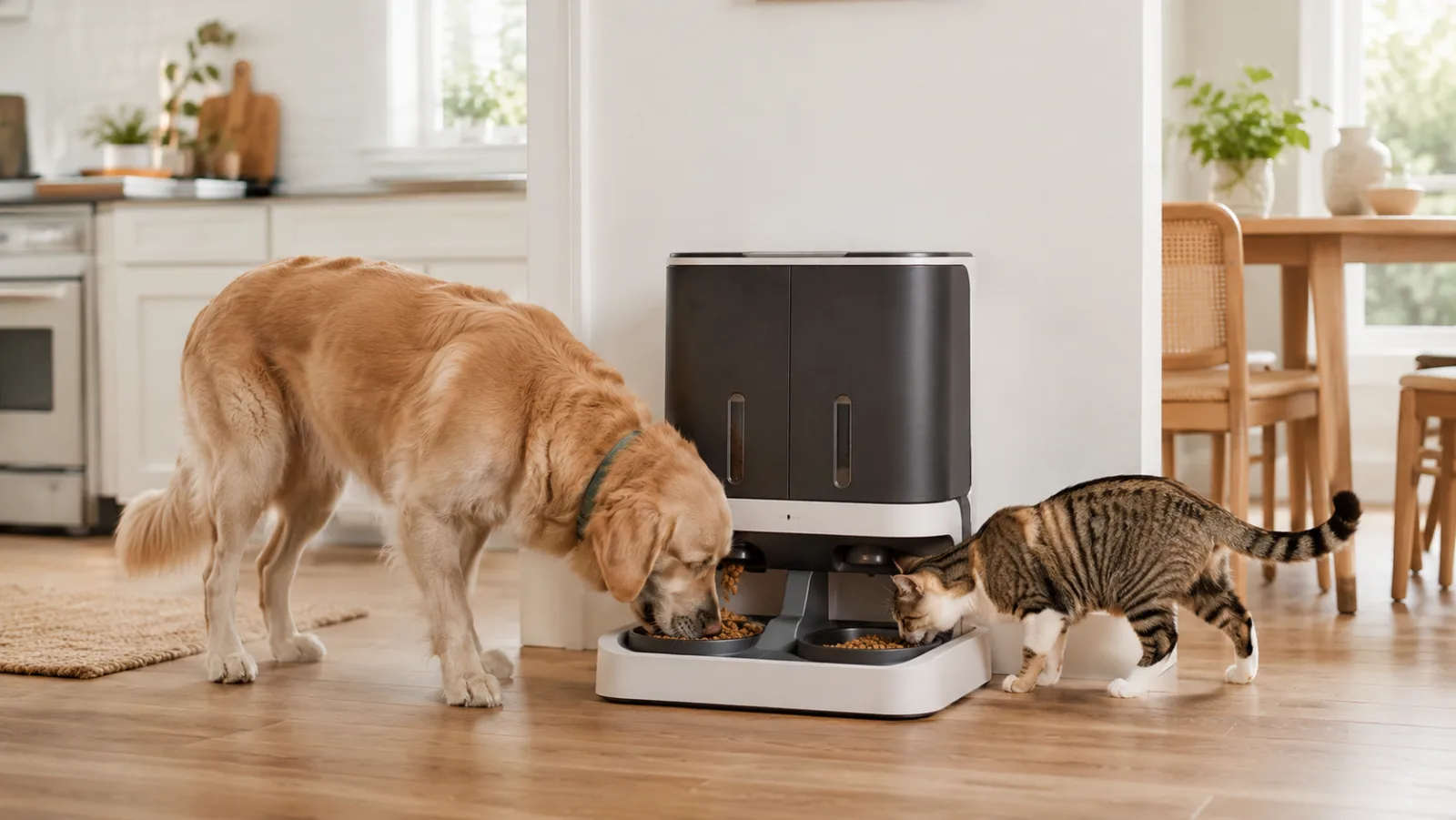
Best Smart Pet Feeders for Multi-Pet Homes: Microchip, RFID, and Wet-Food Picks (2026)
Cats & Dogs
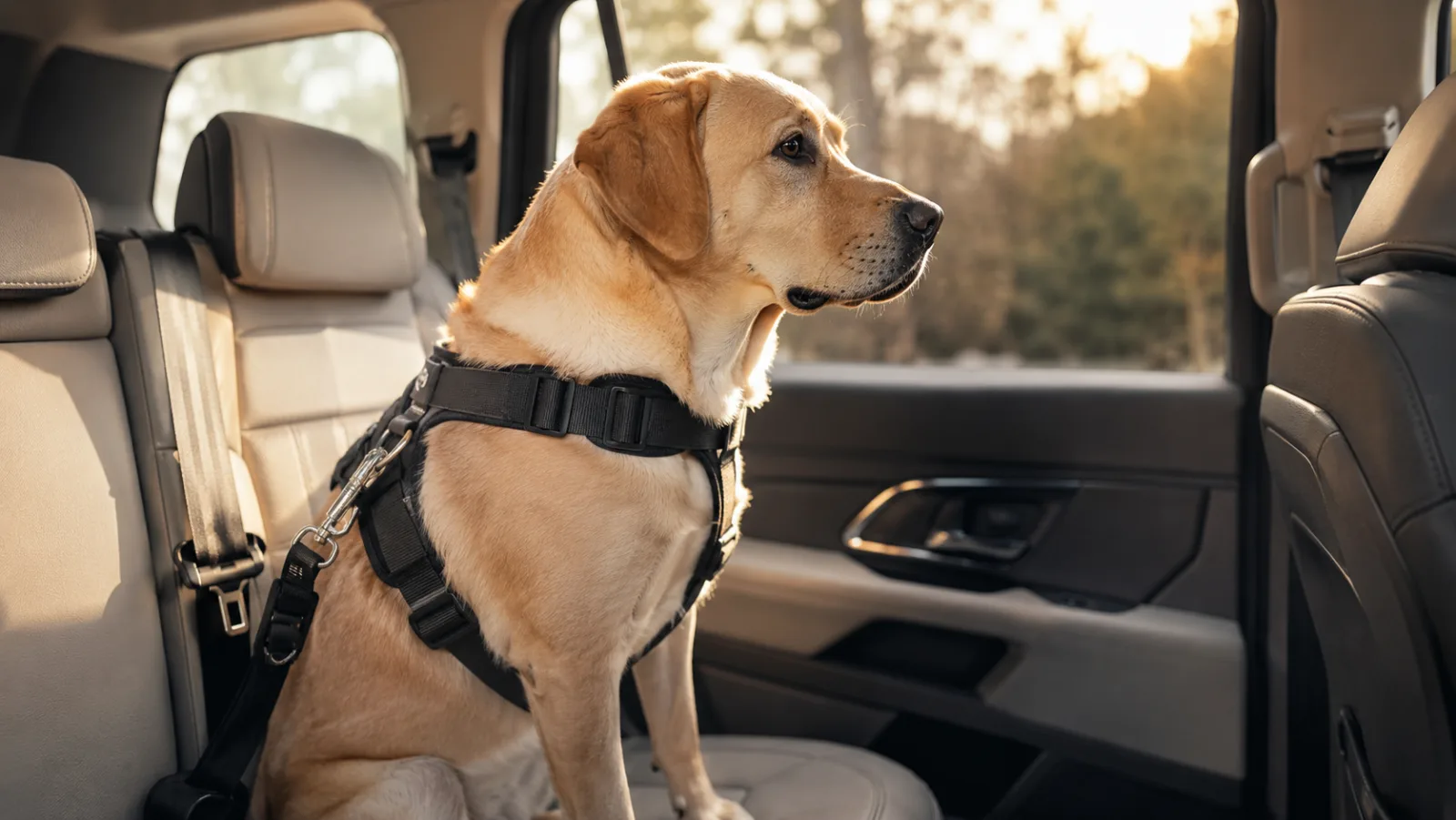
Best Crash-Tested Dog Car Harnesses and Carriers (2026)
Cats & Dogs
Best Airline-Approved Pet Carriers for In-Cabin Travel (2026)
Cats & Dogs