Aquarium
Best RO/DI Water Systems for Reef Aquariums (2026)
The Bulk Reef Supply 4 Stage Value Plus 75 GPD is the RO/DI system we'd start with for most reef tanks: a self-contained 4-stage unit that polishes water down to 0 TDS with a dual inline TDS meter built in. The AquaFX Barracuda 100 GPD is the higher-output pick, and the LiquaGen 6 Stage 150 GPD is the max-output choice with dual DI canisters — but GPD is a production rate that depends on your feed pressure and water temperature, so a 150 GPD label does not mean 150 real gallons on a cold, low-pressure line.
By Nick Miles · Updated August 12, 2026 · ~12 min read
PetPalHQ is reader-supported. We may earn a commission from qualifying Amazon purchases at no extra cost to you.
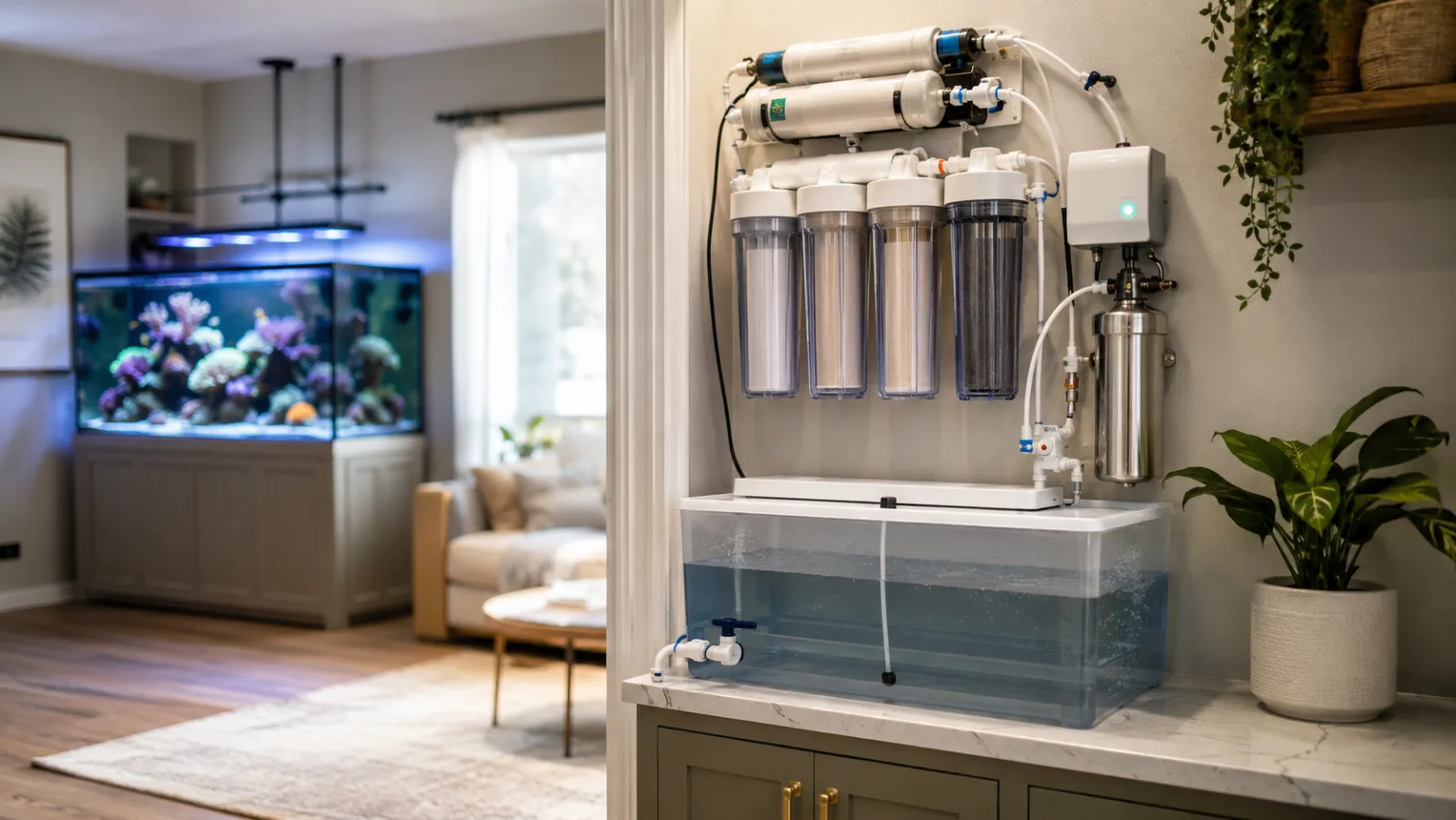
Evidence at a Glance
Bulk Reef Supply 4 Stage Value Plus 75 GPD RO/DI System
Self-contained 4-stage RO/DI system rated for 75 gallons of purified water per day, with a dual inline TDS meter, flush kit, and pressure gauge built in — BRS polishes the water to 0 TDS at the deionization stage and backs it with a limited lifetime warranty.
Sources: Bulk Reef Supply manufacturer documentation, Bulk Reef Supply RO/DI education
Verified Jun 22, 2026
AquaFX Barracuda 100 GPD RO/DI System
Higher-output 4-stage RO/DI unit on a heavy-duty aluminum bracket, running a 1-micron sediment pre-filter, Chlorine Guzzler carbon block, USA-made TFC RO membrane, and color-indicating zero-TDS DI resin to produce ultra-pure 0 TDS water.
Sources: AquaFX manufacturer specifications (via Top Shelf Aquatics), Bulk Reef Supply RO/DI education
Verified Jun 22, 2026
LiquaGen 6 Stage 150 GPD RO/DI Reef System
Max-output 6-stage system that LiquaGen rates to make up to 150 gallons of zero-TDS water per day, using dual DI canisters for extra capacity and handling city water with high chlorine and chloramine levels.
Sources: LiquaGen manufacturer documentation, Bulk Reef Supply RO/DI education
Verified Jun 22, 2026
Our Picks
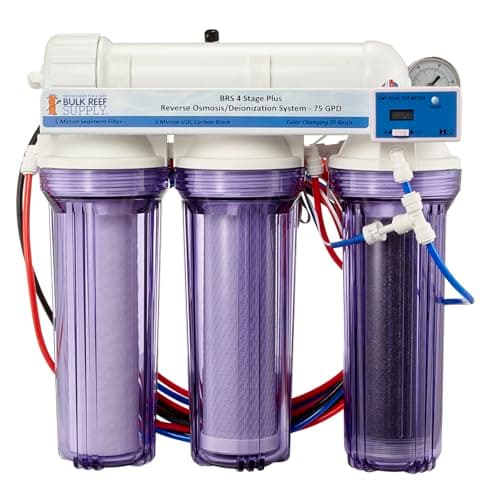
Bulk Reef Supply
Bulk Reef Supply 4 Stage Value Plus 75 GPD RO/DI System
9.2 / 10
- 4-stage RO/DI rated for 75 gallons of purified water per day
- Stage 1 sediment, Stage 2 carbon block, Stage 3 RO membrane, Stage 4 deionization resin to 0 TDS
- Dual inline TDS meter reads after the membrane and after final DI
- Flush kit and glycerin-filled pressure gauge included on a single bracket
$249.99
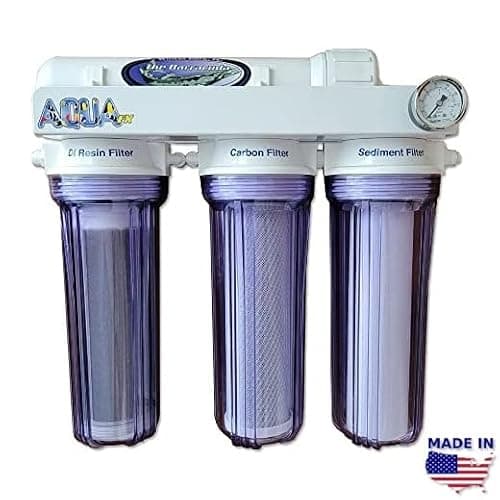
AquaFX
AquaFX Barracuda 100 GPD RO/DI System
8.8 / 10
- 4-stage RO/DI rated at 100 GPD — higher output than the 75 GPD class
- Stage 1 AquaFX 1-micron sediment pre-filter
- Stage 2 Chlorine Guzzler carbon block for chlorine and VOC removal
- Stage 3 USA-made TFC RO membrane; Stage 4 color-indicating zero-TDS DI resin
$209.99
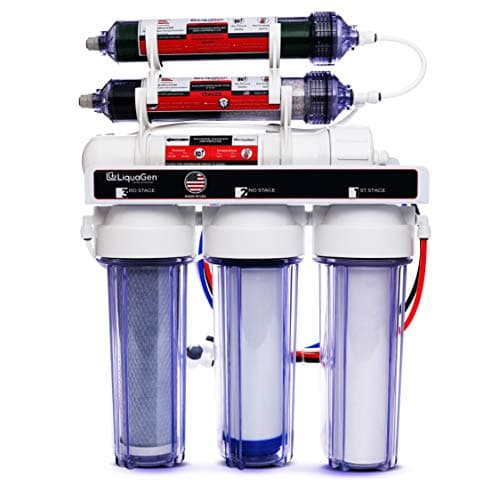
LiquaGen
LiquaGen 6 Stage 150 GPD RO/DI Reef System
9.0 / 10
- Rated to make up to 150 gallons of zero-TDS water per day — the highest output here
- Six-stage design with dual DI canisters for added capacity between resin swaps
- Sediment and carbon stages handle city water high in chlorine and chloramines
- Glycerin pressure gauge and dual TDS meter for monitoring two points
$219.99
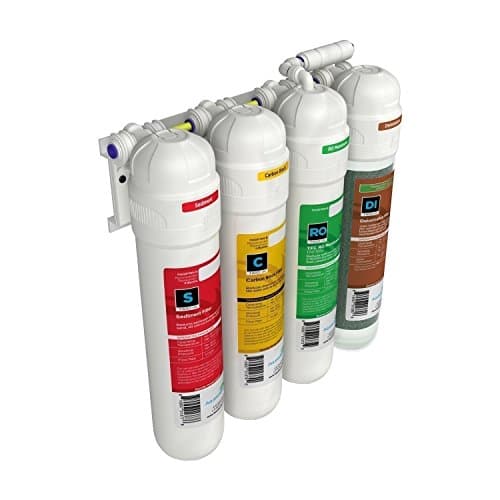
AquaticLife
AquaticLife Twist-In 100 GPD 4-Stage RO/DI Unit
8.3 / 10
- 4-stage RO/DI unit rated at 100 GPD at the lowest price in this guide
- Twist-in cartridge design swaps filters without a wrench or housing opening
- Sediment, carbon block, RO membrane, and DI resin in a compact stack
- Color-changing DI cartridge gives a visual exhaustion cue
$139.99
Amazon's price may vary; check the current price.
List price · AquaticLife · verified 2026-09-08
The Short Answer
The best RO/DI system for a reef tank is the one whose daily output matches how much top-off and salt-mix water you actually use, on water your home pressure can drive. RO/DI stands for reverse osmosis plus deionization, and the DI stage is what reef keepers care about: it polishes the water down to 0 TDS after the RO membrane so you start with a clean, consistent base. For most reef tanks the Bulk Reef Supply 4 Stage Value Plus 75 GPD is the strongest all-round pick — a self-contained 4-stage unit with a dual inline TDS meter, rated for 75 gallons per day and needing at least 50 PSI feed pressure. The AquaFX Barracuda 100 GPD is the higher-output unit for bigger tanks or faster fill-ups. The LiquaGen 6 Stage 150 GPD is the max-output choice, using dual DI canisters for more capacity between resin changes. Whatever you buy, a TDS meter is non-negotiable — it tells you when the membrane and resin are spent.
Every product on this list has been scored against the PetPal Gear Score, a weighted composite of expert consensus, observed effectiveness, animal safety, long-term durability, and value. Review method: Editorial synthesis of manufacturer specifications (Bulk Reef Supply, AquaFX, LiquaGen) and reef-keeping education from Bulk Reef Supply — no first-hand product testing. The Pure Water Score is a composite of published specs and expert/hobbyist consensus, not a measurement. PetPalHQ does not run a testing lab. Ranks reflect each pick's best-fit use case — form factor, output, and budget — rather than raw score order, and the score rates purification capability, build quality, capacity, and serviceability within a pick's class. Value is one explicitly weighted factor of the score; it is the smallest weight, so a higher rank never means a higher score.. Synthesized from 3+ expert sources.
An RO/DI system makes the water a reef tank is built on. RO/DI stands for reverse osmosis plus deionization. Water is forced through a membrane that rejects most dissolved solids, then through a deionization resin that polishes what is left down to 0 TDS — zero total dissolved solids. That clean base matters because tap water carries chlorine, chloramine, nutrients like phosphate, and trace metals that feed algae and stress sensitive corals and invertebrates. Starting from 0 TDS water removes that guesswork from every top-off and salt mix.
The hard part is not the brand. It is matching daily output to how much water you actually use, on the feed pressure your home can supply. GPD is a production rate, not a fixed yield. A 150 GPD label assumes adequate pressure and warm-ish feed water, so a cold, low-pressure line will produce far less and waste more. Every system below was chosen by editorial synthesis of manufacturer specifications and reef-keeping consensus from Bulk Reef Supply. PetPalHQ does not run a testing lab, and every spec claim traces to a named source.
Head-to-Head Comparison
| Feature | Bulk Reef Supply 4 Stage Value Plus 75 GPD RO/DI System | AquaFX Barracuda 100 GPD RO/DI System | LiquaGen 6 Stage 150 GPD RO/DI Reef System | AquaticLife Twist-In 100 GPD 4-Stage RO/DI Unit |
|---|---|---|---|---|
| Rated daily output (GPD) | 75 GPD | 100 GPD | 150 GPD | 100 GPD |
| Filtration stages | 4-stage (sediment / carbon / RO / DI) | 4-stage (sediment / carbon / RO / DI) | 6-stage (dual DI canisters) | 4-stage twist-in (sediment / carbon / RO / DI) |
| Built-in monitoring | Dual inline TDS meter + pressure gauge | Pressure gauge | Dual TDS meter + glycerin pressure gauge | Color-changing DI cartridge |
| Best-fit buyer & price | Most reef tanks, complete package — $249.99 | Mid-to-large reef, faster fills — $209.99 | Large reef / high volume — $219.99 | Beginner / budget, easy service — $129.99 |
| Check price | Amazon | Amazon | Amazon | Amazon |
$249.99
- 4-stage RO/DI rated for 75 gallons of purified water per day
- Stage 1 sediment, Stage 2 carbon block, Stage 3 RO membrane, Stage 4 deionization resin to 0 TDS
- Dual inline TDS meter reads after the membrane and after final DI
- Flush kit and glycerin-filled pressure gauge included on a single bracket
- Needs at least 50 PSI feed pressure; backed by a limited lifetime warranty
The Bulk Reef Supply 4 Stage Value Plus 75 GPD is the RO/DI system we'd reach for first on a typical reef tank. BRS rates it for 75 gallons per day across four stages — sediment, carbon block, RO membrane, and a deionization resin that, in BRS's own words, "will polish your water down to 0 TDS." The reason reef keepers care about that final DI stage is simple: it is what takes RO water the last step to zero total dissolved solids, so you build salt mix and top off from a clean, consistent base rather than from tap water that BRS notes "often contains chlorine, unwanted nutrients, and other contaminants that can cause problems fast."
It earns the top spot on completeness and serviceability, not on raw output. The Value Plus ships self-contained on a single bracket with a dual inline TDS meter, a flush kit, and a glycerin-filled pressure gauge already fitted, so a beginner can monitor membrane and resin health out of the box. BRS backs it with a limited lifetime warranty, reassuring on a device that runs household pressure through plastic housings for years.
What the spec sheet does not tell you is the feed-pressure dependency. BRS lists a minimum water pressure of 50 PSI, and on a low-pressure or cold-water line a 75 GPD membrane will produce well under its rated number and waste more water. If your home pressure is marginal, you may need a booster pump, which adds cost the box does not. On the honesty side, the Pure Water Score weights this pick highest on Purification Performance and Build Quality, and slightly lower on Production Capacity, because 75 GPD is the most modest output here — fine for nano-to-mid reef tanks, slow for a heavily evaporating large system.
What We Love
- Self-contained 4-stage unit with a dual inline TDS meter built in
- Deionization stage polishes water down to 0 TDS, per BRS documentation
- Flush kit and pressure gauge included — fewer add-on purchases
- Limited lifetime warranty from a well-known reef-keeping retailer
- Compact single-bracket design fits tight cabinet or utility spaces
What Could Be Better
- Lowest rated output here at 75 GPD — slow for large, high-evaporation tanks
- Needs at least 50 PSI feed pressure; marginal lines may need a booster pump
- Like all RO/DI units, produces several gallons of waste water per gallon made
- Replacement membrane and resin are ongoing consumable costs the box price hides
The Verdict
The default RO/DI system for most reef tanks. Buy it for the complete, beginner-friendly package — dual TDS meter, flush kit, and 0 TDS DI stage — and accept the modest 75 GPD output and the 50 PSI feed-pressure requirement. If your home pressure is low, budget for a booster pump.
Sources
- Bulk Reef Supply: Deionization resin is the final stage of the RODI system and will polish your water down to 0 TDS. Minimum Water Pressure: 50 PSI
- Bulk Reef Supply: Tap water often contains chlorine, unwanted nutrients, and other contaminants that can cause problems fast.
- Amazon listing: $249.99 — Bulk Reef Supply 4 Stage Value Plus 75 GPD RO/DI Reverse Osmosis Deionization System
$209.99
- 4-stage RO/DI rated at 100 GPD — higher output than the 75 GPD class
- Stage 1 AquaFX 1-micron sediment pre-filter
- Stage 2 Chlorine Guzzler carbon block for chlorine and VOC removal
- Stage 3 USA-made TFC RO membrane; Stage 4 color-indicating zero-TDS DI resin
- Heavy-duty aluminum mounting bracket with a 10-inch filter wrench included
The AquaFX Barracuda 100 GPD is the higher-output pick for keepers who refill faster than a 75 GPD unit comfortably keeps up with. AquaFX's published spec, mirrored across reef retailers, lays out a clean four-stage train: a 1-micron sediment pre-filter, a Chlorine Guzzler carbon block for chlorine and VOCs, a USA-made TFC RO membrane, and a "Mixed Bed Color Indicating Zero TDS DI resin." The color-indicating resin is a genuinely useful touch — the media changes shade as it exhausts, giving a visual cue alongside your TDS meter.
It earns the high-output label on production rate, with the practical caveat that GPD is a rate, not a promise. A 100 GPD membrane is sized to make more water per hour than a 75 GPD unit on the same line, which shortens fill-ups for a mid-to-large reef or for a keeper mixing big salt batches. But that 100 GPD figure assumes adequate pressure and warm-ish feed water; on a cold winter line it will fall short, the same way the BRS 75 GPD unit does. The heavy-duty aluminum bracket and included filter wrench point to a build meant to be serviced for years rather than replaced.
What the spec sheet does not tell you: we describe this unit's purity by what the DI stage delivers — 0 TDS output — rather than a membrane rejection number we cannot verify. The product also sells in several variants (standard, Glacial, Platinum), so confirm you are buying the standard 100 GPD unit. In the Pure Water Score it leads on Production Capacity for this class and scores well on Purification, giving back a little on Maintenance only because the membrane and DI resin are recurring costs.
What We Love
- 100 GPD output is higher than the 75 GPD class for faster fill-ups
- Color-indicating DI resin gives a visual cue when the media is spent
- USA-made TFC RO membrane and Chlorine Guzzler carbon block
- Heavy-duty aluminum bracket and included filter wrench for easy service
- Produces 0 TDS, ultra-pure water suitable for reef and marine tanks
What Could Be Better
- Sold in several variants — easy to buy the wrong trim by accident
- 100 GPD is a rated rate that drops on cold or low-pressure feed water
- Membrane and DI resin remain ongoing consumable costs
The Verdict
The high-output pick for a mid-to-large reef or a keeper who mixes salt water in big batches. Buy it for the 100 GPD rate and the color-indicating DI resin, confirm you are getting the standard trim, and remember the rated output assumes decent feed pressure and temperature.
Sources
- AquaFX (via Top Shelf Aquatics): Stage 1 - AquaFX Premium 1-micron Sediment Filter; Stage 2 - AquaFX Chlorine Guzzler Carbon Block Pre-filter; Stage 3 - AquaFX TFC RO Membrane (made in the USA); Stage 4 - AquaFX Mixed Bed Color Indicating Zero TDS DI resin
- Bulk Reef Supply: Tap water often contains chlorine, unwanted nutrients, and other contaminants that can cause problems fast.
- Amazon listing: $209.99 — AquaFX Barracuda 100 GPD RO/DI System
$219.99
- Rated to make up to 150 gallons of zero-TDS water per day — the highest output here
- Six-stage design with dual DI canisters for added capacity between resin swaps
- Sediment and carbon stages handle city water high in chlorine and chloramines
- Glycerin pressure gauge and dual TDS meter for monitoring two points
- Built in-house in California, per the manufacturer
The LiquaGen 6 Stage 150 GPD is the max-output pick for keepers with large reef systems, frequent water changes, or a desire to fill a storage drum fast. LiquaGen rates the system to "make up to 150 gallons of zero TDS water per day," the highest rated output in this guide, and pairs it with "dual DI canisters" that, in the company's words, "add an extra layer of protection." Two DI stages in series means the second canister keeps polishing as the first exhausts, so you get more 0 TDS water between resin changes — a real convenience on a high-volume tank.
It earns its place on capacity and chloramine handling. LiquaGen calls it a "perfect RO/DI system for almost any type of city water treatment process, including those with high levels of chlorine and chloramines," which matters because chloramine is harder to strip than chlorine and punishes undersized carbon. A glycerin pressure gauge and a dual TDS meter let you watch feed pressure and product quality at two points, and LiquaGen says the units are built in-house in California.
What the spec sheet does not tell you: 150 GPD is the ceiling, not the everyday number. Like every RO/DI system, output scales with feed pressure and water temperature, so a cold, low-pressure line will not hit 150 real gallons, and a high-output membrane also produces proportionally more waste water. The extra DI canister adds a second resin consumable to track and refill. In the Pure Water Score it leads on Production Capacity and rates strongly on Purification thanks to the dual DI stages, giving back a little on Build Quality only because two-canister plumbing is marginally more to maintain than a single-DI unit.
What We Love
- Highest rated output here — up to 150 GPD of 0 TDS water
- Dual DI canisters extend capacity between resin changes
- Carbon stages target city water high in chlorine and chloramines
- Glycerin pressure gauge plus dual TDS meter for two-point monitoring
- Manufacturer states the units are built in-house in California
What Could Be Better
- 150 GPD is a ceiling that drops on cold or low-pressure feed water
- High output means proportionally more waste water down the drain
- Dual DI design adds a second resin consumable to track and refill
- More plumbing connections than a 4-stage unit means more potential leak points
The Verdict
The max-output pick for large reef systems or anyone who wants to fill a storage drum quickly. Buy it for the 150 GPD ceiling and the dual-DI capacity, but treat 150 GPD as a best-case rate, plan for the extra waste water, and budget for two DI resins instead of one.
Sources
- LiquaGen: Makes up to 150 gallons of zero TDS water per day; Dual DI canisters add an extra layer of protection; perfect RO/DI system for almost any type of city water treatment process, including those with high levels of chlorine and chloramines
- Bulk Reef Supply: Tap water often contains chlorine, unwanted nutrients, and other contaminants that can cause problems fast.
- Amazon listing: $219.99 — LiquaGen 6 Stage 150 GPD RO/DI Reef System
$139.99
Amazon's price may vary; check the current price.
List price · AquaticLife · verified 2026-09-08
- 4-stage RO/DI unit rated at 100 GPD at the lowest price in this guide
- Twist-in cartridge design swaps filters without a wrench or housing opening
- Sediment, carbon block, RO membrane, and DI resin in a compact stack
- Color-changing DI cartridge gives a visual exhaustion cue
- Wall-mountable bracket suited to small utility-room installs
The AquaticLife Twist-In 100 GPD is the value pick: the lowest price here, on a 4-stage RO/DI unit whose headline feature is maintenance friction. Instead of unscrewing canister housings and wrestling wet cartridges, the AquaticLife uses sealed twist-in cartridges that thread on and off by hand, like a spin-on oil filter. For a beginner intimidated by RO/DI servicing, that ergonomic alone is worth a lot — the most common reason hobbyists let a membrane or resin go too long is that changing it is a chore.
It earns the value label on price and ease, not on capacity headroom or instrumentation. At a notably lower cost than the picks above, it still delivers the same four functional stages — sediment, carbon, RO membrane, and DI resin — and a color-changing DI cartridge that, per AquaticLife, you "replace when resin changes color completely to amber." For a nano or mid reef on decent municipal pressure, that is a complete, sensible system. The 100 GPD rating, the four-stage train, and the tool-free twist-in cartridges all trace to AquaticLife's own product listing, which describes a design that makes "filter changes simple, easy and clean – no tools required."
What the spec sheet does not tell you: the convenience of sealed twist-in cartridges has a flip side. Proprietary cartridges can cost more per change than standard 10-inch refills you buy in bulk for the BRS, AquaFX, or LiquaGen units, so a cheaper box can mean pricier upkeep over years. It also ships with less built-in monitoring than the BRS dual-meter package. In the Pure Water Score it rates well on Maintenance for the twist-in design and on Value for the low price, and gives back points on Build Quality and instrumentation versus the better-equipped units above.
What We Love
- Lowest purchase price in this guide
- Twist-in cartridges swap by hand — no wrench or housing to open
- Full four-stage RO/DI train: sediment, carbon, membrane, DI resin
- Color-changing DI cartridge flags when the resin is exhausted
- Compact, wall-mountable footprint for small utility spaces
What Could Be Better
- Proprietary twist-in cartridges can cost more per change than standard refills
- Less built-in monitoring than the BRS dual-meter package
- 100 GPD is a rated rate that falls on cold or low-pressure feed water
- Lighter built-in instrumentation than the dual-meter BRS package
- Like all RO/DI units, produces several gallons of waste per gallon made
The Verdict
The value pick for a beginner or a small-to-mid reef on decent water pressure. Buy it for the rock-bottom price and the tool-free twist-in servicing, but price out the proprietary replacement cartridges first — a cheaper unit with pricier refills can cost more over a few years than a slightly dearer system on standard media.
Sources
- AquaticLife: The new Twist-In media cartridge design makes filter changes simple, easy and clean – no tools required and no mess! ... TWIST-IN MIXED BED COLOR CHANGING RESIN DEIONIZATION CARTRIDGE: Replace filter when resin changes color completely to amber.
- Bulk Reef Supply: Tap water often contains chlorine, unwanted nutrients, and other contaminants that can cause problems fast.
- Amazon listing: $129.99 — AQUATICLIFE Twist-in 100 GPD 4-Stage Ro Unit (Sediment, Carbon Block, Membrane, Deionization)
How We Score
Formula
Pure Water Score = (Purification Performance × 0.35) + (Build Quality & Components × 0.25) + (Production Capacity × 0.20) + (Maintenance & Serviceability × 0.12) + (Value × 0.08)
Score Factors
- Purification Performance · 35%
- How thoroughly the system strips contaminants and polishes water toward 0 TDS, based on the membrane and the deionization stage. We synthesize this from manufacturer specs on the RO membrane and DI resin and from Bulk Reef Supply's framing that the DI stage is what brings RO water down to 0 TDS for a clean reef base. The Pure Water Score is a composite of published specs and expert consensus, not a measurement — PetPalHQ does not run a testing lab.
- Build Quality & Components · 25%
- Quality and serviceability of the housings, bracket, fittings, and instrumentation. We credit included monitoring (inline TDS meters, glycerin pressure gauges), durable brackets, USA-made membranes where documented, and standard versus proprietary cartridge formats.
- Production Capacity · 20%
- Rated gallons-per-day output relative to a tank's likely top-off and salt-mix demand. GPD is a production rate that depends on feed pressure and water temperature, so we treat a unit's rated figure as a ceiling and weight it against realistic demand rather than rewarding the biggest number outright.
- Maintenance & Serviceability · 12%
- How easy the system is to live with — cartridge changes, flush kits, dual-DI capacity, and visual exhaustion cues like color-changing resin. We reward designs that make membrane and resin changes painless, since the most common owner failure is leaving spent media in too long.
- Value · 8%
- Purchase price relative to capability and the longer-run cost of replacement membranes and resin. This is the smallest weight in the score by design, so a strong-value pick never outranks a better-purifying system on the score alone — value breaks ties, it does not drive the ranking.
| Rank | Product | Score |
|---|---|---|
| #1 | Bulk Reef Supply Bulk Reef Supply 4 Stage Value Plus 75 GPD RO/DI System | 9.2 |
| #2 | LiquaGen LiquaGen 6 Stage 150 GPD RO/DI Reef System | 9.0 |
| #3 | AquaFX AquaFX Barracuda 100 GPD RO/DI System | 8.8 |
| #4 | AquaticLife AquaticLife Twist-In 100 GPD 4-Stage RO/DI Unit | 8.3 |
When NOT to Buy
Skip an RO/DI system if your tap water is already very low in TDS and chloramine-free, and you keep only hardy freshwater fish. RO/DI exists to give reef and sensitive-species keepers a 0 TDS base; for a basic community freshwater tank on clean municipal water, a simple dechlorinating water conditioner is often all the chemistry you need, and an RO/DI unit is overkill.
Skip a high-GPD unit if your home feed pressure is low. Every system here lists a minimum pressure — BRS specifies at least 50 PSI — and on a marginal or cold-water line a 100 or 150 GPD membrane will badly under-produce and waste extra water. If you cannot meet the pressure spec, either add a booster pump (an extra cost) or choose a lower-output unit, but do not assume the box's GPD number on a weak line.
Skip RO/DI entirely if you have no practical way to deal with the waste water. RO membranes reject several gallons to drain for every gallon of pure water made, so without a drain, a way to repurpose the waste, or tolerance for the runoff, the unit is impractical regardless of how good it is.
Skip the max-output LiquaGen 150 GPD if you keep a nano or single small reef. Its capacity and second DI canister are built for large systems and frequent big water changes; on a 20-to-40-gallon tank you will rarely use the output, and the extra resin consumable is just more to maintain.
Skip any RO/DI purchase if you are not willing to buy and use a TDS meter. The whole point is verifiable 0 TDS water, and without a meter you cannot tell when the membrane or resin is spent — you would be flying blind, defeating the reason to own the system at all.
Frequently Asked Questions
- Do I really need RO/DI water for a reef tank?
- For a reef or sensitive marine tank, yes, in almost every case. Corals and invertebrates react badly to the phosphate, nitrate, and metals that ride along in tap water, and an RO/DI system removes them to give a consistent 0 TDS base. A basic freshwater community tank on clean municipal water can often get by with a simple dechlorinating conditioner instead. Buy RO/DI for the control it gives over your starting water, not because every aquarium needs it.
- What does GPD actually mean, and will a 150 GPD unit make 150 gallons a day?
- GPD is gallons per day, the membrane's rated production rate. It is a ceiling, not a promise. Real output depends on feed pressure and water temperature, so a cold, low-pressure line will produce well under the rated number. Read the rating as best-case. If you need a guaranteed high output, check your home pressure first and consider a booster pump.
- How much feed pressure does an RO/DI system need?
- Most units want a solid household pressure to hit their rated output. Bulk Reef Supply lists a minimum of 50 PSI for its 4-stage system. Below that, the membrane under-produces and wastes more water. If your pressure is marginal or you are on a well, a booster pump brings the membrane up to spec. Always check the unit's stated minimum before buying.
- What is the DI stage, and why do reef keepers insist on it?
- DI is deionization — a resin stage after the RO membrane. The membrane removes most dissolved solids, and the DI resin polishes the rest down to 0 TDS. Bulk Reef Supply describes the deionization resin as the final stage that will polish your water down to 0 TDS. Plain RO water still carries a small amount of dissolved solids, which is fine for drinking but not ideal for a reef. The DI stage closes that gap.
- How do I know when to change the membrane and the DI resin?
- Use a TDS meter — it is the single most important tool here. Many systems, including the BRS pick, include an inline meter that reads after the membrane and after final DI. When the reading off the membrane climbs, the membrane is wearing out; when the final reading rises above 0, the DI resin is spent. Color-indicating DI resin, like the AquaFX Barracuda's, gives a visual backup cue.
- Why does an RO/DI system waste so much water?
- A reverse-osmosis membrane works by sending part of the feed water to drain to carry away the rejected contaminants. That is normal — expect several gallons to drain for every gallon of pure water produced, with the exact ratio depending on the membrane and your pressure and temperature. Some keepers capture the waste water for laundry, plants, or cleaning. If you have no practical way to deal with the runoff, factor that in before buying.
Bottom Line
Get the Bulk Reef Supply 4 Stage Value Plus 75 GPD for most reef tanks. It is the most complete package here — a 4-stage unit with a dual inline TDS meter, flush kit, and pressure gauge built in, polishing water to 0 TDS — and it carries a limited lifetime warranty. Just confirm your home pressure meets the 50 PSI minimum.
Get the AquaFX Barracuda 100 GPD if you have a mid-to-large reef or mix salt water in big batches. The higher 100 GPD rate shortens fill-ups, and the color-indicating DI resin gives a clear visual cue when the media is spent — confirm you are buying the standard trim.
Get the LiquaGen 6 Stage 150 GPD for large systems or high-volume water changes. It is rated to make up to 150 gallons of 0 TDS water a day with dual DI canisters for extra capacity, but treat 150 GPD as a best-case ceiling and plan for the extra waste water.
RO/DI water is an input to two routines: our saltwater reef maintenance schedule shows where the water changes fit, and our auto top-off systems guide covers the device that consumes your 0 TDS output every day.
Sources & Methodology
Methodology
Pure Water Score = (Purification Performance × 0.35) + (Build Quality & Components × 0.25) + (Production Capacity × 0.20) + (Maintenance & Serviceability × 0.12) + (Value × 0.08)
Expert review sources
- Bulk Reef Supply — 4 Stage Value Plus 75 GPD product documentation (stages, 0 TDS DI, 50 PSI minimum, lifetime warranty) and 'Choosing the Best RO/DI System for Your Reef Tank' education
- AquaFX — Barracuda 100 GPD four-stage specifications (1-micron sediment, Chlorine Guzzler carbon, USA TFC membrane, color-indicating zero-TDS DI resin), retrieved via Top Shelf Aquatics
- LiquaGen — 6 Stage 150 GPD product documentation (up to 150 GPD of zero-TDS water, dual DI canisters, chlorine/chloramine handling, built in California)
Community sources
- Bulk Reef Supply learning content — reef-keeper consensus on RO/DI water, the role of the DI stage, GPD/feed-pressure realities, and TDS-meter monitoring
Prices and specs verified June 22, 2026.
About the author
Nicholas Miles is the chief editor of PetPalHQ. The picks above are editorial synthesis of manufacturer specifications and reef-keeping expert consensus — PetPalHQ does not run a testing lab and did no first-hand product testing. The Pure Water Score is a composite of published specs and expert opinion, not a measurement. Sources are cited by name throughout.
PetPalHQ is a participant in the Amazon Services LLC Associates Program. We may earn commissions from qualifying purchases — at no extra cost to you.
More Guides
Aquarium
Best Aquarium Water Conditioner for Freshwater Tanks (2026)
Aquarium
Aquarium Water Quality, Cycling and Testing for Beginners (2026 Guide)
Aquarium
Best Aquarium Water Test Kits for Freshwater Fish Tanks (2026)
Aquarium
Aquarium Filtration & Maintenance Systems for Clear, Healthy Water (2026 Guide)
Aquarium