Aquarium
Best Aquarium Water Test Kits for Freshwater Fish Tanks (2026)
For most freshwater keepers, an API Freshwater Master Test Kit handles ammonia, nitrite, nitrate, and pH; keep Tetra EasyStrips for fast weekly screening once the tank is stable, and skip a digital pH pen unless you inject CO2 or keep soft-water species.
By Nick Miles · Updated September 8, 2026 · 12 min read
PetPalHQ is reader-supported. We may earn a commission from qualifying Amazon purchases at no extra cost to you.
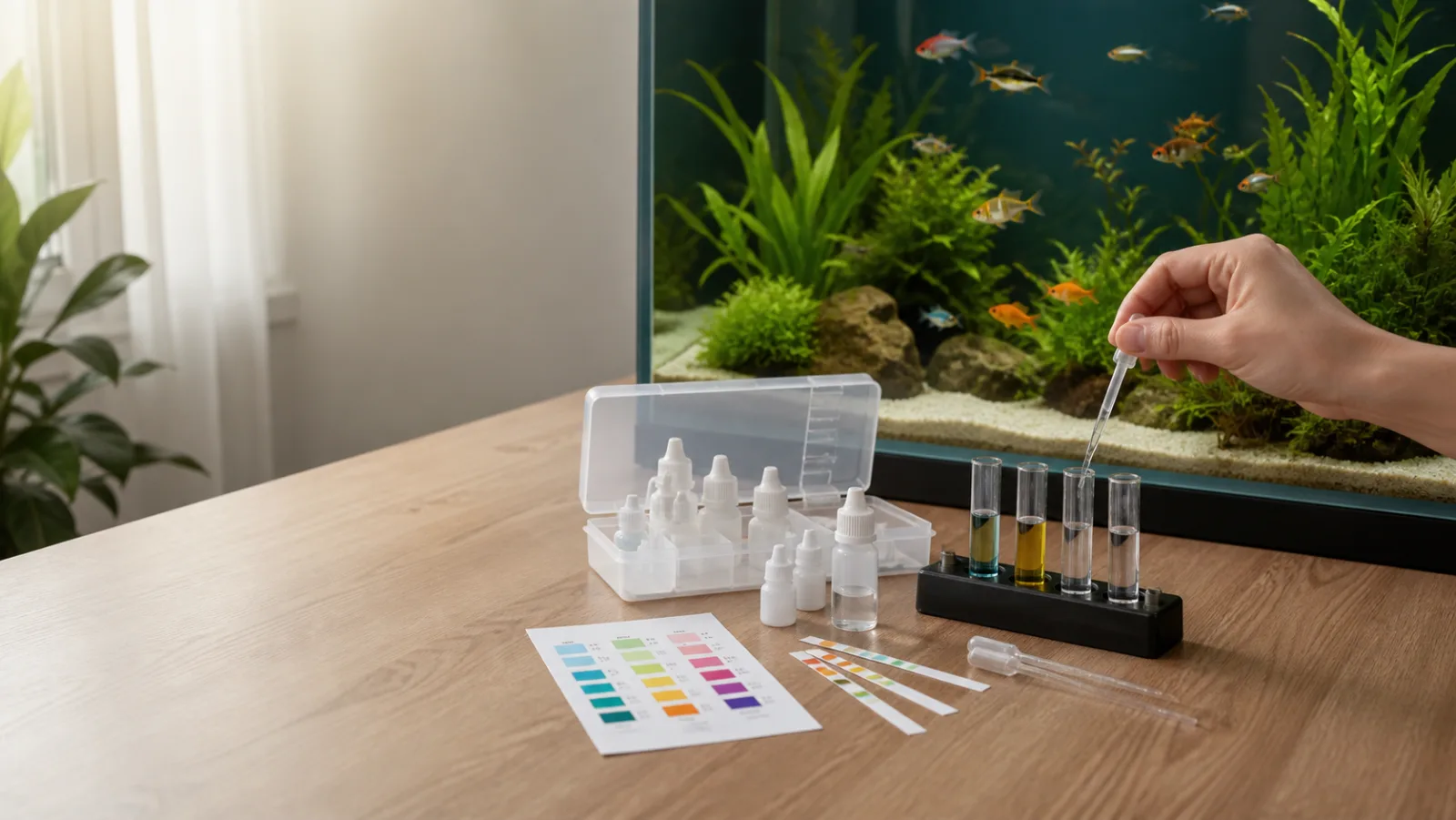
Evidence at a Glance
API Freshwater Master Test Kit
Liquid reagent kit covering pH, high-range pH, ammonia, nitrite, and nitrate — the primary parameters Merck and OATA call critical.
Sources: API manufacturer documentation, Aquarium Co-Op, PetMD, r/aquariums hobbyist consensus
Verified May 4, 2026
API GH and KH Test Kit
Drop-count titration for general hardness and carbonate hardness — the pair shrimp keepers and planted-tank hobbyists need most.
Sources: API manufacturer documentation, Aquarium Co-Op, r/PlantedTank consensus
Verified May 4, 2026
Tetra EasyStrips Complete Test Strips
Multi-parameter dip strips with separate ammonia coverage — the routine-screen kit beginners actually use.
Sources: Tetra manufacturer documentation, Practical Fishkeeping, OATA
Verified May 4, 2026
Our Picks
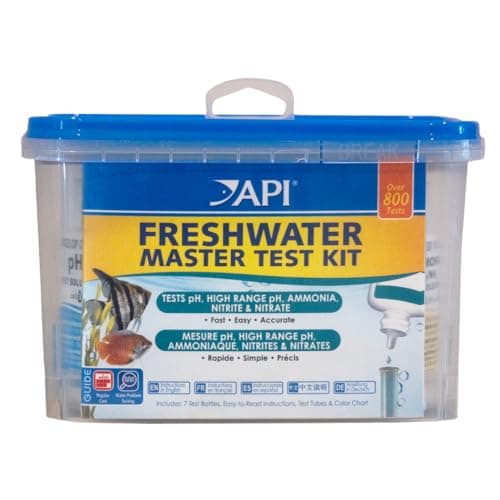
API
API Freshwater Master Test Kit
9.4 / 10
- Tests pH, high-range pH, ammonia, nitrite, and nitrate
- Approximately 800 tests per kit
- Liquid reagent format — more precise than strips
- Industry-standard kit cited by Aquarium Co-Op and PetMD
$41.99
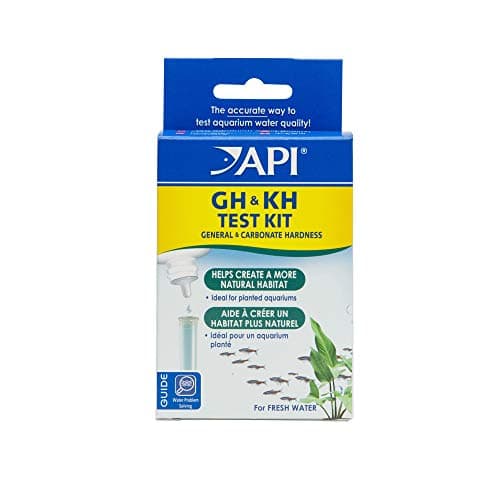
API
API GH and KH Test Kit
8.8 / 10
- Drop-count titration for general hardness and carbonate hardness
- Approximately 200 tests per parameter
- Critical for shrimp, snails, livebearers, and remineralized RO water
- Pairs naturally with the API Master Test Kit
$15.46
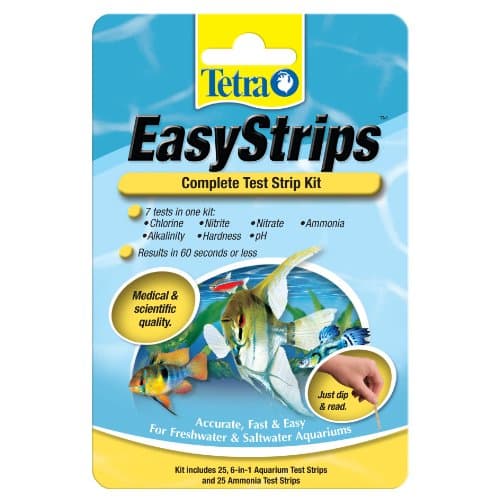
Tetra
Tetra EasyStrips Complete Test Strips
8.0 / 10
- Multi-parameter strips for pH, GH, KH, nitrite, nitrate, and chlorine
- Separate ammonia strips included
- Faster than liquid kits — under 60 seconds per check
- 25-count package
$9.99
Apera Instruments
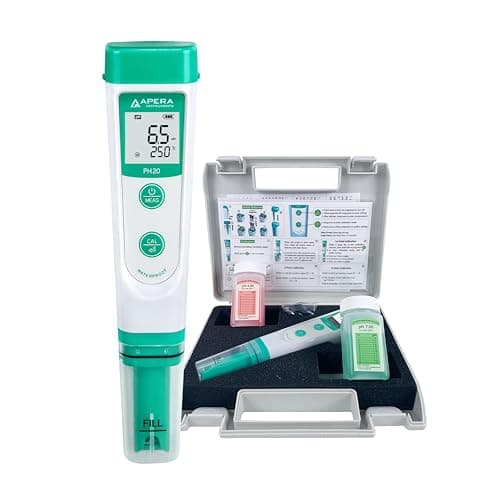
Apera AI209 PH20 pH Tester Kit
8.6 / 10
- Plus or minus 0.1 pH accuracy with automatic temperature compensation
- 1-, 2-, or 3-point calibration
- IP67 waterproof rating; floatable design
- Manufactured by a measurement-instruments specialist, not a generic Amazon brand
$50.40
Seachem
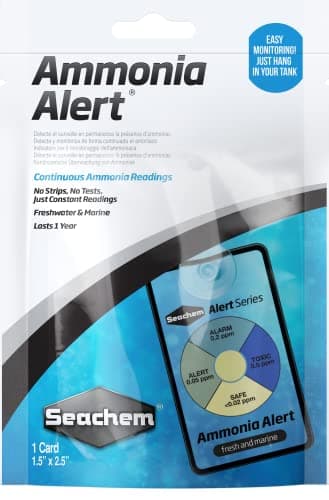
Seachem Ammonia Alert
7.9 / 10
- Continuous in-tank free-ammonia indicator
- Sensitivity below 0.05 mg/L free ammonia
- No reagents or test tubes — passive badge
- Roughly one-year service life
$10.69
Last Amazon read 2026-09-08
The Short Answer
If you keep one freshwater test kit, make it the API Freshwater Master Test Kit — it covers ammonia, nitrite, nitrate, pH, and high-range pH, which are the parameters that matter most during cycling and after water-quality problems. Use the Tetra EasyStrips Complete kit for fast routine checks once your tank is stable, and reach for the Apera AI209 PH20 only if you inject CO2 or keep soft-water species where pH precision matters.
Every product on this list has been scored against the PetPal Gear Score, a weighted composite of expert consensus, observed effectiveness, animal safety, long-term durability, and value. Review method: Editorial synthesis of manufacturer documentation, hobbyist consensus from r/aquariums, r/PlantedTank, and Aquarium Co-Op, plus veterinary and trade-association references — no first-hand product testing.. Synthesized from 8+ expert sources.
For most freshwater hobbyists, the smartest first purchase is still a liquid master kit. Aquarium Co-Op's beginner content, PetMD's fish tank water testing guidance, and the Ornamental Aquatic Trade Association (OATA) all converge on the same point: liquid kits remain the more accurate choice for cycling and diagnosing problems, while strips are best treated as quick-screen tools for routine checks once a tank is stable.
The picks below are editorial synthesis. PetPalHQ does not run a testing lab — every product on this page was selected by reviewing manufacturer documentation, hobbyist consensus on r/aquariums and r/PlantedTank, retailer guidance from Aquarium Co-Op, and accuracy comparisons published by Practical Fishkeeping. Where expert sources disagreed (most commonly on whether digital pH pens are worth the cost), we deferred to the IFAS Extension's framing: stability matters more than precision for most community tanks.
This guide is the buying-side companion to the Aquarium Water Quality, Cycling and Testing for Beginners hub. The hub explains why testing matters; this article covers what to buy.
Head-to-Head Comparison
| Feature | API Freshwater Master Test Kit | API GH and KH Test Kit | Tetra EasyStrips Complete Test Strips | Apera AI209 PH20 pH Tester Kit | Seachem Ammonia Alert |
|---|---|---|---|---|---|
| Method type | Liquid reagent | Liquid titration | Multi-parameter strip | Digital meter | Continuous indicator |
| What it tests | pH, hi-pH, NH3, NO2, NO3 | GH, KH | pH, GH, KH, NO2, NO3, Cl, NH3 | pH only | Free NH3 only |
| Speed | 5–10 min per panel | 1–2 min per parameter | Under 60 seconds | Instant after calibration | Continuous, passive |
| Best paired with | Strips for weekly screening | Master kit + ammonia badge | Master kit for diagnosis | Master kit for the rest | Master kit |
| Check price | Amazon | Amazon | Amazon | Amazon | Amazon |
$41.99
- Tests pH, high-range pH, ammonia, nitrite, and nitrate
- Approximately 800 tests per kit
- Liquid reagent format — more precise than strips
- Industry-standard kit cited by Aquarium Co-Op and PetMD
The API Freshwater Master Test Kit is the default first kit across nearly every credible aquarium-care reference we surveyed — Aquarium Co-Op's beginner content positions it as the kit to start with, PetMD names it in its fish tank water testing guidance, and the kit is consistently the top recommendation in r/aquariums beginner threads.
What it covers is the reason. The five included tests — pH, high-range pH, ammonia, nitrite, and nitrate — match the parameters Merck Veterinary Manual and OATA call critical for cycling and routine monitoring. There is no other entry-level kit that covers this combination at the same per-test cost.
The known weakness is the nitrate test. Hobbyist consensus on r/aquariums and the Aquarium Co-Op forum is that bottle #2 must be shaken aggressively for at least 30 seconds before each use, and the test tube must be tapped against the palm before reading, otherwise the result reads artificially low. The pH and ammonia tests are more straightforward.
What the spec sheet does not tell you: API's own strip-instruction PDF tells users to switch to a liquid pH kit for fine-grained low-range readings. That is a quiet acknowledgment from the manufacturer that the master kit is the more reliable tool for the readings that matter during cycling.
What We Love
- Covers the four most critical parameters plus high-range pH
- Per-test cost is lower than nearly every alternative
- Recognized by every major aquarium reference site
- Reagents have a long shelf life if stored properly
What Could Be Better
- Nitrate test requires aggressive shaking technique
- Color comparison can be subjective in some lighting
- Does not include GH or KH
The Verdict
If you buy one freshwater test kit, this is the one. Editorial consensus across manufacturer documentation, Aquarium Co-Op, PetMD, and r/aquariums is unanimous — the API Master is the default first purchase for any freshwater hobbyist.
$15.46
- Drop-count titration for general hardness and carbonate hardness
- Approximately 200 tests per parameter
- Critical for shrimp, snails, livebearers, and remineralized RO water
- Pairs naturally with the API Master Test Kit
The API GH and KH Test Kit is the missing half of the API Master kit. Where the master kit covers nitrogen-cycle parameters, this kit covers the hardness chemistry that matters most for shrimp, snails, livebearers, African cichlids, and any tank using remineralized RO water.
The drop-count titration format is more direct than color comparison — you add drops one at a time until the water changes color, and you count drops. Each drop equals one degree of hardness. Aquarium Co-Op's beginner content frames this as easier to read than continuous color cards, and r/PlantedTank consensus agrees.
Why it matters: the University of Florida IFAS Extension specifically links low KH (alkalinity) to nitrifier failure and pH instability. Without measurable buffering, your bacteria colony loses efficiency and your pH starts swinging. Beginners who skip GH and KH testing routinely discover the consequence the hard way — usually as a sudden pH crash or unexplained shrimp loss.
What the spec sheet does not tell you: hobbyist forums report that the endpoint color change can be subtle at very low hardness, and the printed chart that ships with some bottles has been criticized as unclear. Drop counts alone are reliable; the chart is the part to ignore.
One buying note from our own check on 2026-09-08: the listing is live and buyable at $15.46, but Amazon's own availability line reads "usually ships within 8 to 9 days" rather than a two-day arrival. Order it with the master kit before you need it, not on the weekend a shrimp tank starts misbehaving.
What We Love
- Cheap, fast, and covers exactly the parameters the master kit misses
- Drop-count format is easier than color matching
- Critical for shrimp and remineralized water
- Long shelf life of reagents
What Could Be Better
- Endpoint subtle at very low hardness
- Amazon's availability line read "usually ships within 8 to 9 days" on our 2026-09-08 check — buyable, but not a two-day arrival
- Printed chart is poorly designed in some batches
- Does not cover ammonia, nitrite, or nitrate
The Verdict
Buy this if you keep shrimp, snails, livebearers, planted tanks, or any tank using remineralized RO water. It is an add-on, not a primary kit, but it is the cheapest way to fix the most common gap in beginner test setups.
$9.99
- Multi-parameter strips for pH, GH, KH, nitrite, nitrate, and chlorine
- Separate ammonia strips included
- Faster than liquid kits — under 60 seconds per check
- 25-count package
The Tetra EasyStrips Complete kit is the routine-screen kit. Practical Fishkeeping's accuracy reviews and OATA's guidance both make the same point: the best test kit is the one a hobbyist actually uses, and many beginners simply will not break out vials and reagents for a weekly check.
What this kit gets right is the bundle. The 6-in-1 dip strip covers pH, GH, KH, nitrite, nitrate, and chlorine, and the package adds separate ammonia strips — covering the same parameter Tetra's standard 6-in-1 strips do not. That is a meaningful upgrade over generic strip bundles that skip ammonia entirely.
What the spec sheet does not tell you: strips are vulnerable to humidity. Practical Fishkeeping's accuracy comparisons note that strips can drift when stored loosely or when readings are taken too late. Keep the bottle tightly sealed, use the strip within the manufacturer's stated read window, and accept that high-end nitrate readings on strips and on liquid kits will sometimes disagree by a meaningful margin. For weekly checks on a stable established tank, that is acceptable. For diagnosing a crisis, switch to a liquid kit.
What We Love
- Fast enough to use weekly without complaint
- Covers pH, GH, KH, nitrate, nitrite, chlorine — plus separate ammonia
- Familiar mass-market brand
- Lower per-strip cost than competitors
What Could Be Better
- Strips drift if stored poorly
- Less precise than liquid kits at high nitrate
- Color reading can be subjective
The Verdict
Use these for weekly routine checks once your tank is stable. They are not the right tool for cycling a new tank or diagnosing a problem — switch to the API Master kit when something is wrong.
$50.40
- Plus or minus 0.1 pH accuracy with automatic temperature compensation
- 1-, 2-, or 3-point calibration
- IP67 waterproof rating; floatable design
- Manufactured by a measurement-instruments specialist, not a generic Amazon brand
The Apera AI209 PH20 is the digital pen recommended whenever someone in r/aquariums or r/PlantedTank asks for "a pH meter that actually works." Apera Instruments is a measurement-instruments specialist, which already separates the AI209 from the unbranded pens that flood Amazon's pH-meter category.
The specifications matter here. Plus or minus 0.1 pH accuracy with automatic temperature compensation, IP67 waterproofing, and 1-, 2-, or 3-point calibration are the spec floor for a usable aquarium pH pen. Cheaper Amazon-house pens routinely fall short on at least one of those.
Where this pen makes sense: planted tanks running CO2 injection, soft-water species where pH stability matters, shrimp tanks with remineralized water, or hobbyists who simply find it easier to read a digital number than match a color card. Where it does not make sense: ordinary tropical community tanks, where the API Master kit's pH test is precise enough.
What the spec sheet does not tell you: pens drift over time without periodic calibration, and the probe must be stored wet (in storage solution, not distilled water). The AI209 PH20 does not have a replaceable probe — when the probe fails, the whole unit is replaced. Hobbyists who want long-term continuity sometimes step up to Apera's PH60 series for the replaceable probe.
What We Love
- Real plus or minus 0.1 pH accuracy with automatic temperature compensation
- Floatable, waterproof, easy to use
- Trusted brand among hobbyists
- Precise enough for CO2-injected planted tanks
What Could Be Better
- Requires periodic calibration and proper storage
- Probe is not replaceable on the PH20 model
- Overkill for ordinary community tanks
The Verdict
Worth it for CO2 planted tanks, soft-water species, and shrimp keepers. Skip if you keep ordinary community fish — the API Master kit's pH test is precise enough.
$10.69
Last Amazon read 2026-09-08
- Continuous in-tank free-ammonia indicator
- Sensitivity below 0.05 mg/L free ammonia
- No reagents or test tubes — passive badge
- Roughly one-year service life
The Seachem Ammonia Alert is the safety net, not the primary kit. It is a passive in-tank badge that changes color in response to free (toxic) ammonia, with stated sensitivity below 0.05 mg/L. Seachem's product page explicitly positions it for betta tanks, quarantine tanks, hospital tanks, and emergency monitoring.
Where it earns inclusion: small tanks where ammonia can spike fast, quarantine and hospital protocols, and as a backup safety layer on heavily stocked or freshly cycled tanks. The badge reads free ammonia, which is the toxic fraction — a meaningful distinction when pH and temperature are high enough to make total-ammonia readings misleading.
The trade-off is interpretation. Seachem itself notes the badge can be confused after dosing certain conditioners, that it should not be handled carelessly, and that it takes time to equilibrate after installation. It is not a replacement for a liquid ammonia test during cycling — Seachem says so directly. Treat the badge as a passive alarm, not as a measurement.
What the spec sheet does not tell you: hobbyist forums repeatedly note that the badge color does not match standard total-ammonia liquid kit readings, because it is reading a different thing. That is by design, but it confuses beginners.
What We Love
- Passive — no reagents or testing routine to maintain
- Reads free ammonia, the actually toxic fraction
- Excellent for betta and quarantine tanks
- Cheap relative to its safety value
What Could Be Better
- Not a replacement for a liquid kit during cycling
- Interpretation can be confusing alongside total-ammonia tests
- Equilibration is slow after installation
- Lifespan is around one year
The Verdict
Add this to a quarantine or betta tank as a passive alarm, alongside a liquid kit, not instead of one. For everyday community tanks running a stable cycle, it is optional.
How We Score
Formula
PetPal Gear Score = (Expert Consensus × 0.35) + (Accuracy / Precision × 0.25) + (Ease of Use × 0.20) + (Value per Test × 0.20)
Score Factors
- Expert Consensus · 35%
- Synthesized from manufacturer documentation, Aquarium Co-Op, Practical Fishkeeping, PetMD, OATA, and hobbyist consensus on r/aquariums and r/PlantedTank. The PetPal Gear Score is a composite of expert opinion — PetPalHQ does not run a testing lab.
- Accuracy and Precision · 25%
- How reliably the kit reads the parameters it claims to cover, based on manufacturer specifications and reported hobbyist agreement vs. reference methods.
- Ease of Use · 20%
- Workflow complexity, time per test, and the chance a beginner will read the result correctly.
- Value per Test · 20%
- Per-test cost across the kit's stated test count at the most common retail size.
| Rank | Product | Score |
|---|---|---|
| #1 | API API Freshwater Master Test Kit | 9.4 |
| #2 | API API GH and KH Test Kit | 8.8 |
| #3 | Apera Instruments Apera AI209 PH20 pH Tester Kit | 8.6 |
| #4 | Tetra Tetra EasyStrips Complete Test Strips | 8.0 |
| #5 | Seachem Seachem Ammonia Alert | 7.9 |
When NOT to Buy
Skip the Apera AI209 PH20 if you keep ordinary tropical community fish — the API Master kit's pH test is precise enough, and a digital pen adds calibration and storage overhead you do not need. Skip the Tetra EasyStrips Complete kit if you are still cycling a new tank or diagnosing a problem; strips are the wrong tool for life-or-death readings during a crisis. Skip a continuous monitor like the Seneye unless your livestock value justifies the upfront cost and the recurring slide expense — for most beginners, a weekly liquid kit covers the same risk for a fraction of the price.
Frequently Asked Questions
- Are liquid aquarium test kits really better than strips?
- Usually yes for cycling and for diagnosing a problem. PetMD writes that liquid tests are more accurate, and OATA agrees. Strips are faster and more beginner-friendly, which is why they win for routine weekly checks once a tank is stable. For a brand-new tank or for figuring out why fish are dying, switch to a liquid kit.
- Which tests matter most in a brand-new freshwater tank?
- Ammonia, nitrite, nitrate, and pH are the four core tests. The API Freshwater Master Test Kit covers all of them. GH and KH become more important if you keep shrimp, snails, livebearers, or any species whose water hardness needs differ from your tap water — and the master kit does not cover either, so that is a separate hardness test.
- Do shrimp keepers really need a separate GH and KH kit?
- For most shrimp tanks, yes. GH affects mineral availability for shells and molting; KH affects buffering and pH stability. The IFAS Extension specifically links low KH to nitrifier failure and pH instability. Aquarium Co-Op and r/PlantedTank consensus agree that shrimp losses on remineralized RO water are routinely caused by hardness drift the keeper never measured.
- Is a digital pH pen worth it for a freshwater aquarium?
- Only sometimes. Worth it if you inject CO2, keep sensitive shrimp or soft-water species, or consistently struggle with color-card interpretation. For ordinary tropical community tanks, the API Master kit's pH test is precise enough — Apera Instruments' own specifications make clear the AI209 PH20 is intended for hobbyists who actually need plus or minus 0.1 pH accuracy.
- How often should a beginner test aquarium water?
- More often during cycling, less often as the tank stabilizes. Aqueon recommends ammonia and nitrite tests every two to three days during cycling, OATA says weekly is the routine baseline, and PetMD notes that established tanks can drop to monthly testing once you understand the pattern. The full schedule is in the hub guide.
Bottom Line
Get the API Freshwater Master Test Kit if you can only buy one kit. It covers ammonia, nitrite, nitrate, pH, and high-range pH — the parameters Merck and OATA call critical.
Get the Tetra EasyStrips Complete kit for routine weekly checks once your tank is stable. They are the wrong tool for cycling a new tank or diagnosing a crisis.
Get the Apera AI209 PH20 only if you inject CO2, keep soft-water species, or run remineralized water where pH precision matters. Skip otherwise.
Sources & Methodology
Methodology
PetPal Gear Score = (Expert Consensus × 0.35) + (Accuracy / Precision × 0.25) + (Ease of Use × 0.20) + (Value per Test × 0.20)
Expert review sources
- API — Freshwater Master Test Kit product documentation
- Tetra — EasyStrips Complete Test Kit product documentation
- Apera Instruments — AI209 PH20 product specifications
- Aquarium Co-Op — beginner test-kit guidance
- PetMD — Fish Tank Water Testing (August 2024)
- Practical Fishkeeping — strip vs. liquid kit accuracy
- Ornamental Aquatic Trade Association — How to test water quality
- Merck Veterinary Manual — Environmental Diseases of Aquatic Animals
Community sources
- r/aquariums — beginner kit consensus threads
- r/PlantedTank — GH/KH and digital-pen discussions
- Fishlore.com forums
Prices and specs verified May 4, 2026.
About the author
Nick Miles is the chief editor of PetPalHQ. The picks above are editorial synthesis of expert consensus and hobbyist community feedback — PetPalHQ does not run a testing lab. The PetPal Gear Score is a composite of expert opinion, not a measurement. Sources are cited by name throughout.
PetPalHQ is a participant in the Amazon Services LLC Associates Program. We may earn commissions from qualifying purchases — at no extra cost to you.
More Guides
Aquarium
Aquarium Water Quality, Cycling and Testing for Beginners (2026 Guide)
Aquarium
Best Aquarium Bacteria Starters for New Freshwater Tanks (2026)
Aquarium
Best Aquarium Water Conditioner for Freshwater Tanks (2026)
Aquarium
Aquarium Filtration & Maintenance Systems for Clear, Healthy Water (2026 Guide)
Aquarium
Best Aquarium Canister Filters (2026)
Aquarium
Best Aquarium Cleaning Tools for Better Water Quality (2026)
Aquarium