Cats & Dogs
Pet Behavior, Anxiety, and Enrichment for Cats and Dogs (2026 Guide)
How to tell normal species behavior from stress and anxiety, build real enrichment for cats and dogs, and know when behavior change needs a veterinarian.
By Nick Miles · Updated May 5, 2026 · 16 min read
PetPalHQ is reader-supported. We may earn a commission from qualifying Amazon purchases at no extra cost to you.
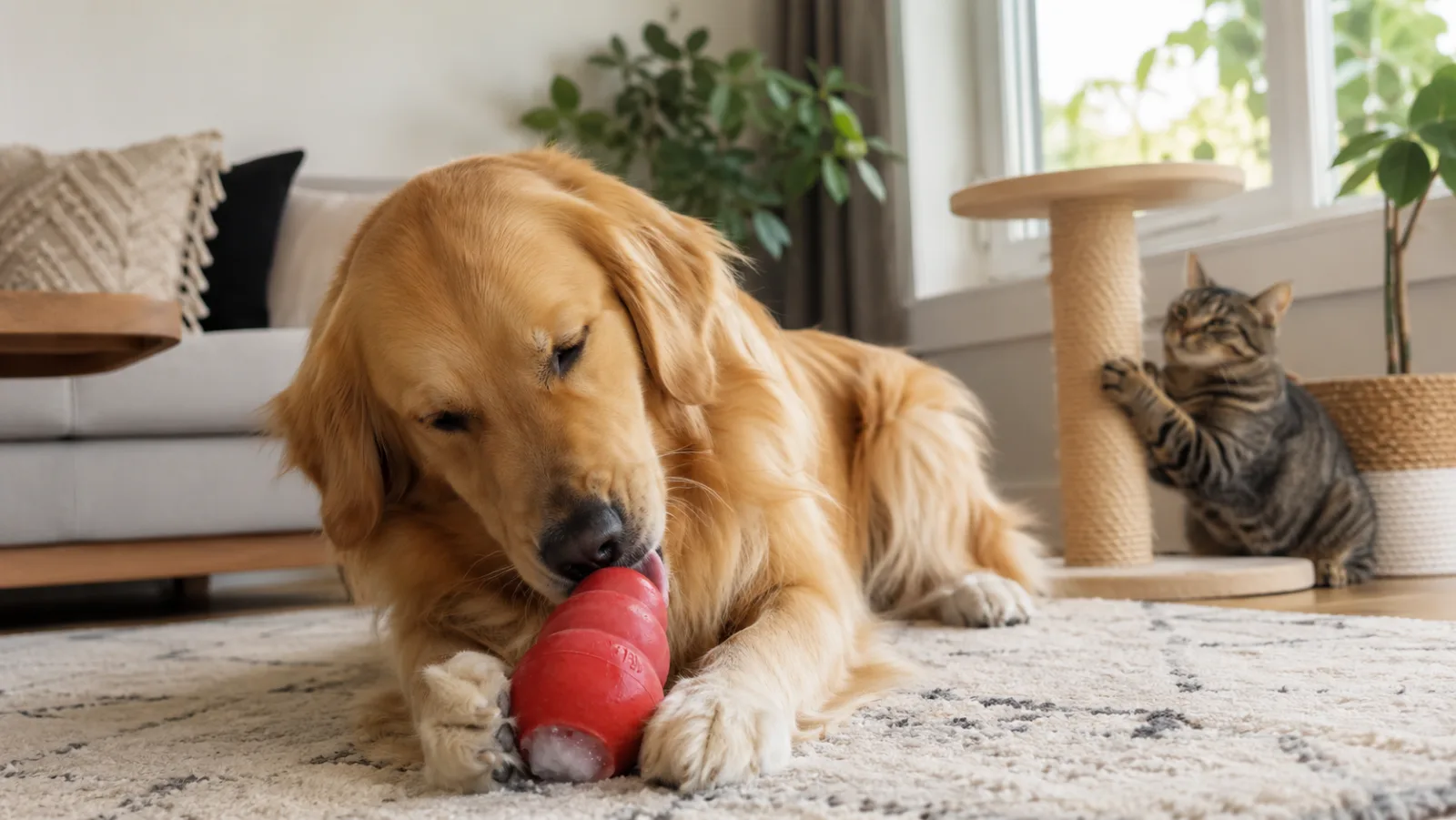
Every product on this list has been scored against the PetPal Gear Score, a weighted composite of expert consensus, observed effectiveness, animal safety, long-term durability, and value. Review method: Editorial synthesis of veterinary, regulatory, university, and trade-association guidance. Sources include the American Veterinary Society of Animal Behavior, the Merck Veterinary Manual, the Feline Veterinary Medical Association/AAFP, the ASPCA, the American Kennel Club, Fear Free, International Cat Care, and peer-reviewed studies on canine anxiety, training methods, and feline enrichment.. Synthesized from 14+ expert sources.
A new toy does not solve a behavior problem. A sterner correction does not solve fear. The American Veterinary Society of Animal Behavior, the Merck Veterinary Manual, the Feline Veterinary Medical Association, and the ASPCA all converge on the same starting point: pet behavior work begins by separating three things owners constantly blur together — normal species behavior, an under-enriched environment, and disorder-level fear or anxiety. The pet aisle flattens that into product marketing; this hub puts it back in order.
PetPalHQ does not run a behavior lab. The recommendations below are an editorial synthesis of veterinary, regulatory, and peer-reviewed guidance, with sources cited by name throughout. These include the American Veterinary Society of Animal Behavior (AVSAB) on training methods and trainer choice; the Merck Veterinary Manual on diagnosis and treatment; the Feline Veterinary Medical Association (FelineVMA, formerly the AAFP) on cat-specific environmental needs and intercat tension; the ASPCA on enrichment and separation distress; the American Kennel Club (AKC) on canine fear and anxiety education; Fear Free on cooperative-care handling; International Cat Care on subtle feline stress; and peer-reviewed work on canine anxiety prevalence and the welfare costs of aversive training.
What are you actually looking at with your pet's behavior?
Before deciding on a toy, a class, a calming chew, or a medication, the first move is naming the category honestly. The Merck Veterinary Manual explicitly distinguishes normal-but-undesirable behavior from abnormal or pathological behavior. It notes that chewing, digging, scratching, predatory play, barking, urine marking, climbing, and nighttime activity are all natural species behavior — not automatic evidence of a disorder. Each category points to a different fix.
So the real question owners should ask is not "Is this annoying?" but "Is this normal-but-mismanaged, under-enriched, emotionally driven, medically amplified, or unsafe?" Each branch points to a different fix.
- Normal but undesirable behavior. Chewing, scratching, predatory play, barking, marking, climbing — natural for the species, hard in a human home. The Merck Veterinary Manual frames the response as redirection and management, not punishment.
- Fear, anxiety, and stress. AVSAB's positive veterinary care statement and Fear Free both define fear as a response to immediate threat, anxiety as expectation of possible threat, and stress as the body's response to challenge. Both organizations frame the goal as preventing fear, anxiety, and stress, not just suppressing visible signs.
- Enrichment shortfalls. Merck describes enrichment as a way to support species-typical behavior and provide "the power and perception of choice." It is explicit that enrichment cannot compensate for poor husbandry or substandard management.
- Medical amplification. The Merck Veterinary Manual says any behavior problem diagnosis requires excluding underlying medical conditions. The ASPCA's cat aggression resources add that hyperthyroidism, arthritis, dental disease, neurologic disease, and cognitive dysfunction can drive behavior change in cats. The same logic applies to senior dogs.
- Unsafe situations. Bite risk, self-injury, panic while alone, or sudden new aggression are not "training opportunities" — they are escalation triggers.
What universal rules should guide all pet behavior work?
Most home-behavior advice goes wrong at the same handful of crossroads. Across AVSAB, Merck, FelineVMA, ASPCA, AKC, and Fear Free, the consensus rules are unusually consistent. Rule out pain or illness first. Meet species-typical needs before adding tools. Keep all behavior work below threshold. Use reward-based methods exclusively.
- Rule out pain, illness, and age-related change before treating behavior as "just training." This is especially important for sudden house-soiling, new aggression, a cat that stops eating, or a senior pet who suddenly seems confused.
- Meet species-typical needs first. The ASPCA describes daily exercise, sniffing, chewing, and problem-solving as basic dog welfare. The FelineVMA's environmental-needs guidance describes hiding, climbing, scratching, hunting-style play, predictable resources, and control over social interaction as basic cat welfare needs.
- Keep all behavior work below threshold. The AKC's fearful-dog guidance says fear interferes with learning. Merck says high arousal can trigger reflexive fight-or-flight responses that block learning. If a pet refuses food, will not orient, or tips into barking, lunging, or freezing, the setup is too hard.
- Use reward-based methods. AVSAB's humane training position statement says there is no evidence aversive training is necessary for dog training or behavior modification. Aversive methods should not be used. A 2020 PLOS ONE paper by Vieira de Castro and colleagues found worse welfare outcomes in dogs trained with aversive-based methods.
- Management is not "giving up." It is the safety layer that prevents rehearsal of the unwanted behavior while learning is happening.
- Escalate early for self-injury, bite risk, prolonged panic while alone, severe multi-cat conflict, or sudden behavior change.
How do you identify separation distress, fear, and reactivity in dogs?
Dog anxiety is often misread because the early signs look like "bad manners." The ASPCA describes separation anxiety as distress triggered by separation from the guardian — persistent vocalization, destruction near exits, escape attempts, drooling, pacing, self-injury, and exaggerated reunion behavior. Merck's behavior-problems-of-dogs reference adds that signs often start in the first 15 to 30 minutes of departure. Video is often essential because owners genuinely cannot see what happens after the door closes.
That matters because the differential diagnosis is wide. The Ballantyne review (2018) on what is scaring that dog notes that separation anxiety, noise aversion, and confinement distress can be comorbid and easily confused with one another. The same outward behavior can have different drivers.
Boredom vs. separation anxiety. The ASPCA is direct: a bored dog left alone can be destructive without being anxious. A separation-anxious dog is in distress. The treatment paths differ. A bored dog often improves with structured exercise, food puzzles, and chews. A separation-anxious dog usually needs sub-threshold departure practice, video assessment, and sometimes medication.
Crates are not an automatic answer. The AKC includes crate comfort as one part of broad puppy prevention. Merck and AVSAB-aligned separation guidance both note that many dogs with true separation anxiety do not improve in a crate and may worsen if confinement anxiety is also present. The safest editorial framing: crate comfort can help some dogs learn to settle. Once separation-related panic is suspected, the crate is not the treatment by default.
Reactivity and on-leash fear. AKC's how-to-train-a-fearful-dog material and Merck both describe gradual, reduced-intensity exposure paired with reinforcement — the desensitization-and-counterconditioning pattern — as the main learning pathway for fearful or reactive dogs. Both stress keeping exposures short enough that the dog can still take food, orient, and re-engage with the handler.
Stress signals to read in real time. The AKC lists whale eye, tucked ears or tail, lip licking, yawning, panting, avoidance, and changes in vocalization as common clues that a dog is over threshold. Reading those signals early means sessions are less likely to end in a flooded, sensitized dog.
A 2020 Scientific Reports paper by Salonen and colleagues found canine anxiety traits are common in pet populations. Noise sensitivity is especially prevalent, with separation-related behavior estimated in roughly the 14 to 20 percent range across that literature stream. That is useful as a "common" framing, but use exact percentages only when the population and outcome are named.
| Trigger pattern | Hallmark signs | Often confused with | First-line home strategy | When to escalate |
|---|---|---|---|---|
| Separation distress | Destruction near exits, persistent vocalization, drooling, exaggerated reunion | Boredom, house-training failure | Sub-threshold departure practice; video; enrichment for short alone time (ASPCA) | Self-injury, escape attempts, prolonged panic — vet plus behavior pro (Merck) |
| Confinement anxiety | Distress in crate or closed space, even when guardian is home | "Hates the crate" | Re-evaluate crate use; use video to confirm | Panic, injury — stop crate use, escalate (Merck) |
| Noise aversion | Trembling, hiding, attempts to escape during fireworks/storms | "Just dramatic," misread as separation | Safe space, sound masking, sub-threshold work | Severe panic — vet conversation about medication (Merck) |
| On-leash reactivity / fear | Lunging, barking, freezing at distance triggers | "Aggression," "stubbornness" | Distance-first counterconditioning with high-value food (AKC) | Bite risk, escalating intensity — qualified behavior pro |
| Generalized fear | Hides, won't take food, slow to recover | "Just shy" | Build choice, reduce pressure, predictable routine | Pet stops eating, hides for days — vet (Merck) |
Sources: ASPCA Separation Anxiety; Merck Veterinary Manual Behavior Problems of Dogs; AKC fearful-dog and stress-signal guidance; Ballantyne review (2018); AVSAB humane training statement.
How do subtle stress, intercat tension, and environment affect cat behavior?
Cat behavior problems are easier to miss than dog problems, and the consensus literature is consistent on why. The 2013 AAFP/ISFM environmental needs guidelines, maintained by the Feline Veterinary Medical Association, say cats often do not overtly express stress. Unmet environmental needs increase abnormal behavior or normal behavior that caregivers find undesirable. The 2019 AAFP indoor-cats position statement adds that a cat's comfort with its environment is intrinsically linked to physical health, emotional wellbeing, and behavior.
A cat hiding more, eating less, missing the litter box, marking, or attacking a housemate is sending the same kind of signal a dog sends by barking and pacing. Owners just have to look harder for it.
The five environmental-needs framework. The FelineVMA's 2013 environmental-needs guidance is built around five primary concepts: a safe place; multiple, separated key environmental resources (food, water, toileting, scratching, play, resting/sleeping areas); opportunity for play and predatory behavior; positive, consistent, and predictable human-cat social interaction; and an environment that respects the cat's sense of smell and other senses. Almost every behavior question owners ask about cats traces back to a shortfall in one or more of these five concepts.
Intercat tension. The 2024 AAFP Intercat Tension Guidelines describe poor tolerance and lack of friendly interactions between household cats as common, subtle, and clinically important. This is relevant to wellbeing, caregiver burden, and stress-related disease. The guidelines explicitly note that subtle conflict can persist in homes with no obvious fights. "My cats don't fight" is not proof the household is harmonious.
The same guidelines emphasize step-by-step introductions for new cats: separation, scent swapping, controlled visual access, and short positive sessions before free interaction. Rushed introductions are a known source of ongoing household stress.
Litter-box problems. The ASPCA's litter-box guidance uses the one-box-per-cat-plus-one-extra rule as a baseline. It ties resource shortage and routine change to inappropriate elimination and urine marking. Merck's behavior-problems-of-cats reference frames house-soiling and marking as one of the most common reasons cats are surrendered. That is why the front line of feline behavior support is environmental review, not punishment.
Subtle stress signs to watch for. International Cat Care and the ASPCA both note that cat stress signs are often quiet: hiding, withdrawal, reduced appetite, litter-box changes, urine marking, household tension around resources, increased vigilance, and over-grooming. The Amat and colleagues' 2016 review of stress in owned cats reaches similar conclusions about behavioral changes and welfare implications.
A second cat is not a universal fix. FelineVMA guidance is explicit that cats may be content as single cats or with compatible others. The safest editorial framing, combined with the 2024 Intercat Tension Guidelines, is: do not present "get another cat" as a universal enrichment cure. Compatibility, slow introductions, and resource design determine whether another cat is a benefit or a stressor.
A 2024 study by Wojtaś and colleagues found lower hair cortisol — a longer-term stress marker — in cats from more enriched shelter environments than in cats with fewer resources. That aligns with the broader guideline-level message: environment is welfare, not decoration.
| Symptom | Common environmental driver | Resource fix | Medical overlap to rule out | Monitor or escalate |
|---|---|---|---|---|
| Hiding more, withdrawal | New stressor; household tension; resource pressure | Add hiding spots, vertical space, predictable routine | Pain, illness — vet first if sudden (ASPCA, Merck) | Multi-day hiding, off food — escalate |
| Reduced appetite, eating less | Stress; intercat tension; resource access blocked | Multiple feeding stations; separated from litter | Dental disease, GI disease, hyperthyroidism | Off food >24 hours in a cat — vet (urgent) |
| Litter-box misses, urine marking | Box count, location, type, cleanliness; intercat conflict | One box per cat + one; separated, low-traffic, clean | Urinary disease, GI disease | Persistent misses despite fixes — vet |
| Inter-cat aggression | Forced introductions; resource scarcity; visual/territorial conflict | Slow re-intro; separated resources; vertical escape | Pain, hyperthyroidism, neurologic disease | Injuries or chronic stalking — pro help (FelineVMA) |
| Over-grooming, hair loss | Stress, anxiety; intercat tension | Reduce stressors; enrichment baseline | Allergies, pain, skin disease | Bald patches, skin damage — vet |
| Carrier and vet panic | No positive carrier history; stressful transport | Leave carrier out; positive associations; pheromones | — | Repeated panic — Fear Free clinic |
Sources: 2013 AAFP/ISFM Environmental Needs Guidelines; 2024 AAFP Intercat Tension Guidelines; ASPCA Litter Box Problems; Merck Veterinary Manual Behavior Problems of Cats; International Cat Care; Amat et al. 2016; Wojtaś et al. 2024.
What does real enrichment look like versus a pile of toys?
The word "enrichment" gets misused in two predictable directions: as "any toy I bought," and as "the cure for everything." Neither is what the consensus literature describes. The Merck Veterinary Manual's animal welfare reference says enrichment promotes natural behavior and gives the animal the power and perception of choice. It is explicit that enrichment cannot compensate for poor husbandry or substandard management. The ASPCA's canine and feline DIY enrichment pages translate that into concrete categories.
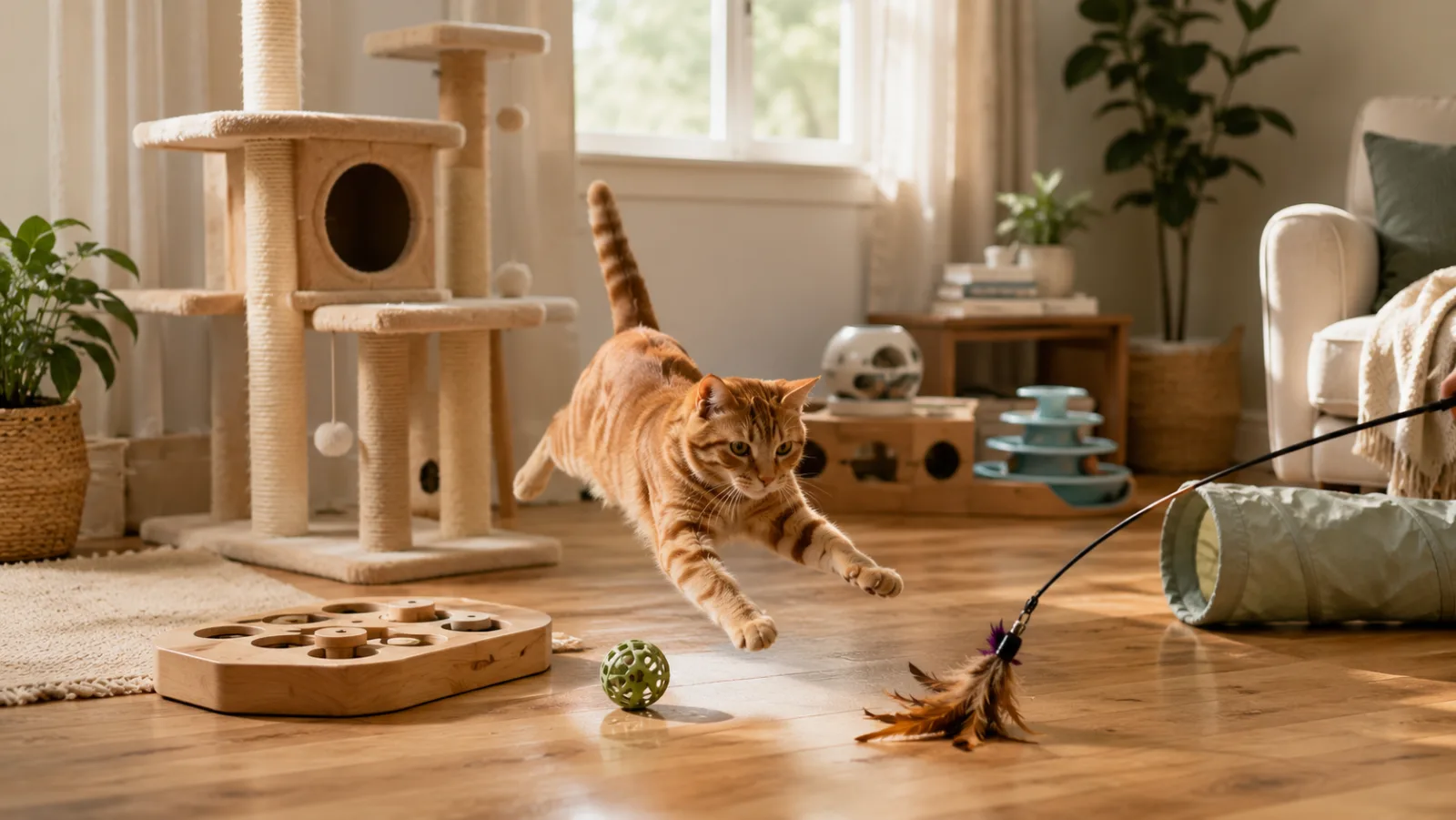
For dogs, the ASPCA's canine enrichment material centers food puzzles, scent games, chewing, scavenging, and interactive problem-solving, alongside structured exercise. The point is to build daily outlets for sniffing, chewing, working for food, and problem-solving. It is not about adding a gadget.
For cats, the FelineVMA's feeding consensus statement is unusually direct: typical ad-lib or one-to-two large meals often fail to address behavioral needs. The better default is frequent small meals, puzzle feeders, forage feeding, and multiple food and water stations in many households. The FelineVMA's positive-reinforcement toolkit says positive reinforcement training can strengthen the caregiver-cat bond and improve quality of life through multiple short sessions of about 5 to 10 minutes. The picture for cats is an all-day environmental baseline plus short active sessions on top, rather than one big play session and a quiet day.
Enrichment is not a substitute for treatment. The ASPCA notes that special toys and food puzzles can help in mild separation-anxiety cases. Highly anxious dogs often will not eat when alone — meaning the same puzzle that works for a bored dog can fail entirely for a panicking one. Merck similarly treats supplements, pheromones, calming wraps, and other adjuncts as selective tools within a larger plan, not stand-alone care.
| Species | Life stage | Food enrichment | Sensory enrichment | Movement/play | Rest/hide/perch | Training layer | Cautions |
|---|---|---|---|---|---|---|---|
| Dog | Puppy | Puzzle feeders sized for puppies, frozen lick mats | Varied, controlled exposure to surfaces, sounds (AVSAB socialization window) | Short play, age-appropriate exercise | Quiet space; positive crate work | Reward-based foundation (sit, settle, recall) | Avoid flooding; keep below threshold |
| Dog | Adult | Snuffle mats, food puzzles, chew rotation | Sniff walks, novel scents | Daily walk, structured play, off-leash where safe | Bed in low-traffic area | Settle, response substitution, cooperative-care basics | Treats count toward calories |
| Dog | Senior | Easier puzzles; softer chews | Gentle novel scents; bird-watching | Lower-impact exercise; physical-therapy informed | Orthopedic bed, ramp access | Reinforce calm; avoid abrupt change | Pain and cognitive change masquerade as behavior (ASPCA) |
| Cat | Kitten | Puzzle feeders, foraging stations | Varied textures, safe handling, gentle exposure | Multiple short play sessions; predatory wand toys | Hides at floor level; vertical perches | Positive reinforcement basics (FelineVMA toolkit) | Early socialization window matters |
| Cat | Adult | Multiple feeding stations; puzzle feeders; forage feeding | Window perches, scent rotation, safe outdoor sounds | 5–10 min predatory play sessions, multiple per day | Vertical space; private hiding | Cooperative-care, carrier training | Resource shortage drives intercat tension |
| Cat | Senior | Easier puzzles; ground-level access | Reduced startle exposure; gentle sensory | Shorter, more frequent gentle play | Easy-access perches; warm hides | Gentle handling reinforcement | Pain, sensory loss, cognitive change (ASPCA) |
Sources: Merck Animal Welfare; ASPCA Canine and Feline DIY Enrichment; FelineVMA Feeding Consensus Statement and Positive Reinforcement Training Educational Toolkit; AVSAB Puppy Socialization.
Which training methods does veterinary consensus actually support?
Reward-based methods are the consensus standard for all canine training and behavior work. The American Veterinary Society of Animal Behavior's 2021 humane training statement says there is no evidence aversive training is necessary. Aversive methods should not be used. The Merck Veterinary Manual agrees: punishment can increase fear, avoidance, and aggression. It is not recommended for behavior treatment. A 2020 PLOS ONE paper by Vieira de Castro and colleagues confirmed welfare disadvantages in dogs trained with aversive-based methods.
The same logic extends to cats. The FelineVMA's positive-reinforcement training toolkit says positive reinforcement can be used at any age. It can strengthen the caregiver-cat bond and improve quality of life. It is most successful in multiple short sessions using the individual cat's preferred reward.
That gives a method ladder that is unusually clear:
| Approach | Best use case | What it changes | When it fails | Vet involvement |
|---|---|---|---|---|
| Environmental management | Every case, as the safety layer | Prevents rehearsal; reduces trigger intensity | Cannot replace learning long-term | Optional for routine cases |
| Enrichment | Daily welfare; mild boredom; treatment multiplier | Supports species-typical behavior | Will not cure clinical fear/anxiety alone | Not required, but informs the plan |
| Desensitization + counterconditioning | Fear, anxiety, reactivity, handling sensitivity | Changes emotional response over time | If exposures stay above threshold | Vet input for severe fear/anxiety |
| Response substitution + positive reinforcement | Communication, life skills, alternative behaviors | Builds an easier behavior to do instead | If reinforcement is too low-value | Often paired with the above |
| Medication (vet-prescribed) | Frequent, severe, or unpredictable distress | Lowers emotional intensity so learning can happen | If used as a stand-alone fix | Required — Merck is explicit |
| Aversive methods (shock, prong, choke, alpha-rolling) | None supported by AVSAB or Merck | Suppresses outward signs; can increase fear | Welfare cost; risk of escalation | Not recommended |
Sources: AVSAB Humane Dog Training (2021); Merck Veterinary Manual Treatment of Behavior Problems and Behavior Problems of Dogs; FelineVMA Positive Reinforcement Training Educational Toolkit; Vieira de Castro et al. 2020.
The trainer-fit conversation lives inside this same ladder. AVSAB's "How to Choose a Trainer" handout centers reward-based methods. It explicitly discourages trainers who rely on fear, pain, choke/prong/shock tools, or physical confrontation. It advises escalation to appropriately credentialed behavior professionals when problems exceed basic training. Many anxious-pet owners spend their first budget on the wrong help. That is one of the most expensive mistakes in this whole topic.
What do medication and calming products actually do for anxious pets?
The Merck Veterinary Manual is direct about the role of medication: psychotropic drugs and adjunctive therapies can stabilize emotional state and improve trainability. Only concurrent behavior modification changes learning and emotional responses. For canine separation anxiety in the U.S., Merck specifically notes approved veterinary formulations of fluoxetine and clomipramine in conjunction with behavior plans.
The honest framing for owners is that medication is not a shortcut around training, and training is not a way to avoid medication when emotional intensity is too high for learning. They are paired tools.
Calming products — supplements, nutraceuticals, pheromones, calming wraps, CBD — sit in a more uneven evidence landscape. The AKC notes limited data for CBD in dogs. Merck treats supplements, pheromones, and wraps as selective adjunctive tools rather than one-size-fits-all solutions. The safest editorial position: present these as optional adjuncts with mixed evidence, always subordinate to diagnosis, management, and a real behavior plan.
What are the most common pet behavior mistakes owners make?
Most household behavior trouble traces back to a small, predictable set of mistakes that the same consensus sources name repeatedly — AVSAB, Merck, FelineVMA, ASPCA, and AKC. The most costly ones share a pattern: treating the symptom instead of the category, using hardware or punishment instead of the right environment, or skipping the medical check that would have changed the whole approach.
- Mislabeling boredom as anxiety, or anxiety as defiance
- Using the crate as an automatic answer when video would show separation or confinement panic
- Working above threshold — pushing through a scared dog or stressed cat instead of reducing intensity
- Running multi-cat households with too few resources (boxes, feeding stations, hides, vertical space)
- Treating a calming chew, pheromone diffuser, or single toy as a complete plan
- Missing the medical angle in older pets, where pain, sensory decline, and cognitive dysfunction can present as "behavior"
- Hiring a punishment-based trainer for a fearful or anxious pet
- Assuming a second cat will "fix" a lonely cat without compatibility, slow introductions, or resource design
- Treating behavior change as a one-week project rather than an ongoing routine
When should you escalate a pet behavior problem, and to whom?
Self-management stops being appropriate when behavior is unsafe, medically driven, or not responding to the right tools. The Merck Veterinary Manual says any behavior diagnosis requires a physical and neurologic assessment to rule out underlying medical causes. The ASPCA adds that change in a senior pet may reflect treatable disorders, pain, or cognitive dysfunction. AVSAB and AKC both say severe, dangerous, or escalating behavior belongs with a veterinarian and a qualified behavior professional. A general trainer is not the right resource for that category.
| Sign or scenario | Bucket | What to do |
|---|---|---|
| Sudden new aggression, snapping, freezing, biting | Universal red flag | Vet first to rule out pain/medical drivers, then qualified behavior professional |
| House-soiling with distress around departures | Universal red flag | Vet plus separation-case behavior plan; use video |
| Cat hiding, not eating, or new litter-box changes | Universal red flag | Veterinarian promptly — cats mask illness |
| Self-injury during alone time, escape attempts | Universal red flag | Vet and qualified behavior professional; do not rely on crate alone |
| Senior pet with night vocalizing, disorientation, or new anxiety | Universal red flag | Vet first — pain, sensory loss, cognitive dysfunction |
| Multi-cat tension without obvious fights | Common-but-clinically-important | Vet-informed environmental and behavior review (FelineVMA Intercat Tension) |
| Repeated panic during grooming or vet handling | Common target | Fear Free–style cooperative-care plan; vet input if needed |
| Mild boredom signs in an otherwise healthy adult dog | Common target | Increase structured exercise, sniffing, food puzzles, chewing |
| Single-symptom litter-box miss in an otherwise normal cat | Common target | Audit box count, location, cleanliness; vet if it persists |
Sources: Merck Veterinary Manual Diagnosis of Behavior Problems; ASPCA separation, older-pet, and aggression resources; AKC fearful-dog and aggression articles; AVSAB humane training and trainer-choice statements; Fear Free cooperative care; FelineVMA Intercat Tension Guidelines.
Frequently Asked Questions
- What is the difference between fear, anxiety, and stress in pets?
- AVSAB's positive veterinary care statement and Fear Free's cooperative-care materials define these terms precisely. Fear is a reaction to an immediate threat. Anxiety is the expectation of a possible threat. Stress is the body's physical or emotional response to challenge. Short-term stress is not always harmful. Chronic distress is. The practical goal of behavior work is not just obedience — it is lower distress and better coping.
- How can I tell boredom from separation anxiety in my dog?
- The ASPCA distinguishes the two clearly: a bored dog left alone can be destructive without being anxious. A separation-anxious dog is in distress. Merck's behavior-problems-of-dogs reference adds that signs of separation anxiety often start in the first 15 to 30 minutes of departure. Video is often essential because owners cannot see what happens after the door closes. If your dog is destructive specifically near exits, vocalizes persistently, drools, or paces, that pattern points toward separation distress. Exaggerated reunion behavior is another signal. Boredom destruction looks different.
- Can exercise alone fix dog anxiety?
- No. The ASPCA and AKC both describe exercise and mental stimulation as basic daily welfare needs. They are not a treatment for clinical anxiety. The Merck Veterinary Manual describes anxiety treatment as a combination of environmental management, reinforcement-based behavior modification, and sometimes medication. Exercise belongs in the foundation. It does not replace the plan.
- Will crate training prevent or fix separation anxiety?
- Not reliably. The American Kennel Club includes crate comfort as one part of broad puppy prevention. The Merck Veterinary Manual and AVSAB-aligned separation guidance both note that many dogs with true separation anxiety do not improve in a crate. They may worsen if confinement anxiety is also present. Once separation-related panic is suspected, use video and individualized assessment rather than assuming a crate is the treatment.
- Are punishment-based methods faster for an anxious dog?
- Expert consensus says no. The American Veterinary Society of Animal Behavior's 2021 humane training statement says there is no evidence aversive training is necessary for dog training or behavior modification. Aversive methods should not be used. The Merck Veterinary Manual notes that punishment can increase fear, avoidance, and aggression. A 2020 PLOS ONE study by Vieira de Castro and colleagues found welfare disadvantages in dogs trained with aversive-based methods. Reward-based work is the consensus default.
- What actually counts as cat enrichment?
- The Feline Veterinary Medical Association's environmental-needs guidance and the ASPCA's feline DIY enrichment material describe real cat enrichment as predatory-style play, climbing, hiding, scratching, foraging, safe observation points like window perches, and control over social interaction. It is not just buying more toys. The FelineVMA's feeding consensus statement adds that frequent small meals, puzzle feeders, and multiple feeding stations are part of enrichment. They are not just nutrition logistics.
- Can cats really learn with positive reinforcement?
- Yes. The FelineVMA's positive reinforcement training educational toolkit says positive reinforcement can be used at any age. It can strengthen the caregiver-cat bond and improve quality of life. It recommends multiple short sessions of about 5 to 10 minutes each. Use the individual cat's preferred reward — food for many cats, but play or affection for some.
- Will getting a second cat fix a lonely cat?
- Not automatically. The 2024 AAFP Intercat Tension Guidelines describe household cat tension as common, subtle, and clinically relevant. Some cats are content as single cats. Others can be compatible with another cat under the right conditions. Compatibility, slow staged introductions, and resource design matter. Multiple feeding and litter stations, hides, and vertical space all determine whether a second cat is a benefit or a stressor. "Get another cat" is not a universal enrichment fix.
Bottom Line
The American Veterinary Society of Animal Behavior says reward-based methods should be used for all canine training and behavior work. There is no evidence aversive methods are necessary.
The Merck Veterinary Manual says behavior problem diagnosis requires excluding underlying medical conditions first. Sudden new aggression, house-soiling, hiding, or confusion in older pets is a vet conversation, not a training one.
The 2013 AAFP/ISFM environmental-needs guidelines, maintained by the Feline Veterinary Medical Association, treat unmet environmental needs as the foundation of feline behavior problems. Cats need hiding, climbing, scratching, predatory play, and predictable resource access — not just toys.
The ASPCA distinguishes boredom from separation anxiety in dogs. Merck adds that video is often essential. Noise aversion, confinement anxiety, and separation distress can imitate one another.
The 2024 AAFP Intercat Tension Guidelines describe household cat tension as common, subtle, and clinically important. 'My cats don't fight' is not proof a multi-cat home is harmonious.
All articles in this guide
Best Dog Puzzle Toys and Treat-Dispensing Toys (2026)
KONG Classic anchors the all-purpose pick; the Busy Buddy Twist 'n Treat is the pick when you want to dial difficulty up or down without rebuying. Editorial recommendations grounded in ASPCA, AVSAB, and manufacturer documentation — not first-hand testing.
12 min read
Best Lick Mats for Dogs and Cats: Decompression, Baths, and Training (2026)
The LickiMat Tuff Soother anchors the everyday durable pick; the Mighty Paw Interactive Dog Lick Pad covers bath-time suction. Editorial recommendations grounded in ASPCA, Karen Pryor Academy, and manufacturer documentation.
12 min read
Best Products for Dog Separation Anxiety: Routines, Calming Aids, and Cameras (2026)
Clinical separation anxiety often needs veterinary behavior modification and may need prescription medication. The picks below are supportive tools, not cures. Editorial synthesis of AVSAB, Merck Veterinary Manual, ASPCA, AKC, and Karen Pryor Academy guidance.
12 min read
Best Cat Pheromone Diffusers and Calming Products: Multi-Cat Tension, Vet Visits, Moving (2026)
For cats, calming starts with environment, not sedatives. Pheromone diffusers, travel sprays, calming chews, and safe-place beds support the AAFP/ISFM five-pillar framework — but sudden behavior change, aggression, hiding, appetite change, or house-soiling needs a veterinarian, not a product.
12 min read
Best Cat Scratching Posts and Furniture Alternatives (2026)
Scratching is normal feline behavior — AAFP and ASPCA both oppose declawing as a furniture-protection solution. The SmartCat Pioneer Pet Ultimate Scratching Post anchors the everyday vertical sisal pick; the PetFusion 3-Sided Vertical Scratch Play & Perch is the preference test for cats that reject sisal. Editorial synthesis of veterinary and welfare-organization guidance.
12 min read
Best No-Pull Harnesses and Leash Manners Tools for Dogs (2026)
AVSAB explicitly opposes prong, choke, and shock collars for dog training — reward-based methods are the consensus standard. The PetSafe Easy Walk No-Pull Dog Harness anchors the budget front-clip pick; the Ruffwear Front Range Dog Harness is the everyday padded dual-clip option. Editorial synthesis of AVSAB, AKC, and manufacturer guidance.
12 min read
Best Dog Chew Toys for Anxiety, Decompression, and Boredom (2026)
Chew, lick, and sniff are the three calming mechanisms behind enrichment. The KONG Classic anchors the chew axis; a LickiMat covers licking; a snuffle mat covers foraging. Editorial synthesis of ASPCA, AKC, and peer-reviewed studies — not first-hand testing.
12 min read
Best Pet Calming Aids for Anxiety in 2026
Calming aids for an anxious pet are supportive tools, not cures. A pressure wrap, a lick mat, a cat pheromone diffuser, and a dog pheromone diffuser each ease a different kind of stress — but clinical anxiety often needs veterinary behavior modification and sometimes medication. We read the research, then matched each tool to the animal and the trigger it actually fits.
13 min read
Sources & Methodology
Expert review sources
- AVSAB — Position Statement on Humane Dog Training (2021)
- AVSAB — Position Statement on Puppy Socialization
- AVSAB — Position Statement on Positive Veterinary Care
- AVSAB — How to Choose a Trainer
- Merck Veterinary Manual — Diagnosis of Behavior Problems in Animals (2024–2025)
- Merck Veterinary Manual — Behavior Problems of Dogs (2025)
- Merck Veterinary Manual — Behavior Problems of Cats
- Merck Veterinary Manual — Treatment of Behavior Problems in Animals
- Merck Veterinary Manual — Animal Welfare and Enrichment
- FelineVMA/AAFP — 2013 AAFP/ISFM Environmental Needs Guidelines
- FelineVMA/AAFP — Meeting the Physical and Emotional Needs of Owned Indoor Cats (2019)
- FelineVMA/AAFP — 2024 AAFP Intercat Tension Guidelines
- FelineVMA/AAFP — Feline Feeding Programs Consensus Statement
- FelineVMA/AAFP — Positive Reinforcement Training Educational Toolkit
- FelineVMA/AAFP — Feline Behavior Guidelines
- ASPCA — Separation Anxiety
- ASPCA — Canine DIY Enrichment
- ASPCA — Feline DIY Enrichment
- ASPCA — Litter Box Problems
- ASPCA — Cat Aggression and Older-Pet Behavior Resources
- AKC — Separation Anxiety in Dogs
- AKC — Anxiety in Dogs
- AKC — How to Train a Fearful Dog
- AKC — How to Tell If Your Dog Is Stressed
- Fear Free — Mission and Cooperative-Care Resources
- International Cat Care — Stress and Cat-Friendly Handling Guidance
Community sources
- Salonen et al., 'Prevalence, comorbidity, and breed differences in canine anxiety' (Scientific Reports, 2020)
- Vieira de Castro et al., 'Does training method matter? Evidence for the negative impact of aversive-based methods on companion dog welfare' (PLOS ONE, 2020)
- Ballantyne, 'Separation, Confinement, or Noises: What Is Scaring That Dog?' (Vet Clin North Am Small Anim Pract, 2018)
- Amat et al., 'Stress in owned cats: behavioural changes and welfare implications' (2016)
- Wojtaś et al., 'The Impact of Environmental Enrichment on the Cortisol Level of Shelter Cats' (2024)
- r/Dogtraining wiki and separation-anxiety resources — used to spot owner failure modes, not as authority on medical claims
Prices and specs verified May 4, 2026.
About the author
Nick Miles is the chief editor of PetPalHQ. PetPalHQ does not run a behavior or training lab. Every claim on this page is synthesized from veterinary references, position statements, university and trade-association guidance, and peer-reviewed studies. Sources are cited by name in body prose; the bibliography above lists every primary source consulted for this hub.
PetPalHQ is a participant in the Amazon Services LLC Associates Program. We may earn commissions from qualifying purchases — at no extra cost to you.
More Guides
Cats & Dogs
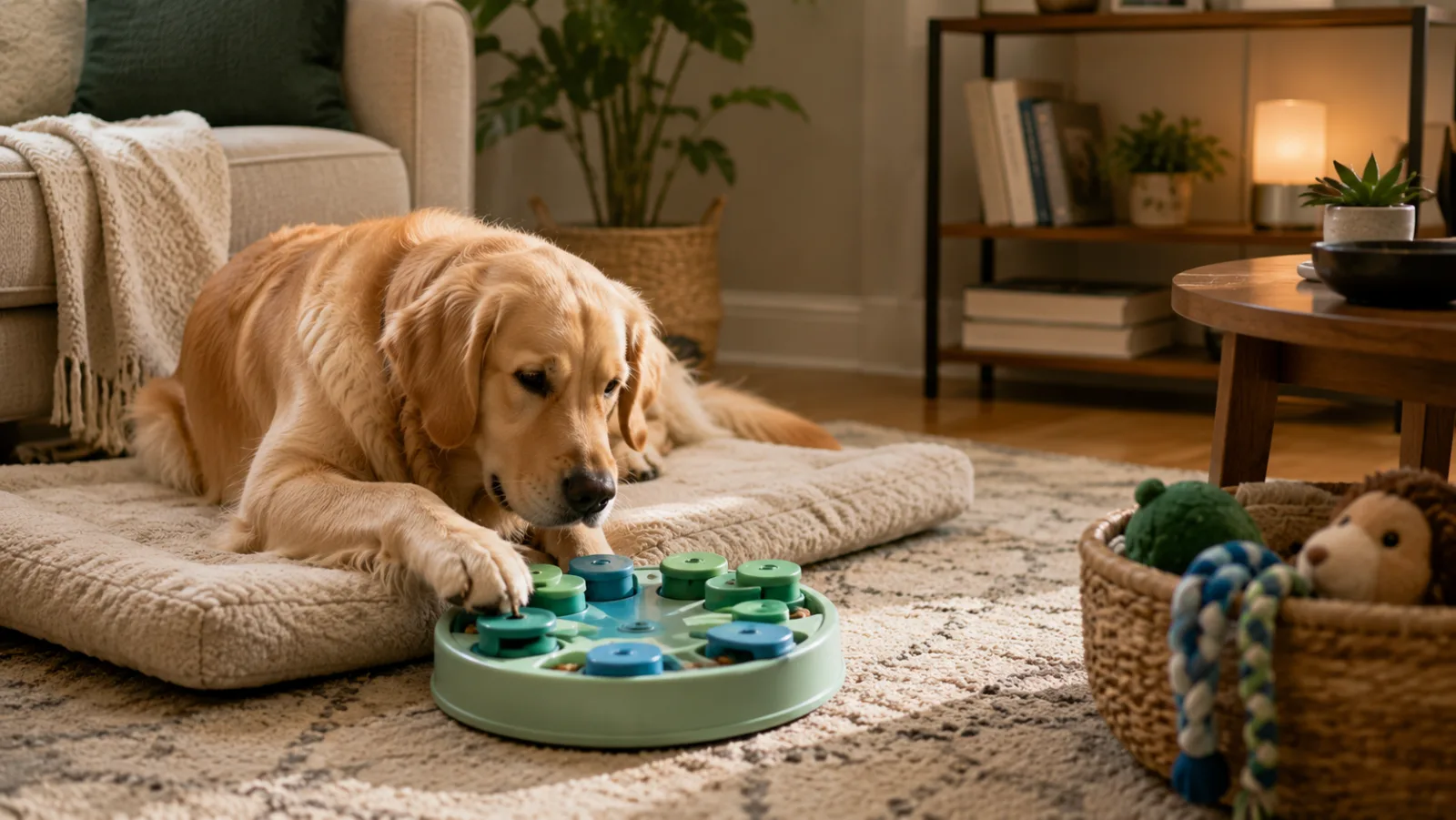
Best Dog Puzzle Toys and Treat-Dispensing Toys (2026)
Cats & Dogs
Best Lick Mats for Dogs and Cats: Decompression, Baths, and Training (2026)
Cats & Dogs
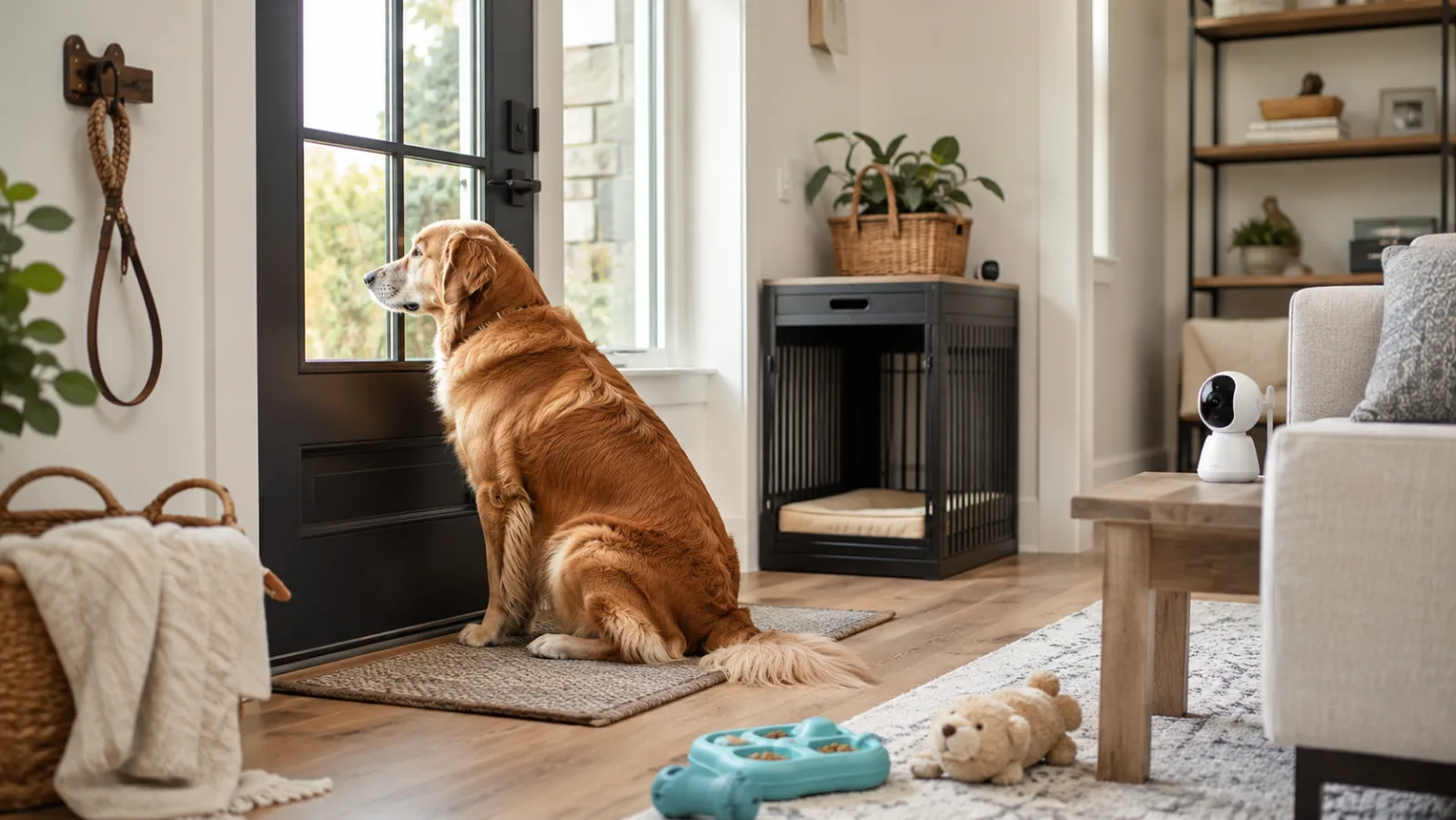
Best Products for Dog Separation Anxiety: Routines, Calming Aids, and Cameras (2026)
Cats & Dogs
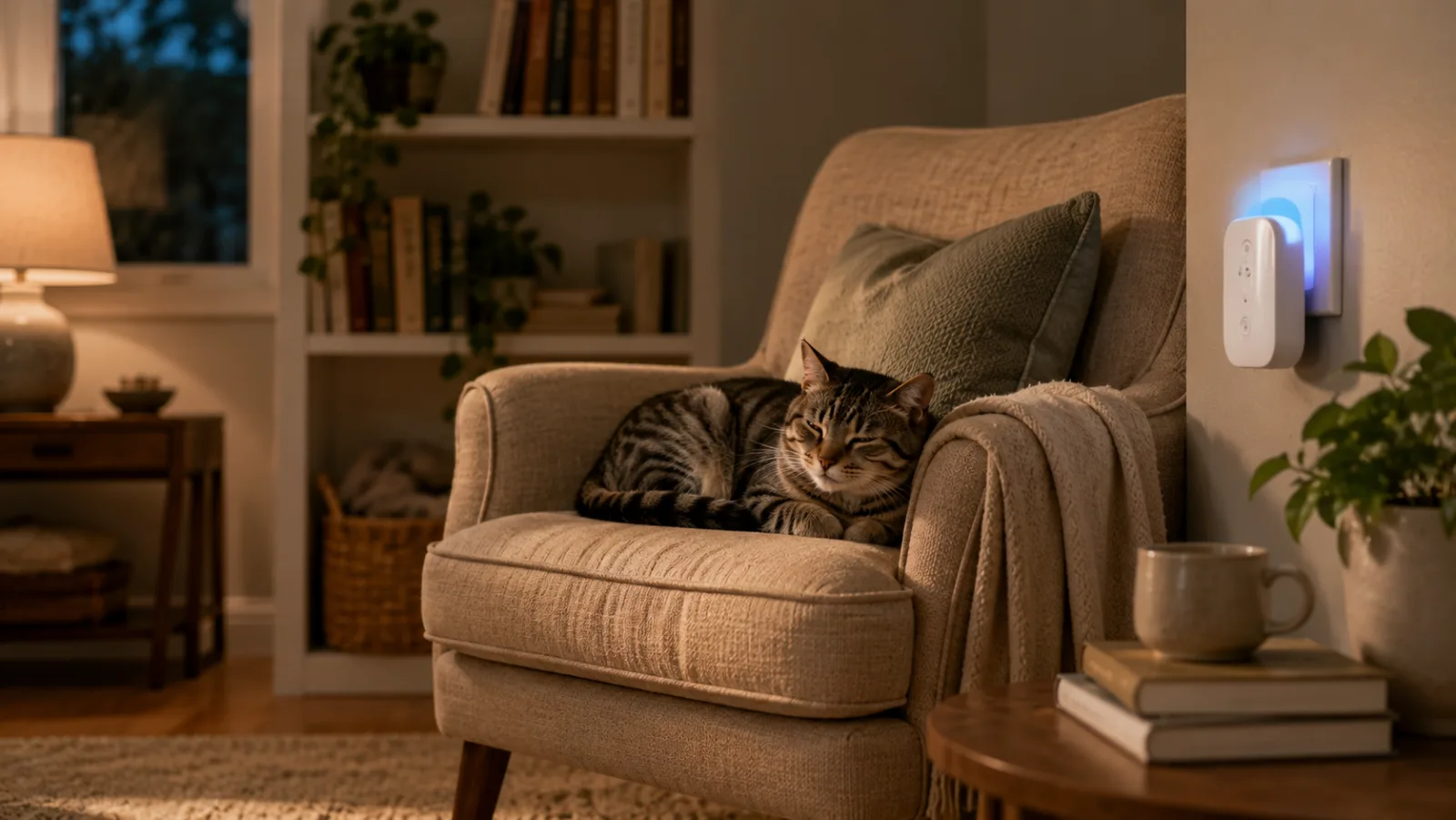
Best Cat Pheromone Diffusers and Calming Products: Multi-Cat Tension, Vet Visits, Moving (2026)
Cats & Dogs
Best Cat Scratching Posts and Furniture Alternatives (2026)

Cats & Dogs