Cats & Dogs
Best Dog Puzzle Toys and Treat-Dispensing Toys (2026)
KONG Classic anchors the all-purpose pick; the Busy Buddy Twist 'n Treat is the pick when you want to dial difficulty up or down without rebuying. Editorial recommendations grounded in ASPCA, AVSAB, and manufacturer documentation — not first-hand testing.
By Nick Miles · Updated September 8, 2026 · 12 min read
PetPalHQ is reader-supported. We may earn a commission from qualifying Amazon purchases at no extra cost to you.
Evidence at a Glance
KONG Classic Stuffable Dog Toy
Stuffable rubber toy that supports licking, chewing, and frozen-meal enrichment — the cleanest expert-to-product fit because ASPCA specifically recommends stuffed puzzle toys for alone-time management.
Sources: ASPCA — Canine DIY Enrichment, KONG manufacturer documentation, Merck Veterinary Manual
Verified May 5, 2026
West Paw Zogoflex Toppl Treat-Dispensing Puzzle, Large
Top-rack dishwasher-safe, fill-and-freeze puzzle cup that holds 3/4 cup and interlocks with a second size — the synthesis pick for wet-food enrichment and slow feeding.
Sources: West Paw Toppl product page (westpaw.com, accessed 2026-09-08), ASPCA — Canine DIY Enrichment, Karen Pryor Academy
Verified Sep 8, 2026
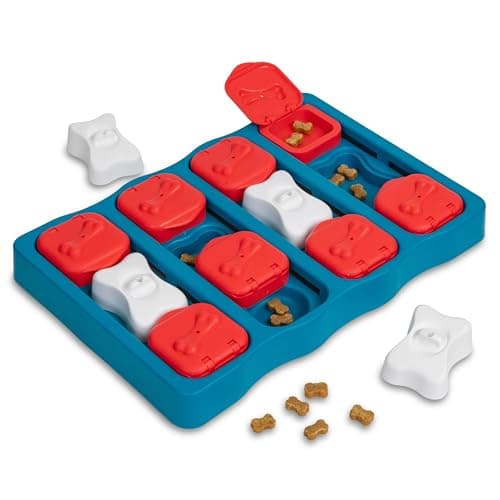
Outward Hound by Nina Ottosson Dog Brick (Level 2)
Beginner-intermediate board puzzle that taps hunting and foraging instincts during supervised sessions — Outward Hound's product copy explicitly frames it around boredom and stress reduction.
Sources: Outward Hound manufacturer documentation, AVSAB — Humane Dog Training Position Statement
Verified May 5, 2026
Our Picks
KONG
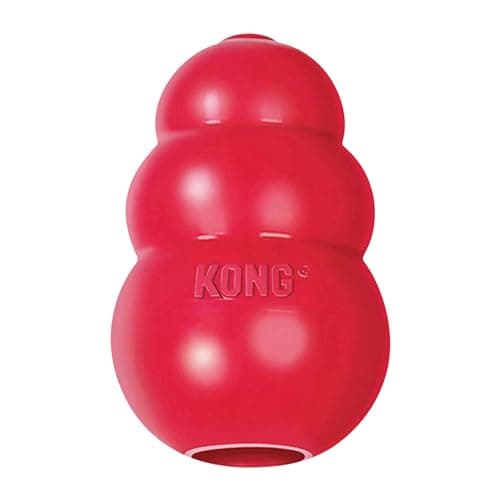
KONG Classic Stuffable Dog Toy
9.5 / 10
- Natural rubber stuffable toy designed for licking, chewing, and erratic-bounce play
- Cited by ASPCA as a recommended food-puzzle toy for alone-time enrichment
- Compatible with peanut butter, kibble, wet food, and freezer use
- Available in five sizes from XS to XXL with chewer-strength variants
$11.96
West Paw
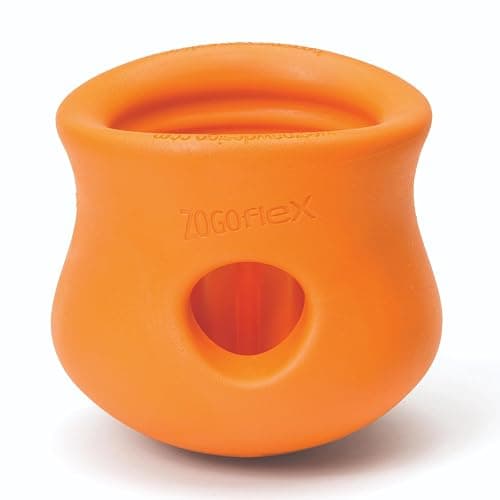
West Paw Zogoflex Toppl Treat-Dispensing Puzzle, Large (Tangerine)
9.0 / 10
- Zogoflex puzzle cup moulded in Bozeman, Montana — top-rack dishwasher safe, and West Paw's own line is fill-and-freeze
- Interlocking challenge mode — two sizes twist together so the smaller sits inside the larger
- Large holds 3/4 cup at 3.5 x 4 x 3.5 inches, shallower and wider than a stuffed cone, so wet food goes in with a spoon
- Three sizes on West Paw's own page — Small 1/4 cup, Large 3/4 cup, XL 1 1/4 cup — plus several colorways
$25.95
Outward Hound
Outward Hound by Nina Ottosson Dog Brick (Level 2)
8.6 / 10
- Level 2 (Intermediate) interactive treat puzzle with sliders and lift-out blocks
- Outward Hound positions it as a problem-solving toy that taps hunting and foraging instincts
- Composite construction — supervised use only, not a chew toy
- Designed by Swedish behaviorist Nina Ottosson
$14.30
PetSafe
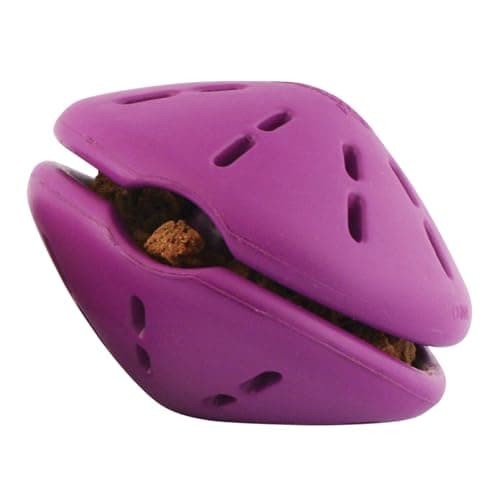
PetSafe Busy Buddy Twist 'n Treat
8.2 / 10
- Adjustable opening — twist the two halves to widen or narrow the treat gap
- Compatible with kibble, soft treats, and smearable food
- Two-piece flexible rubber construction
- Available in three sizes by weight
$9.95
Outward Hound
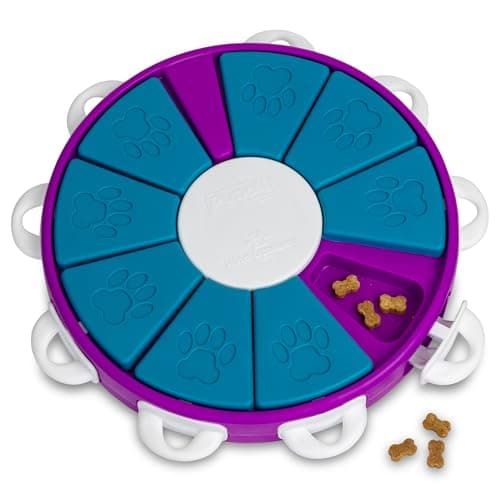
Outward Hound by Nina Ottosson Dog Twister (Level 3)
8.4 / 10
- Level 3 (Advanced) puzzle with rotating discs over treat compartments
- Outward Hound positions it as mental and physical stimulation
- Best for dogs that have already mastered lids, sliders, and hidden-treat logic
- Designed by Swedish behaviorist Nina Ottosson
$11.99
The Short Answer
If you buy one dog puzzle toy, make it the KONG Classic — ASPCA explicitly recommends stuffed puzzle toys for alone-time enrichment, and KONG's manufacturer documentation centers the toy on stuffing, chewing, and licking. Pair an Outward Hound Nina Ottosson Dog Brick with supervised sessions for problem-solving practice. Use a PetSafe Busy Buddy Twist 'n Treat when you want to scale difficulty without buying new toys — twisting the two halves narrows the treat gap, so the same toy gets harder as the dog learns it, and step up to the Nina Ottosson Dog Twister only after your dog has already mastered lids and sliders.
Every product on this list has been scored against the PetPal Gear Score, a weighted composite of expert consensus, observed effectiveness, animal safety, long-term durability, and value. Review method: Editorial synthesis of ASPCA, AVSAB, AKC, Merck Veterinary Manual, Karen Pryor Academy, and manufacturer documentation from KONG, Outward Hound, PetSafe, and West Paw — no first-hand product testing.. Synthesized from 10+ expert sources.
For most households, the smartest first puzzle toy is still a stuffable rubber cone. The ASPCA's canine enrichment and separation-anxiety pages, AVSAB's humane dog training position statement, and the Merck Veterinary Manual's behavior chapters all converge on the same point. Enrichment products work best when they support species-typical behaviors — foraging, licking, chewing, and problem-solving — inside a broader management plan, not as a standalone fix.
The picks below are editorial synthesis. PetPalHQ does not run a testing lab. Every product on this page was selected by reviewing manufacturer documentation from KONG, Outward Hound, and PetSafe; expert guidance from the ASPCA, AVSAB, AKC, the Merck Veterinary Manual, and Karen Pryor Academy; and hobbyist consensus from r/Dogtraining. Where expert sources disagree (most commonly on whether board puzzles or stuffables should come first), we deferred to the Merck Veterinary Manual's framing: meet behavioral needs and prevent rehearsal of unwanted behavior before optimizing for novelty.
This guide is the buying-side companion to the Pet Behavior, Anxiety, and Enrichment for Cats and Dogs hub. The hub explains why enrichment matters and where the line is between management and treatment; this article covers what to buy.
A note on the boundary the hub enforces: puzzle toys are not a treatment for clinical separation anxiety. The Merck Veterinary Manual is direct that true separation anxiety often requires behavior modification and may require prescription medication under veterinary supervision. A stuffed KONG can be part of an alone-time routine that supports a clinical behavior plan; it cannot replace one. If your dog is panicking, self-injuring, escaping, or escalating when left alone, move out of product-shopping mode and into veterinary mode. Telling those two situations apart means watching the dog when it is genuinely alone, which is what the cameras in our best pet cameras guide are for.
Head-to-Head Comparison
| Feature | KONG Classic Stuffable Dog Toy | West Paw Zogoflex Toppl Treat-Dispensing Puzzle, Large (Tangerine) | Outward Hound by Nina Ottosson Dog Brick (Level 2) | PetSafe Busy Buddy Twist 'n Treat | Outward Hound by Nina Ottosson Dog Twister (Level 3) |
|---|---|---|---|---|---|
| Difficulty level | Beginner-friendly stuffable | Beginner to intermediate (interlocking mode) | Level 2 (Intermediate) | Adjustable beginner to intermediate | Level 3 (Advanced) |
| Material / dishwasher safe | Natural rubber, top-rack safe | Zogoflex, top-rack dishwasher safe, fill-and-freeze | Composite, hand-wash recommended | Flexible rubber, hand-wash | Composite, hand-wash recommended |
| Best for | Power chewer / departure ritual | Slow eater / wet-food enrichment | Supervised problem solver | Scaling difficulty over weeks | Experienced puzzle dog |
| Size range | XS through XXL plus chewer variants | Small (1/4 cup), Large (3/4 cup), XL (1 1/4 cup) | One size — match by weight | Small, Medium, Large | One size — match by weight |
| Check price | Amazon | Amazon | Amazon | Amazon | Amazon |
$11.96
- Natural rubber stuffable toy designed for licking, chewing, and erratic-bounce play
- Cited by ASPCA as a recommended food-puzzle toy for alone-time enrichment
- Compatible with peanut butter, kibble, wet food, and freezer use
- Available in five sizes from XS to XXL with chewer-strength variants
The KONG Classic has the cleanest expert-to-product fit in this entire category. The ASPCA's canine enrichment and separation-anxiety pages explicitly recommend stuffed food-puzzle toys as part of an alone-time routine. KONG's manufacturer documentation centers the product around exactly the behaviors expert sources call calming — licking, chewing, and slow problem-solving for the food inside.
What makes it the default first pick is versatility. The same toy can hold a smear of peanut butter for a quick distraction, a stuffed-and-frozen meal for crate training, or a few pieces of kibble for fast foraging — without buying a different product for each use case. The Merck Veterinary Manual frames behavior support as meeting behavioral needs and preventing rehearsal of unwanted chewing; a stuffed KONG addresses both at once during the alone-time window.
The size and chewer-strength match matters more than most owners realize. KONG publishes a sizing chart by weight and a separate "Extreme" line for power chewers. The wrong combination — an undersized Classic for a large dog, or a softer puppy version for an adult chewer — is the most common cause of premature destruction. Match by weight first, then by chewer profile.
What the spec sheet does not tell you: a stuffed KONG is not a substitute for behavior modification when a dog is panicking when left alone. Merck Veterinary Manual is direct that clinical separation anxiety often requires both behavior modification and prescription medication. Position the KONG as a routine support tool, not a treatment.
What We Love
- Most versatile stuffable in the category — works for meals, treats, and freezer use
- Cited by name in ASPCA enrichment guidance
- Wide size and chewer-strength range for accurate fit
- Dishwasher-safe top rack per KONG documentation
What Could Be Better
- Sizing and chewer-strength mismatch is the most common destruction cause
- Not a substitute for veterinary care in clinical separation anxiety
- Power chewers should use the Extreme variant, not the Classic
The Verdict
If you can only buy one dog puzzle toy, this is the one. Synthesis across ASPCA, AVSAB, KONG manufacturer documentation, and the Merck Veterinary Manual converges on stuffed rubber toys as the highest-confidence enrichment category — and KONG is the canonical product.
$25.95
- Zogoflex puzzle cup moulded in Bozeman, Montana — top-rack dishwasher safe, and West Paw's own line is fill-and-freeze
- Interlocking challenge mode — two sizes twist together so the smaller sits inside the larger
- Large holds 3/4 cup at 3.5 x 4 x 3.5 inches, shallower and wider than a stuffed cone, so wet food goes in with a spoon
- Three sizes on West Paw's own page — Small 1/4 cup, Large 3/4 cup, XL 1 1/4 cup — plus several colorways
- BPA-, latex-, phthalate- and silicone-free, and recyclable through West Paw's own Join the Loop program
The West Paw Toppl is the synthesis pick when the use case is slow feeding rather than alone-time stuffing. West Paw's own product page positions the Toppl exactly there: fill with wet treats and freeze for a long-lasting challenge, interlock two sizes for a puzzle the dog can chase, and use it as a slow feeder for scatter-feeding enrichment. It is top-rack dishwasher safe, BPA-, latex-, phthalate- and silicone-free, and moulded from recyclable Zogoflex in Bozeman, Montana.
What it gets right is the shape. A KONG Classic is a deep cone — great for frozen plugs, harder to fill cleanly with wet food. The Toppl's shallow, wide bowl is the inverse: easy to spoon raw or wet food into, easy to scrape out for cleaning, and easy to freeze flat. West Paw puts the Large at 3.5 by 4 by 3.5 inches holding 3/4 cup, which is a meal-sized portion for a medium dog rather than a treat pocket. That makes it the more practical pick for owners doing structured slow-feeding meals rather than one-off stuffing.
The Karen Pryor Academy's reward-based learning framework backs starting easy and letting the dog win quickly. The Toppl supports that progression naturally — start with kibble at room temperature, graduate to wet food at room temperature, then move to frozen wet food, and finally to the interlocked two-size configuration once the dog has mastered the basic shape. ASPCA's enrichment guidance implicitly endorses this kind of graduated foraging difficulty. West Paw now lists three sizes rather than two, so the interlock is Small-in-Large or Large-in-XL depending on the dog.
What the spec sheet does not tell you: West Paw rates the Toppl for moderate chewers and says plainly on the same page that no dog toy is indestructible. Hobbyist communities echo the point — strong chewers can damage Zogoflex over time, and the Toppl is best treated as a supervised or short-window enrichment tool rather than a leave-alone chew toy. At $25.95 it is also the most expensive toy on this page, more than double the KONG Classic's $11.96, and it is sold on Amazon by a third-party seller shipping from Amazon rather than by Amazon itself. West Paw's own store lists the same Large at the same $25.95, so the Amazon price is not a markup.
What We Love
- Easier to fill with wet food than a stuffed cone, and the 3/4-cup Large takes a real portion
- Top-rack dishwasher safe and fill-and-freeze per West Paw's product page
- Interlocking two-size configuration scales difficulty without buying a different toy
- Moulded from recyclable Zogoflex in Bozeman, Montana, with no BPA, latex, phthalates or silicone
What Could Be Better
- West Paw rates it for moderate chewers and states no dog toy is indestructible — not an unattended chew for power chewers
- $25.95 is the highest price on this page, more than double the KONG Classic's $11.96
- Strong chewers can damage Zogoflex over time
- Sold on Amazon by a third-party seller rather than by Amazon, though it ships from Amazon
The Verdict
Buy this if your priority is slow feeding, wet-food meals, or freezable enrichment. It is not a power-chewer toy and at $25.95 it is the dearest thing here, but it is the most thoughtful product in the category for graduated foraging difficulty — and West Paw sells it for the same money direct.
$14.30
- Level 2 (Intermediate) interactive treat puzzle with sliders and lift-out blocks
- Outward Hound positions it as a problem-solving toy that taps hunting and foraging instincts
- Composite construction — supervised use only, not a chew toy
- Designed by Swedish behaviorist Nina Ottosson
The Dog Brick is the strongest beginner board puzzle in the category because Outward Hound's product copy is explicit about both what it does and what it is not. The manufacturer positions it as a Level 2 (Intermediate) puzzle that taps hunting and foraging instincts and helps reduce boredom and stress — language that aligns directly with the ASPCA's enrichment guidance and the Merck Veterinary Manual's framing that meeting behavioral needs and preventing rehearsal of unwanted behaviors is the foundation of behavior support.
What makes it the right starter board puzzle is the multi-step structure. The Dog Brick combines sliders that move side-to-side with lift-out blocks that hide treats underneath — two distinct mechanics that teach the dog the basic puzzle vocabulary (slide to reveal, lift to reveal) without overwhelming a novice. AVSAB's reward-based training position statement makes the case that learners should win early and often; a single Level 2 puzzle gives a dog two ways to win in one product.
Where it requires careful framing is supervision. Outward Hound's own safety language is unambiguous: this is not a chew toy. Show the dog how it works, supervise the entire session, store the puzzle once the food is gone, and inspect for damage between uses. For households with strong chewers, even a Level 2 puzzle is a closely-supervised enrichment tool, not a leave-alone option.
What the spec sheet does not tell you: a board puzzle goes stale faster than a stuffable rubber toy. Once a dog has memorized the Dog Brick's solution path, the enrichment value drops sharply. Plan to rotate it with other puzzle types — Karen Pryor Academy's training writing emphasizes novelty as part of what keeps reinforcement effective.
What We Love
- Two distinct puzzle mechanics in one product
- Manufacturer copy aligns directly with ASPCA enrichment language
- Designed by a recognized animal behaviorist
- Affordable entry point for board-puzzle play
What Could Be Better
- Not a chew toy — requires close supervision
- Loses novelty after a few sessions
- Composite material can crack if mouthed by strong chewers
The Verdict
The cleanest beginner board puzzle in the category. Buy it if you want to introduce supervised problem-solving sessions and you understand it is not a leave-alone toy.
$9.95
- Adjustable opening — twist the two halves to widen or narrow the treat gap
- Compatible with kibble, soft treats, and smearable food
- Two-piece flexible rubber construction
- Available in three sizes by weight
The PetSafe Busy Buddy Twist 'n Treat is the cleanest "scale the difficulty without buying a new toy" pick. PetSafe's product documentation centers the design on a variable opening — you twist the two halves further apart to widen the gap and let kibble fall out faster, or closer together to make extraction harder. That single adjustment turns one product into a beginner toy and an intermediate toy depending on how the owner sets it.
Why that matters: the most common beginner mistake in puzzle-toy use is jumping difficulty levels too fast and creating frustration. Karen Pryor Academy's reward-based learning content is consistent on this — the learner should win early, win often, and ratchet difficulty up gradually. A single adjustable dispenser is the cheapest way to enforce that progression in practice without buying a graduated set of toys.
The other thing the Twist 'n Treat does well is bridge between dry-food puzzle feeding and lick-mat-style smearing. PetSafe's compatibility notes cover both kibble and smearable treats, which matches ASPCA's note that licking can have a calming effect for dogs left alone. For owners building an alone-time routine on a budget, that crossover use is meaningful.
What the spec sheet does not tell you: the rubber is softer than a Classic KONG and is not intended for power chewers. PetSafe markets it as a treat dispenser, not a chew toy, and household reports consistently match that framing — supervised foraging works fine, leave-alone chewing risks damage.
What We Love
- Variable opening scales difficulty without buying a new toy
- Bridges kibble dispensing and smearable-treat use
- Affordable entry point for adjustable foraging
- Three sizes for accurate weight-match
What Could Be Better
- Softer rubber than a Classic KONG — not for power chewers
- Can become trivially easy at the widest opening setting
- Two-piece construction means more crevices to clean
The Verdict
Buy this if you want to scale difficulty over weeks without rebuying products. It is the most flexible budget pick in the category, but it is not a substitute for a stuffable Classic KONG when you need an unattended-friendly chew.
$11.99
- Level 3 (Advanced) puzzle with rotating discs over treat compartments
- Outward Hound positions it as mental and physical stimulation
- Best for dogs that have already mastered lids, sliders, and hidden-treat logic
- Designed by Swedish behaviorist Nina Ottosson
The Dog Twister is the natural upgrade once a dog has finished the Dog Brick's vocabulary and started solving it in seconds. Outward Hound positions the Twister as a Level 3 (Advanced) puzzle and frames it around mental and physical stimulation — a step up in both the rotational mechanics and the sequencing required to clear all compartments.
Where it earns its inclusion is the difficulty curve. AVSAB's reward-based training position statement and Karen Pryor Academy's clicker-mechanics writing both make the same point: a learner who has already won easy reps benefits from harder ones. A learner who has not earned the easy reps yet will disengage if started too high. The Twister is the toy you buy after the dog has mastered the Brick — not before.
The behavior story it tells is consistent with the broader hub. ASPCA's enrichment guidance frames problem-solving as part of mental stimulation, and the Merck Veterinary Manual frames meeting behavioral needs as the foundation of behavior care. A dog that has graduated from beginner puzzles to advanced ones is using species-typical foraging cognition — exactly the behavior the literature supports.
What the spec sheet does not tell you: jumping straight to a Level 3 puzzle with a novice dog is the most common reason households conclude "puzzle toys don't work for my dog." Outward Hound's own product line is laid out in graduated levels for a reason. Start at Level 1 or 2; the Twister is for Level 3 readiness, not Level 3 ambition.
What We Love
- Real difficulty progression for dogs that have mastered Level 2
- Multiple mechanics — rotation, sequencing, compartments
- Affordable for the difficulty level
- Designed by a recognized animal behaviorist
What Could Be Better
- Frustrates novices if started too early
- Not a chew toy — supervised use only, store after sessions
- Loses novelty once the dog memorizes the solve sequence
The Verdict
Buy this only after your dog has mastered a Level 2 puzzle like the Dog Brick. As a first puzzle for a novice, it is a recipe for disengagement; as a graduation toy for an experienced puzzle dog, it is the cleanest pick in the category.
How We Score
Formula
PetPal Gear Score = (Expert Consensus × 0.35) + (Material Safety / Durability × 0.25) + (Ease of Use × 0.20) + (Behavioral Fit × 0.20)
Score Factors
- Expert Consensus · 35%
- Synthesized from ASPCA, AVSAB, AKC, Merck Veterinary Manual, Karen Pryor Academy, and manufacturer documentation from KONG, Outward Hound, and PetSafe. The PetPal Gear Score is a composite of expert behavior recommendations and material safety standards — PetPalHQ does not run a testing lab.
- Material Safety and Durability · 25%
- How well the product matches the chewer profile and intended use, based on manufacturer construction documentation and stated chewer-strength compatibility.
- Ease of Use · 20%
- Workflow complexity, cleaning effort, and how easy it is for a household to integrate the toy into a real alone-time or slow-feeding routine.
- Behavioral Fit · 20%
- How cleanly the product supports species-typical foraging, licking, chewing, or problem-solving behaviors named by ASPCA, AVSAB, and the Merck Veterinary Manual as supportive of canine enrichment.
| Rank | Product | Score |
|---|---|---|
| #1 | KONG KONG Classic Stuffable Dog Toy | 9.5 |
| #2 | West Paw West Paw Zogoflex Toppl Treat-Dispensing Puzzle, Large (Tangerine) | 9.0 |
| #3 | Outward Hound Outward Hound by Nina Ottosson Dog Brick (Level 2) | 8.6 |
| #4 | Outward Hound Outward Hound by Nina Ottosson Dog Twister (Level 3) | 8.4 |
| #5 | PetSafe PetSafe Busy Buddy Twist 'n Treat | 8.2 |
When NOT to Buy
Skip puzzle toys as a primary intervention if your dog is showing clinical separation anxiety symptoms — panicking, self-injuring, escaping, destroying barriers, refusing to eat when alone, or escalating distress. The Merck Veterinary Manual is direct that canine separation anxiety often requires behavior modification and may require prescription medication under veterinary care. A stuffed KONG can support a behavior plan, but it is not a treatment, and positioning it as one delays the help the dog actually needs. Skip board puzzles entirely for unsupervised use — Outward Hound's own safety language is explicit that the Dog Brick and Dog Twister are not chew toys and should be stored once the food is gone. Skip the Dog Twister if your dog is new to puzzle toys; AVSAB's reward-based training position and Karen Pryor Academy's mechanics writing both warn that starting too hard creates disengagement. Skip aversive collars, prong collars, or punishment-based "training tools" entirely — AVSAB recommends reward-based methods for all canine training and behavior work, and these products are a brand mismatch for the behavior, anxiety, and enrichment cluster.
Frequently Asked Questions
- Do puzzle toys actually help anxious dogs?
- They can help with boredom, arousal management, and routine alone-time enrichment. The ASPCA's separation-anxiety guidance specifically recommends food-puzzle toys and chew items, and notes that chewing and licking can have a calming effect when dogs are left alone. But the Merck Veterinary Manual is equally clear that clinical separation anxiety often requires behavior modification and may require prescription medication. Puzzle toys belong in a behavior plan, not in place of one.
- How do I size a KONG Classic correctly for my dog?
- Match by body weight first, then by chewer strength. KONG publishes a sizing chart by weight (XS through XXL) and a separate chewer-strength line that includes the Extreme variant for power chewers. The most common destruction cause is sizing or chewer-strength mismatch — an undersized Classic for a large dog, or a softer puppy version for an adult chewer. If the toy is small enough that the dog can fit it fully in the back of the mouth, it is too small; supervise carefully and size up.
- Are board puzzles like the Dog Brick safe to leave with my dog?
- No. Outward Hound's own safety language is explicit that board puzzles are not chew toys. Show the dog how the puzzle works, supervise the entire session, store the puzzle once the food is gone, and inspect for damage between uses. Strong chewers can crack composite components; ingestion of small puzzle parts is the failure mode to prevent. For unsupervised use, switch to a stuffable rubber toy in the correct size and chewer-strength variant.
- What is the best first puzzle toy for a dog that has never had one?
- A stuffable rubber toy in the correct size and chewer-strength variant — the KONG Classic is the cleanest default. Karen Pryor Academy's reward-based learning material backs starting easy and letting the dog win quickly, and ASPCA's enrichment guidance specifically names stuffed food-puzzle toys for novices. Begin with kibble at room temperature so the dog wins fast, graduate to wet-food smears, and only then move to frozen plugs or board puzzles like the Dog Brick.
- When should I stop shopping for puzzle toys and call my vet?
- When the behavior crosses from boredom into clinical territory. The Merck Veterinary Manual lists panic, self-injury, escape attempts, refusal to eat when alone, household destruction, and escalating distress as signs that move a case out of enrichment-shopping and into behavior-medicine. The same applies to compulsive behaviors — repetitive licking, tail-chasing, or pacing that the dog cannot easily redirect from. ASPCA, AVSAB, and Merck all agree the right next step in those cases is a veterinary or veterinary behavior consult, not another product.
Bottom Line
Get the KONG Classic if you can only buy one puzzle toy. ASPCA explicitly recommends stuffed food-puzzle toys for alone-time enrichment, and the Classic is the canonical product.
Get the Outward Hound Dog Brick if you want a supervised problem-solving puzzle. It is the cleanest beginner board puzzle, but it is not a chew toy and must be stored after sessions.
Get the PetSafe Busy Buddy Twist 'n Treat if you want to scale difficulty over weeks without buying a new toy. The variable opening is the cheapest way to enforce a real difficulty curve.
Get the Outward Hound Dog Twister only after your dog has mastered the Dog Brick. As a first puzzle for a novice, it creates frustration; as a graduation toy, it is the right pick.
Sources & Methodology
Methodology
PetPal Gear Score = (Expert Consensus × 0.35) + (Material Safety / Durability × 0.25) + (Ease of Use × 0.20) + (Behavioral Fit × 0.20)
Expert review sources
- ASPCA — Canine DIY Enrichment
- ASPCA — Separation Anxiety
- ASPCA — Position Statement on Dog Chews and Treats
- AVSAB — Position Statement on Humane Dog Training (2021)
- AKC — Snuffle Mats and Indoor Scent Games for Dogs
- Merck Veterinary Manual — Behavior Problems of Dogs
- Merck Veterinary Manual — Treatment of Behavior Problems in Animals
- Karen Pryor Academy — What Is Clicker Training and Building Confidence with Training
- International Cat Care — Stress and Cat-Friendly Handling (cross-species enrichment context)
- Fear Free — Cooperative-Care Resources
- KONG — Classic product documentation
- Outward Hound — Dog Brick and Dog Twister product documentation
- PetSafe — Busy Buddy Twist 'n Treat product documentation
Community sources
- r/Dogtraining — puzzle-toy comparison discussions
- r/Dogtraining — mentally stimulating dog toys consensus threads
Prices and specs verified May 5, 2026.
About the author
Nick Miles is the chief editor of PetPalHQ. The picks above are editorial synthesis of expert consensus and manufacturer documentation — PetPalHQ does not run a testing lab. The PetPal Gear Score is a composite of expert opinion and material-safety guidance, not a measurement. Sources are cited by name throughout.
PetPalHQ is a participant in the Amazon Services LLC Associates Program. We may earn commissions from qualifying purchases — at no extra cost to you.