Reptile
Best Reptile Hygrometers & Thermometers 2026: Accurate Terrarium Monitoring
The terrarium monitoring gear that reads true — digital hygrometers and thermometers picked for rated accuracy, calibration support, and probe placement, plus the analog gauges every keeper community says to throw away.
By Nick Miles · Updated August 12, 2026 · 12 min
PetPalHQ is reader-supported. We may earn a commission from qualifying Amazon purchases at no extra cost to you.
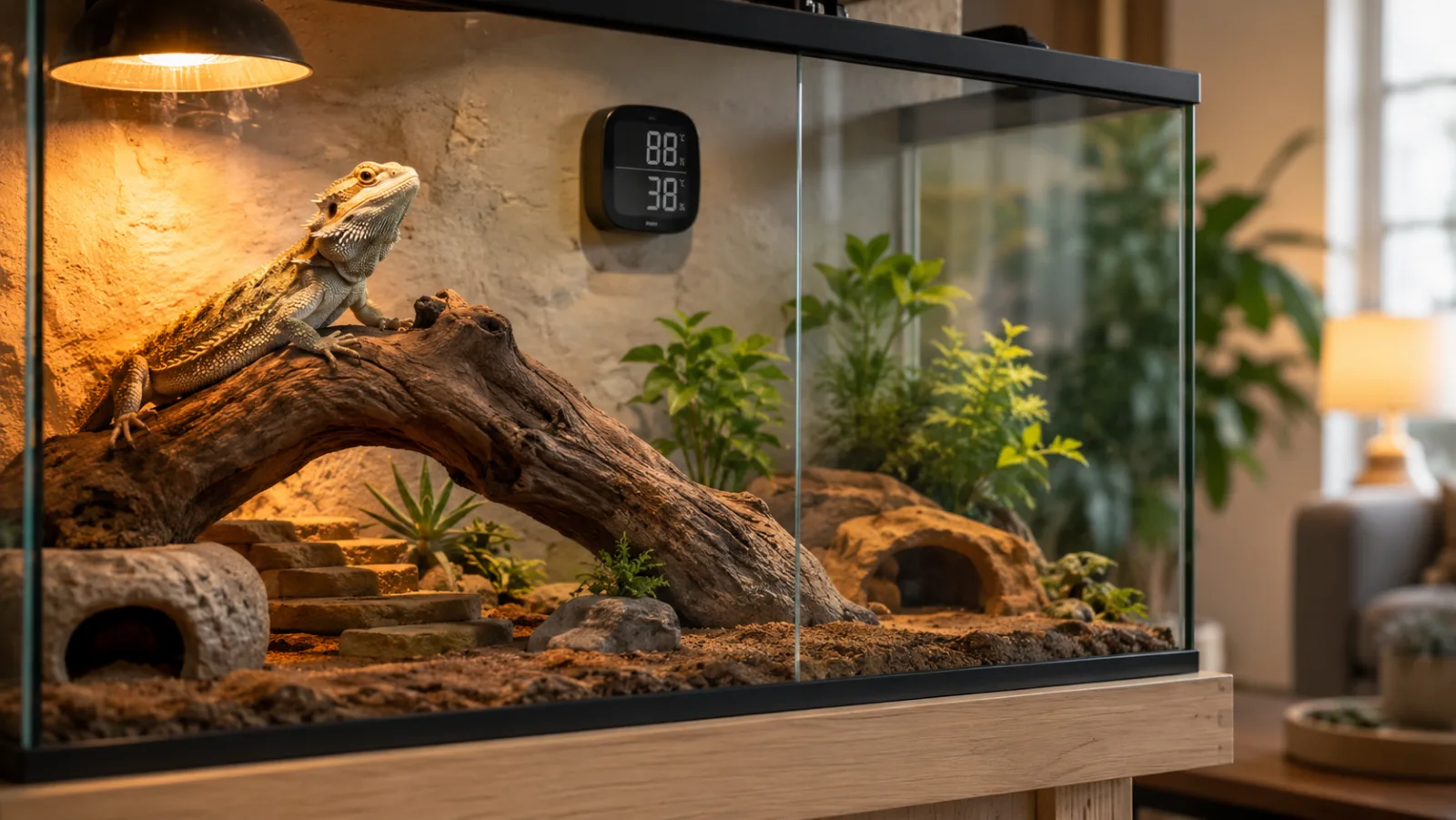
Evidence at a Glance
Govee H5075 Bluetooth Hygrometer Thermometer
±0.54°F and ±3% RH rated accuracy from a Swiss-made sensor, 2-second refresh, Bluetooth app history with 2 years of free data storage, and in-app calibration offsets — the data-logging default that reptile forums recommend for ambient enclosure monitoring.
Sources: FrogPets combo-gauge review, Our Reptile Forum standing recommendation, Govee manufacturer spec sheet
Verified Jun 10, 2026
Inkbird IBS-TH2 Plus with External Probe
External temperature probe drops into a warm hide or onto substrate while the unit body reads ambient air — one device covering both ends of the thermal gradient, with 30,000 on-device data points and user calibration for temperature and humidity.
Sources: Inkbird manufacturer documentation, MorphMarket Reptile Community threads, Tortoise Forum calibration discussion
Verified Jun 10, 2026
ThermoPro TP49 Digital Hygrometer Thermometer
Around $10 per unit with a 10-second refresh, bold LCD digits on a mini footprint, and three mounting options — the cheapest reliable digital gauge for keepers monitoring several enclosures at once.
Sources: The Vet Desk reptile thermometer ranking, Home Depot owner accuracy reports
Verified Jun 10, 2026
Our Picks
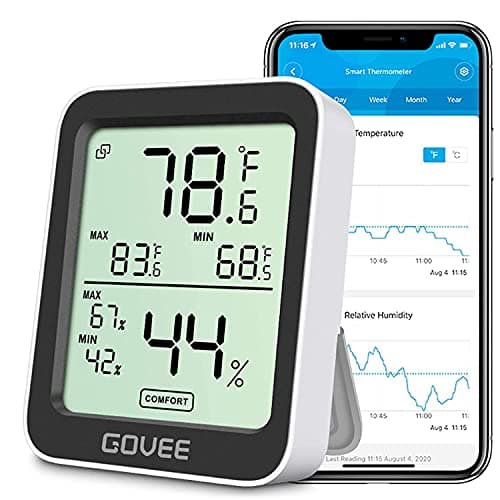
Govee
Govee Digital Hygrometer Indoor Thermometer H5075, Bluetooth Temperature Humidity Meter
9.1 / 10
- Rated accuracy of ±0.54°F temperature and ±3% RH humidity from a Swiss-made sensor
- Bluetooth app control with up to 164 ft range and notification alerts
- 2-second sensor refresh rate for near-instant readings
- 2 years of free data storage with history export from the Govee Home app
$12.99
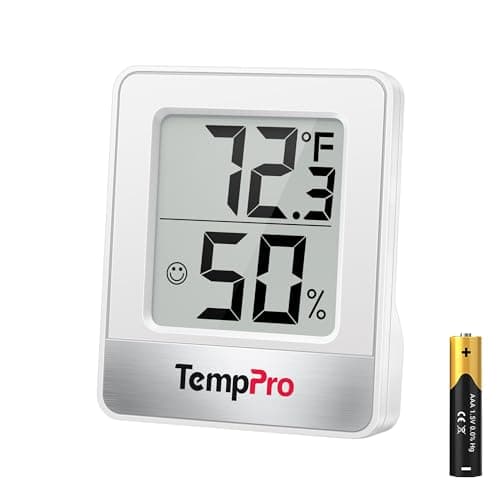
ThermoPro (TempPro)
TempPro TP49 Digital Hygrometer Indoor Thermometer Humidity Meter (Previously ThermoPro)
8.3 / 10
- 10-second sensor refresh for near-real-time readings
- Large bold LCD digits on a mini footprint that tucks into small enclosures
- Face-icon comfort indicator flags dry, comfortable, or wet conditions at a glance
- Three mounting options: tabletop stand, magnetic back, and hanging hole
$8.99
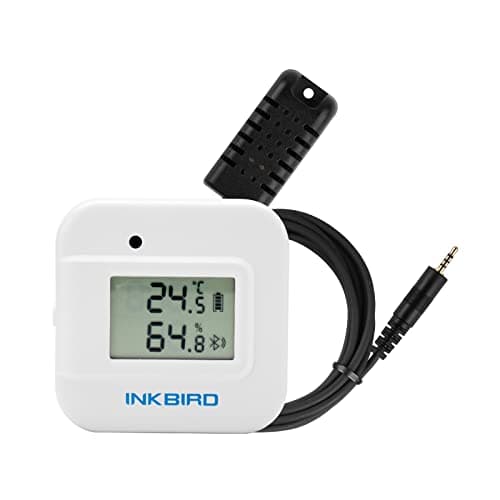
Inkbird
Inkbird IBS-TH2 Plus Smart Thermometer and Humidity Monitor with External Temperature Probe
8.7 / 10
- External temperature probe — drop it into a warm hide or onto substrate while the body reads ambient
- Stores up to 30,000 data points on-device for app export
- Bluetooth remote monitoring up to 98 ft
- User calibration supported for both temperature and humidity readings
$23.99
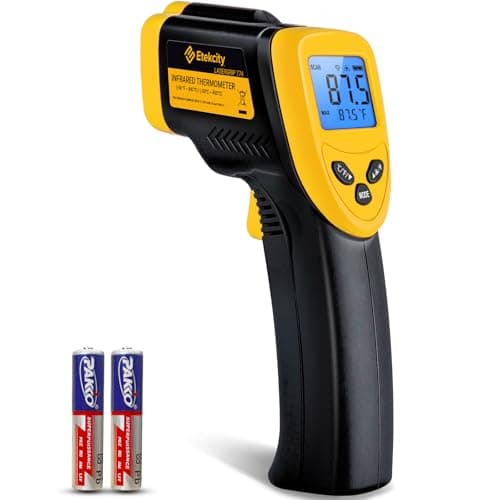
Etekcity
Etekcity Lasergrip 774 Infrared Thermometer Laser Temperature Gun
8.5 / 10
- Non-contact infrared readings of actual surface temperature — the number a basking reptile's belly experiences
- Adjustable emissivity for accurate readings across glass, slate, wood, and substrate surfaces
- Max-measure function captures the peak temperature while sweeping across a basking zone
- Laser-targeted aiming makes spot checks take seconds, with no enclosure hardware installed
$18.99
The Short Answer
Digital monitoring beats analog in every keeper community we surveyed. Reptile Forums UK members measured analog gauges reading 20 to 25 points low, which is a husbandry failure waiting to happen. The Govee H5075 at $12.99 is the default pick. It pairs ±0.54°F and ±3% RH rated accuracy with Bluetooth data history and the in-app calibration that keepers cite as its edge over rivals. The ThermoPro TP49 at $8.99 is the value gauge for multi-enclosure racks, and it is the cheapest thing here that reads true. The Etekcity 774 infrared gun at $18.99 is the basking-surface spot-checker the others cannot replace. Whatever you choose, the rule stands: thermostats control heat, but thermometers verify it.
Every product on this list has been scored against the PetPal Gear Score, a weighted composite of expert consensus, observed effectiveness, animal safety, long-term durability, and value. Review method: Editorial synthesis of ReptiFiles equipment guidance, FrogPets combo-gauge reviews, The Bio Dude material on probe and sensor placement, and The Vet Desk reptile thermometer rankings. Keeper consensus drawn from Tortoise Forum, MorphMarket Reptile Community, Our Reptile Forum, and Reptile Forums UK calibration threads. Manufacturer documentation from Govee, ThermoPro, and Etekcity was reviewed for rated accuracy and feature claims. Owner sentiment from Amazon, Home Depot reviews, r/ballpython, and r/reptiles informed pick selection. PetPalHQ does not run a terrarium testing lab.. Synthesized from 7+ expert sources.
Monitoring gear is the cheapest equipment in the reptile hobby and the most consequential. A $12.99 gauge decides whether a ball python sheds in one piece, whether a bearded dragon's basking slate is a comfort or a burn hazard, and whether the humidity number you husbanded toward all month was ever real. The gear itself is low-risk; the readings are not.
PetPalHQ.com earns affiliate commissions from qualifying purchases; commission rates never influence our picks. We read 7 expert sources for this guide, from ReptiFiles equipment guidance and FrogPets gauge reviews to the calibration threads on Tortoise Forum and Reptile Forums UK, and we checked every accuracy claim against manufacturer spec sheets and owner reports. We do not test instruments ourselves — every claim below traces to a named source.
The 2026 field sorts into two sensor architectures, and most enclosures want one of each. Ambient combo units are the workhorses: the Govee H5075 pairs a ±3% RH rated sensor with Bluetooth history and in-app calibration, while the ThermoPro TP49 strips the concept to an $8.99 glance-and-go gauge for multi-enclosure racks. Both read the air where they sit, which is the right question for humidity and overall enclosure climate and the wrong one for a hot spot. If you are still building the heating side of the enclosure, our reptile thermostats guide covers the regulation half of the equation.
The second architecture is the infrared spot-checker, and it earns the specialist slot for a reason mounted gauges cannot answer. The Etekcity 774 reads the actual surface temperature of a basking platform — the number a reptile's belly experiences — which is why keeper forums treat a temp gun as the reference instrument their mounted gauges get validated against. Keepers running high-humidity setups should also read our misting and fogging systems guide, because the moisture those systems produce is both the thing you are measuring and the thing that eventually kills cheap sensors. A note on ordering: we rank by sensor architecture and buyer fit — not by raw PetPal Gear Score — so a specialist pick serving a specific measurement question can outscore picks ranked above it.
Ambient or Infrared: Match the Sensor to the Question
Every device in this guide answers a different question, and buying the wrong type leaves the real question unanswered. The Bio Dude's placement principle is the organizing idea: probe and sensor placement determines whether readings reflect what the animal actually experiences, and a fixed ambient sensor cannot capture basking-surface temperature no matter how accurate it is.
An ambient unit like the Govee H5075 or TP49 answers "what is the air doing where the unit sits" — the right question for humidity management and overall enclosure climate, and the wrong one for a hot spot. Neither reaches inside a warm hide, which is where a thick-bodied snake actually spends its day; for that you need a separate probe thermostat or a spot check. An infrared gun answers "what is this exact surface right now" — the burn-prevention question, and per Our Reptile Forum practice, the accuracy-audit question for everything else you have mounted.
The practical build for most keepers is one mounted unit per enclosure plus one shared temp gun for the whole collection. A single Lasergrip 774 services every basking surface in the house in a few seconds each, while per-enclosure gauges like the Govee H5075 do the continuous watching.
Why Wrong Readings Are an Animal-Safety Issue
The safety hazard in this category is not the hardware — it is believing a number that is false. Two documented failure patterns from our sources show what that costs, and both argue for digital instruments with calibration support.
The first is analog drift. Reptile Forums UK keepers measured Exo Terra analog gauges reading 20 to 25 points low against calibrated instruments. One royal python sat at an actual 90 percent humidity while the dial showed 70 — a genuine respiratory-infection risk the keeper could not see. The inverse error runs the enclosure too dry and produces stuck sheds in humidity-dependent species. The community verdict was that digital units are much, much better, and our scoring reflects it: no analog dial can pass the accuracy factor.
The second is the unverified hot spot. Thermostats control heat sources, but thermometers verify them — never run a heat mat or basking lamp on thermostat trust alone. Contact surfaces routinely run hotter than what ambient sensors report, and that gap is the classic cause of thermal burns. The fix costs $18.99: sweep the basking zone with the Etekcity 774 and compare the surface peak against your thermostat's setpoint. Species targets make the stakes concrete, because a single safe number does not exist — a ball python enclosure should hold roughly 60 to 80 percent humidity, while a bearded dragon needs the opposite climate at 20 to 35 percent with a basking surface in the 90 to 115°F range. The same gauge serves both keepers; only the verified number tells them apart.
Placement is the last safety variable. Keep sensor bodies, cords, and battery compartments out of the animal's reach, and mount units away from direct misting-system spray — condensation soak degrades the non-waterproof housings every pick here uses.
What We Passed On
The Zoo Med Labs TH-31 combo gauge was the hardest cut. FrogPets named it a top all-around combo, and its temperature probe checks out against temp guns. We passed because the owner complaints about the humidity side are too consistent to ignore: reports of the gauge sticking at 10 percent RH no matter how high a fogger ran, spiking to 99 percent when condensation forms on the probe, and a humidity probe that is not waterproof in a device aimed at misted enclosures. Half a combo gauge working is not enough.
The Exo Terra analog thermo-hygrometer stands in for analog dials generally, and this is less a pass than a warning. Reptile Forums UK keepers measured these gauges 20 to 25 points off, the failure that left a royal python near 90 percent actual humidity under a dial reading 70. Analog dials are the one product class in this category we recommend actively replacing, including the ones bundled free with starter kits — an $8.99 TP49 outperforms every dial we found documentation on.
Head-to-Head Comparison
| Feature | Govee Digital Hygrometer Indoor Thermometer H5075, Bluetooth Temperature Humidity Meter | TempPro TP49 Digital Hygrometer Indoor Thermometer Humidity Meter (Previously ThermoPro) | Inkbird IBS-TH2 Plus Smart Thermometer and Humidity Monitor with External Temperature Probe | Etekcity Lasergrip 774 Infrared Thermometer Laser Temperature Gun |
|---|---|---|---|---|
| Price | $11.69 | $8.99 | $23.99 | $18.99 |
| Pick category | Best overall | Best value | Best for data logging & probe placement | Specialist (basking-surface spot checks) |
| Terrarium Truth Score | 9.1 | 8.3 | 8.7 | 8.5 |
| Check price | Amazon | Amazon | Amazon | Amazon |
$12.99
- Rated accuracy of ±0.54°F temperature and ±3% RH humidity from a Swiss-made sensor
- Bluetooth app control with up to 164 ft range and notification alerts
- 2-second sensor refresh rate for near-instant readings
- 2 years of free data storage with history export from the Govee Home app
- In-app user calibration: up to ±5.4°F temperature and ±20% RH humidity offset
The Govee H5075 is the editorial pick for the keeper who wants to know what the enclosure is doing when nobody is watching it. FrogPets selected this unit for exactly that reader — the terrarium keeper who loves data. The Bluetooth app history shows how humidity moves after misting, overnight, and during the workday. A single glance at a gauge tells you the conditions right now. The H5075's two years of free data storage tells you whether the morning misting spike actually holds until evening. That is the question that determines shed quality in humidity-dependent species like ball pythons.
The accuracy spec is the foundation. Govee rates the Swiss-made sensor at ±0.54°F for temperature and ±3% RH for humidity, with a 2-second refresh rate. Just as important is the in-app calibration. The Govee Home app accepts user offsets up to ±5.4°F and ±20% RH, so a unit that drifts can be corrected against a reference rather than replaced. Tortoise Forum keepers cite that calibration support as the deciding advantage in side-by-side comparisons against rival gauges. One keeper described Govees as solid while the rivals needed constant fiddling. Our Reptile Forum treats the Govee as the standing recommendation for ambient temperature and humidity inside an enclosure.
Here's the honest trade-off: there is no external probe. The H5075 reads the air where it sits, which means it cannot report warm-hide surface temperature or substrate temperature — readings The Bio Dude flags as the ones the animal actually experiences. Connectivity is Bluetooth only, with roughly 164 feet of range, so alerts stop once you leave the house; remote monitoring requires stepping up to a pricier WiFi model. The housing is not waterproof, and heavy misting or fogger condensation can degrade the sensor over time. The on-device LCD shows current readings only — trends, alerts, and calibration all live in the app.
What We Love
- ±0.54°F / ±3% RH rated accuracy at a $12.99 price
- Two years of free humidity and temperature history with export
- In-app calibration offsets keep an aging sensor honest
- Standing recommendation across multiple reptile-keeper forums
- 2-second refresh shows misting response in near-real time
What Could Be Better
- No external probe — reads ambient air only, not warm-hide or substrate surfaces
- Bluetooth-only range (~164 ft) means no alerts once you leave the house
- Housing is not waterproof; fogger condensation can degrade the sensor over time
- Trends, alerts, and calibration all require the Govee Home app
The Verdict
Buy the Govee H5075 as the primary ambient monitor in almost any enclosure. Pair it with an infrared gun for basking surfaces, because no ambient unit can report what the hot spot is doing.
Sources
- FrogPets: picked the Govee H5075 for 'the terrarium keeper who loves data' — the Bluetooth app history shows exactly how humidity fluctuates after misting, overnight, or while you're at work
- Our Reptile Forum: the Govee thermometer/hygrometer is the standing recommendation for monitoring ambient temps and humidity inside an enclosure
- Tortoise Forum keepers: Govee units are calibratable in-app — cited as the key advantage in side-by-side comparisons against rival units; one keeper described Govees as 'solid' while the rivals needed constant fiddling
- Govee (manufacturer spec sheet): ±0.54°F / ±3% RH rated accuracy with 2-second refresh and in-app calibration range of ±5.4°F / ±20% RH
ThermoPro (TempPro) TempPro TP49 Digital Hygrometer Indoor Thermometer Humidity Meter (Previously ThermoPro)
$8.99
- 10-second sensor refresh for near-real-time readings
- Large bold LCD digits on a mini footprint that tucks into small enclosures
- Face-icon comfort indicator flags dry, comfortable, or wet conditions at a glance
- Three mounting options: tabletop stand, magnetic back, and hanging hole
- Under $10 per unit — the cheapest reliable digital option for multi-enclosure setups
The ThermoPro TP49 is the pick for keepers who need accurate numbers in several enclosures at once and would rather not pay app-logger prices four times over. At $8.99 per unit, a four-enclosure rack comes to about $36 — less than three Govees. The Vet Desk ranked the TP49 among the best reptile thermometers and hygrometers on the strength of its accurate sensor and 10-second refresh. Owner data backs the consistency claim. Home Depot reviewers running two TP49 units side by side found they tracked within 1°F of each other and read considerably more accurate than hardware-store alternatives.
The physical design earns its place in a terrarium context. The mini footprint tucks into small enclosures without dominating the view, the bold LCD digits read from across the room, and the three mounting options — tabletop stand, magnetic back, and hanging hole — cover glass tanks, PVC enclosures, and rack tubs without extra hardware. The face-icon comfort indicator is built for living rooms rather than vivariums, but it works as a fast visual flag that conditions have moved out of the normal band before you read the actual digits.
Here's the honest trade-off, and it is a structural one: the TP49 has no app, no logging, and no alerts. You know the conditions at the moment you look at the screen and at no other moment. An overnight humidity crash that resolves by morning is invisible to this gauge, where the Govee H5075 would have the whole curve on a chart. The Vet Desk also cautioned that the compact screen gets hard to read through condensation-covered glass, and that the unit is designed for general home use — its longevity inside a constantly humid tropical terrarium is a known concern. There is no external probe either, so basking-spot and substrate temperatures remain out of reach.
What We Love
- Cheapest reliable digital gauge in the category at $8.99
- Owner-reported unit-to-unit consistency within 1°F
- Three mounting options fit glass tanks, PVC enclosures, and rack tubs
- Bold LCD digits read clearly at a distance
What Could Be Better
- No app, no logging, no alerts — readings exist only while you are looking
- Small screen is hard to read through glass with condensation on it
- Built for general indoor use; durability in constantly humid terrariums is a known concern
- No external probe, so it cannot measure basking-spot or substrate temperatures
The Verdict
Buy TP49 units in multiples for rack setups and dry-species enclosures where a glance is enough. Keepers of high-humidity species should spend the extra $4 on the Govee and get the history and alerts instead.
Sources
- The Vet Desk: ranked the TP49 among the best reptile thermometers and hygrometers, praising the accurate sensor and 10-second refresh
- Home Depot owner reviews: two TP49 units tracked within 1°F of each other and were considerably more accurate than hardware-store alternatives
- The Vet Desk: cautioned that the compact screen can be hard to read in a tank filled with condensation, and that the unit is designed for general home use rather than constant terrarium humidity
Inkbird Inkbird IBS-TH2 Plus Smart Thermometer and Humidity Monitor with External Temperature Probe
$23.99
- External temperature probe — drop it into a warm hide or onto substrate while the body reads ambient
- Stores up to 30,000 data points on-device for app export
- Bluetooth remote monitoring up to 98 ft
- User calibration supported for both temperature and humidity readings
- Built-in magnetic mount plus LCD showing temp, humidity, Bluetooth signal, and battery level
The Inkbird IBS-TH2 Plus solves the problem every ambient-only gauge shares: a thermal gradient has two ends, and a sensor can only sit at one of them. The Plus version ships with an external temperature probe. The standard deployment puts the unit body on the cool side reading ambient air and humidity while the probe lies inside the warm hide or on the basking substrate. One device, both ends of the gradient — that editorial fit is why it takes this slot despite costing nearly twice what the Govee H5075 does.
The brand carries real standing with the keepers who depend on stable heat most. Inkbird sells the IBS-TH2 line under a dedicated reptile collection. MorphMarket Reptile Community boa and snake breeders run dedicated threads vetting Inkbird gear — an established name in rooms full of high-value animals. The spec sheet is genuinely strong for $23.99: up to 30,000 data points stored on the device for app export, Bluetooth range to 98 feet, user calibration for both temperature and humidity, and a magnetic mount behind an LCD that shows readings, signal, and battery at once.
Here's the honest trade-off cluster. The included probe measures temperature only — humidity is still read at the unit body, so a humid hide cannot be probed separately. Calibration support is real but imperfect. Tortoise Forum keepers confirm the correction value works, yet some found their readings stayed slightly off even after applying the offset. That residual drift is part of why the Govee outranks it overall. Connectivity is Bluetooth-only unless you add an Inkbird WiFi gateway or step up to a WiFi model, so there are no away-from-home alerts out of the box. And the app holding all that history is, by common report, less polished than Govee's. None of these flaws touch the probe-placement advantage, which no other pick here offers at this price.
What We Love
- External probe covers warm-hide or substrate temperature while the body reads ambient
- 30,000 on-device data points survive Bluetooth dropouts until export
- User calibration supported for both temperature and humidity
- Established reputation among MorphMarket breeders and Inkbird's dedicated reptile line
What Could Be Better
- Included probe reads temperature only — humidity stays at the unit body
- Some Tortoise Forum keepers report readings slightly off even after calibration
- Bluetooth-only without a separately purchased WiFi gateway — no remote alerts
- App is less polished than Govee's for history and alert management
The Verdict
Buy the IBS-TH2 Plus when warm-hide or substrate temperature matters as much as ambient — thick-bodied snakes and burrowing species are the obvious cases. Accept a rougher app in exchange for the probe.
Sources
- Inkbird (manufacturer): the IBS-TH2 line is sold under a dedicated reptile collection, supports accuracy calibration, stores up to 30,000 data points, and reaches up to 98 ft over Bluetooth
- MorphMarket Reptile Community: boa and snake keepers run dedicated threads vetting Inkbird thermostats and hygrometers — it's an established name among breeders
- Tortoise Forum: Inkbird units include a correction value to adjust readings up or down, though some keepers found theirs read slightly off even after calibration
- Editorial fit: pairing the probe in the warm hide with the body on the cool side covers both ends of the thermal gradient with one device
$18.99
- Non-contact infrared readings of actual surface temperature — the number a basking reptile's belly experiences
- Adjustable emissivity for accurate readings across glass, slate, wood, and substrate surfaces
- Max-measure function captures the peak temperature while sweeping across a basking zone
- Laser-targeted aiming makes spot checks take seconds, with no enclosure hardware installed
- Named by ReptiFiles as a good infrared thermometer for reptile keeping
The Etekcity 774 answers the question no mounted gauge can: how hot is the surface the animal is actually lying on? The Bio Dude's placement guidance is blunt on this point. A fixed ambient sensor cannot capture basking-surface temperature, because probe and sensor placement determines whether readings reflect what the animal experiences. Contact surfaces that run hotter than ambient sensors report are the classic cause of thermal burns. An infrared gun is the only pick in this guide that measures that risk directly. ReptiFiles names the Etekcity 774 specifically as a good infrared thermometer for reptile keeping, alongside its broader guidance that probe-based devices are among the most accurate ways to track enclosure conditions.
The feature set maps cleanly onto terrarium work. Adjustable emissivity matters because glass, slate, wood, and substrate each reflect infrared differently. A fixed-emissivity gun reads some of those surfaces wrong, while the Lasergrip 774 can be tuned per material. The max-measure function captures the peak while you sweep the beam across a basking zone, which finds the hottest point of an uneven slate pile in one pass. Laser aiming makes the whole check a seconds-long routine with zero hardware mounted inside the enclosure. Keepers on Our Reptile Forum routinely validate their mounted digital gauges against a temp gun — in that community, the IR reading is the reference the others get judged against.
Here's the honest trade-off: this is a complement, never a replacement. It reads surface temperature only — no humidity, no ambient air — and infrared readings of air or water are unreliable by physics, so it is strictly a surfaces tool. It logs nothing and alerts on nothing, which means it cannot warn you about an overnight temperature crash the way the Govee H5075 can. And the cooking-oriented branding with bright yellow housing is pure function over terrarium aesthetics.
What We Love
- Reads actual basking-surface temperature — the thermal-burn variable mounted gauges miss
- Adjustable emissivity stays accurate across glass, slate, wood, and substrate
- Max-measure sweep finds the hottest point of a basking zone in one pass
- The reference tool keeper forums use to validate their mounted gauges
What Could Be Better
- Surface temperature only — no humidity and no ambient air monitoring
- Spot-check tool with zero logging; it cannot catch an overnight crash
- Useless for air or water readings by the physics of infrared measurement
- Cooking-oriented branding and bright yellow housing clash with display enclosures
The Verdict
Buy the Lasergrip 774 as the second instrument in any basking-species setup — bearded dragons especially. It verifies the one number that causes burns, and nothing mounted in the enclosure can.
Sources
- ReptiFiles: recommends the Etekcity 774 as a good infrared thermometer, alongside its guidance that probe-based devices are among the most accurate ways to track enclosure conditions
- Our Reptile Forum: keepers routinely validate their mounted digital gauges against a temp gun — an IR gun is the reference check the community trusts
- The Bio Dude: probe and sensor placement determines whether readings reflect what the animal actually experiences — a fixed ambient sensor cannot capture basking-surface temperature, which is the IR gun's job
How We Score
Formula
Terrarium Truth Score = (Reading Accuracy × 0.35) + (Placement & Coverage × 0.25) + (Data, Alerts & Calibration × 0.25) + (Humid-Enclosure Survivability × 0.15)
Score Factors
- Reading Accuracy · 35%
- How close the displayed number sits to reality, weighted heaviest because every husbandry decision depends on it. Manufacturer-rated tolerances anchor the factor, and the Govee's ±0.54°F and ±3% RH rating is the strongest documented spec in this field. Owner-measured consistency reports refine it, like the Home Depot reviewers who found two TP49 units tracking within 1°F. Reptile Forums UK keepers measured analog dials reading 20 to 25 points low against calibrated instruments. That drift is why no analog gauge can score competitively in this factor.
- Placement & Coverage · 25%
- Whether the device can measure the location that matters to the animal, per The Bio Dude's principle that sensor placement determines whether readings reflect what the animal actually experiences. A mounted unit can only report the air where it sits, so none of the picks here reach inside a warm hide on their own. Infrared guns score highest for basking surfaces, since contact surfaces hotter than ambient sensors report are the classic cause of thermal burns. Ambient-only units score lowest because they report one point of air and nothing else.
- Data, Alerts & Calibration · 25%
- Whether the device tells you about conditions you did not personally witness, and whether a drifting sensor can be corrected. Logging depth counts — two years of exportable history on the Govee is the benchmark the rest of the field is measured against. Threshold alerts and user-calibration range count too. Tortoise Forum keepers treat in-app calibration as the deciding feature in side-by-side comparisons, because an uncorrectable gauge that drifts becomes landfill. Glance-only gauges like the TP49 score low here by design, not by defect.
- Humid-Enclosure Survivability · 15%
- How long the device keeps reading true inside a misted, fogged, or tropical enclosure. None of the picks carry waterproof housings, so the factor rewards designs that tolerate condensation cycles and penalizes known failure patterns. The Vet Desk flags constant terrarium humidity as a longevity concern for home-oriented gauges. The passed-on Zoo Med combo unit shows what failure looks like when a humidity probe meets a fogger. Spot-check tools that live outside the enclosure, like an infrared gun, sidestep the hazard entirely.
| Rank | Product | Score |
|---|---|---|
| #1 | Govee Govee Digital Hygrometer Indoor Thermometer H5075, Bluetooth Temperature Humidity Meter | 9.1 |
| #2 | Inkbird Inkbird IBS-TH2 Plus Smart Thermometer and Humidity Monitor with External Temperature Probe | 8.7 |
| #3 | Etekcity Etekcity Lasergrip 774 Infrared Thermometer Laser Temperature Gun | 8.5 |
| #4 | ThermoPro (TempPro) TempPro TP49 Digital Hygrometer Indoor Thermometer Humidity Meter (Previously ThermoPro) | 8.3 |
When NOT to Buy
Skip the app-connected tier if you will never open the app. The Govee earns its top slot through history, alerts, and calibration — features that live entirely in its phone app. A keeper who only ever glances at the on-device LCD is paying for a data logger and using an $8.99 gauge. Buy the ThermoPro TP49 instead and put the difference toward a second unit.
Skip Bluetooth models entirely if you need alerts while away from home. The Govee is Bluetooth-only, with roughly 164 feet of range, and it sends no notification once you are out of it. Keepers of incubators or high-value collections who travel should budget for a WiFi-capable model or an added gateway instead, which costs more than anything on this page.
Do not buy any of these as a substitute for a thermostat. A thermometer verifies; it controls nothing. A heat mat or basking lamp running without a thermostat is a burn and fire hazard no matter how accurate the gauge beside it reads. Set up regulation first, then add verification — never run a heat source on thermostat trust alone, either.
Skip the infrared gun as a sole instrument. It reads surfaces only, by physics — no humidity, no air temperature, no logging — so a Lasergrip 774 without a mounted hygrometer leaves you blind on the variable that drives sheds and respiratory health in humidity-dependent species.
Finally, skip mounting any of the electronic units in the spray path of a misting system or directly over a fogger outlet. None of the housings are waterproof, and repeated condensation soak is the documented failure mode for sensors in this category. Mount the unit away from direct spray, and keep sensor bodies, cords, and battery compartments out of the animal's reach.
Frequently Asked Questions
- Should I trust the analog gauge that came with my terrarium kit?
- No. Reptile Forums UK keepers measured Exo Terra analog gauges reading 20 to 25 points low against calibrated instruments, and the community verdict is that digital units are much, much better. The documented case is sobering: a royal python held near an actual 90 percent humidity while the dial showed 70, a real respiratory-health risk. Drift that large makes husbandry decisions worse than guessing, because the number looks authoritative. Replace bundled dials with any digital pick in this guide — the ThermoPro TP49 costs $8.99 and ends the problem.
- Where should I place thermometer and hygrometer sensors in a terrarium?
- Place them where the animal lives, not where the cord is convenient. The Bio Dude's principle is that sensor placement determines whether readings reflect what the animal actually experiences. The standard layout puts an ambient unit like the Govee H5075 at mid-height on the cool side, away from direct misting spray. If you run a thermostat with an external probe, that probe belongs inside the warm hide or on the heated substrate. Basking-surface temperature cannot be measured by any mounted sensor — sweep it with an infrared gun instead. Keep all sensor bodies, cords, and battery compartments out of the animal's reach.
- What humidity does a ball python need compared with a bearded dragon?
- Roughly opposite climates, which is why a single "reptile-safe" number does not exist. A ball python enclosure should hold about 60 to 80 percent relative humidity for healthy sheds and respiratory function. A bearded dragon should stay near 20 to 35 percent humidity with a basking surface in the 90 to 115°F range. Every guide section and every alert threshold you set should start from your species' documented range, and the monitoring gear simply tells you the truth about where you are inside it.
- Can I use a regular indoor hygrometer like a Govee in a reptile tank?
- Yes — the Govee H5075 is a general indoor unit, and it is also the standing recommendation on Our Reptile Forum for monitoring ambient temperature and humidity inside an enclosure. The rated accuracy of ±0.54°F and ±3% RH outperforms most reptile-branded gauges, and the in-app calibration keeps it correctable as it ages. The caveats are environmental. The housing is not waterproof, so heavy misting or fogger condensation can degrade the sensor over time. Longevity in constantly humid tropical setups is a known concern for home-oriented gauges generally. Mount it out of the spray path and it serves well.
- Do I need a thermometer if my heat source already has a thermostat?
- Yes, and treating the two as interchangeable is the most common monitoring mistake we found across our sources. A thermostat controls the heat source; an independent thermometer verifies that the control is doing what the dial claims. Never run a heat mat or basking lamp on thermostat trust alone — a failed or misplaced thermostat probe reads fine while the enclosure does not. Surface temperatures add a second gap: contact surfaces hotter than what ambient sensors report are the classic cause of thermal burns, which is why keepers spot-check basking zones with an infrared gun like the Etekcity 774 rather than trusting any single mounted number.
Bottom Line
Start with the Govee H5075 at $12.99 for almost any enclosure. The rated accuracy, two years of exportable history, and in-app calibration make it the default ambient monitor that keeper forums already recommend.
Pick the ThermoPro TP49 at $8.99 per unit when you are outfitting a rack of enclosures and accept glance-only monitoring with no logging or alerts.
Add the Etekcity 774 infrared gun at $18.99 to any basking-species setup. Surface temperature is the thermal-burn variable, and no mounted gauge can measure it.
Throw away the analog dial that came with your kit. Reptile Forums UK keepers measured analog gauges reading 20 to 25 points low — one royal python sat at an actual 90 percent humidity while the dial showed 70.
For a species where the humidity band is the whole game, our ball python enclosure guide builds the husbandry around a dual thermometer-hygrometer and a humid hide from day one.
Sources & Methodology
Methodology
Terrarium Truth Score = (Reading Accuracy × 0.35) + (Placement & Coverage × 0.25) + (Data, Alerts & Calibration × 0.25) + (Humid-Enclosure Survivability × 0.15)
Expert review sources
- ReptiFiles — infrared thermometer recommendation and enclosure-monitoring equipment guidance
- FrogPets — combo gauge reviews and the data-logging case for Bluetooth hygrometers
- The Bio Dude — probe and sensor placement principles for readings the animal actually experiences
- The Vet Desk — reptile thermometer and hygrometer rankings, including TP49 evaluation
- Tortoise Forum — Govee hygrometer calibration comparisons from working keepers
- Our Reptile Forum — standing Govee recommendation and temp-gun validation practice
- Reptile Forums UK — measured analog-gauge drift of 20 to 25 points against calibrated instruments
Community sources
- r/ballpython and r/reptiles community discussion on humidity monitoring and probe placement
- Amazon and Home Depot owner reviews on unit-to-unit accuracy consistency and condensation durability
- Manufacturer documentation — Govee, ThermoPro, and Etekcity spec sheets
Prices and specs verified June 10, 2026.
About the author
Nick Miles is the chief editor of PetPalHQ. The picks above are editorial synthesis of herpetological care references, manufacturer specifications, and verified keeper-community sentiment. PetPalHQ does not run a terrarium testing lab. The Terrarium Truth Score is a composite of expert opinion and documented design factors, not a measurement.
PetPalHQ is a participant in the Amazon Services LLC Associates Program. We may earn commissions from qualifying purchases — at no extra cost to you.
More Guides
Reptile
Best Reptile Thermostats for Heat Mats, CHEs & Heating Elements (2026)
Reptile
Best Reptile Misting and Fogging Systems for Humidity Control (2026)
Reptile
Best Reptile UVB Bulbs for Safe Lighting (2026)
Reptile
Reptile Habitat Setup and Environmental Control: 2026 Guide for Heat, Humidity, and Safety
Reptile