Reptile
Reptile Habitat Setup and Environmental Control: 2026 Guide for Heat, Humidity, and Safety
How to design heat gradients, humidity zones, and safe enclosure controls for bearded dragons, geckos, snakes, and tortoises — synthesized from veterinary and university references.
By Nick Miles · Updated May 5, 2026 · 18 min read
PetPalHQ is reader-supported. We may earn a commission from qualifying Amazon purchases at no extra cost to you.
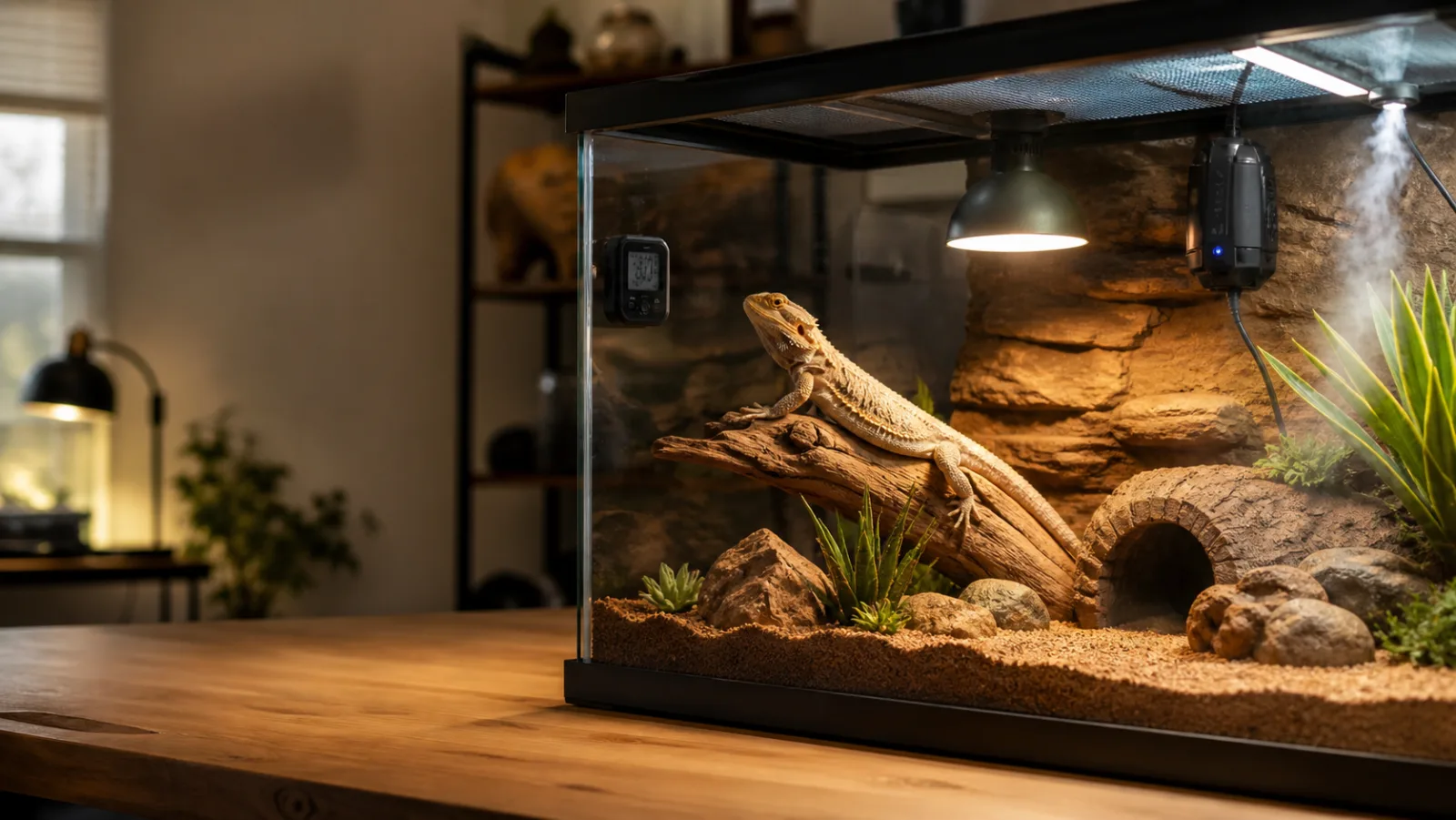
Every product on this list has been scored against the PetPal Gear Score, a weighted composite of expert consensus, observed effectiveness, animal safety, long-term durability, and value. Review method: Editorial synthesis of veterinary, university, hospital, and welfare guidance. Sources include the Merck Veterinary Manual, NC State CVM Hospital, UC Davis CVET, Bowling Green State University Herpetarium, RSPCA, World Wildlife Fund, and VCA Animal Hospitals. Public-safety references for fire and electrical risk were also consulted. No first-hand product testing.. Synthesized from 8+ expert sources.
A heat lamp on its own is not a habitat. The Merck Veterinary Manual, the NC State College of Veterinary Medicine teaching hospital, and the UC Davis CVET exotics care guide all converge on a single core idea: reptiles regulate their body temperature behaviorally, which means the enclosure must offer real options — warmer and cooler areas, drier and more humid zones, and day-night shifts that match the species. Without those options, the animal cannot self-regulate the way it would under sunlight.
This guide synthesizes the consensus across veterinary references, university hospital care sheets, and welfare publications for the questions every new keeper has to answer: how to build a thermal gradient, how to manage humidity without causing mold, how to measure and verify what the animal is actually experiencing, and how to avoid the burn, overheating, and ventilation mistakes that authoritative sources name repeatedly. PetPalHQ does not run a testing lab — the recommendations below are editorial synthesis of expert guidance, with sources cited by name throughout.
Why do reptile temperature gradients matter?
Reptiles are ectotherms. The Merck Veterinary Manual is direct: they depend on environmental temperature and behavior to stay within a species-specific preferred optimal temperature zone (POTZ). Inside that zone the animal can digest, move, fight off pathogens, and shed normally. Push the temperature too far in either direction for too long and those processes degrade — appetite drops, immunity falls, and shedding fails.
A useful one-line definition: a reptile enclosure should never have one uniform temperature. Veterinary, university, and welfare sources repeatedly recommend a warm end and a cool end so the animal can pick conditions that fit basking, resting, digestion, and hydration needs. This is the single most-cited husbandry rule in the source set.
Three numbers describe a healthy reptile enclosure, and they are not interchangeable:
- Ambient air temperature gradient — the range of air temperatures across the enclosure, warm side to cool side.
- Basking-zone temperature — the surface temperature on the platform or branch directly under the heat source. The Merck Veterinary Manual's husbandry table notes that basking temperatures generally run about 5°C (roughly 9°F) higher than the air gradient itself.
- Nighttime minimum — the temperature the enclosure is allowed to fall to after dark, which the same Merck reference frames as roughly 5°C below the daytime gradient for many species.
For aquatic turtles, water temperature is a fourth, separate variable. The World Wildlife Fund's red-eared slider assessment and the Merck Veterinary Manual both treat the dry basking dock as a distinct zone from the water itself.
How do you heat a reptile enclosure safely?
There is no single "best" reptile heating device. The UC Davis CVET feeding guide and Merck both frame the right approach as matching the device to the job, then controlling it with a thermostat. Heat lamps create directional basking spots; ceramic heat emitters provide invisible overnight warmth; heat mats add supplemental floor heat for ground-dwelling species. No single device covers all three jobs for every species.
Heat lamps and basking bulbs
Overhead heat is the foundation of most basking-species enclosures. Halogen and incandescent flood-style basking lamps create a directional warm patch that mimics top-down solar heat and gives diurnal lizards and turtles a place to thermoregulate the way they would in the wild. The trade-off is real: the Merck Veterinary Manual and VCA Animal Hospitals' snake-problems article both flag exposed heat sources as a leading cause of reptile burns, particularly when animals can rest against an unguarded bulb. Use guarded fixtures and verify basking-surface temperature with a digital thermometer.
Ceramic heat emitters and night heat
When the species needs warmth after dark and visible light has to be off, a ceramic heat emitter (CHE) is the workhorse. The NC State CVM bearded dragon care sheet and the RSPCA crested gecko care sheet both treat non-light-emitting ceramic heat as an acceptable nighttime option. CHEs run on the same fixtures as bulbs but emit only infrared — meaning they preserve the day/night cycle while keeping minimum temperatures from collapsing in cool homes.
Heat mats and under-tank heating
Heat mats are best understood as supplemental, not central. The UC Davis CVET guide and Merck both note that under-tank heaters can be useful for some lizards and snakes — particularly as warm-side floor heat for ground-dwelling species — but the same sources are direct that mats should cover no more than about 30% of the enclosure floor and must never allow direct-contact burns. For basking species like bearded dragons and aquatic turtles, overhead heat remains the primary zone.
Infrared and deep heat projectors
Deep heat projectors and similar overhead infrared radiant heaters are a newer category. Authoritative husbandry references describe them functionally as a non-light overhead radiant option in the same general decision space as CHEs and basking bulbs. The honest editorial position: treat them as one option among several, not as categorically superior, and apply the same thermostat and verification rules as any other overhead heater.
Why every heat source needs a thermostat
This is the rule with the strongest support in the source set. The Merck Veterinary Manual states that heat sources should be thermostat-controlled; the RSPCA crested gecko care sheet goes further and says all heat sources must be used with a thermostat. The same RSPCA sheet adds that thermostats are not perfectly accurate, which is why a thermostat plus an independent digital thermometer is the safe baseline — the thermostat regulates output, and the thermometer verifies what the animal is actually experiencing.
A practical phrasing: thermostats regulate; thermometers verify. Both are required.
How do you control humidity without causing mold?
Humidity is the parameter beginners most often get wrong in both directions. Merck's environmental-disease chapter notes that low humidity causes dysecdysis and dehydration, while VCA Animal Hospitals links chronically low humidity to retained spectacles and constricting skin rings. The opposite mistake — sealing the enclosure to hold moisture — drives bacterial growth. The correct approach is humidity delivery through misting or a humid hide, paired with dry-out cycles and maintained airflow.
What humidity does for skin, hydration, and shedding
A reptile's skin is its largest organ and its primary water-loss surface. The Merck environmental-disease reference and the VCA snake-problems article both connect chronic low humidity to bad sheds — retained eye caps in snakes, retained skin rings on lizard toes and tails, and (in iguanas, per VCA) avascular necrosis of distal tissue when low humidity persists. Even arid species need humid microclimates during shedding and growth, which is one of the nuances Merck's husbandry chapter calls out explicitly.
Misters, foggers, and humid microclimates
For tropical species and during shed cycles, misting and fogging are the two most-cited delivery tools. The UC Davis CVET feeding guide describes misting and repti-foggers as the easiest way to reach appropriate humidity in smaller setups. The RSPCA crested gecko care sheet adds the necessary caveat: the enclosure should dry between misting events, and the substrate should not become waterlogged. The framing the source set actually supports is "humidity boosts plus dry-out cycles," not "constant fog."
A humid hide — a small box with damp moss or paper towel — is often a better tool than tank-wide misting. It gives the animal a humid microclimate to choose when it needs one, without forcing the rest of the enclosure to stay damp.
Ventilation and dry-out cycles
The Merck husbandry chapter and the RSPCA crested gecko care sheet both make the same point: poor ventilation is associated with skin and respiratory disease. If the enclosure can't dry between misting cycles, the answer is more airflow, not more sealing. For tropical species kept in glass enclosures, a perforated or partially screened top is the standard solution.
How do you measure and monitor a reptile enclosure?
Control devices regulate output; measuring devices verify what the animal actually experiences — these are separate jobs. The UC Davis CVET feeding guide, the Merck husbandry chapter, and the RSPCA crested gecko care sheet all converge on this principle. A thermostat set to the right temperature is not enough on its own: the RSPCA explicitly warns that thermostats are not perfectly accurate, which is why an independent digital thermometer is required alongside every heat source.
Thermometers
The Merck husbandry chapter recommends at least two thermometers in many setups, one at the warm end and one at the cool end, because a single reading does not describe the enclosure. The UC Davis CVET feeding guide goes further and explicitly says stick-on dial thermometers are inaccurate; digital instruments are preferred. For basking species, a third reading on the basking surface itself — taken with a probe thermometer or a temperature gun — closes the loop on whether the heat lamp is actually delivering the target.
Hygrometers
Humidity must be measured, not guessed. The UC Davis CVET guide and the RSPCA crested gecko care sheet are aligned: a digital hygrometer is the only reliable way to know whether the enclosure is in range, especially when species require different humidity at different life stages or during shed.
Timers and day-night cycles
The Merck husbandry chapter accepts a 12-hour photoperiod as a maintenance default for many reptiles, and the RSPCA crested gecko care sheet specifically endorses running daytime heat lamps and lights on a simple plug-in timer for a 12-on, 12-off cycle. Stable day/night routines are one of the easiest husbandry wins and one of the most often skipped.
Remote monitoring and data logging
Wi-Fi probe monitors and data loggers are a useful upgrade — particularly for keepers who travel, run multiple enclosures, or keep species sensitive to thermal swings. The honest editorial framing: they are convenience and observability tools, not life-support devices. They should layer on top of a thermostat and physical thermometer, never replace them.
Species setup examples
The table below shows the gradient logic across common pet reptiles. Numbers are example care ranges from authoritative references, not universal absolutes — check whether each number is an air gradient, basking target, water temperature, or night minimum before applying it to a real enclosure.
| Species | Day air gradient | Basking / hot-end | Night minimum | Humidity | Source |
|---|---|---|---|---|---|
| Bearded dragon | 75–85°F daytime air | 88–100°F basking spot | 70–75°F if supplemental night heat is needed | 20–40% | NC State CVM bearded dragon care sheet; Merck husbandry table |
| Leopard gecko | 70–80°F ambient (manual POTZ 77–86°F) | ~80–90°F basking area | Modest night drop | 30–40% with humid hide during shed | UC Davis CVET; Merck husbandry table |
| Ball python | 77–86°F air gradient | Warm-hide / hot-end derived from gradient | About 5°C below daytime gradient | 50–80%; higher during shed | Merck husbandry table |
| Corn snake | 77–86°F air gradient | Warm-zone target above ambient | About 5°C below daytime gradient | 30–70%; higher during shed | Merck husbandry table |
| Crested gecko | Cool end 68–75°F; daytime low-to-mid 70s | Hot end 79–82°F or basking 78–84°F (avoid sustained >85°F) | 64–68°F can be safe | Baseline 40–50% with brief boosts to ~60–80% then dry-out | Bowling Green State University Herpetarium; RSPCA crested gecko care sheet |
| Red-eared slider (turtle) | 75–80°F water | 85–95°F dry basking dock | Stable day-night routine | Track water temp + dock dryness, not ambient RH | World Wildlife Fund slider assessment; Merck husbandry table |
| Sulcata tortoise | Cool zone ~75–85°F | Basking ~85–95°F | Species-appropriate night drop | 40–60% | UC Davis CVET feeding guide |
| Mediterranean tortoise (Greek/Hermann's) | 68–82°F air gradient | Basking warmer than air | Species-specific seasonal cooling may apply | 30–50% | Merck husbandry table |
| Tropical tortoise (red-footed) | 77–86°F air gradient | Basking warmer than air | Modest nighttime drop | 50–90% | Merck husbandry table |
The Mediterranean and tropical rows are intentionally separated. "Tortoise" is not a single humidity profile — the Merck table treats Greek tortoises and red-footed tortoises as substantially different husbandry profiles, and treating them the same is one of the tortoise mistakes the source set names most often. For keepers translating these gradient and humidity targets into an actual indoor build, the indoor tortoise enclosures and tables roundup compares the housing options.
What are the most common reptile husbandry mistakes and safety risks?
Most reptile husbandry failures trace back to a small set of mistakes the consensus literature names repeatedly: running heat sources without a thermostat, relying on inaccurate stick-on gauges, flattening the temperature across the whole tank, and sealing the enclosure to trap humidity. Merck, the RSPCA, UC Davis CVET, and VCA Animal Hospitals all cite these patterns — they are preventable and cause the majority of burns, overheating events, and shedding failures in captive reptiles.
Using one temperature number for the whole tank. Reptiles need a gradient, not a flat number. Both the Merck overview chapter and the UC Davis CVET guide are direct on this point.
Relying on stick-on gauges. The UC Davis CVET feeding guide explicitly warns that stick-on thermometers are inaccurate. Digital instruments are the standard.
Running heat sources without a thermostat. This is the clearest preventable risk in the source set. The Merck husbandry chapter and the RSPCA crested gecko care sheet both treat thermostat-controlled heat as a safety requirement, not a feature upgrade.
Buying a thermostat and assuming that is enough. The RSPCA care sheet notes that thermostats are not perfectly accurate, which is why daily verification with a digital thermometer is part of the routine.
Using hot rocks or letting reptiles contact heated surfaces directly. Both Merck and the UC Davis CVET guide warn about burns from direct contact with heated surfaces. Hot rocks specifically are discouraged across veterinary, university, and hospital sources.
Treating "desert" species as if they never need humidity. The Merck husbandry chapter is explicit that even some arid species benefit from humid microclimates, especially during shedding and growth. A leopard gecko without a humid hide is a common preventable shed problem.
Trying to maintain humidity by reducing ventilation. The Merck chapter and the RSPCA care sheet both treat poor ventilation as a skin and respiratory disease risk. The right answer to "humidity is too low" is more delivery (misting, humid hide, fogging on a timer), not less airflow.
Letting the enclosure stay wet after misting. The RSPCA crested gecko care sheet warns that waterlogged substrate promotes bacterial growth. Mist, then let the enclosure dry.
Leaving visible light on at night. The NC State CVM bearded dragon care sheet and the RSPCA crested gecko care sheet both discourage visible nighttime light. If supplemental night heat is required, use a non-light-emitting source (typically a CHE) on a thermostat.
Putting the enclosure in direct sunlight or near drafts. The RSPCA care sheet warns this disrupts temperature control and can cause dangerous heat spikes — particularly behind glass, which can become a heat trap quickly.
Burns
Unscreened bulbs and exposed heat sources are a common burn hazard, and burn cases are often complicated by dehydration plus secondary bacterial or fungal infection (per VCA Animal Hospitals' snake-problems and iguana-problems articles). Snakes in particular may rest against an excessively hot object for too long because they are seeking warmth, not because the heat is safe. Use guarded fixtures and verify surface temperatures.
Overheating
The Merck Veterinary Manual warns that enclosure temperatures exceeding the upper limit by only about 10°F can be deadly for some species. This is why heat lamps are controlled equipment, not decorative bulbs. A thermostat plus a thermometer is the floor.
Dehydration and retained shed
Water should be available at all times for every species, including arid ones. The Merck environmental-disease chapter and the VCA snake-problems article both link chronic low humidity to dysecdysis. In snakes this manifests as retained eye caps; in lizards as constricting skin rings on toes and tails; in iguanas, per VCA, as avascular necrosis of distal tissue. If a reptile is shedding poorly despite a hygrometer reading "in range," check the gauge with a second instrument and consider adding a humid hide.
Mold, bacteria, and poor ventilation
Waterlogged substrate, sealed enclosures, and attempts to hold humidity by closing down airflow are linked to bacterial growth, skin disease, and respiratory problems. The Merck husbandry chapter and the RSPCA crested gecko care sheet are aligned here: humidity comes from delivery and dry-out cycles, not from sealing the tank.
Fire and electrical safety
Public-safety guidance from Ohio State Ag Safety and Clark County WA's coop-fire publications applies directly to reptile rooms because the same heat-lamp physics are at work: hot bulbs ignite nearby combustibles, spring clamps can fail under heat cycling, damaged cords start fires, and dust accumulation increases risk. The City of Lawrence KS Fire Medical's electrical-fire-safety guidance flags extension cord misuse as a known hazard. Practical translation for reptile keepers: use guarded fixtures rated for the bulb wattage, mount securely with hardware not friction, keep clearance around bulbs and emitters, replace damaged cords immediately, and treat outlets and wiring as part of habitat safety.
Frequently Asked Questions
- Do reptiles need both a thermostat and a thermometer?
- Yes. A thermostat controls the heater, but the RSPCA crested gecko care sheet warns that thermostats are not perfectly accurate. The Merck husbandry chapter independently recommends multiple thermometers — one warm side, one cool side. A single reading does not describe the enclosure. The standard rule: thermostats regulate, thermometers verify.
- Are stick-on thermometers good enough?
- Not as a primary monitoring tool. The UC Davis CVET feeding guide explicitly says stick-on thermometers are inaccurate and recommends digital instruments instead. Stick-ons can supplement a digital probe but should not replace one.
- How much should nighttime temperatures drop?
- There is no universal number. The Merck husbandry table notes that listed air gradients generally drop by about 5°C (roughly 9°F) at night for many species. But species care sheets refine this further. The NC State CVM bearded dragon sheet and the RSPCA crested gecko care sheet give species-specific minimums that differ substantially from each other. Always check the care sheet for the species you keep before assuming the 5°C rule applies.
- Can I use a ceramic heat emitter at night?
- Often yes. The NC State CVM bearded dragon care sheet and the RSPCA crested gecko care sheet both cite ceramic heat or other non-light-emitting night heat as appropriate when supplemental warmth is needed after dark. CHEs preserve the day/night cycle that visible-light bulbs disrupt.
- Is a heat mat enough by itself?
- Sometimes as supplemental heat for ground-dwelling species, but rarely as the only heat source for basking species. The Merck husbandry chapter and the UC Davis CVET feeding guide both note that under-tank heaters can be useful. They should cover no more than about 30% of the enclosure floor and must not create direct-contact burn risk. For bearded dragons, turtles, and other basking species, overhead heat is the primary zone.
- Are foggers safe for all reptiles?
- Not automatically. The UC Davis CVET feeding guide says misting and repti-foggers are an effective humidity tool. But the RSPCA crested gecko care sheet warns the enclosure should dry between misting events. The substrate should not stay waterlogged. The framing the source set actually supports is humidity boosts plus dry-out cycles, with adequate ventilation throughout.
- Why is my reptile having bad sheds even though the enclosure has humidity?
- Because shedding problems have multiple causes. The Merck environmental-disease chapter and the VCA snake-problems article both connect dysecdysis to improper temperature, nutrition, parasites, infection, and lack of suitable abrasive surfaces — not just humidity. Verify your hygrometer is accurate (use a second one). Confirm the temperature gradient with a digital thermometer. Add a humid hide if there is not one. Provide rough surfaces (cork bark, branches, rocks) for the animal to rub against during shed.
- Can I put the enclosure near a sunny window to help with warmth?
- No. The RSPCA crested gecko care sheet warns directly against placing enclosures in direct sunlight because it disrupts temperature control and can create dangerous heat spikes. Glass enclosures behind a window can become lethal in a single afternoon. Use controlled artificial heat with a thermostat instead.
Bottom Line
Always use a thermostat with any heating element — basking bulbs, ceramic emitters, and radiant heat panels alike. Welfare guidance and the Merck Veterinary Manual both treat controlled heat as a safety requirement. Unregulated bulbs and emitters are linked to burns, overheating, and fire risk.
Reptiles need a thermal gradient, not a single number. Veterinary and university sources consistently recommend warm and cool ends so the animal can choose conditions that fit basking, resting, digestion, and shedding.
Match humidity to species, not climate marketing. Even arid species often need a humid microclimate during shedding. Tropical species fail when ventilation is sacrificed to hold moisture.
Thermostats regulate; thermometers verify. The RSPCA's crested gecko care sheet warns that thermostats are not perfectly accurate. Digital thermometers and hygrometers are non-negotiable.
Stick-on dial gauges are not reliable husbandry tools. The UC Davis CVET feeding guide explicitly says digital instruments are preferred.
All articles in this guide
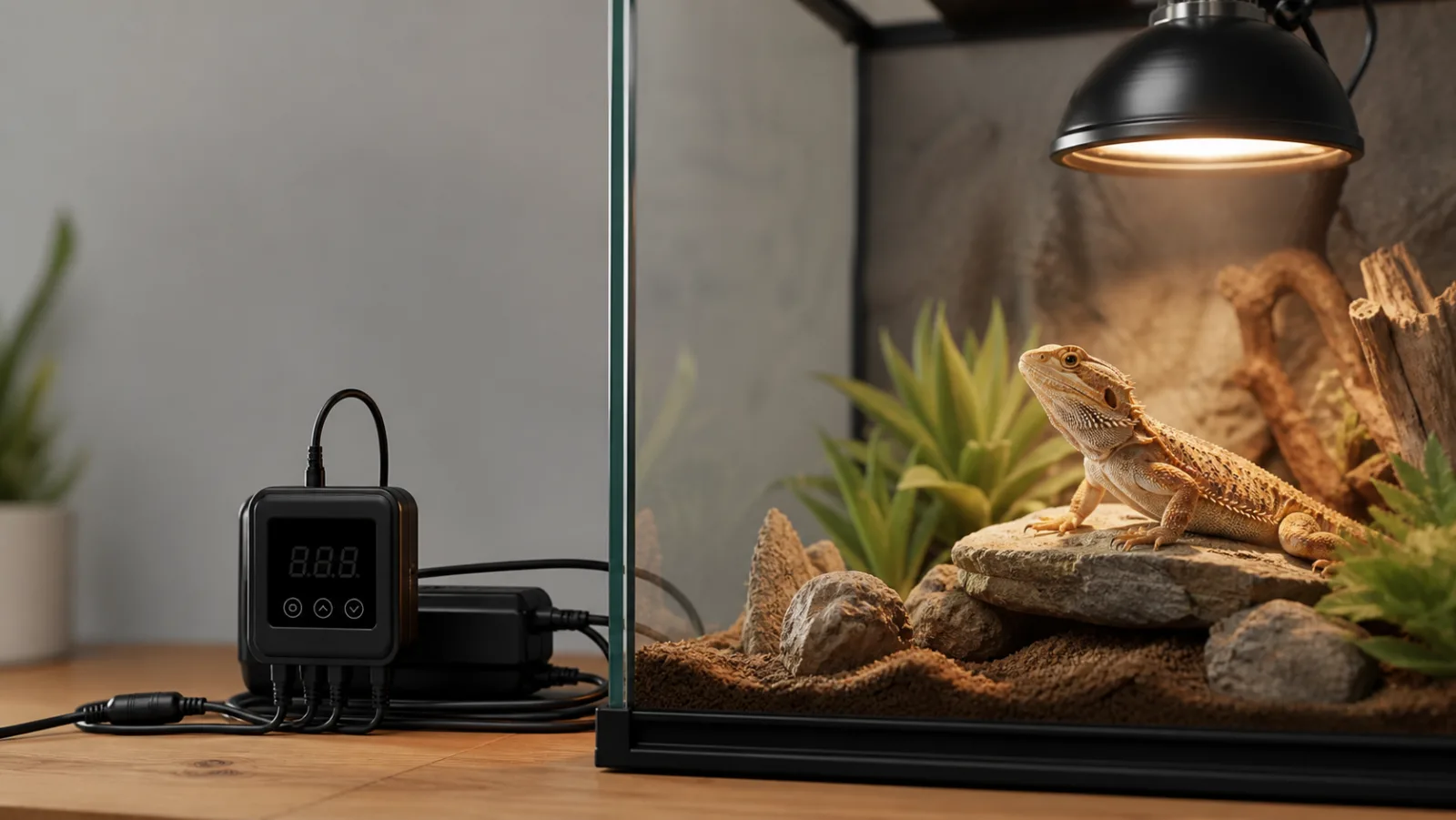
Best Reptile Thermostats for Heat Mats, CHEs & Heating Elements (2026)
The Exo Terra Dimming and Pulse Proportional Thermostat is the synthesis pick for reptile-specific proportional control; the Inkbird ITC-308 anchors the budget on/off tier. Editorial recommendations grounded in the Merck Veterinary Manual, LafeberVet, BGSU Herpetarium guidance, and reptile-keeper consensus — PetPalHQ does not run a testing lab.
12 min read
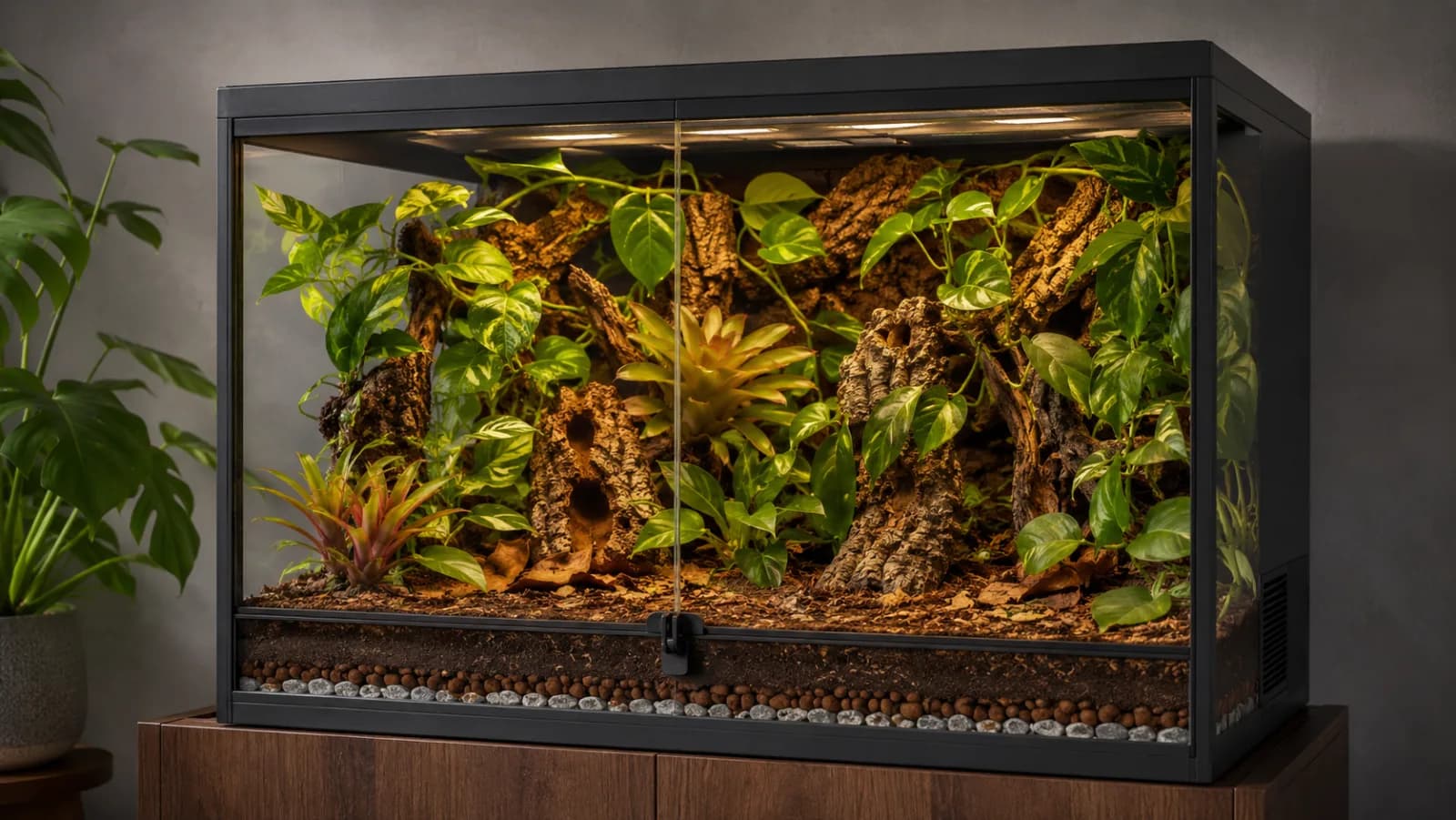
Best PVC Reptile Enclosures for Bioactive Setups (2026)
The Zen Habitats 4x2x2 PVC enclosure is the synthesis pick for terrestrial bioactive builds; the REPTI ZOO Tall glass terrarium anchors the arboreal entry tier. Editorial recommendations grounded in Mader's Reptile Medicine and Surgery, ARAV consensus, Bio Dude bioactive documentation, manufacturer data, and r/reptiles, r/bioactive, and r/BeardedDragons keeper community feedback — PetPalHQ does not run a testing lab.
13 min read
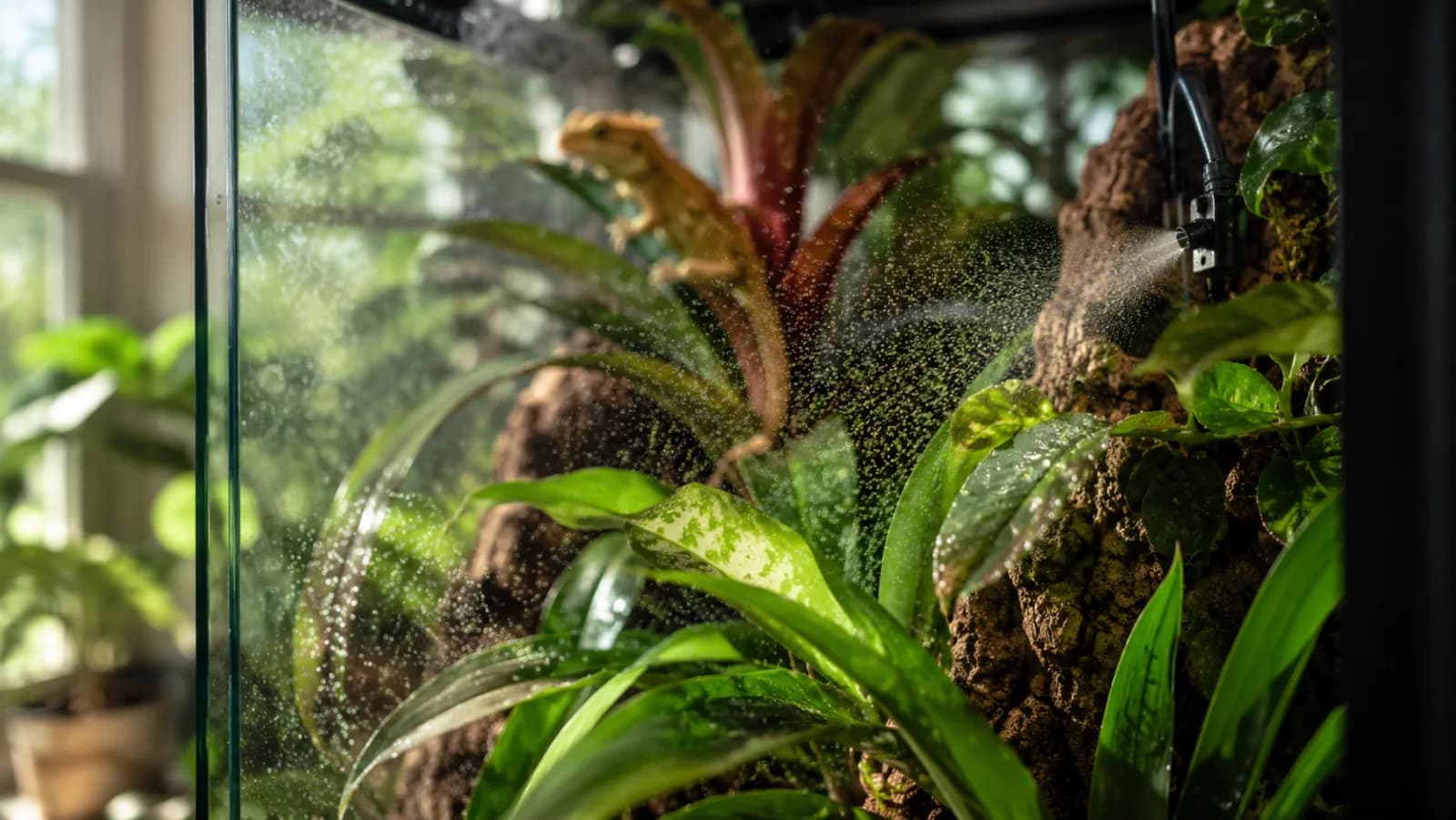
Best Reptile Misting and Fogging Systems for Humidity Control (2026)
The MistKing Starter v5 is the pump-mister synthesis pick for hobbyists who need scheduling precision and fine droplet delivery; the Exo Terra Monsoon Solo II is the mid-tier alternative with the widest reptile-trade distribution. Ultrasonic foggers serve a different job — airborne mist without surface wetting. Editorial synthesis of the Merck Veterinary Manual, RSPCA care sheets, manufacturer documentation, and reptile-keeper community consensus — PetPalHQ does not run a testing lab.
12 min read
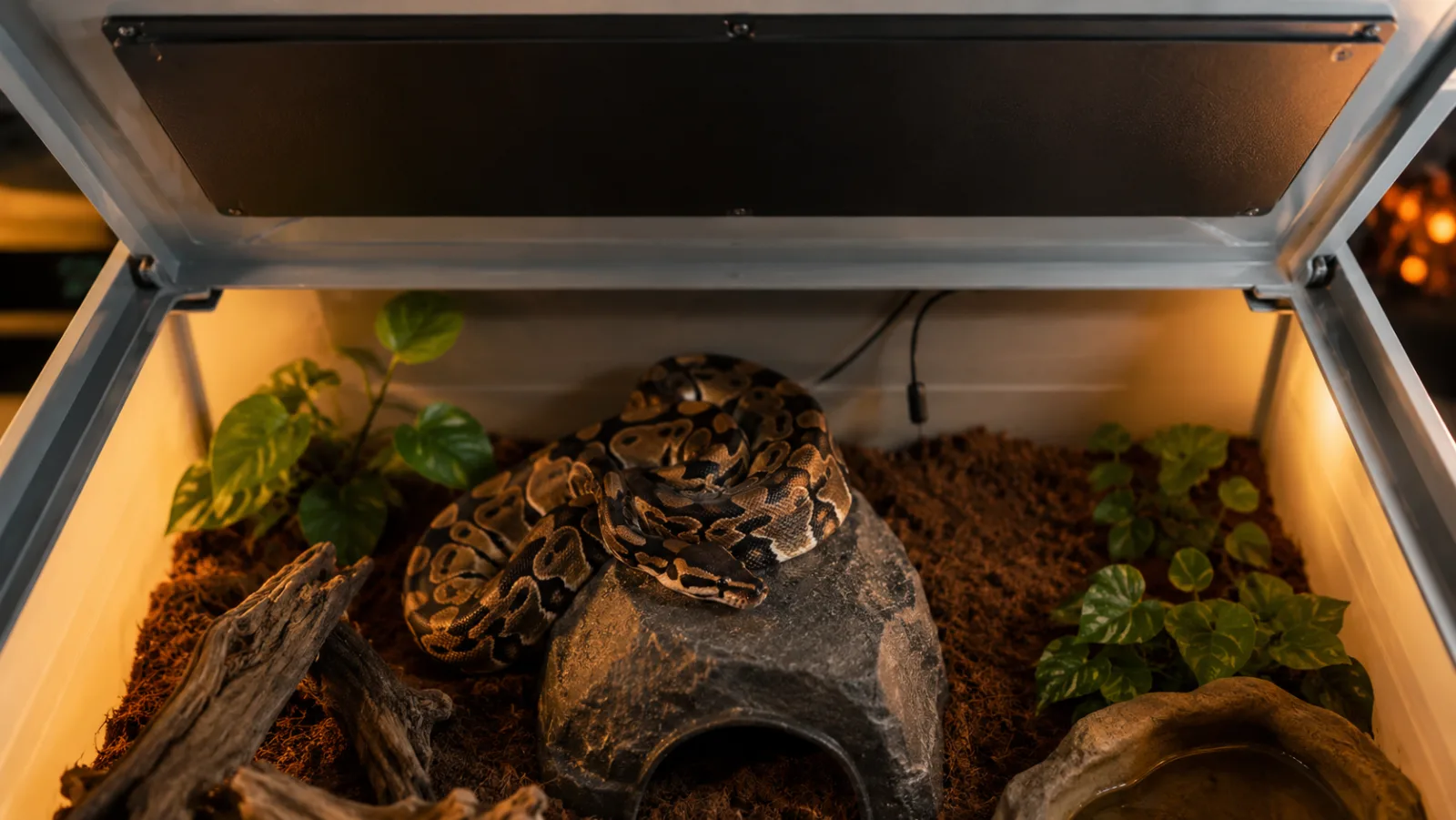
Best Reptile Radiant Heat Panels and Overhead Heat for 2026
The keeper community's flat-panel radiant heat panels, from Reptile Basics and Pro Products, sell direct from their own websites. Arcadia's Deep Heat Emitter is the strongest overhead light-free heat you can buy on Amazon, with documented IR-A and IR-B output. Editorial synthesis of the Merck Veterinary Manual, LafeberVet, RSPCA, and reptile-keeper consensus — PetPalHQ does not run a testing lab.
12 min read
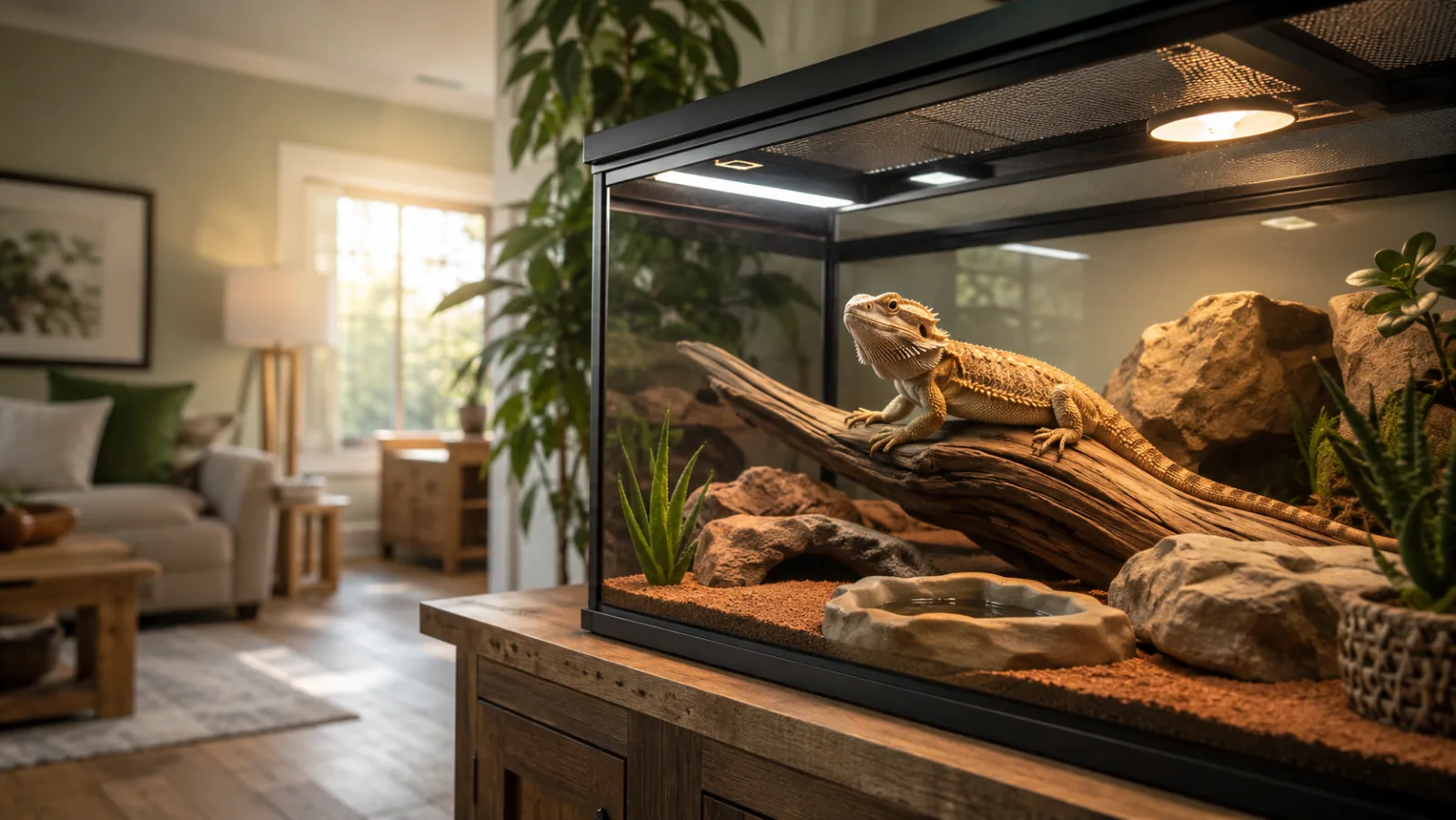
Best Bearded Dragon Starter Kits (2026)
The REPTI ZOO 50-gallon front-opening terrarium anchors the best build-your-own setup; a linear T5 HO Desert tube is the upgrade that fixes the UVB most kits get wrong. Editorial recommendations grounded in the Merck Veterinary Manual, ReptiFiles, LafeberVet, and reptile-keeper consensus — PetPalHQ does not run a testing lab.
13 min read
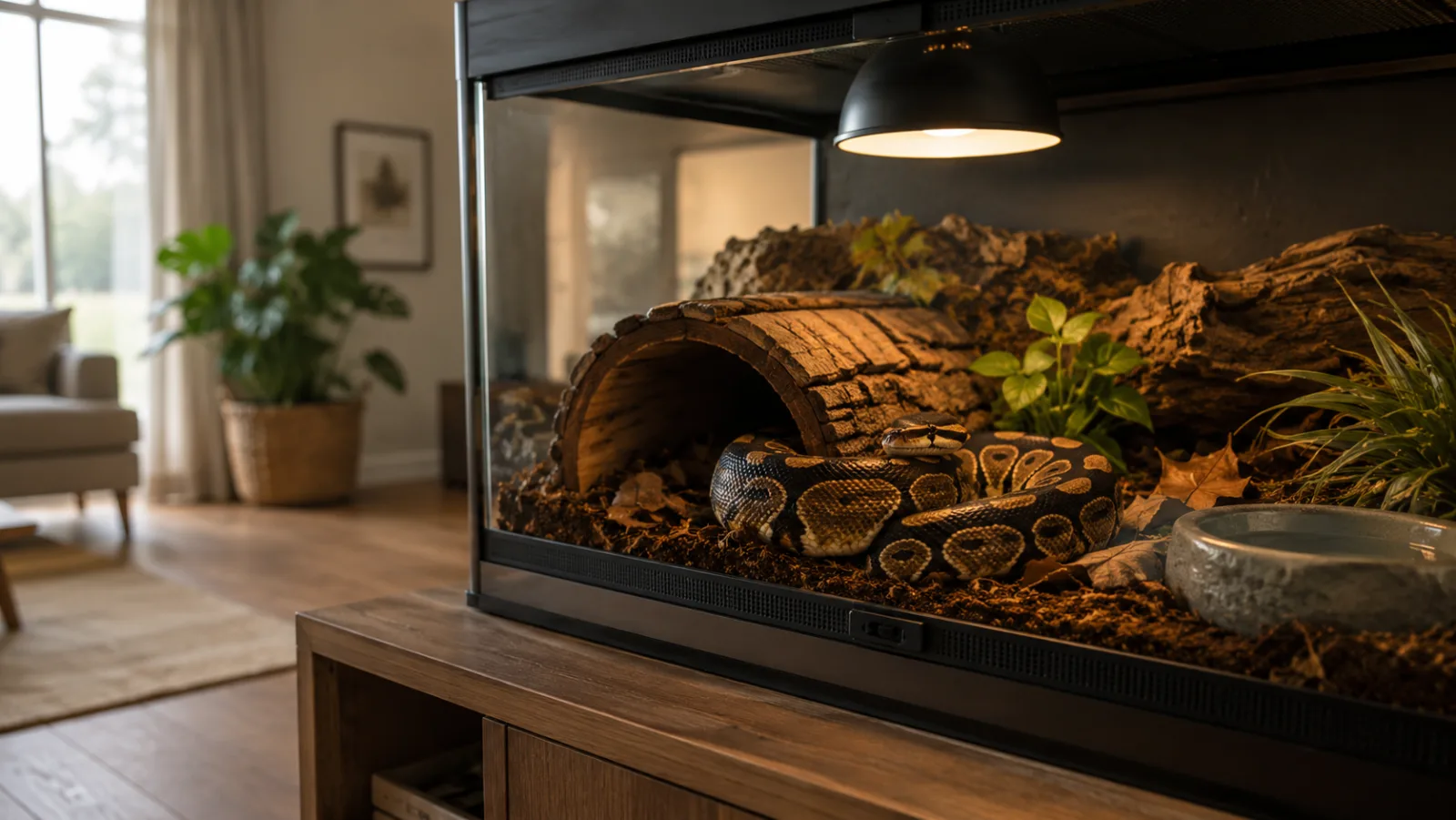
Best Ball Python Starter Kits (2026)
The REPTI ZOO front-opening glass terrarium anchors a build-your-own ball python kit with a four-foot floor footprint at a glass price, and an Inkbird thermostat plus a Zoo Med ceramic heat emitter cover heat and control. Editorial recommendations grounded in the Merck Veterinary Manual, ReptiFiles, PetMD, and ball python keeper consensus — PetPalHQ does not run a testing lab.
12 min read
Best Reptile Heat Lamps & Basking Fixtures (2026)
The Zoo Med Repti Basking Spot is the mainstream default most keepers buy first; the Exo Terra Sun Glo is the halogen step up for deep-tissue basking heat. Editorial recommendations grounded in veterinary references and the Ferguson Zone / UV-Tool framework.
12 min read
Best Indoor Tortoise Enclosures and Tables 2026: Open-Top Houses That Breathe
Most wooden tortoise houses on Amazon are starter and small-species sizes, not adult forever-homes. These six open-top enclosures and tables earn their place on airflow, build quality, and floor space — with the shallow-substrate trade-off flagged on every pick.
11 min
Best Turtle & Aquatic-Reptile Tank Filters (2026)
Turtles are filthy compared with fish, so the rule that runs this whole guide is to oversize. The Marineland Magniflow 400 is the best-overall pick for a large turtle tank at 400 GPH; the Fluval 207 suits small or compact setups; the turtle-specific Zoo Med Turtle Clean is the smallest-capacity, most-purpose-built option; and the Fluval FX6 is the heavy-bioload monster. Editorial synthesis of manufacturer documentation, PetMD, and aquarist consensus — PetPalHQ does not run a testing lab. Note: rank reflects best-fit use case, not raw score.
~12 min read
Sources & Methodology
Expert review sources
- Merck Veterinary Manual — Overview of Reptiles
- Merck Veterinary Manual — Management and Husbandry of Reptiles (revised Jul 2025)
- Merck Veterinary Manual — Environmental Diseases and Traumatic Injuries of Reptiles (revised Jul 2025)
- Merck Veterinary Manual — Providing a Home for a Reptile (revised Aug 2020; modified Sept 2024)
- NC State College of Veterinary Medicine — Caring for Your Pet Bearded Dragon
- UC Davis CVET — Avian, Small Mammal, and Exotics Care and Feeding Guide (last updated January 2025)
- Bowling Green State University Herpetarium — New Caledonian Crested Gecko (page updated 2026-03-05)
- RSPCA — Crested Gecko Care Sheet
- World Wildlife Fund — Red-Eared Slider Pet Risk and Care Assessment
- VCA Animal Hospitals — Common Problems in Pet Snakes
- VCA Animal Hospitals — Iguanas: Problems
Community sources
- Ohio State Ag Safety — Using Heat Lamps: Proceed with Caution!
- Clark County WA — Safety tips to prevent a chicken coop fire (May 2021)
- City of Lawrence KS Fire Medical — Electrical Fire Safety
Prices and specs verified May 4, 2026.
About the author
Nick Miles is the chief editor of PetPalHQ. PetPalHQ does not run a testing lab — every claim on this page is synthesized from veterinary references, university and hospital husbandry guides, animal-welfare publications, and public-safety guidance. Sources are cited by name in body prose; the bibliography above lists every primary source consulted for this hub.
PetPalHQ is a participant in the Amazon Services LLC Associates Program. We may earn commissions from qualifying purchases — at no extra cost to you.
More Guides
Reptile
Best Reptile Thermostats for Heat Mats, CHEs & Heating Elements (2026)
Reptile
Best PVC Reptile Enclosures for Bioactive Setups (2026)
Reptile
Best Reptile Misting and Fogging Systems for Humidity Control (2026)
Reptile
Best Reptile Radiant Heat Panels and Overhead Heat for 2026
Reptile
Best Bearded Dragon Starter Kits (2026)
Reptile
Best Ball Python Starter Kits (2026)
Reptile