Birds
Smart Bird Feeders and Backyard Birdwatching Gear: 2026 Guide for U.S. Homes
What a smart bird feeder actually is, how camera-and-AI feeders compare to standard feeders, and how to set up a safer, cleaner backyard birdwatching station.
By Nick Miles · Updated May 5, 2026 · 18 min read
PetPalHQ is reader-supported. We may earn a commission from qualifying Amazon purchases at no extra cost to you.
Every product on this list has been scored against the PetPal Gear Score, a weighted composite of expert consensus, observed effectiveness, animal safety, long-term durability, and value. Synthesized from 14+ expert sources.
Backyard birding is no longer a quiet hobby — it is a mass-market category with a connected-tech layer on top. The U.S. Fish and Wildlife Service's 2022 birding analysis reports that 96 million Americans age 16 and older engaged in birding that year, including roughly 91 million backyard birders, with total birding-related expenditures reaching $107.6 billion. Cornell Lab of Ornithology says its Merlin Bird ID app has reached 10 million active users, and the 2026 Great Backyard Bird Count logged more than 1.23 million saved Merlin identifications worldwide. That cultural shift is why "smart" bird feeders — feeders with built-in cameras, apps, and AI species recognition — have moved from gadget niche to mainstream gift.
This guide synthesizes how authoritative birding organizations, federal and state wildlife agencies, and manufacturer documentation describe the category. PetPalHQ does not run a testing lab; recommendations below are editorial synthesis of expert consensus, with sources cited by name throughout. The aim is to help you choose a feeder, set it up safely, and clean it on a schedule that respects bird health — and to be candid about a real disagreement among experts on whether to feed at all during disease outbreaks.
What are smart bird feeders?
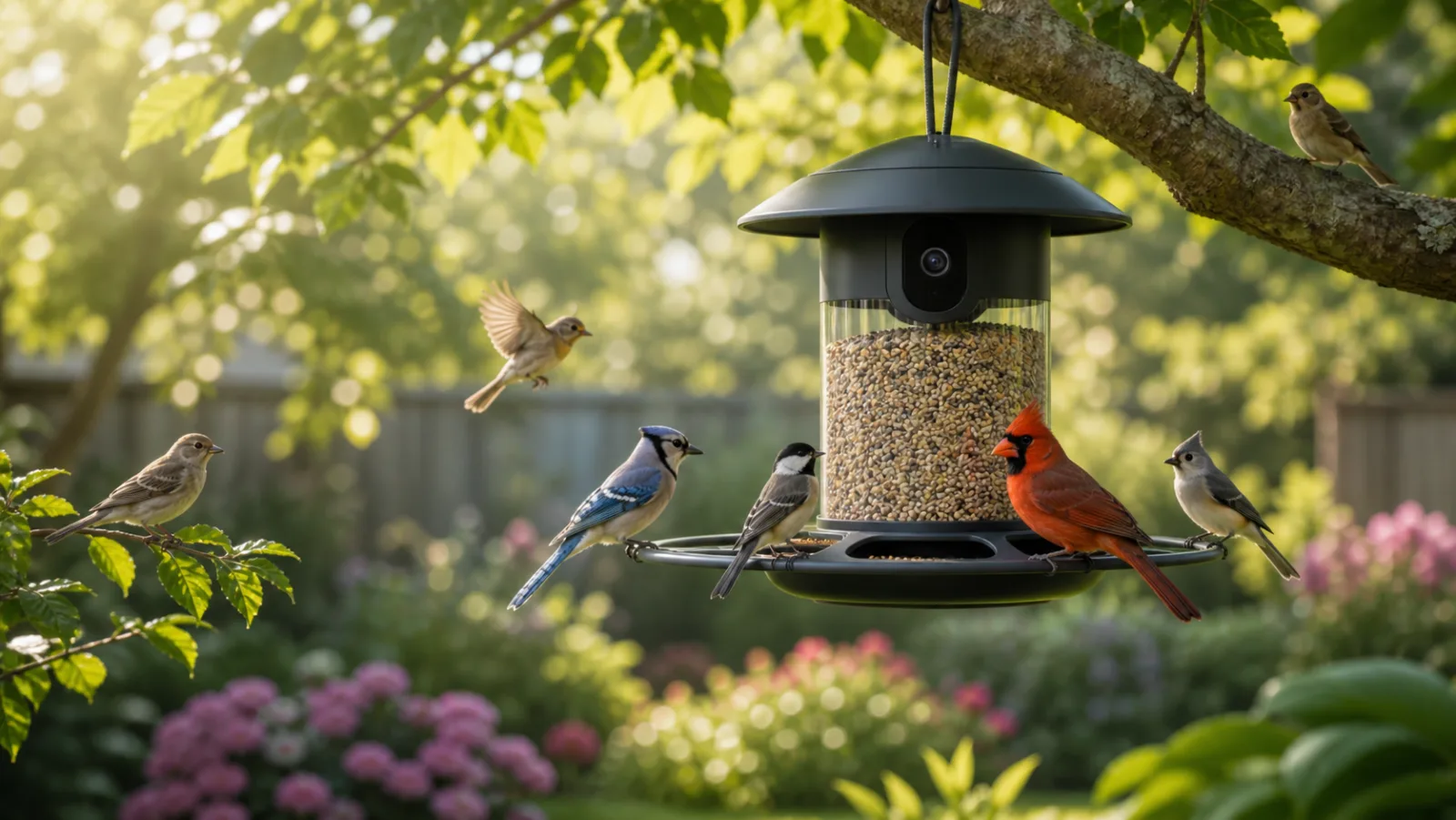
A smart bird feeder is a conventional feeder body combined with a connected camera and companion smartphone app. Birdbuddy delivers bird visits as "postcards" to the app; Birdfy specs include a 1080p camera, 155-degree field of view, motion-triggered capture, and rolling cloud storage. Good Housekeeping's 2026 review frames the category plainly: "essentially a bird feeder with a Wi-Fi-enabled camera attached." The new value is alerts, AI bird identification, and shareable photos — not a different way to feed birds.
Standard Feeder vs Smart Feeder
A standard seed feeder feeds birds. A smart feeder also captures the visit, sends an alert to your phone, runs the image through a machine-learning model that tries to name the species, and (depending on brand) lets you save clips, share access with family, and stream live video. The food still works the same way; the difference is what happens around the food.
How AI Bird ID Works
Birdbuddy's support documentation says species identification is performed by a machine-learning model that improves over time as it encounters more training data. Birdfy ships a similar AI workflow with cloud-based recognition and saved clips. Cornell Lab's Merlin Bird ID is the gold-standard reference app; while Merlin is a separate product, the consumer expectation it created — point a camera at a bird and get a name back — is what every smart feeder is now competing with.
The honest framing is that AI identification is a learning aid, not a perfect field guide. Birdbuddy's own documentation notes the model is evolving, and Good Housekeeping's 2026 review observed misidentifications and "unrecognized" captures on fleeting visits.
Cloud Storage vs Local Storage
Cloud is the default. Birdfy's official feeder pages say the device offers rolling cloud storage with retention limits, and add-on subscription tiers extend recognition and clip saving. Birdfy is also explicit that most of its products do not support microSD storage or playback for end users, even on models with a card slot. Birdbuddy emphasizes a postcard-and-album workflow rather than raw video files. If long-term local control of footage matters to you, treat that as a hard buyer requirement and check the spec sheet before purchase.
How do smart bird feeder cameras work?
A sensor detects motion, the camera records a clip, the device pushes it to a cloud service, the AI model attempts a species ID, and the app delivers a notification. Birdfy lists a passive infrared (PIR) sensor; Birdbuddy lists a proprietary detection sensor. PIR can produce false triggers from wind or miss very brief visits. WIRED's 2026 testing found capture reliability — not headline resolution — is the variable that matters most for real-world performance.
Wi-Fi compatibility is a practical detail buyers under-check. Birdfy and Birdbuddy both publish models that depend on 2.4 GHz Wi-Fi, with some newer feeders adding 5 GHz support. If your home network is router-managed and 5 GHz-only, confirm 2.4 GHz availability on a guest band before you buy.
Which smart bird feeder features actually matter?
The features worth prioritizing are camera quality and field of view, motion-detection reliability, AI identification accuracy, notification and sharing options, battery and solar performance, subscription terms, weather resistance (IP rating), and cleaning access. WIRED's 2026 testing consistently ranked app quality, capture reliability, and connectivity as the decisive differences between feeders — not headline resolution or 4K marketing. Cornell Lab adds that easy cleaning is among the most important buying criteria for any feeder type.
Camera and capture. The minimum reasonable bar is reliable 1080p with useful close focus. Birdfy's official feeder page lists 1080p plus a 155-degree field of view; Birdbuddy's current spec page cites 5 MP stills, HDR/WDR, and up to 2K video. WIRED's 2026 testing repeatedly stresses field of view, low-light performance, HDR/WDR, and close-focus sharpness over raw 4K marketing.
Motion detection. Confirm whether the feeder uses PIR or a proprietary sensor — Birdfy explicitly lists PIR, Birdbuddy lists a proprietary sensor — because the choice affects false-trigger rate and missed visits.
AI identification. Treat as a learning aid, not a perfect field guide. Birdbuddy says identification depends on training data, and reviewers including Good Housekeeping have noted that fleeting visits often go unrecognized.
Notifications and sharing. Real-time alerts are why most buyers want a smart feeder; guest sharing matters for gifts. Birdbuddy's documentation says its free account supports automatic postcards, livestream access, alerts, and guest access. Birdfy supports account sharing with live-feed access.
Power. Birdbuddy says battery life can be up to a month depending on usage; Birdfy publishes battery capacity but cautions real-world life depends on traffic, weather, and sensitivity. Solar charging is increasingly standard; Birdbuddy's solar roof documentation says panel orientation and direct sun exposure matter.
Storage and subscriptions. Subscription friction is now one of the most commercially important buyer issues. Birdbuddy says core feeder functions work without a membership; Birdfy ships multiple AI and cloud-service tiers; WIRED's 2026 guide highlights wide variation across brands. Read the exact subscription terms for the exact model before you buy — they change often.
Durability and IP rating. Prefer a published IP rating. Birdfy lists IP65 on its feeder; Birdbuddy lists IP67 on its Nature Cam Pro. Both publish wall, pole, and tree mounting options.
Cleaning access. Cornell Lab is direct: easy cleaning is one of the most important feeder-buying criteria. WIRED's 2026 coverage echoes that maintenance design affects whether owners actually keep up with cleaning.
What are the different types of bird feeders and which should you choose?
Cornell Lab's guidance anchors the standard taxonomy: tube feeders for finches, hopper feeders for mixed flocks, platform feeders for the broadest species variety, window feeders for close-up viewing, hummingbird feeders for nectar birds, suet feeders for woodpeckers and winter birds, and smart camera feeders for buyers who want alerts and AI identification. Each type suits different species, yard conditions, and maintenance habits — smart feeders are a parallel category, not a replacement.
Tube Feeders
Best for finches, chickadees, and small songbirds. Tube feeders keep seed drier than open trays, reduce droppings inside the seed column, and are an easy starter option. Watch-outs from Cornell: regular cleaning matters because moldy seed can collect at the bottom, and plastic tubes can be squirrel-damaged.
Hopper Feeders
Best for mixed backyard flocks — cardinals, chickadees, titmice. Hoppers have a roof that helps shed rain and a larger seed capacity, which is the classic backyard look. They are usually easier for squirrels to dominate and harder to deep-clean than open trays.
Platform Feeders
Best for the broadest species variety, including ground-feeding birds. Cornell describes platforms as offering excellent visibility and versatile mounting. Watch-outs: seed gets wet more easily, droppings accumulate, and platforms attract larger or unwanted visitors.
Window Feeders
Best for apartments, close-up viewing, and collision-aware setups. Cornell explicitly notes window feeders provide excellent close views and can be safer near glass. Capacity is small, suction-cup reliability varies, and droppings accumulate on the tray.
Hummingbird Feeders
Their own category. Cornell's "Feeding Hummingbirds" is unambiguous: use table sugar and water, not honey; do not add red dye; and do not leave nectar out more than two to three days, or daily in very hot weather. Choose a feeder that comes apart easily — Cornell lists ease of cleaning as one of the most important buying criteria.
Suet Feeders
Best for woodpeckers, nuthatches, chickadees, and titmice. Suet is a high-energy winter food and attracts species that often skip seed feeders. Heat can make suet rancid, so warm-weather use is limited and Audubon's winter feeding guidance is the most relevant reference.
Smart Camera Feeders
Best for buyers who want alerts, photos, AI ID, and gift appeal. The trade-off is higher price, dependence on Wi-Fi and app quality, and ongoing subscription decisions. Birdbuddy's CES 2026 next-generation launch and Birdfy's CES 2026 hummingbird and panoramic concepts (covered by The Verge and PR Newswire) confirm the category is now treated as mainstream consumer tech, not gadget-niche.
Bird Feeder Type Comparison
| Feeder type | Best for | Main strengths | Main watch-outs |
|---|---|---|---|
| Tube feeder | Finches, chickadees, small songbirds | Drier seed, less mess, easy starter | Regular cleaning required; squirrel-vulnerable plastic |
| Hopper feeder | Mixed backyard flocks, cardinals | Sheds rain; large capacity; classic look | Squirrel-friendly; harder to deep-clean |
| Platform feeder | Broad species variety, ground-feeders | Best visibility; versatile mounting | Wet seed; droppings; larger visitors |
| Window feeder | Apartments, close-up viewing | Excellent close views; can be safer near glass | Small capacity; suction reliability |
| Hummingbird feeder | Nectar-feeding birds | High engagement; small spaces; gift appeal | Nectar spoils fast; very frequent cleaning; insects |
| Suet feeder | Woodpeckers, nuthatches, winter feeders | High-energy winter food; new species | Heat makes suet rancid; warm-weather limits |
| Smart camera feeder | Alerts, AI ID, gifts | App, livestream, notifications, sharing | Higher price; Wi-Fi-dependent; subscriptions |
Sources for the table: Cornell Lab of Ornithology, National Audubon Society, U.S. Fish and Wildlife Service, Birdbuddy, Birdfy, WIRED.
Do bird baths and heated bird baths make a difference?
Water attracts birds that ignore feeders entirely. Cornell Lab treats a bird bath as equal in importance to food, and both Audubon and the U.S. Fish and Wildlife Service back that framing. Heated bird baths are especially valuable in winter, keeping water open when ice would otherwise eliminate a water source — Cornell and Audubon both treat winter water as a meaningful support for cold-weather bird populations.
Six bath types are worth knowing: pedestal baths, ground-level saucers, deck and rail baths, hanging baths, drippers and fountains, and heated winter baths. Cornell says shallow, easy-to-clean baths work best, that birds prefer a gentle slope, and that moving water is highly attractive.
Safe depth follows a Cornell/Audubon consensus: roughly 1 inch at the edge sloping to no more than 2 inches in the center. Deeper baths discourage smaller birds and create a drowning risk for fledglings.
Heated bird baths are useful when the goal is to keep water open during freezing weather. Audubon's "Winter Bird Feeding 101" and Cornell both stress safe electrical use — purpose-built heaters only, plug into a GFCI circuit, and never add antifreeze or glycerin.
How do you set up a backyard birdwatching station safely?
Window placement is a safety topic, not a convenience topic. Cornell Lab and the U.S. Fish and Wildlife Service both advise placing feeders either within about three feet of reflective windows — close enough that birds cannot build up fatal collision momentum — or well beyond 30 feet. Mounting options, squirrel baffles, solar exposure for smart feeders, and first-week expectations all factor into setup; birds typically need one to two weeks to discover and accept a new feeder location.
Mounting options include hanging brackets, wall mounts, pole systems, tree hangers, and rail clamps. Audubon recommends pole systems with squirrel baffles and meaningful distance from jump-off structures like fences and tree limbs — squirrels can leap several feet horizontally from a launch point. For smart feeders, also confirm Wi-Fi reach; Birdfy's documentation notes signal strength at the install location is one of the top setup variables.
Solar exposure is often the second-biggest setup variable for smart feeders. Birdbuddy's solar-roof guidance is explicit that the panel needs direct sun and proper orientation to maintain charge in a bird-traffic-heavy yard.
First-week expectations are simple: birds need time. Even a perfectly placed feeder may sit empty for several days as birds discover and accept it. Do not relocate a feeder before giving it at least two weeks unless something is clearly wrong.
How do you clean bird feeders and prevent disease?
Clean seed feeders at least every two weeks — Cornell Lab and the U.S. Fish and Wildlife Service both set this as the baseline, with more frequent cleaning during hot, wet, or high-traffic conditions. Hummingbird feeders need nectar changed every two to three days, and daily in very hot weather. Disease prevention follows directly from cleaning frequency: feeders that harbor mold, wet seed, or accumulated droppings create the transmission conditions that authoritative birding organizations and wildlife agencies warn against.
How Often to Clean Feeders
Cornell Lab and the U.S. Fish and Wildlife Service both say standard seed feeders should be cleaned at least every two weeks as a baseline. In hot, wet, or high-use conditions, cleaning frequency moves closer to weekly or every few days. Cornell recommends a dishwasher on a hot setting where possible, or hand washing with soap and boiling water or a dilute bleach solution of no more than 1 part bleach to 9 parts water, with thorough rinsing and full drying before refilling. The U.S. Fish and Wildlife Service adds that spilled seed and hulls beneath feeders should be raked or swept up regularly.
Hummingbird feeders need much more attention. Cornell's older but still authoritative "Feeding Hummingbirds" guidance says nectar should be changed at least every two to three days, and daily in very hot weather. Use table sugar and water; do not use honey; do not add red dye.
How to Store Seed
Audubon's "11 Tips for Feeding Backyard Birds" warns that damp seeds can grow mold that may be fatal to birds. Store seed in secure metal containers with tight lids in a cool, dry place. Project FeederWatch's "Reasons Why We Should Keep Our Seed Dry" summarizes research showing the parasite Trichomonas gallinae persisted only in wet seed and only briefly — keeping seed dry is genuinely protective. Discard any clumped or moldy seed, and avoid filler-heavy mixes that birds reject and that then sit and decay.
Bird Bath Cleaning
Audubon recommends a 9:1 water-to-vinegar scrub for bird baths, with a stiff brush, and refreshing water daily or every other day in warm weather. Heated bird baths follow the same cleaning rhythm with the additional electrical safety steps above.
What to Do If You See Sick Birds
Project FeederWatch's "Sick Birds and Bird Diseases" recommends taking down feeders for a couple of weeks when sick birds appear, so flocks disperse and the local outbreak fades. State wildlife agencies including Georgia DNR have published similar guidance — about a week of feeder downtime when sick birds are observed. Clean the feeder area thoroughly during the pause before putting feeders back up.
Responsible Feeding During Outbreaks
This is the most important nuance in the entire category, and it is exactly where authoritative sources disagree.
Cornell Lab of Ornithology, the National Audubon Society, and the U.S. Fish and Wildlife Service publish detailed guidance for safer feeding — clean feeders on schedule, pause feeding when sick birds appear, store seed properly, place feeders away from collision hazards. Their position is that responsible feeding is compatible with healthy bird populations.
The California Wildlife Health Lab goes further and says artificial food and water can increase disease transmission, and recommends not feeding as the safer default — especially during disease pressure. The California Department of Fish and Wildlife echoes that, saying feeding is generally discouraged and is especially risky near backyard poultry, ducks, pigeons, or captive birds because of avian influenza spillover risk.
The honest synthesis: risk tolerance is regional. If your area is under an active avian influenza advisory, if you keep backyard chickens or other captive birds, or if your wildlife health agency has published an active feeder-suspension recommendation, the more conservative position is to pause feeding. Outside those conditions, the Cornell/Audubon/USFWS framework of clean, responsible feeding is the consensus baseline. PetPalHQ surfaces both because that disagreement is real and trustworthy content acknowledges it rather than burying it.
How do you choose the right bird feeder for your yard?
Match the feeder to your yard conditions and priorities. The "fun gift" case prioritizes a polished app with guest sharing and automatic notifications. High-squirrel or high-weather yards need a metal or guarded body, a published IP rating, pole mounting, and a squirrel baffle. Apartments do better with compact or window feeders. Winter climates benefit from a suet option and a heated bird bath alongside any seed feeder. Buyers who dislike subscriptions should confirm terms before purchasing any smart feeder.
For the "fun gift" effect. Prioritize an easy app, automatic notifications, guest sharing, and a polished onboarding flow. Birdbuddy's free account supports automatic postcards, livestream access, guest access, and alerts; Good Housekeeping's 2026 review found setup relatively easy when Wi-Fi and sunlight conditions were met.
For image quality. Prioritize wide field of view, close-focus sharpness, HDR/WDR, and dependable capture before chasing 4K alone. Birdbuddy's specs and WIRED's 2026 testing both note that real-world quality depends on more than headline resolution.
For high-squirrel, high-weather yards. Prioritize a metal or guarded body, a published IP rating, pole mounting, and a squirrel baffle. Audubon recommends pole systems with baffles plus meaningful spacing from launch points; Birdfy and Birdbuddy publish IP ratings (IP65 and IP67 respectively on the relevant models) and pole-mount accessories.
For apartments and small spaces. Window feeders, compact hummingbird feeders, and smaller smart models make more sense than large hopper systems. Cornell explicitly lists window feeders as offering excellent close-up views.
For winter climates. Pair a seed feeder with a suet option and a heated bird bath. Cornell and Audubon's winter feeding guidance both treat winter water and high-energy foods as meaningful supports during cold months.
For shoppers who hate subscriptions. Make subscription clarity a top filter. Birdbuddy says the feeder works without a membership; Birdfy ships multiple AI and cloud-service tiers; WIRED notes that subscription terms vary widely across brands.
Common buyer mistakes. Five recur across reviews and authoritative guidance: buying on resolution alone instead of capture reliability and field of view; ignoring the cleaning-access design and then cleaning less often than needed; placing feeders in the dangerous mid-distance window zone; assuming seed storage isn't a safety issue; and not reading the subscription terms before purchase.
What birdwatching accessories are worth buying?
A complete backyard station includes more than the feeder. Feeder poles with squirrel baffles are the single biggest upgrade for high-squirrel yards, per Audubon's spacing guidance. Secure metal seed storage containers address the mold risk Audubon explicitly warns about. Window collision decals treat a real and preventable bird-mortality cause that both Cornell Lab and the U.S. Fish and Wildlife Service identify. Binoculars remain core birding gear that no smartphone app replaces for distance viewing.
- Feeder poles and squirrel baffles. The single biggest upgrade for high-squirrel yards, per Audubon's spacing guidance.
- Seed storage containers. Audubon's mold warning makes secure metal containers a priority purchase, not a nice-to-have.
- Cleaning brushes and tools. Cornell's cleaning protocol is much easier when you actually have a long-handled brush sized for your feeder type.
- Window collision decals. Cornell and U.S. Fish and Wildlife Service both treat window strikes as a real and preventable bird-mortality cause; decals or patterned films are standard mitigation.
- Binoculars and field guides. Still core birding gear; Cornell Lab's Merlin app does not replace a good binocular for distance viewing.
- Smart-home adjacent extras. Some smart feeders integrate with broader smart-home platforms; check the manufacturer's current docs for the specific model.
When should you stop feeding backyard birds?
Pause feeding when sick or dying birds appear at your feeder, when your region is under an active avian influenza advisory, or when your local or state wildlife agency has issued a feeder-suspension recommendation. Cornell, Audubon, and the U.S. Fish and Wildlife Service treat responsible feeding as compatible with healthy bird populations — but the California Wildlife Health Lab and California Department of Fish and Wildlife advise against feeding during disease pressure, especially near backyard poultry or captive birds.
- An active disease outbreak in your region, especially avian influenza, when local or state wildlife agencies are recommending a pause.
- Sick or dying birds visiting your feeder. Project FeederWatch recommends about two weeks of feeder downtime; state agencies including Georgia DNR have recommended about a week.
- Backyard poultry or other captive birds on the property — the California Department of Fish and Wildlife specifically flags this as a higher-risk context.
- A feeder you cannot keep clean. If life conditions are preventing the cleaning rhythm above, pausing is more responsible than continuing.
Frequently Asked Questions
- What is a smart bird feeder?
- A smart bird feeder is a feeder body with a connected camera and companion app. According to Birdbuddy and Birdfy product documentation and Good Housekeeping's 2026 review, the standard feature set now includes app alerts, live view, AI bird identification, guest sharing, and rolling cloud storage.
- How do camera bird feeders work?
- Most use motion or presence detection — Birdfy lists a passive infrared sensor; Birdbuddy lists a proprietary detection sensor — to trigger capture, then push images or clips to an app where AI attempts to identify the species and a notification is delivered to your phone.
- Do I need Wi-Fi?
- Usually yes. Many current Birdfy and Birdbuddy models depend on home Wi-Fi, often 2.4 GHz, though some newer feeders support both 2.4 and 5 GHz per the brand spec sheets and CES 2026 coverage from The Verge.
- Is AI bird identification accurate?
- Useful, yes; perfect, no. Birdbuddy's support documentation says identification depends on training data and improves over time; Good Housekeeping's 2026 review observed misidentifications and "unrecognized" captures on fleeting visits. Treat AI ID as a learning aid that complements, not replaces, a field guide or Cornell Lab's Merlin app.
- Are subscriptions required?
- Not always. Birdbuddy says core feeder functions work without a membership; Birdfy publishes multiple AI and cloud-service tiers. WIRED's 2026 guide notes that subscription terms vary widely across brands. Check the exact plan for the exact model before buying.
- What's more important: 4K video or a good app?
- For most buyers, the better app wins. WIRED's 2026 testing repeatedly highlights app quality, capture reliability, and connectivity as decisive differences between feeders, and Birdbuddy's own specs emphasize HDR/WDR and field of view alongside resolution.
- Where should I put a bird feeder?
- Place it close to cover but treat windows carefully. Cornell Lab and the U.S. Fish and Wildlife Service both advise placing feeders either within about three feet of reflective windows or well beyond the collision danger zone — generally past 30 feet. Audubon also recommends decals or films on large windows.
- How often should I clean a feeder?
- Standard seed feeders: at least every two weeks per Cornell Lab and the U.S. Fish and Wildlife Service, more often in hot, wet, or high-use conditions. Hummingbird feeders: every two to three days per Cornell, and daily in very hot weather. Bird baths: refreshed daily or every other day in warm weather, scrubbed with a 9:1 water-to-vinegar mix per Audubon.
- Is it always a good idea to feed birds?
- Not always. Cornell, Audubon, and the U.S. Fish and Wildlife Service publish safer-feeding guidance and consider responsible feeding compatible with healthy bird populations. The California Wildlife Health Lab and California Department of Fish and Wildlife take a more conservative position and discourage feeding during disease pressure or near captive birds. Local risk depends on your region, your wildlife agency's current advisory, and whether you keep backyard poultry.
Bottom Line
A smart bird feeder is a conventional feeder body with a connected camera and companion app — the new value is alerts, AI bird identification, and shareable photos, not a different way to feed birds.
AI bird ID is now mainstream. Cornell Lab of Ornithology says Merlin Bird ID has reached 10 million active users, and brand apps from Birdbuddy and Birdfy ship machine-learning recognition out of the box.
Clean feeders on a schedule. Cornell and the U.S. Fish and Wildlife Service both say standard seed feeders should be cleaned at least every two weeks, and hummingbird feeders every few days, with much higher frequency in heat or disease pressure.
Window safety matters as much as feeder choice. Cornell and U.S. Fish and Wildlife Service both advise placing feeders within about three feet of reflective windows, or well past the collision danger zone.
Authoritative birding orgs disagree with some wildlife-health agencies on whether to feed at all during disease outbreaks. Risk tolerance is regional — this guide explains the disagreement instead of hiding it.
All articles in this guide
Sources & Methodology
Expert review sources
- Cornell Lab of Ornithology — How to Choose the Right Kind of Bird Feeder (updated August 22, 2024)
- Cornell Lab of Ornithology — How to Clean Your Bird Feeder
- Cornell Lab of Ornithology — Feeding Hummingbirds (April 20, 2009)
- Cornell Lab of Ornithology — Feeding Birds: A Quick Guide to Seed Types (April 20, 2009)
- Cornell Lab of Ornithology — Attract Birds With Birdbaths
- Cornell Lab of Ornithology — The Magic of Merlin (September 2025)
- Great Backyard Bird Count — 2026 Final Results
- Project FeederWatch — Sick Birds and Bird Diseases
- Project FeederWatch — Reasons Why We Should Keep Our Seed Dry
- National Audubon Society — 11 Tips for Feeding Backyard Birds (September 27, 2011)
- National Audubon Society — Why You Should Keep Your Birdbath Clean (September 20, 2016)
- National Audubon Society — Winter Bird Feeding 101 (February 1, 2024)
- U.S. Fish and Wildlife Service — Birdwatching in America (December 9, 2024)
- U.S. Fish and Wildlife Service — 2022 Birding in the United States: A Demographic and Economic Analysis (November 19, 2024)
- U.S. Fish and Wildlife Service — To Feed or Not to Feed Wild Birds
- California Department of Fish and Wildlife — Should I Take Down My Bird Feeders Because of Avian Influenza? (August 25, 2022)
- California Wildlife Health Lab — Avian Investigations
- Birdbuddy Support — The Birdbuddy Membership
- Birdbuddy Support — Bird Species Identification
- Birdbuddy Support — Solar Roof
- Birdbuddy — Smart Bird Feeder Pro product specifications
- Birdfy Support — Birdfy Feeder FAQ
- Birdfy Support — Birdfy Feeder Specifications
- Birdfy — Birdfy Feeder with Solar Panel product page
- Good Housekeeping — Bird Buddy Review 2026
- WIRED — The Best Smart Bird Feeders for Backyard Birding (April 26, 2026)
Community sources
- The Verge — Birdbuddy 2 Mini CES 2026 coverage (January 2026)
- The Verge — Birdfy Hum Bloom and Vista CES 2026 coverage (January 2026)
- PR Newswire — Birdbuddy CES 2026 next-generation launch (January 5, 2026)
Prices and specs verified May 4, 2026.
About the author
Nick Miles is the chief editor of PetPalHQ. PetPalHQ does not run a testing lab — every claim on this page is synthesized from authoritative birding organizations, federal and state wildlife agencies, manufacturer documentation, and consumer-tech reviews. Sources are cited by name in body prose; the bibliography above lists every primary source consulted for this hub.
PetPalHQ is a participant in the Amazon Services LLC Associates Program. We may earn commissions from qualifying purchases — at no extra cost to you.
More Guides
Birds
Best Smart Bird Feeders for U.S. Backyards (2026)
Birds
Best Bird Baths and Solar Fountains for Backyard Birding (2026)
Birds
Best Hummingbird Feeders That Stay Clean, Full, and Pest-Free (2026)
Birds
Best Large Parrot & Macaw Flight Cages (2026)
Birds
Best Squirrel-Proof Bird Feeders That Actually Hold the Line (2026)
Birds