Cats & Dogs
Senior Pet Mobility and Preventive Care: 2026 Guide for Aging Dogs and Cats
How to recognize pain, schedule screening, protect mobility, and modify the home for aging dogs and cats — synthesized from AAHA, Merck, Cornell, and Tufts.
By Nick Miles · Updated May 5, 2026 · 16 min read
PetPalHQ is reader-supported. We may earn a commission from qualifying Amazon purchases at no extra cost to you.
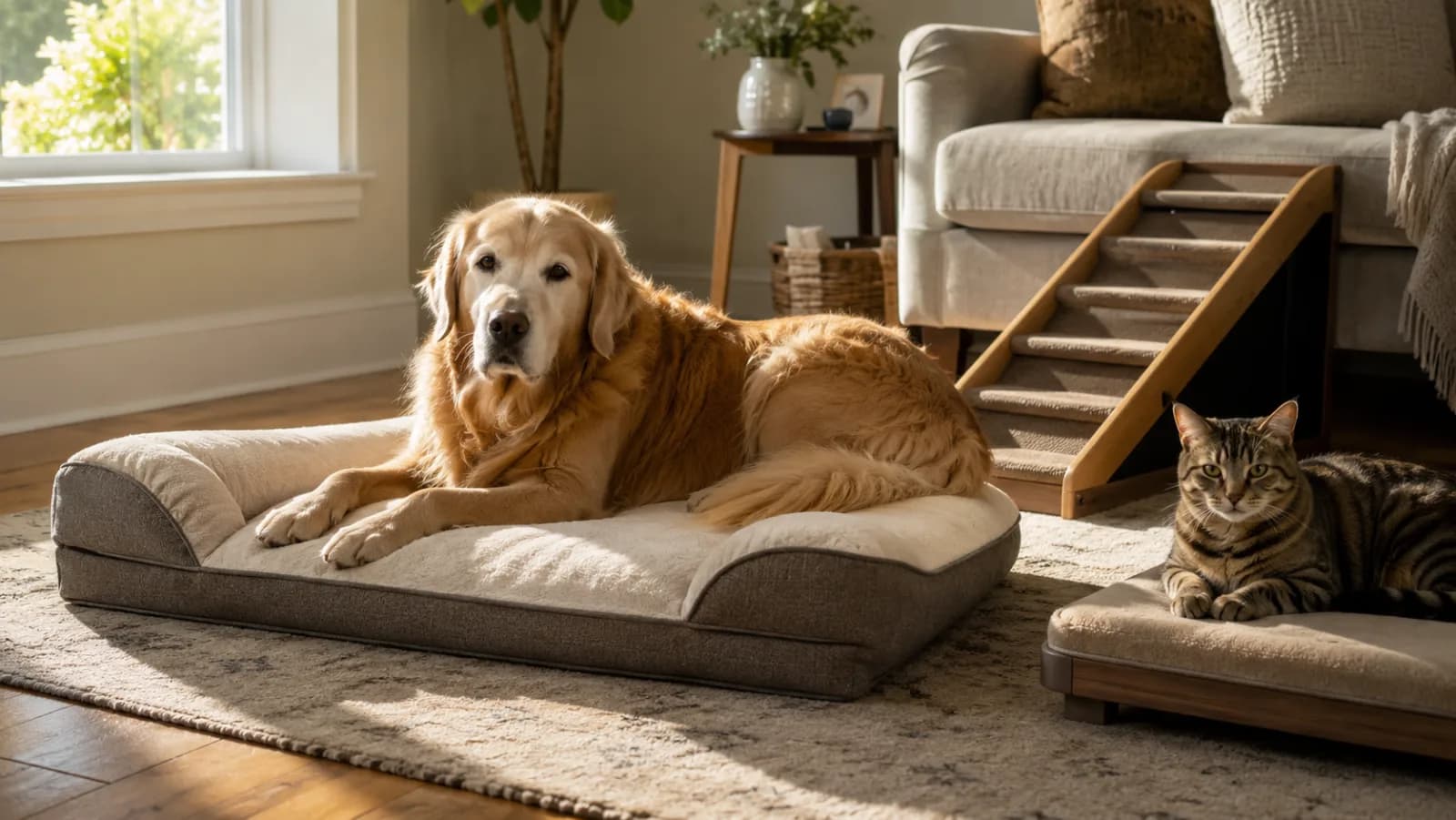
Every product on this list has been scored against the PetPal Gear Score, a weighted composite of expert consensus, observed effectiveness, animal safety, long-term durability, and value. Review method: Editorial synthesis of veterinary, university, and peer-reviewed guidance — the 2023 AAHA Senior Care Guidelines, the 2022 AAHA Pain Management Guidelines, the 2021 AAHA Nutrition and Weight Management Guidelines, and the AAHA/AAFP feline life-stage definitions. Also synthesized: the Merck Veterinary Manual, the Cornell Feline Health Center, and Tufts Cummings School of Veterinary Medicine. Additional sources include the American Association of Feline Practitioners, the American Heartworm Society, the Association for Pet Obesity Prevention, and the North American Pet Health Insurance Association. Peer-reviewed orthopedic and frailty research was also reviewed, including the Marshall et al. canine OA weight-loss study.. Synthesized from 14+ expert sources.
A senior pet that is "slowing down" is rarely just slowing down. The 2023 AAHA Senior Care Guidelines open on exactly that point: aging is a life stage, not a diagnosis, and the most common owner mistake is letting treatable changes — chronic pain, dental disease, hyperthyroidism, kidney disease, hypertension, cognitive dysfunction — drift under the cover of "old age." Mobility is where this hits first, because mobility is what owners see day to day. But the same outward signs can come from joints, mouth, brain, kidneys, heart, or hormones, and the editorial point of this hub is that catching the difference earlier is the single largest lever an owner has.
PetPalHQ does not run a senior-care lab. The recommendations below are synthesized from veterinary guidelines and reference texts, with sources cited by name throughout — the AAHA 2023 senior-care, 2022 pain-management, and 2021 nutrition guidelines; the AAHA/AAFP feline life-stage definitions; the Merck Veterinary Manual on osteoarthritis, geriatric feeding, periodontal disease, and senior canine behavior; the Cornell Feline Health Center on senior cats, slowing down, and cognitive dysfunction; Tufts Cummings School on aging-dog care; the American Heartworm Society on year-round prevention; the Association for Pet Obesity Prevention on weight; NAPHIA on insurance context; and peer-reviewed work on canine OA weight loss, feline OA, and emerging frailty screening.
When is a pet actually "senior," and why does age alone fail as a threshold?
The useful starting point is to abandon the universal-birthday model. AAHA's Canine Life Stage Definitions describe senior status as the last 25 percent of expected lifespan, which is why a Great Dane often needs senior-care framing at five or six and a small mixed-breed dog often does not until ten or eleven. The AAHA/AAFP Feline Life Stage Definitions treat 10 years and older as the senior threshold for cats, while explicitly noting individual variation matters more than a numeric birthday.
The 2023 AAHA senior-care guideline adds a layer beyond chronological age: frailty. Frailty refers to reduced physiologic reserve and increased vulnerability — the difference between an active, well-muscled fourteen-year-old cat and a thin, weakening eleven-year-old cat with three comorbid diseases. A 2024 Frontiers in Veterinary Science paper on canine frailty screening and a 2024 BMC Veterinary Research paper on frailty in "apparently healthy" senior dogs both argue that simple owner-facing screens may add information that age alone misses. This research is still emerging — not a household standard — but the direction is clear.
| Species | Senior-status rule | Practical age shorthand | Why age alone fails |
|---|---|---|---|
| Dogs | Last 25% of expected lifespan (AAHA) | Giant breeds ~5–6+; large breeds ~7+; small breeds ~10+ | Lifespan is breed-size-dependent, so a single age threshold misclassifies most dogs |
| Cats | 10 years and older (AAHA/AAFP) | ~10+ broadly; "geriatric" framing common after ~15 | Individual variation; some cats age faster, some slower; frailty matters more than birthday |
Source: AAHA Canine Life Stage Definitions; AAHA/AAFP Feline Life Stage Definitions; AAHA 2023 Senior Care Guidelines.
What are the subtle mobility and pain signs that actually matter in senior pets?
Chronic pain in dogs and cats is common, frequently underrecognized by owners, and best treated proactively rather than waiting for severe decline — that is the core finding of the 2022 AAHA Pain Management Guidelines. The Merck Veterinary Manual describes osteoarthritis as one of the most common chronic painful conditions in both species, and AAHA's 2023 senior guideline notes that owner videos and at-home pain-assessment tools often tell a better story than the clinic exam alone — and a home pet camera is the easiest way to capture those videos without being in the room, because the stiffness an owner never witnesses is usually the stiffness that happens in an empty house.
In dogs, Tufts Cummings School and the Merck osteoarthritis chapter list early signs as reluctance to rise, slower stair use, shorter walks, reluctance to play, a shuffling gait, posture changes, and sleeping more. Some dogs become subtly less interactive before they ever limp.
In cats, the Cornell Feline Health Center's "Is Your Cat Slowing Down?" material and the AAHA pain guideline both stress that pain is behavioral first: less jumping, choosing the bottom step instead of the top of the cat tree, hesitation entering the litter box, reduced self-grooming (a matted coat in a previously fastidious cat is a clinical signal), reclusiveness, and altered sleep. Limping in cats is the late sign, not the early one.
Prevalence framing matters. AAHA's 2023 senior-care guideline cites studies indicating that more than 60 percent of cats have osteoarthritis in at least one joint, and the 2025 Journal of Feline Medicine and Surgery review on feline OA reports very high age-associated prevalence while emphasizing that owner recognition still lags. For dogs, the AAHA 2022 pain guideline describes osteoarthritis as a leading source of chronic pain, with prevalence reported near 40 percent in dogs. The honest editorial wording: feline OA is common, underdiagnosed, and rises sharply with age, with prevalence estimates that vary by how the disease is measured.
| Owner observation | Possible mobility/pain cause | Other diseases to rule out | Urgency |
|---|---|---|---|
| Slower to rise; stair hesitation; shorter walks (dog) | Osteoarthritis, muscle loss, neurologic change | Cardiac disease, endocrine disease, dental pain | Book exam soon |
| Less jumping; chooses lower perches; litter-box hesitation (cat) | Feline OA (often hips, elbows, lumbosacral) | Kidney disease, hyperthyroidism, vision loss | Book exam soon |
| Coat matting; reduced grooming (cat) | Spinal/hip pain limiting reach | Dental pain, systemic illness | Book exam soon |
| House-soiling or new litter-box avoidance | Arthritis pain, cognitive dysfunction | Kidney disease, diabetes, UTI, hypertension | Book exam soon |
| Sudden slipping on previously manageable floors | New pain flare or neurologic change | Vestibular disease, cardiac event | Book exam promptly |
| Severe panting, collapse, marked breathing change | Cardiac, respiratory, heat injury, pain crisis | Anaphylaxis, internal bleeding | Urgent care |
Sources: 2023 AAHA Senior Care Guidelines; 2022 AAHA Pain Management Guidelines; Merck Veterinary Manual osteoarthritis chapter; Cornell Feline Health Center "Is Your Cat Slowing Down?".
Why do weight, muscle, and body condition matter most for senior pet mobility?
Weight and muscle condition are the highest-leverage mobility variables in senior pet care. The 2021 AAHA Nutrition and Weight Management Guidelines say body condition score and muscle condition score should be assessed at every veterinary examination. The Merck Veterinary Manual's geriatric feeding guidance notes that older pets can age in opposite nutritional directions: some enter old age overweight, while others lose body condition, lose muscle, or digest nutrients less efficiently.
The strongest, most citable mobility statistic comes from Marshall et al. (2010), summarized in PubMed/PMC and referenced across veterinary OA literature: in overweight dogs with osteoarthritis, even modest weight loss improved lameness, with measurable improvement reported from about a 6.1 percent body-weight reduction. The Merck Veterinary Manual osteoarthritis chapter treats weight optimization as foundational OA care for this reason. The editorial implication is unambiguous: any senior-mobility content that ignores weight and muscle is incomplete.
Scope matters too. The Association for Pet Obesity Prevention reported in its 2022 U.S. survey that 59 percent of dogs and 61 percent of cats evaluated by veterinary professionals were overweight or had obesity. That is the population baseline this hub is written into.
The flip-side problem in older pets is sarcopenia and loss of body condition. Merck's geriatric feeding section and the 2021 AAHA nutrition guideline both stress that lean-mass loss in seniors is not benign — it correlates with weakness, falls, and reduced mobility. Tufts Cummings School's aging-dog material specifically points to weight loss, controlled exercise, and physical therapy as core levers. The right body-composition target for a senior pet is rarely "lower number on the scale"; it is "lean mass preserved, fat mass appropriate."
How often should senior pets be screened, and what should the workup include?
The 2023 AAHA Senior Care Guidelines convert wellness into a concrete cadence: senior dogs and cats benefit from CBC, chemistry, and urinalysis every 6 to 12 months, with annual blood pressure and annual T4 screening given particular emphasis — especially in cats, where hyperthyroidism, hypertension, and chronic kidney disease form a clinically linked triad that often emerges gradually and without obvious early signs.
The AAHA/AAFP feline life-stage framework states that senior cats should generally be seen at least every 6 months. Cornell Feline Health Center senior-cat resources reinforce this cadence and specifically flag the hyperthyroidism / hypertension / CKD triad as the reason cat-specific screening matters. For dogs, AAHA's table supports exams and diagnostics every 6 to 12 months in seniors, with frequency increasing as disease burden rises.
Parasite prevention does not retire. The American Heartworm Society recommends year-round prevention and notes that heartworm has been diagnosed in all 50 states. For cats specifically, AHS notes there is no approved treatment for feline heartworm infection — which is exactly why prevention still matters in older indoor cats.
| Care item | Senior dogs | Senior cats | When frequency rises |
|---|---|---|---|
| Wellness exam | Every 6–12 months (AAHA) | At least every 6 months (AAHA/AAFP) | Active chronic disease, recent decline |
| CBC, chemistry, urinalysis | Every 6–12 months (AAHA 2023) | Every 6–12 months (AAHA 2023) | New medication, weight loss, polydipsia |
| Blood pressure | Annually | Annually (especially with CKD or hyperthyroidism risk) | Confirmed kidney disease, hyperthyroidism, ocular signs |
| Thyroid (T4) | Annually as advised | Annually (high yield in older cats) | Weight loss with good appetite, behavior change |
| Heartworm/tick screening | Per AHS year-round prevention | Per AHS — risk in all 50 states | Geographic risk, missed doses |
| Oral exam | Every visit (AAHA) | Every visit (AAHA) | Bad breath, drooling, reduced eating |
| Body and muscle condition score | Every visit (AAHA 2021 nutrition) | Every visit (AAHA 2021 nutrition) | Visible weight or muscle change |
Sources: 2023 AAHA Senior Care Guidelines; AAHA/AAFP Feline Life Stage Definitions; American Heartworm Society; 2021 AAHA Nutrition and Weight Management Guidelines.
Why does dental and oral pain belong in every senior mobility assessment?
A senior mobility plan that ignores the mouth is incomplete. The 2023 AAHA senior-care guideline's Dentistry section says oral exams belong at every veterinary visit in older pets, who carry increased risk for periodontal disease, broken teeth, oral neoplasia, and feline tooth resorption. The Merck Veterinary Manual's periodontal-disease reference describes periodontal disease as extremely common and worsening with age in both species.
The clinical link to mobility is that chronic oral pain quietly degrades the things owners track as "mobility": pets in oral pain may eat less, lose weight, resist handling, sleep more, and disengage from routines. A pet that is suddenly less playful is sometimes telling you about a tooth, not a hip. The editorial wording the Merck and AAHA materials support: an oral exam is non-optional in senior assessments, and any new behavior change in an older pet earns at least a look in the mouth.
How do you distinguish cognitive dysfunction from other treatable diseases in senior pets?
AAHA frames cognitive dysfunction as a diagnosis of exclusion — physical exam, neurologic assessment, and biochemical evaluation come before "your old pet has dementia." AAHA's "Managing Cognitive Dysfunction and Behavioral Anxiety in Senior Pets" describes the condition as presenting with disorientation, sleep-wake disruption, loss of house training, altered activity, pacing, anxiety, and changed social interaction, and the Merck Veterinary Manual's senior-dog behavior reference uses similar sign clusters.
The Cornell Feline Health Center's cognitive-dysfunction page makes the most editorially valuable point: arthritis, kidney disease, hyperthyroidism, hypertension, and dental disease can all mimic or worsen "dementia-like" signs in cats. The workup — CBC, chemistry, urinalysis, blood pressure — exists to separate those treatable diseases from genuine neurodegenerative change before landing on "dementia" as the explanation.
That ordering matters. Pacing in a thirteen-year-old cat is not specific to cognitive dysfunction. It can be hyperthyroid hyperactivity, hypertensive distress, painful arthritis, sensory loss, or dementia — and the difference is what the workup is for.
What does therapeutic nutrition actually mean for a senior pet — and is "senior food" enough?
The 2021 AAHA nutrition guideline rejects the "senior food" monolith in favor of disease-specific nutrition. AAHA identifies dietary changes that may support chronic kidney disease, osteoarthritis, hyperthyroidism, diabetes, and cognitive dysfunction — and specifically calls out omega-3 fatty acids (EPA and DHA) for canine osteoarthritis and medium-chain triglycerides (MCTs) for cognitive dysfunction.
Merck's geriatric-feeding section adds important nuance: older dogs may require more dietary protein than commonly assumed to maintain muscle reserves, while older cats may digest protein and fat less efficiently and sometimes need higher digestibility or adjusted fat. "Senior" on the front of a bag is marketing; what matters is matching the diet to the actual disease burden, body condition, and species.
The supplement conversation is genuinely mixed. The Merck Veterinary Manual osteoarthritis chapter notes that evidence for commonly used joint supplements such as glucosamine and chondroitin is inconsistent, while support for omega-3 fish oil in canine OA is meaningfully stronger. The honest editorial wording: supplements may be adjuncts, but they should not outrank weight management, controlled exercise, multimodal pain care, and home-environment modifications.
What home modifications actually help senior pets with mobility problems?
The 2023 AAHA senior-care guideline recommends environmental modification as part of senior care, with an important framing: home setup is supportive care, not a substitute for diagnosing why the pet is struggling. Ramps and rugs do not treat arthritis — they reduce daily friction for a pet who already has it and is being managed medically.
The high-yield modifications, all referenced across AAHA's senior-care kit, Merck's OA management material, and Cornell's senior-cat resources:
- Traction. Hard floors are the single most-cited home hazard for arthritic dogs in caregiver communities, and AAHA's senior guideline specifically suggests rugs, runners, or yoga mats on slick surfaces.
- Ramps and steps. Replacing jumps onto sofas, beds, and into vehicles with gentle inclines reduces both flare-ups and the risk of an acute injury. This is the highest-traffic spoke topic for senior dogs and is the spoke this hub links to first.
- Orthopedic bedding. Memory-foam or supportive bedding offloads pressure on hips, elbows, and shoulders. The clinical purpose is sleep quality and joint offloading; the marketing-speak is irrelevant.
- Lower-entry litter boxes for cats. The Cornell Feline Health Center repeatedly notes that older cats with arthritis can struggle with high-walled boxes, and that house-soiling sometimes reflects physical access difficulty rather than behavior.
- Raised feeders, when appropriate. For some larger or arthritic dogs, raised feeders reduce neck and shoulder strain at meals; AAHA's senior-care material treats this as situational rather than universal.
- Lifting harnesses for large senior dogs. When stair use or rising becomes unreliable, a torso-supporting harness reduces both pet and owner injury risk.
- Toe grips and paw traction aids. Useful adjunct for traction on hardwood when rugs are not practical.
| Problem | Home adjustment | Species caveat | Watch-outs |
|---|---|---|---|
| Slipping on hardwood/tile | Runners, yoga mats, toe grips | Both | Slipping that is sudden or worsening still needs a vet workup |
| Difficulty jumping onto bed/sofa | Pet steps or ramp | Both | Choose stable, non-collapsing designs; introduce slowly |
| Difficulty entering vehicle / stairs | Ramp; lifting harness for large dogs | Dogs primarily | Vehicle ramps need adequate length and non-slip surface |
| High-walled litter box hesitation | Lower-entry box, more boxes, accessible locations | Cats | Multi-cat households need at least one box per cat plus one |
| Hard floors at sleeping area | Orthopedic bed in a quiet, accessible spot | Both | Replace before extreme wear; cleanability matters |
| Bowl-level neck strain | Raised feeder | Situational, more often dogs | Not all dogs benefit; size and posture matter |
Sources: 2023 AAHA Senior Care Guidelines (home modification and senior-care kit sections); Merck Veterinary Manual osteoarthritis management; Cornell Feline Health Center senior-cat material.
Mobility-management approach comparison
The cleanest way to compare interventions in a hub is by role, not by product:
| Approach | Best for | What it helps | Limits | When it is not enough |
|---|---|---|---|---|
| Weight optimization | Overweight pets, OA, diabetes risk | Mobility, longevity, comorbidity load | Slow; needs portion discipline; not for thin/sarcopenic pets | Sarcopenia or weight loss with good appetite — workup first |
| Controlled exercise + rehab | Most senior pets | Strength, balance, joint function | Not all-or-nothing — overdoing flares OA | Severe pain or instability — pain plan first |
| Multimodal pain care | Confirmed chronic pain | Function, sleep, behavior, quality of life | Prescription-only components require vet | "Wait until severe" approaches lose ground |
| Therapeutic nutrition | Disease-specific (CKD, OA, diabetes, cognition) | Supports the underlying disease | Not plug-and-play; needs vet input | Generic "senior food" without a target disease |
| Environmental modification | Any senior pet with mobility friction | Daily safety and confidence | Does not treat disease | Replacing diagnostic workup with ramps |
| Quality-of-life and frailty tools | Trend-tracking and care planning | Pattern recognition; structured conversation | Many online QOL scales are not validated | Standalone "decision engines" without a vet |
Sources: 2022 AAHA Pain Management Guidelines; Merck Veterinary Manual osteoarthritis chapter; Tufts Cummings School aging-dog guidance; 2023 AAHA Senior Care Guidelines.
How should owners track quality of life and frailty in aging pets?
Structured quality-of-life observation is the core caregiver discipline of the senior years — appetite, thirst, weight, muscle, sleep, mobility, litter or house habits, social interaction, and good days versus bad days tracked over time. The 2023 AAHA senior-care guideline supports this approach, and the Merck Veterinary Manual's quality-of-life material treats QOL scales as support tools for owner-veterinarian conversations, not standalone decision engines.
The 2024 Frontiers in Veterinary Science canine frailty paper and the 2024 BMC Veterinary Research paper on frailty in apparently healthy senior dogs both argue that simple, owner-facing frailty screens may add information beyond age alone. Frailty refers to reduced physiologic reserve and increased vulnerability — clinically meaningful, but still developmental rather than a settled household standard. The honest framing: track the trend, bring it to the veterinarian, and let validated tools support the conversation rather than replace it.
AAHA also explicitly notes that many online QOL scales are not validated, even though both AAHA and Merck recommend structured scales generally. The practical implication for owners is to use a scale consistently, look at the trend across weeks rather than fixating on a single bad day, and bring the worksheet to wellness visits.
When should owners think about insurance and chronic-care financial planning?
Senior pet care has a predictable cost shape — regular diagnostics, ongoing pain management, sometimes therapeutic diets and chronic-disease management — and budgeting or coverage decisions are best made before chronic disease arrives. Most policies exclude pre-existing conditions, which is why NAPHIA's 2025 State of the Industry data is most useful as a planning prompt, not a reactive response to a diagnosis.
The North American Pet Health Insurance Association's 2025 State of the Industry, released April 2025, reported about 7.03 million insured pets in North America at year-end 2024, with U.S. average accident-and-illness premiums of about $749 per year for dogs and $386 per year for cats. This is planning context, not a sales pitch — the NAPHIA data is most useful for illustrating that senior-care costs are predictable and worth anticipating.
What are the most common mistakes owners make with senior pet care?
The 2023 AAHA senior-care guideline, the 2022 AAHA pain guideline, Merck's osteoarthritis chapter, and Cornell's senior-cat material converge on a small number of recurring mistakes. Most of them share the same root: treating treatable clinical problems as inevitable aging, or using supportive tools instead of pursuing a diagnosis.
- Mistake: assuming reduced activity is "just age." Better wording: AAHA, Tufts, and Cornell all emphasize that pain and treatable disease commonly masquerade as normal aging.
- Mistake: waiting for a limp to think "arthritis," especially in cats. Better wording: in cats, pain is behavioral first — jumping less, grooming less, hesitating at the litter box.
- Mistake: chasing supplements before assessing weight, muscle, pain, and home traction. Better wording: the Merck OA chapter notes inconsistent evidence for glucosamine/chondroitin; AAHA puts weight, exercise, and multimodal pain care ahead of most supplement claims.
- Mistake: treating ramps and rugs as the diagnosis. Better wording: AAHA treats home modification as supportive care that runs alongside diagnostic workup, not instead of it.
- Mistake: using unvalidated online quality-of-life tools as a final answer. Better wording: AAHA and Merck both describe QOL scales as discussion supports, and AAHA notes many internet scales are not validated.
- Mistake: skipping dental exams in older pets. Better wording: the AAHA dentistry section says oral exams belong at every visit in seniors.
- Mistake: assuming indoor senior cats do not need parasite prevention. Better wording: the American Heartworm Society reports heartworm in all 50 states and notes no approved treatment for feline heartworm.
Universal red flags vs. common targets
| Sign or scenario | Bucket | What to do |
|---|---|---|
| Severe panting, collapse, marked breathing change | Universal red flag | Urgent care |
| Sudden inability to rise or walk | Universal red flag | Urgent or same-day vet |
| New severe vocalization with handling or movement | Universal red flag | Same-day vet |
| Weight loss despite good appetite (older cat) | Universal red flag | Book exam soon — hyperthyroidism / diabetes / GI workup |
| New litter-box avoidance or house-soiling | Universal red flag | Book exam soon — pain or medical disease likely |
| Pacing, night vocalization, disorientation | Universal red flag | Book exam soon — rule out medical disease before "dementia" |
| Slipping on previously manageable floors | Universal red flag | Book exam soon — pain flare or neurologic change |
| Slow rise, stair hesitation in a known-OA dog on stable plan | Common target | Recheck weight, exercise, pain plan; trend the QOL scale |
| Cat choosing lower perches, jumping less | Common target | Treat as early OA signal; book a senior-care exam |
| Mild stool softening after a recent diet change | Common target | Slow the transition; recheck if persistent |
Sources: 2023 AAHA Senior Care Guidelines; 2022 AAHA Pain Management Guidelines; Merck Veterinary Manual osteoarthritis chapter; Cornell Feline Health Center senior-cat and cognitive-dysfunction pages; American Heartworm Society.
Frequently Asked Questions
- When is a dog officially a senior?
- AAHA's Canine Life Stage Definitions describe senior status as the last 25 percent of expected lifespan. A giant breed often enters the senior life stage at five or six. A small mixed-breed dog often does not until ten or eleven. Universal-age shortcuts misclassify most dogs. Senior care should begin based on breed-size-adjusted lifespan and clinical changes rather than a universal birthday.
- When is a cat a senior?
- The AAHA/AAFP Feline Life Stage Definitions generally treat 10 years and older as the senior threshold, while explicitly recognizing individual variation. Some cats age faster, some slower. The senior frame is about care cadence, not a numeric birthday.
- How often should senior pets see a veterinarian?
- The AAHA/AAFP feline guidance says senior cats should generally be seen at least every 6 months. The 2023 AAHA Senior Care Guidelines support exams plus CBC, chemistry, and urinalysis every 6 to 12 months for senior dogs and cats. Annual blood pressure and thyroid screening are especially important in cats. More frequent rechecks are needed when chronic disease is present.
- Is it normal for an old dog or cat to slow down?
- Some slowing can happen with age. The 2023 AAHA Senior Care Guidelines, Tufts Cummings School's aging-dog material, and the Cornell Feline Health Center all caution that pain and treatable disease commonly masquerade as normal aging. The honest answer: probably partly normal, probably partly not — which is exactly why senior wellness exams exist.
- What are subtle signs of arthritis in cats?
- The Cornell Feline Health Center and the 2022 AAHA Pain Management Guidelines list early feline-OA signs as reduced jumping, choosing lower perches, hesitation entering the litter box, reduced self-grooming (matted coat in a previously fastidious cat), reclusiveness, and altered sleep. Limping is a late sign in cats, not an early one.
- What are subtle signs of arthritis in dogs?
- The Merck Veterinary Manual osteoarthritis chapter, the 2022 AAHA pain guideline, and Tufts' aging-dog material list slow rising, reduced stair tolerance, shorter walks, reluctance to play, a shuffling gait, posture changes, and increased sleep as common early signs.
- Does weight loss really help arthritis?
- Yes — meaningfully. Marshall et al. (2010) found that overweight dogs with osteoarthritis showed measurable improvement in lameness with about a 6.1 percent body-weight reduction. The Merck Veterinary Manual treats weight optimization as foundational OA care. The Association for Pet Obesity Prevention reported that 59 percent of dogs and 61 percent of cats evaluated by U.S. veterinary professionals in 2022 were overweight or obese. That is why weight is page-one mobility content.
- Are joint supplements enough on their own?
- Not usually. The Merck Veterinary Manual osteoarthritis chapter notes that evidence for commonly used joint supplements such as glucosamine and chondroitin is inconsistent. Support for omega-3 fish oil in canine OA is stronger. Expert consensus across AAHA's pain and senior guidelines is that supplements are adjuncts — behind weight management, controlled exercise, multimodal pain care, and home modifications.
Bottom Line
AAHA's 2023 Senior Care Guidelines say the central senior-pet mistake is dismissing treatable changes as 'just old age.' Chronic pain, dental disease, kidney disease, hyperthyroidism, hypertension, and cognitive dysfunction all routinely masquerade as normal aging.
Weight optimization is the single highest-leverage mobility intervention. The Merck Veterinary Manual lists it first for canine osteoarthritis. Marshall et al. (2010) found that overweight OA dogs improved measurably in lameness with about 6.1 percent body-weight reduction.
AAHA/AAFP feline guidance says senior cats should generally be seen at least every 6 months. AAHA's senior-care diagnostic table recommends CBC, chemistry, and urinalysis every 6 to 12 months for senior dogs and cats. Annual blood pressure and thyroid screening are especially important in cats.
In cats, pain is behavioral first. The Cornell Feline Health Center's 'Is Your Cat Slowing Down?' material and the 2022 AAHA pain guideline both emphasize this. Reduced jumping, litter-box hesitation, reduced grooming, and reclusiveness — not limping — are the early signals.
Home modifications are supportive care, not a diagnosis: traction on slick floors, ramps to replace risky jumps onto beds, sofas, and into vehicles, lower-entry litter boxes for cats, orthopedic bedding to offload arthritic hips and elbows, raised feeders where posture warrants, and a lifting harness for large senior dogs whose rising or stair use has become unreliable. AAHA's senior-care guideline frames them alongside multimodal pain plans and screening — not instead of them.
All articles in this guide
Best Joint Supplements and Fish Oils for Aging Dogs and Cats (2026)
Welactin Canine Omega-3 is the synthesis pick for the best-supported supplement lane — EPA/DHA fish oil — for senior dogs. Nutramax Dasuquin with MSM is the synthesis pick for daily multi-ingredient chews. Editorial recommendations grounded in the Merck Veterinary Manual, AAHA's 2022 Pain Management Guidelines, and Tufts Cummings Petfoodology — not first-hand testing.
14 min read
Best Orthopedic Dog Beds for Senior Pets (2026)
Big Barker is the synthesis pick for giant senior dogs; Bedsure Orthopedic is the broad-reach value pick for the median senior dog. Editorial recommendations grounded in AAHA senior-care guidelines, the Merck Veterinary Manual, and AKC arthritis-care advice — not first-hand testing.
14 min read
Best Dog Ramps and Stairs for Senior Dogs (2026)
The PetSafe CozyUp Bed Ramp is the synthesis pick for everyday bedroom access; the PetSafe Happy Ride Telescoping Dog Ramp is the pick for car, SUV, and truck entry. Editorial recommendations grounded in AAHA senior-care guidelines, the Merck Veterinary Manual, and AKC arthritis-care advice — not first-hand testing.
13 min read
Best Dog Lift Harnesses & Support Slings 2026: Worn Aids Ranked for Senior and Post-Op Mobility
Worn human-assisted lift slings for senior and post-op dogs, ranked on support coverage, comfort, fit, and value — with honest guidance on rear-leg vs full-body support and when to ask your vet.
12 min
Senior Cat Accessibility Setup: Low-Entry Litter, Raised Bowls, Steps & Traction
If your senior cat started peeing outside the box, hesitating to jump up, or moving stiffly, the home itself is part of the problem. The Petmate Basic Litter Pan is the synthesis pick for low-entry litter access; the Y YHY Raised Ceramic Cat Bowl is the easy-win feeding upgrade; the Best Pet Supplies Foam Pet Steps are the synthesis pick for furniture access. Editorial recommendations grounded in Cornell, AAFP, AAFP/ISFM, and Merck — not first-hand testing.
14 min read
At-Home Pet Health Monitoring Tools (2026): Smart Scales, Activity Trackers, and Smart Litter for Senior Pets
Greater Goods Smart Baby Scale is the synthesis pick for senior cats and small dogs; the W.C. Redmon Precision Digital Pet Scale is the synthesis pick for large dogs; FitBark 2 is the synthesis pick for activity trends. Editorial recommendations grounded in AAHA, AVMA, AAFP, and AJVR — not first-hand testing. Whistle is no longer a live recommendation: the platform shut down after acquisition by Tractive.
13 min read
Best Pet Recovery and Medication Compliance Aids: Slings, Pill Pockets & Recovery Suits (2026)
Every recovery aid on this page is an adjunct to your veterinary team's instructions, not a substitute. Picks anchored on AAHA pain-management and anesthesia guidance, ASPCA Animal Poison Control's xylitol warnings, the Merck Veterinary Manual, and manufacturer documentation — not first-hand testing.
13 min read
Pet Insurance and Wellness Plans for U.S. Owners: How to Compare Without Getting Burned
NAPHIA reports 7.03 million insured pets in North America, but the right plan depends on plan design — not brand. This is editorial synthesis of NAPHIA, NAIC, AVMA, and current carrier sample-policy materials. Verify state sample policy, underwriter, and waiting periods at quote time. Not financial or veterinary advice.
20 min read
Best Cat Ramps and Steps for Senior Mobility (2026)
The PetSafe Happy Ride Folding Dog Ramp wins because it is the only pick here whose listing states high-traction treads, side rails and rubber feet together — a continuous incline with edges, for a cat who no longer trusts a jump. The PetSafe CozyUp Wooden Pet Bed Ramp is the permanent bedroom answer at a published 25-inch height, and the Pet Gear Easy Step II is one of only two stepped picks that publishes its rise — and the only one that also publishes its landing depths. VCA Animal Hospitals recommends this whole category by name: provide a ramp or stool/step for getting onto higher surfaces.
14 min read
Senior Dog Arthritis Home Setup: A Mobility Checklist for Aging Dogs in 2026
Arthritis in an aging dog is managed as much by changing the house as the dog. A supportive bed, a ramp, floor traction, a raised bowl, and a lift harness remove the daily movements that hurt most — home setup that supports a veterinary plan, not replaces it.
14 min read
Best Dog Wheelchairs and Mobility Carts for Senior and Disabled Dogs (2026)
The Walkin' Wheels Large is our top rear-support pick for dogs 70–180 pounds. The Best Friend Mobility FML Elite is the best-value rear pick. The Walkin' Wheels Corgi edition fits small and long-backed breeds. Recommendations are grounded in ACVS IVDD guidance, Cornell DM materials, and Walkin' Pets advisory content — not first-party testing.
13 min read
Best Dog Strollers for Senior & Large Dogs (2026)
The Pet Gear No-Zip NV is the synthesis pick for most senior dogs up to 70 pounds; the dual-entry Pet Gear Expedition No-Zip is the synthesis pick for big dogs that need to walk in without being lifted. Editorial recommendations grounded in manufacturer documentation, independent reviewer notes, and AKC and Canine Arthritis Resources guidance — not first-hand testing.
~12 min read
Sources & Methodology
Expert review sources
- AAHA — 2023 AAHA Senior Care Guidelines for Dogs and Cats
- AAHA — 2022 AAHA Pain Management Guidelines for Dogs and Cats
- AAHA — 2021 AAHA Nutrition and Weight Management Guidelines for Dogs and Cats
- AAHA — Canine Life Stage Definitions (2019)
- AAHA/AAFP — Feline Life Stage Definitions (2021 framework)
- AAHA — Managing Cognitive Dysfunction and Behavioral Anxiety in Senior Pets
- AAHA — Dentistry section, 2023 Senior Care Guideline
- AAHA — Quality of Life and End-of-Life resources
- Merck Veterinary Manual — Osteoarthritis in Dogs and Cats (revised Oct. 2024, modified Aug. 2025)
- Merck Veterinary Manual — Feeding Practices in Small Animals (revised Nov. 2023)
- Merck Veterinary Manual — Periodontal Disease in Small Animals
- Merck Veterinary Manual — Behavior Problems of Senior Dogs
- Cornell Feline Health Center — Is Your Cat Slowing Down?
- Cornell Feline Health Center — The Special Needs of the Senior Cat
- Cornell Feline Health Center — Cognitive Dysfunction
- Tufts Cummings School — What is the best way to help dogs as they age?
- American Association of Feline Practitioners — Senior Care Guidelines
- American Heartworm Society — Heartworm in Cats and Heartworm Guidelines
- Association for Pet Obesity Prevention — 2022 U.S. State of Pet Obesity Report
- North American Pet Health Insurance Association — 2025 State of the Industry (April 2025)
Community sources
- Peer-reviewed: Marshall et al. — 'The effect of weight loss on lameness in obese dogs with osteoarthritis' (2010)
- Peer-reviewed: Frontiers in Veterinary Science — 'Establishing a clinically applicable frailty phenotype screening tool for aging dogs' (2024)
- Peer-reviewed: BMC Veterinary Research — 'Exploring frailty in apparently healthy senior dogs' (2024)
- Peer-reviewed: Journal of Feline Medicine and Surgery review — 'Osteoarthritis in cats: what we know, and mostly, what we don't know yet' (2025)
Prices and specs verified May 4, 2026.
About the author
Nick Miles is the chief editor of PetPalHQ. PetPalHQ does not run a testing lab — every claim on this page is synthesized from veterinary guidelines, reference texts, university publications, and peer-reviewed research. Sources are cited by name in body prose; the bibliography above lists every primary source consulted for this hub.
PetPalHQ is a participant in the Amazon Services LLC Associates Program. We may earn commissions from qualifying purchases — at no extra cost to you.
More Guides
Cats & Dogs
Best Joint Supplements and Fish Oils for Aging Dogs and Cats (2026)

Cats & Dogs
Best Orthopedic Dog Beds for Senior Pets (2026)

Cats & Dogs
Best Dog Ramps and Stairs for Senior Dogs (2026)
Cats & Dogs
Best Dog Lift Harnesses & Support Slings 2026: Worn Aids Ranked for Senior and Post-Op Mobility
Cats & Dogs
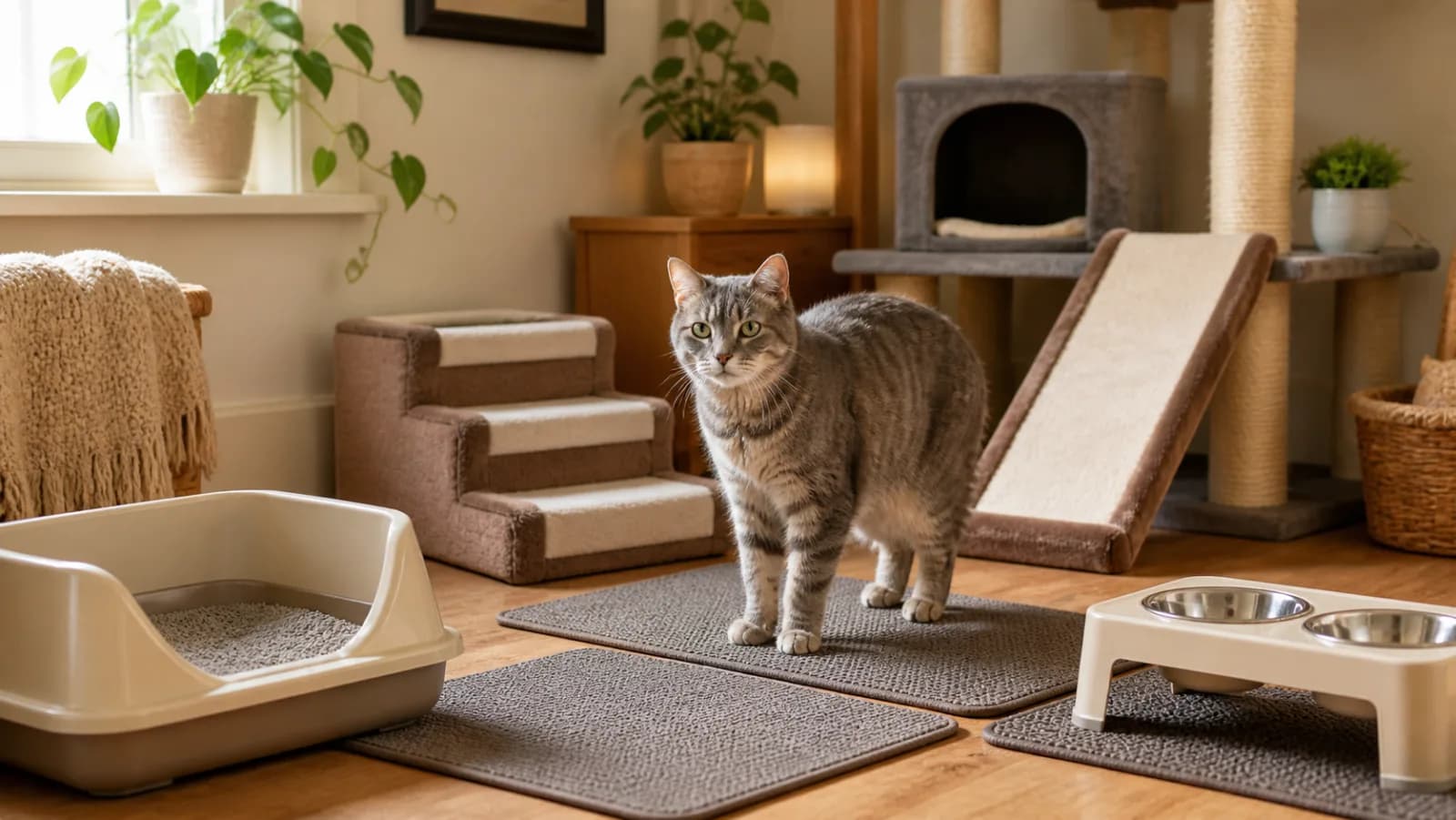
Senior Cat Accessibility Setup: Low-Entry Litter, Raised Bowls, Steps & Traction

Cats & Dogs
At-Home Pet Health Monitoring Tools (2026): Smart Scales, Activity Trackers, and Smart Litter for Senior Pets
Cats & Dogs
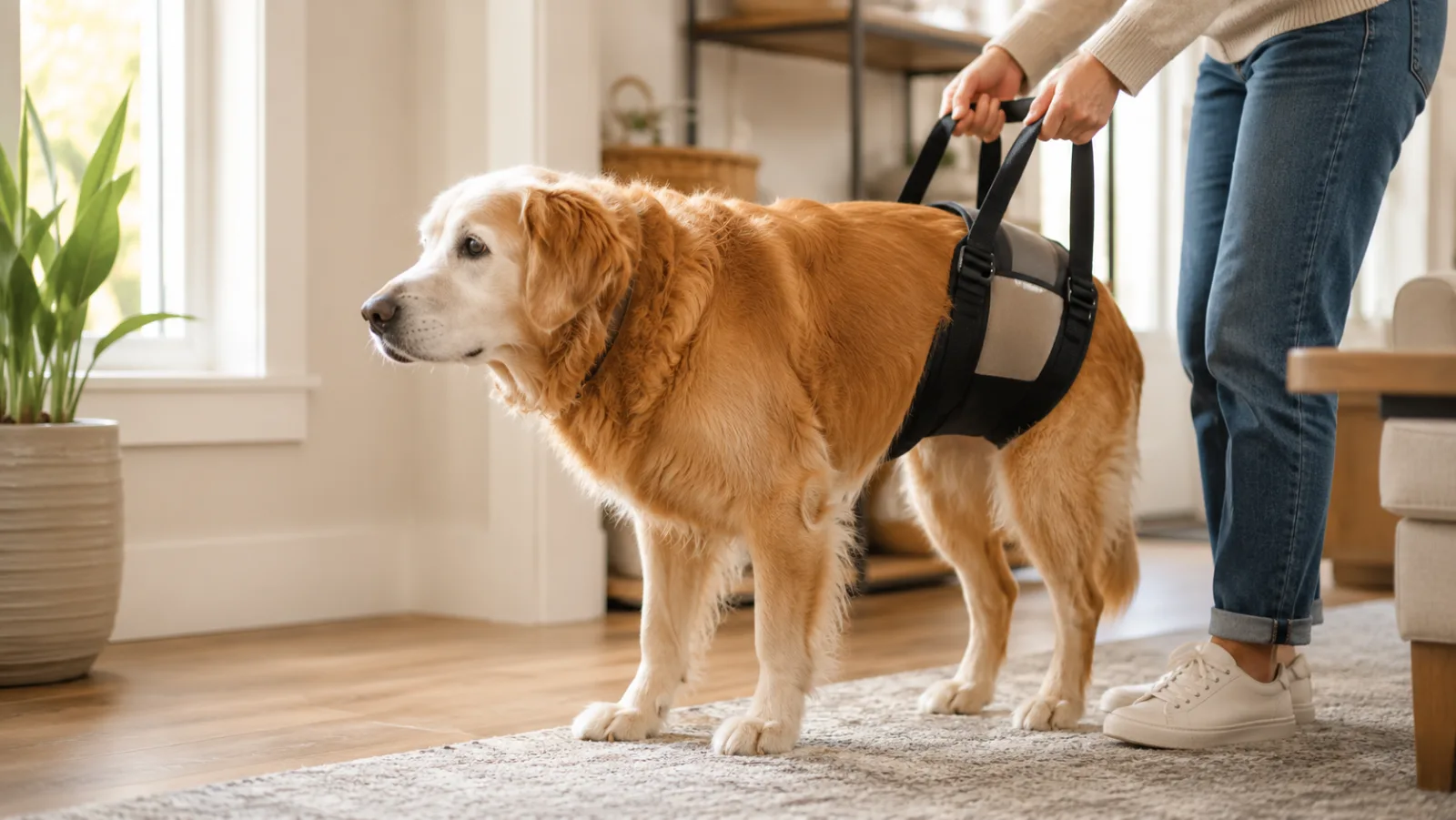
Best Pet Recovery and Medication Compliance Aids: Slings, Pill Pockets & Recovery Suits (2026)

Cats & Dogs