Birds
Best Hummingbird Feeders That Stay Clean, Full, and Pest-Free (2026)
The feeders that keep nectar fresh and pests out — a 40-ounce big-yard reservoir and one hand-blown glass showpiece, ranked by expert consensus and cleanability rather than capacity claims.
By Nick Miles · Updated August 12, 2026 · 11 min
PetPalHQ is reader-supported. We may earn a commission from qualifying Amazon purchases at no extra cost to you.
Evidence at a Glance
Aspects HummZinger HighView 12 oz
The consensus saucer: Bob Vila tested 12 popular feeders over six weeks and named the HummZinger HighView its top pick, reporting it was the most popular feeder with the birds in the test yard. Birds & Blooms experts Kenn and Kimberly Kaufman recommend the same 12-ounce model. Four ports, a raised wraparound perch for full-view feeding, a built-in ant moat, bee-resistant port geometry, and unbreakable polycarbonate backed by a lifetime warranty.
Sources: Bob Vila 12-feeder six-week field test, Birds & Blooms (Kenn and Kimberly Kaufman), Aspects manufacturer documentation
Verified Jun 10, 2026
First Nature 3055 Wide-Mouth 32 oz
The value math is hard to argue with: 32 ounces of capacity and 10 feeding ports for $12.78, with a wide-mouth jar opening sized for a bottle brush and a leakproof sealing ring between reservoir and base. It frequently sells in two-packs for roughly the price of one premium saucer. The trade-off is exposed oversized ports with no bee guards — small bees can crawl in and foul the nectar.
Sources: Hummingbirds Plus First Nature roundup, Birds & Blooms easy-clean feeder guidance, Amazon listing verified live 2026-06-10
Verified Jun 10, 2026
More Birds Big Gulp 40 oz Glass
A 40-ounce glass bottle over five soft feeding ports with an integrated perch ring and a built-in ant moat above the feeding stations. The wide bottle opening and detachable flat base make filling and scrubbing manageable, and the Bird Health+ line uses BPA-free, bird-safe materials. Everything Backyard reports experienced hummingbird feeders were very pleased with the constant traffic it attracted.
Sources: Everything Backyard owner-experience reporting, More Birds Bird Health+ manufacturer documentation
Verified Jun 10, 2026
Our Picks
Aspects
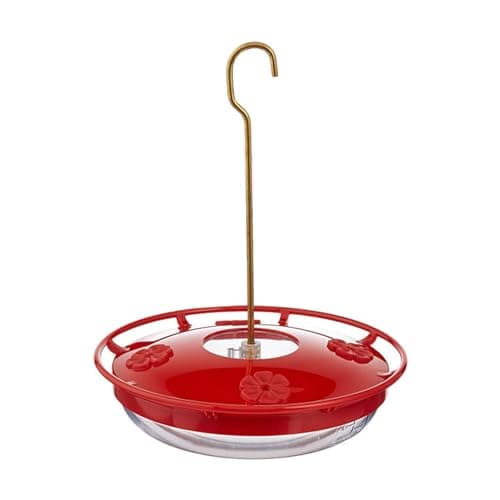
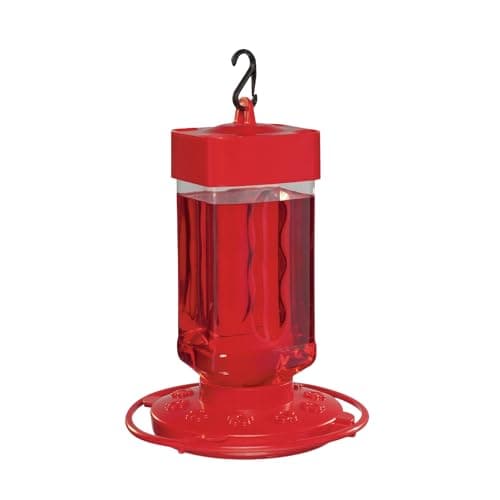
Aspects HummZinger HighView 12 Oz Hanging Hummingbird Feeder - 429, Red
9.2 / 10
- 12 oz saucer-style reservoir — holds 2 to 4 days of nectar for a typical yard
- 4 feeding ports with a raised wraparound perch for full-view feeding
- Built-in ant moat plus bee-resistant port geometry
- Unbreakable polycarbonate body that shrugs off temperature swings that crack glass
$28.96
First Nature
First Nature Hummingbird Feeder with Wide-Mouth Reservoir and Leakproof Sealing Ring - 10 Feeding Ports
7.8 / 10
- 32 oz nectar reservoir from the First Nature 3055 series — also sold in 2-packs
- 10 feeding ports — the most of any pick in this guide
- Wide-mouth jar opening sized for a bottle brush, with no narrow neck to fight
- Leakproof sealing ring between reservoir and base
$14.96
Last Amazon read 2026-09-08
More Birds
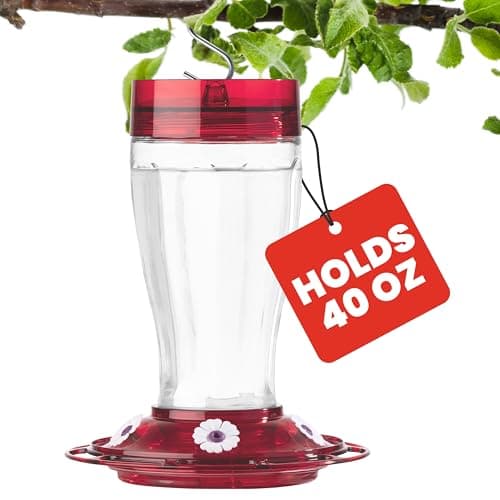
More Birds Bird Health+ Big Gulp Hummingbird Feeder, Glass, 5 Feeding Stations, 40 Ounces
8.3 / 10
- 40 oz glass nectar bottle — sized for yards that drain a feeder between cleanings
- 5 soft feeding ports with an integrated perch ring
- Built-in ant moat above the feeding stations
- Wide bottle opening and detachable flat base for filling and scrubbing
$25.48
Nature's Way Bird Products
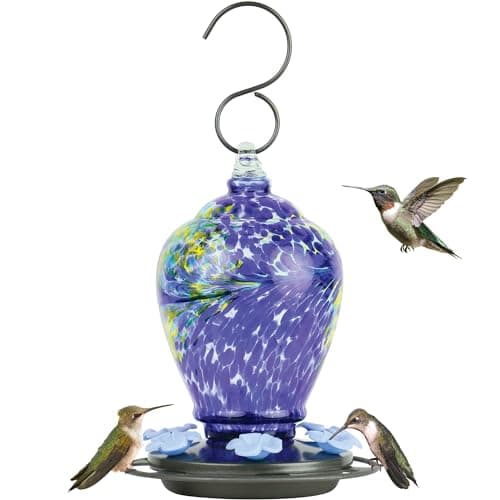
Nature's Way Bird Products AGF2 Hand Blown Artisan Gravity Spring Rain Hummingbird Feeder
7.6 / 10
- Genuine hand-blown artisan glass in the Spring Rain blue-green colorway — each unit is unique
- Gravity-fed bottle design with base-mounted flower feeding ports
- Metal flower ports with rubber gaskets rather than snap-in plastic, per owner reports
- Thick, heavy glass that owners report stays put and does not spill in wind
$23.97
The Short Answer
The More Birds Big Gulp is the feeder we would hang first in a yard with real traffic. Forty ounces of glass over five soft feeding ports covers a busy migration corridor between cleanings, the perch ring lets birds sit and drink rather than hover, and the ant moat sits built in above the ports. At $21.99 it is also the cheaper of the two picks here. The Nature's Way Spring Rain at $23.97 is the alternative when looks matter as much as function — the hand-blown glass is genuinely hand-made and wind-stable, but it runs four ports and carries no integrated pest defense, so budget an add-on ant moat. Whatever you hang, Audubon's cleaning math is the real commitment — in summer heat, nectar gets dumped and the feeder washed every day or two, and Cornell Lab's 4-to-1 water-to-sugar recipe with plain white sugar and no red dye is what actually brings birds back.
Every product on this list has been scored against the PetPal Gear Score, a weighted composite of expert consensus, observed effectiveness, animal safety, long-term durability, and value. Review method: Editorial synthesis of the National Audubon Society's hummingbird feeding FAQs and red-dye guidance. Cornell Lab of Ornithology nectar-recipe protocol published through All About Birds. Birds & Blooms recommendations from bird experts Kenn and Kimberly Kaufman and nature author Sally Roth. Bob Vila's six-week field test of 12 popular hummingbird feeders. Bird Watching HQ feeder coverage. Hummingbird Guide leaking-feeder diagnostics. Everything Backyard owner-experience reporting on the More Birds line. Manufacturer documentation from More Birds and Nature's Way Bird Products was reviewed. Community sentiment from r/hummingbirds plus Amazon and Walmart owner reviews informed pick selection. PetPalHQ does not run a backyard feeder-testing lab.. Synthesized from 7+ expert sources.
A hummingbird feeder is a chemistry commitment disguised as a garden ornament, which is why this guide weighs cleanability and pest defense as heavily as capacity. We read 7 expert sources for this guide, from the National Audubon Society's feeding FAQs and Cornell Lab of Ornithology's nectar protocol to Hummingbird Guide's leak diagnostics, and the four picks below cover the designs that matter here: the high-capacity gravity bottle and the artisan glass showpiece. This is wild-bird feeding gear throughout — caged pet birds are a different vertical with different products.
PetPalHQ.com earns affiliate commissions from qualifying purchases. Our recommendations are based on expert consensus — we synthesize professional reviews and published owner durability data, plus guidance from ornithology organizations, to find gear that's worth your investment. Commission rates never influence our editorial recommendations.
The lineup splits by yard and by buyer, not by quality tier alone. The More Birds Big Gulp is the default hang for most yards: 40 ounces of glass over five ports at $21.99, built for migration-corridor traffic and the cheaper of the two picks here. The Spring Rain feeder is the decorative specialist — hand-blown glass at $23.97 for people who want the nectar station to look like something. Hummingbirds share airspace with the seed crowd, so if you are building out a full station, our smart bird feeder guide covers the camera tier and the backyard birdwatching hub maps the whole setup. A note on ordering: we rank by buyer fit — which feeder best serves your yard and priorities — not by raw PetPal Gear Score, so a specialist pick can outscore picks ranked above it.
Saucer or Bottle: The Physics That Decide Most of It
Every hummingbird feeder is one of two machines. A saucer holds nectar in a flat dish below top-mounted ports, so gravity works for you: nothing presses nectar toward the openings, and Birds & Blooms notes the sugar water sits far enough below the ports that bees and wasps cannot dive in. A gravity bottle inverts a reservoir over base-mounted ports, and physics works against you — sun-heated air expands in the pocket above the nectar and pushes liquid out.
That single difference explains most of the leak complaints in this category. Hummingbird Guide's diagnostics point to the same culprits owners curse on review pages: heat-expanded air, loose seals between reservoir and base, and wind-sway pumping nectar through the ports. The heavy Spring Rain feeder resists wind-sway and the Big Gulp's detachable flat base seats firmly against its bottle, but no gravity design escapes the thermodynamics entirely. A saucer simply opts out of the problem — worth knowing if leaking is the thing that has soured you on feeders before.
Bottles win the other war: capacity. A 12-ounce saucer cannot serve a yard where a dozen birds drain the dish daily, which is exactly the yard the 40 oz Big Gulp exists for. Match the machine to the traffic — and if ants are marching down your hanger to either style, the fix starts at the hardware, so see our pole systems and baffles guide for the mounting half of the defense.
Nectar Safety: The 4:1 Recipe, the No-Dye Rule, and the Cleaning Clock
The feeder is the cheap part of this hobby; the nectar discipline is the real purchase. Cornell Lab of Ornithology's recipe is the entire chemistry: four parts water to one part plain white table sugar, boiled briefly to drive off chlorine and kill yeast, then cooled before filling. Nothing else goes in the reservoir.
Never use honey, which ferments into compounds that harm hummingbirds, and never use red dye. Audubon's guidance is unambiguous: artificial coloring is unnecessary because the feeder's red parts are attractant enough, and food dyes have harmed other animals. Every pick in this guide carries red components precisely so the nectar can stay clear.
The cleaning clock is where good intentions die. In summer heat, nectar ferments and molds within a day or two, so Audubon says to empty and clean feeders every day or every other day in hot weather, and every three days in temperate weather. Wash with hot water plus hydrogen peroxide, a weak vinegar solution, or a 1:10 bleach solution rinsed thoroughly — and skip dish soap, which leaves residue harmful to the birds. This schedule is why we score cleanability so heavily: the Big Gulp's wide bottle opening and detachable flat base get washed on time, and a fussy feeder quietly becomes a fermentation vat.
What We Passed On
One feeder made the research list and did not survive the cut, and the cut sharpens the picks above.
The Perky-Pet 203CPBN pinch-waist glass feeder at $7.99 was the hardest pass. It is a live listing with real expert support — nature author Sally Roth recommends the pinch-waist design in Birds & Blooms — and it includes both an ant moat and bee guards. But long-term owner reports describe chronic leaking across decades of this bottle design, with one owner reporting all four of their Perky-Pet feeders leaked over 20 years, naming capillary action and wind-sway as the causes. An 8-ounce reservoir is also too small for peak June traffic. Cheap, charming, and leak-prone is not a combination that earns a hook here.
$28.96
- 12 oz saucer-style reservoir — holds 2 to 4 days of nectar for a typical yard
- 4 feeding ports with a raised wraparound perch for full-view feeding
- Built-in ant moat plus bee-resistant port geometry
- Unbreakable polycarbonate body that shrugs off temperature swings that crack glass
- Lifetime warranty from Aspects; lift-off red cover for fast rinse-and-refill cleaning
The HummZinger HighView is the closest thing this category has to a consensus answer. Bob Vila ran 12 popular hummingbird feeders through a six-week field test and named the Aspects HighView its top pick, reporting that it was the most popular feeder with the birds in the test yard. Birds & Blooms reaches the same conclusion through a different door: bird experts Kenn and Kimberly Kaufman recommend this exact 12-ounce model. When a field test and the Kaufmans converge on one feeder, the ranking decision makes itself.
The saucer geometry is what the convergence is about. Birds & Blooms explains that flying-saucer-style feeders are the easiest to clean and refill, and that the sugar water sits far enough below the ports that bees and wasps cannot dive in. The HummZinger adds a built-in ant moat above the dish, so both major pest lanes are closed without add-on accessories. The bright red lift-off cover draws birds from a distance and comes off in one motion for a rinse and refill — and per Audubon's hot-weather guidance, you will be doing that every day or two in summer, so a 60-second cleaning loop is worth real money.
Durability is the quiet third leg. Bob Vila notes the unbreakable polycarbonate withstands temperature swings, harsh weather, and impacts that would easily crack glass, and Aspects backs the dish with a lifetime warranty that makes it a long-term investment rather than a seasonal purchase.
Here is the honest trade-off: $37.92 buys the smallest reservoir in this lineup, which makes the HummZinger HighView the worst dollars-per-ounce purchase in this lineup. Four ports also means queueing at the dish when June traffic peaks — the First Nature 3055 offers ten. And the styling is function-first red plastic; buyers who want a feeder that doubles as garden decor should look at the blown-glass specialist below.
What We Love
- Bob Vila's top pick after a six-week, 12-feeder field test — most popular feeder with the birds
- Recommended by Birds & Blooms experts Kenn and Kimberly Kaufman
- Saucer design keeps nectar below the ports where bees and wasps cannot reach
- Built-in ant moat closes the second pest lane without accessories
- Lifetime warranty on an unbreakable polycarbonate body
What Could Be Better
- Highest price here for the smallest reservoir — the worst dollars-per-ounce in this lineup
- Only 4 ports versus 10 on the value pick, so peak June traffic queues at the dish
- 12 oz capacity means refills every 2 to 4 days, and Audubon's hot-weather rule still demands near-daily dumping
- Function-first looks — a plain red plastic dish with none of the glass aesthetics decorative buyers want
The Verdict
If you want the feeder that experts and field testing agree on, hang the HummZinger HighView and accept the small reservoir. The daily summer cleaning Audubon prescribes makes its 60-second rinse loop more valuable than raw capacity.
Sources
- Bob Vila: top pick after testing 12 popular feeders over 6 weeks — it was the most popular feeder with the birds in the test yard
- Bob Vila: unbreakable polycarbonate withstands temperature swings, harsh weather, and impacts that would easily crack glass; lifetime warranty makes it a long-term investment
- Birds & Blooms: bird experts Kenn and Kimberly Kaufman recommend the Aspects HummZinger HighView 12-ounce feeder
- Birds & Blooms: flying-saucer-style feeders are the easiest to clean and refill, and the sugar water sits far enough below the ports that bees and wasps can't dive in
- Bob Vila: bright red lift-off cover draws hummingbirds from a distance and comes off easily for quick cleaning and refilling
First Nature First Nature Hummingbird Feeder with Wide-Mouth Reservoir and Leakproof Sealing Ring - 10 Feeding Ports
$14.96
Last Amazon read 2026-09-08
- 32 oz nectar reservoir from the First Nature 3055 series — also sold in 2-packs
- 10 feeding ports — the most of any pick in this guide
- Wide-mouth jar opening sized for a bottle brush, with no narrow neck to fight
- Leakproof sealing ring between reservoir and base
- All-plastic two-piece body that twists apart for cleaning
The First Nature 3055 wins the arithmetic. For $10.49 — verified live on the Amazon listing as of August 21, 2026 — you get a 32-ounce reservoir and ten feeding ports, and the 3055 series frequently sells in two-packs for roughly the price of a single premium saucer. For a first feeder, a rental backyard, or a second station at the far fence line, the dollars-per-port ratio is untouchable in this lineup.
The design earns its keep on cleaning day, which matters more than most buyers expect. Birds & Blooms experts stress that the best feeder is the one that is easy to clean and keeps pests out, because feeders that are hard to scrub simply do not get cleaned — and the birds can get sick. The wide-mouth jar opening on the First Nature takes a full-size bottle brush without a fight, the two-piece body twists apart, and the leakproof sealing ring keeps the reservoir-to-base joint from weeping the way cheap bottle feeders do.
Here is the honest trade-off, and it is a real one: the oversized feeding holes carry no bee guards. Hummingbirds Plus reports that small bees can crawl through the ports, die inside, and pollute the nectar — an ugly discovery on refill day. The 32-ounce capacity is also more nectar than a low-traffic yard can use before it spoils, since Audubon's guidance says hot-weather nectar gets dumped every one to two days regardless of how much remains. Fill it a third full unless your yard is genuinely busy. And as a gravity bottle, it is inherently more drip-prone than a saucer when sun-heated air expands inside the reservoir, with no warranty story to lean on when plastic fatigues.
What We Love
- 32 oz and 10 ports for $10.49 — the strongest dollars-per-port ratio in the guide
- Wide-mouth opening takes a full bottle brush, so the Audubon cleaning cadence is actually sustainable
- Leakproof sealing ring between reservoir and base
- Frequently sold in 2-packs for roughly the price of one premium saucer
What Could Be Better
- No bee guards on the oversized ports — owners report small bees crawling in, drowning, and fouling the nectar
- 32 oz outruns what low-traffic yards can use before spoilage under Audubon's 1-to-2-day hot-weather dump rule
- All-plastic build with no warranty coverage to match the HummZinger's lifetime backing
- Bottle-style reservoir drips more than saucer designs when sun-heated air expands inside
The Verdict
Buy the First Nature 3055 for the price, the ten ports, and the bottle-brush-friendly opening — then under-fill it and stay on the cleaning schedule. Bee intrusion through the unguarded ports is the failure mode to watch.
Sources
- Hummingbirds Plus: the feeding holes are large with no bee guards, so small bees can crawl through the ports, die, and pollute the nectar
- Amazon listing (verified live 2026-08-21): wide-mouth reservoir, leakproof sealing ring, and 10 feeding ports at $10.49
- Birds & Blooms: experts stress the best feeder is one that's easy to clean and keeps pests out — feeders that are hard to scrub don't get cleaned, and the birds can get sick
- Source: eBay/Amazon listings confirm the 3055 sells as a 32-ounce feeder, frequently in sets of 2 for roughly the price of one premium saucer feeder
More Birds More Birds Bird Health+ Big Gulp Hummingbird Feeder, Glass, 5 Feeding Stations, 40 Ounces
$25.48
- 40 oz glass nectar bottle — sized for yards that drain a feeder between cleanings
- 5 soft feeding ports with an integrated perch ring
- Built-in ant moat above the feeding stations
- Wide bottle opening and detachable flat base for filling and scrubbing
- Bird Health+ line: BPA-free, bird-safe materials with recyclable parts
The More Birds Big Gulp is the pick for yards where the nectar actually disappears. Forty ounces of glass is a lot of reservoir for a hummingbird feeder, and Everything Backyard reports that experienced hummingbird feeders were very pleased with how the feeder attracted a constant supply of hummingbirds. Five soft feeding ports around an integrated perch ring let multiple birds work the feeder at once, which is the configuration a genuinely busy migration-corridor yard needs.
The supporting details are better than the price suggests. The built-in ant moat sits above the feeding stations and stops ants before they reach the nectar, per the manufacturer's Bird Health+ documentation, which also covers the BPA-free, bird-safe materials and recyclable parts. The wide bottle opening and the detachable flat base mean filling and scrubbing do not require specialty tools — a meaningful point when Audubon's summer cadence has you washing the feeder every day or two.
Here is the honest trade-off, and it comes straight from owner reports: the base is not dishwasher safe. Amazon and Walmart owners describe even top-rack washing warping the base until it no longer fits the bottle, a lesson most learn the hard way. Heat is the other recurring theme — some Walmart owners report glass bottles slipping from the base or clear bottoms cracking in intense summer heat, with a few resorting to food-grade silicone glue to secure the red tops to the glass. The plastic base components also crack over time with extended sun exposure and temperature swings. And like every gravity bottle, the Big Gulp drips more readily than a saucer when heat expands the air pocket above the nectar, so hang it in afternoon shade if you can.
What We Love
- 40 oz capacity carries a heavy-traffic yard from one cleaning to the next
- 5 ports with a perch ring support multiple birds feeding at once
- Built-in ant moat above the stations stops ants before they reach the nectar
- Wide opening and detachable flat base keep the cleaning loop manageable
- BPA-free, bird-safe Bird Health+ materials
What Could Be Better
- Base warps in the dishwasher, even top rack — hand-wash only, which owners learn the hard way
- Owner reports of bottles slipping from the base and clear bottoms cracking in intense summer heat
- Plastic base components crack over time with extended sun exposure and temperature swings
- Gravity-bottle design drips more than saucers when heat expands the air pocket above the nectar
The Verdict
For a yard with real traffic, the Big Gulp's 40 ounces and five ports earn the $21.99. Hand-wash the base, hang it out of the harshest afternoon sun, and the known failure modes mostly stay theoretical.
Sources
- Everything Backyard: experienced hummingbird feeders were very pleased with how the More Birds feeder attracted a constant supply of hummingbirds
- Manufacturer (Bird Health+ line): built-in ant moat stops ants before they reach the nectar; BPA-free bird-safe materials
- Amazon/Walmart owner reviews: the base is not dishwasher safe — even top-rack washing can warp it so it no longer fits the bottle
- Walmart owner reviews: some glass bottles slipped from the base or cracked in intense heat; owners resorted to food-grade silicone glue to secure the red tops to the glass
Nature's Way Bird Products Nature's Way Bird Products AGF2 Hand Blown Artisan Gravity Spring Rain Hummingbird Feeder
$23.97
- Genuine hand-blown artisan glass in the Spring Rain blue-green colorway — each unit is unique
- Gravity-fed bottle design with base-mounted flower feeding ports
- Metal flower ports with rubber gaskets rather than snap-in plastic, per owner reports
- Thick, heavy glass that owners report stays put and does not spill in wind
- Model AGF2; verified live on Amazon at $23.97 (2026-06-10)
The Spring Rain feeder is the pick for buyers who want the nectar station to look like garden art, and the surprise is that the craftsmanship claims hold up. Owner reviews confirm the glass really is hand-blown — thick and heavy, in a blue-green Spring Rain colorway where no two units match. That weight is functional, not just decorative: owners report the feeder stayed put and did not spill even when the wind blew, which is more than most lightweight bottles manage on an exposed hook.
The hardware is the second pleasant surprise at $23.97. The flower feeding ports are metal with rubber gaskets at the water entry rather than the snap-in plastic that cheap decorative feeders use, so the part that touches nectar daily is the part built to last.
Here is the honest trade-off, and there are several. Shipping damage is the recurring complaint with hand-blown glass — one buyer's unit arrived looking like a cracked car window, so inspect the box the day it lands. The warranty fine print deserves equal skepticism: on a sibling illuminated model, the box advertises a lifetime warranty in large print, but customer service reportedly told a buyer the coverage applies only to the rubber seal. Functionally, the gravity bottle must be inverted to fill and is more heat-drip-prone than any saucer, and there are no bee guards or integrated ant moat — pest defense depends entirely on add-on accessories. This is a showpiece that feeds birds well, not a low-maintenance workhorse, and it scores accordingly.
What We Love
- Genuine hand-blown artisan glass — thick, heavy, and unique per unit
- Owner-reported wind stability: the heavy glass does not spill when gusts hit
- Metal flower ports with rubber gaskets instead of snap-in plastic
- Garden-decor looks at $23.97 — the only pick that doubles as ornament
What Could Be Better
- Hand-blown glass sometimes arrives cracked from shipping — inspect immediately on delivery
- Advertised lifetime warranty reportedly covers only the rubber seal, per customer-service responses on a sibling model
- Gravity bottle must be inverted to fill and drips more readily in heat than saucer designs
- No bee guards or integrated ant moat — pest defense relies on add-on accessories
The Verdict
Buy the Spring Rain feeder as functional garden art and check the glass the day it arrives. For pure feeding utility per dollar, the Big Gulp above does the same job for less money and with fewer caveats.
Sources
- Owner reviews (Walmart / Meh community): the glass really is hand-blown, thick and heavy — feeders did not spill even when the wind blew
- Owner reviews: the flowers are metal with rubber gaskets at the water entry, not cheap plastic
- Owner complaints: hand-blown glass sometimes arrives cracked from shipping — one buyer's feeder arrived 'looking like a cracked car window'
- Owner complaints (illuminated sibling model): the box says LIFETIME WARRANTY in large print, but customer service told a buyer the warranty covers only the rubber seal
How We Score
Formula
Nectar Station Score = (Expert Consensus × 0.30) + (Cleanability & Nectar Freshness × 0.25) + (Bird Safety & Pest Defense × 0.20) + (Durability × 0.15) + (Value × 0.10)
Score Factors
- Expert Consensus · 30%
- How strongly the named outlets converge on the product. Bob Vila's six-week field test of 12 feeders carries the most weight because it is comparative and time-boxed; Birds & Blooms expert recommendations from Kenn and Kimberly Kaufman rank next; single-outlet roundup mentions and owner-experience reporting count but cannot outvote a field test. No feeder in this guide carries a comparative field-test endorsement, so owner-experience reporting and manufacturer documentation do the work here — which is why nothing clears 8.5 on consensus alone.
- Cleanability & Nectar Freshness · 25%
- How realistic the Audubon cleaning cadence is with this design — every day or two in hot weather, every three days in temperate weather. Feeders that disassemble fast and take a bottle brush get cleaned; feeders that fight you do not, and Birds & Blooms warns that dirty feeders make birds sick. Saucer dishes with lift-off covers score highest, wide-mouth bottles score well, and narrow-neck or invert-to-fill designs score lowest.
- Bird Safety & Pest Defense · 20%
- Whether the design protects the nectar and the birds without add-on hardware. Built-in ant moats, bee-resistant port geometry, and saucer designs that hold sugar water below the reach of diving wasps score highest. Unguarded oversized ports that admit small bees — which then die and pollute the nectar — score lowest. BPA-free, bird-safe materials earn credit; designs that depend on accessories for basic pest defense lose it.
- Durability · 15%
- How the feeder survives sun, temperature swings, and seasons of handling. Polycarbonate that withstands impacts which crack glass scores highest, especially backed by a genuine lifetime warranty. Glass earns marks for UV stability but loses them where owners report heat-cracking or base separation. Plastic that warps in a dishwasher or fatigues in sun is scored on documented owner reports, not marketing claims.
- Value · 10%
- Dollars per ounce of usable capacity and per feeding port, adjusted for multi-pack availability. The More Birds Big Gulp takes raw value here at $21.99 for 40 ounces across five ports. Value is deliberately the lightest weight in the formula because a cheap feeder that skips pest defense or cleanability costs more in spoiled nectar and sick birds than it saves at checkout.
| Rank | Product | Score |
|---|---|---|
| #1 | Aspects Aspects HummZinger HighView 12 Oz Hanging Hummingbird Feeder - 429, Red | 9.2 |
| #2 | More Birds More Birds Bird Health+ Big Gulp Hummingbird Feeder, Glass, 5 Feeding Stations, 40 Ounces | 8.3 |
| #3 | First Nature First Nature Hummingbird Feeder with Wide-Mouth Reservoir and Leakproof Sealing Ring - 10 Feeding Ports | 7.8 |
| #4 | Nature's Way Bird Products Nature's Way Bird Products AGF2 Hand Blown Artisan Gravity Spring Rain Hummingbird Feeder | 7.6 |
When NOT to Buy
Skip the category entirely if you cannot commit to the cleaning schedule. Audubon's guidance is blunt: in hot weather, nectar ferments and molds fast enough that feeders need emptying and cleaning every day or every other day, and every three days even in temperate weather. A neglected feeder serves spoiled nectar that can sicken the birds it attracts. If that cadence is not realistic for your household, a pollinator garden delivers the hummingbirds without the maintenance contract.
Skip the 40-ounce reservoir if your yard sees only occasional visitors. Big bottles tempt owners into filling them full, and the nectar spoils long before the birds drink it down. A low-traffic yard is better served by a small feeder — or by the Big Gulp deliberately under-filled — than by a half-gallon of sugar water aging in the sun.
Skip any feeder you plan to hang in all-day direct sun, especially the gravity bottles. Heat expands the air pocket above the nectar and pushes drips out of bottle-style ports, accelerates fermentation, and — per owner reports on the glass picks — can crack components outright. If your only hook is full sun, plan on drips from any gravity bottle and commit to daily changes.
Skip the decorative glass pick if you cannot inspect the package on arrival. Hand-blown glass ships imperfectly often enough that owners report units arriving cracked, and the advertised lifetime warranty reportedly covers only the rubber seal on at least one sibling model. Order it when someone will be home, and open the box that day.
Finally, never buy or mix red-dyed nectar to compensate for a plain-looking feeder. Audubon's position is that artificial coloring is unnecessary — the feeder's red parts are attractant enough — and food dyes have harmed other animals in testing. Plain white sugar at Cornell Lab's 4-to-1 ratio is the entire recipe.
Frequently Asked Questions
- What is the correct sugar-to-water ratio for hummingbird nectar?
- Four parts water to one part plain white table sugar, per Cornell Lab of Ornithology. Boil the water briefly to drive off chlorine and kill yeast and mold spores, stir in the sugar until dissolved, and cool it before filling the feeder. Refrigerate extra for up to a week. Never substitute honey, which ferments into compounds harmful to hummingbirds, and skip brown sugar, agave, and artificial sweeteners — the 4:1 white-sugar solution approximates flower nectar, and it is the only recipe the ornithology organizations endorse.
- Is red dye in hummingbird nectar safe?
- No reputable source recommends it. Audubon's position is that artificial coloring is unnecessary and that food dyes have been shown to harm other animals, so there is no reason to gamble with a three-gram bird. The red parts molded into every feeder in this guide do the attracting; the nectar itself should be clear. If a commercial nectar mix is dyed red, leave it on the shelf and stir sugar into water at home for a fraction of the price.
- How often should I clean my hummingbird feeder in summer?
- Every day or every other day in hot weather, per Audubon — heat ferments and molds nectar fast, and spoiled sugar water can sicken the birds you are trying to help. In temperate weather, every three days. Wash with hot water plus hydrogen peroxide, a weak vinegar solution, or a 1:10 bleach solution rinsed thoroughly, and avoid dish soap, which leaves harmful residue. This cadence is exactly why wide openings and detachable bases dominate our rankings: the feeder that cleans in sixty seconds is the feeder that actually gets cleaned.
- How do I keep bees and ants off my hummingbird feeder?
- Geometry first, accessories second. The Big Gulp's built-in ant moat sits above the feeding stations and drowns the ant trail before it reaches the nectar, which closes the commonest lane on its own. Bees are the geometry half: saucer designs hold nectar far enough below the ports that bees and wasps cannot dive in, per Birds & Blooms, while any bottle with bare oversized ports lets small bees crawl inside and foul the reservoir. The Spring Rain carries no integrated moat and no bee guards at all, so budget an add-on moat if that is the feeder you hang. Keep moats filled with plain water, relocate the feeder a few feet if bees swarm it, and never coat hangers with oils or sticky products, which can foul feathers.
- Why is my hummingbird feeder leaking?
- Usually physics, not defects. In gravity-bottle designs, sun-heated air expands in the pocket above the nectar and pushes drips through the ports — the mechanism behind most summer leak complaints, per Hummingbird Guide's diagnostics. Wind-sway pumps nectar out the same way, and a worn or misseated seal between reservoir and base finishes the job. Fixes in order: move the feeder to afternoon shade, check the sealing ring, and hang it where gusts cannot swing it. If the dripping persists, switch to a saucer design, which holds nectar below the ports and cannot siphon.
- What size hummingbird feeder should I buy?
- Think in terms of what your yard drinks in two days, not what the bottle holds. Audubon's hot-weather rule means nectar gets dumped every day or two no matter how much is left, so an oversized reservoir in a quiet yard just wastes sugar. Neither pick in this guide is a small-format feeder, and you do not need one to get the sizing right: fill the 40-ounce Big Gulp a third full in a quiet yard and top it to the shoulder only when birds are genuinely draining it between cleanings. Two feeders hung out of sight of each other work better than one big one in a territorial yard, whatever size you buy.
Bottom Line
Start with the More Birds Big Gulp if your yard gets real traffic. Forty ounces of glass over five ports is a lot of nectar between refills, the built-in ant moat closes the commonest pest lane, and at $21.99 it is the cheaper of the two picks here. Hand-wash the base and keep it out of the harshest afternoon sun.
Pick the Nature's Way Spring Rain only if looks matter as much as function. The hand-blown glass is real and wind-stable, but inspect for shipping cracks and budget for add-on pest defense.
Whatever you hang, the feeder is the cheap part. Cornell Lab's 4-to-1 water-to-sugar recipe with plain white sugar, no red dye per Audubon, and a wash every day or two in summer heat are what actually keep hummingbirds coming back safely.
Sources & Methodology
Methodology
Nectar Station Score = (Expert Consensus × 0.30) + (Cleanability & Nectar Freshness × 0.25) + (Bird Safety & Pest Defense × 0.20) + (Durability × 0.15) + (Value × 0.10)
Expert review sources
- National Audubon Society — Hummingbird Feeding FAQs and Red-Dye Guidance
- Cornell Lab of Ornithology / All About Birds — Nectar Recipe Protocol
- Birds & Blooms — Kenn and Kimberly Kaufman Feeder Recommendations; Sally Roth Design Commentary
- Bob Vila — Six-Week Field Test of 12 Popular Hummingbird Feeders
- Bird Watching HQ — Hummingbird Feeder Coverage
- Hummingbird Guide — Leaking-Feeder Diagnostics
- Everything Backyard — More Birds Owner-Experience Reporting
Community sources
- r/hummingbirds community discussion on feeder hygiene, pest defense, and placement
- Amazon and Walmart owner reviews on dishwasher warping, heat-cracking, and shipping damage across the More Birds and Nature's Way lines
- Manufacturer documentation from More Birds and Nature's Way Bird Products
Prices and specs verified June 10, 2026.
About the author
Nick Miles is the chief editor of PetPalHQ. The picks above are editorial synthesis of ornithology-organization guidance, published field testing, manufacturer specifications, and verified community sentiment. PetPalHQ does not run a backyard feeder-testing lab. The Nectar Station Score is a composite of expert opinion and documented design factors, not a measurement.
PetPalHQ is a participant in the Amazon Services LLC Associates Program. We may earn commissions from qualifying purchases — at no extra cost to you.