Birds
Best Smart Bird Feeders for U.S. Backyards (2026)
Bird Buddy is the synthesis pick for U.S. backyards needing AI-assisted identification; Birdfy edges ahead on dual-lens optics and solar bundles. Editorial recommendations grounded in Cornell Lab of Ornithology, Audubon, and brand documentation.
By Nick Miles · Updated May 5, 2026 · 13 min read
PetPalHQ is reader-supported. We may earn a commission from qualifying Amazon purchases at no extra cost to you.
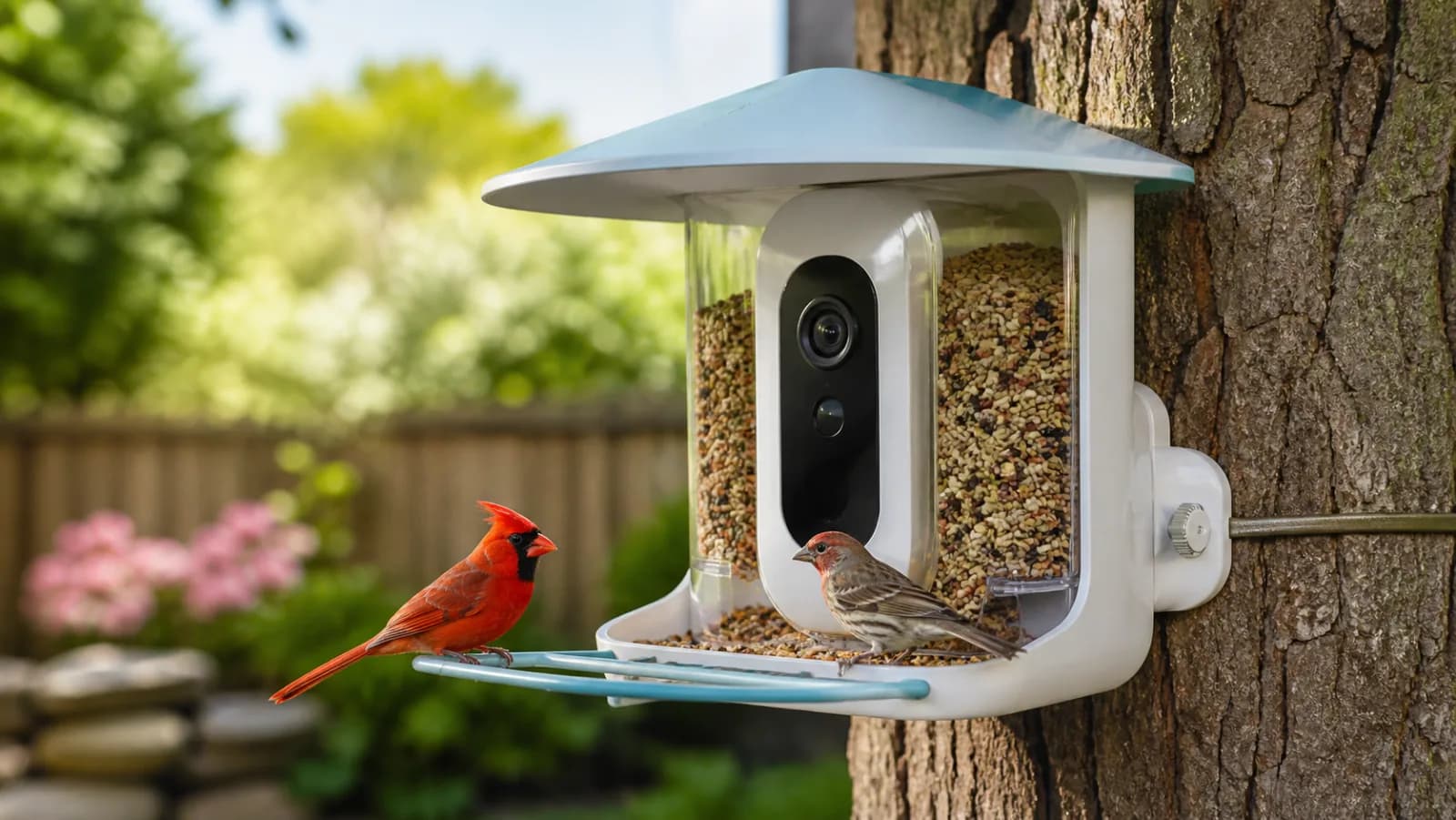
Evidence at a Glance
Birdbuddy PRO Solar Smart Bird Feeder
Solar roof, 5 MP stills, up to 2K video, HDR/WDR, IP67-rated Nature Cam Pro module — the model Good Housekeeping's 2026 review found easiest to set up when Wi-Fi and sun exposure are met.
Sources: Birdbuddy product specifications, Birdbuddy support documentation, Good Housekeeping Bird Buddy Review 2026, Cornell Lab of Ornithology
Verified May 4, 2026
Birdfy 2 Smart Bird Feeder with Dual-Lens Camera
Dual-lens 2K + 1080p capture for live streaming and close-up bird photography, AI species identification, solar-powered — the Birdfy variant The Verge highlighted in CES 2026 coverage as the next-generation imaging direction for the brand.
Sources: Birdfy product specifications, Birdfy support FAQ, WIRED Best Smart Bird Feeders 2026, The Verge CES 2026 coverage
Verified May 4, 2026
Squirrel Buster Classic
Mechanical squirrel-proof tube feeder — no camera, no subscription, no Wi-Fi dependency. The classic non-smart benchmark Cornell Lab's cleaning protocol is easiest to actually follow on.
Sources: Brome Bird Care manufacturer documentation, Cornell Lab of Ornithology, National Audubon Society
Verified May 4, 2026
Our Picks
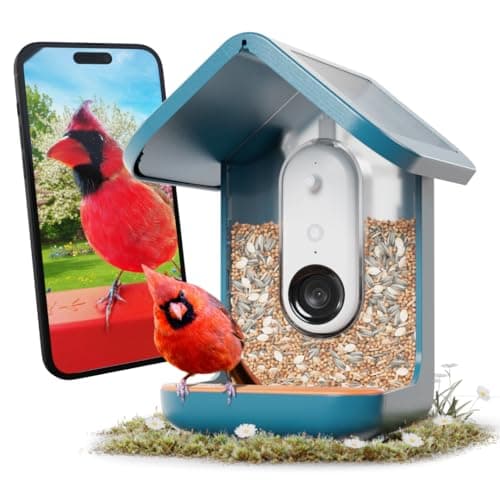
Birdbuddy
Birdbuddy PRO Solar Smart Bird Feeder
9.3 / 10
- Solar roof for sustained charging in sun-exposed yards
- 5 MP stills, up to 2K video, HDR/WDR, slow-motion capture
- AI species identification via Birdbuddy app and machine-learning model
- IP67-rated Nature Cam Pro camera module per brand specifications
$239.99
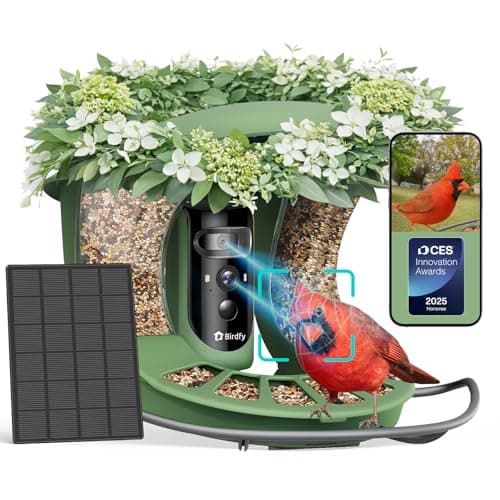
Birdfy
Birdfy 2 Smart Bird Feeder with Dual-Lens Camera
9.0 / 10
- Dual-lens system pairs a 2K wide-angle camera with a 1080p close-up lens
- Solar-powered with rechargeable battery backup
- AI species identification with cloud-based saved-clip workflow
- Live streaming plus close-up macro photography in a single device
$259.99
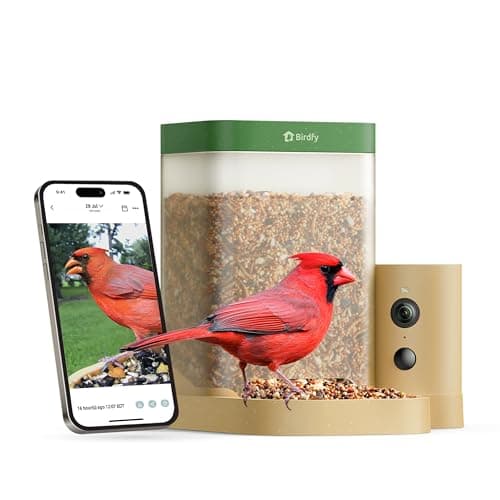
Birdfy
Birdfy Smart Bird Feeder for Rookie
8.2 / 10
- Sub-$50 entry into the smart-feeder category
- Camera with dual night vision per product listing
- AI bird recognition by subscription
- IP66 weather rating per product listing
$59.99
Brome Bird Care
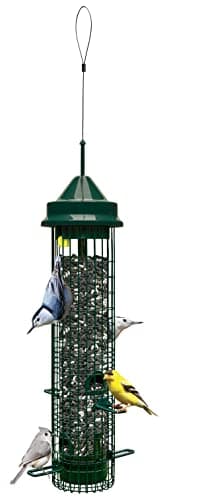
Squirrel Buster Classic Squirrel-Proof Bird Feeder
8.6 / 10
- Mechanical weight-activated squirrel-proof shroud
- Four feeding ports for mixed backyard flocks
- 2.4-pound seed capacity
- No camera, no Wi-Fi, no subscription, no battery
$79.22
Birdfy
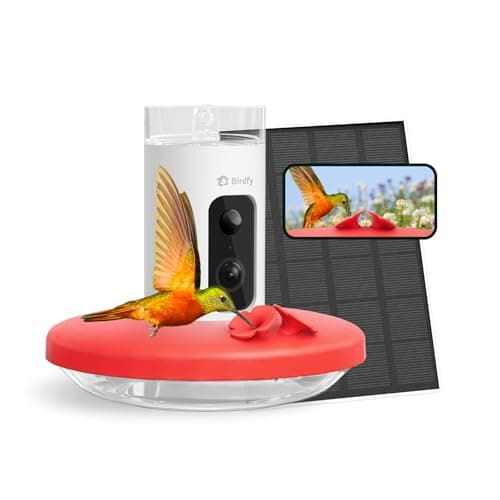
Birdfy Hummingbird Feeder with Camera and Solar Panel
8.4 / 10
- Smart camera bird feeder built specifically for hummingbird capture
- Solar panel for sustained charging
- AI hummingbird species recognition with capture workflow
- 14-ounce nectar capacity, easy-clean design
$149.99
The Short Answer
If you can only buy one smart bird feeder, the Birdbuddy PRO Solar Smart Bird Feeder is the synthesis pick — it pairs a solar roof, 2K video, and the most polished onboarding flow Good Housekeeping documented in 2026. The Birdfy 2 Dual-Lens edges ahead if you want true close-up macro shots and the strongest published weather rating in this roundup. Pick the budget Birdfy Rookie if you want AI capture under $50 and can accept a subscription for full recognition. Pick the Squirrel Buster Classic if you do not need a camera at all and want a feeder Cornell Lab's cleaning guidance is easiest to follow on.
Every product on this list has been scored against the PetPal Gear Score, a weighted composite of expert consensus, observed effectiveness, animal safety, long-term durability, and value. Review method: Editorial synthesis of Cornell Lab of Ornithology, National Audubon Society, U.S. Fish and Wildlife Service, Project FeederWatch, brand specification documents from Birdbuddy and Birdfy, and consumer-tech reporting from WIRED and Good Housekeeping — no first-hand product testing.. Synthesized from 12+ expert sources.
The smart bird feeder category is no longer a gadget niche. The U.S. Fish and Wildlife Service's 2022 birding analysis reports 96 million Americans engaged in birding, including roughly 91 million backyard birders, with total birding-related expenditures reaching $107.6 billion. Cornell Lab of Ornithology says its Merlin Bird ID app has reached 10 million active users, and the 2026 Great Backyard Bird Count logged more than 1.23 million saved Merlin identifications worldwide. Camera-and-AI feeders from Birdbuddy and Birdfy now sit on the same shelf as standard hopper and tube feeders, and they are framed in consumer-tech outlets as mainstream giftable outdoor tech rather than birding gear.
The picks below are editorial synthesis. PetPalHQ does not run a testing lab — every product on this page was selected by reviewing brand specification documents from Birdbuddy and Birdfy, support documentation from both manufacturers, Good Housekeeping's 2026 review of Bird Buddy, WIRED's 2026 smart-feeder roundup, and authoritative cleaning, placement, and disease-prevention guidance from Cornell Lab of Ornithology, the National Audubon Society, the U.S. Fish and Wildlife Service, and Project FeederWatch. Where expert sources disagreed — most importantly on whether to feed at all during disease outbreaks — we surface the disagreement instead of hiding it.
This guide is the buying-side companion to the Smart Bird Feeders and Backyard Birdwatching Gear Guide hub. The hub covers what a smart bird feeder is, how camera capture works, the full taxonomy of feeder types, cleaning and disease-prevention protocols, and the responsible-feeding nuance that separates Cornell and Audubon's position from California's wildlife health agencies. This article covers what to actually buy.
Why Smart Bird Feeders Are Now Mainstream
Three numbers explain the category shift. Cornell Lab's Merlin Bird ID has crossed 10 million users. The 2026 Great Backyard Bird Count saw Merlin use up nearly 100 percent year over year. The U.S. Fish and Wildlife Service's 2022 demographic analysis put backyard birding at 91 million Americans. Consumer-tech outlets including WIRED and The Verge now cover Birdbuddy and Birdfy product launches at CES alongside other connected-home gadgets. Good Housekeeping reviewed Bird Buddy in 2026 with the same framing it would use for a video doorbell.
What that adds up to: AI-assisted bird identification is no longer a novel feature. It is the consumer expectation. Buyers shopping for a feeder in 2026 are weighing whether to buy a connected feeder by default, with the non-camera classics now positioned as the deliberate alternative — exactly the inversion of the category three years ago.
Buying Considerations the Marketing Pages Do Not Highlight
Camera angle and close-focus matter more than headline resolution. Birdbuddy's published specs emphasize HDR/WDR, field of view, and 2.6-inch close focus alongside the 5 MP stills and 2K video. WIRED's 2026 testing repeatedly notes that capture reliability and field of view matter more than 4K marketing. The Birdfy 2's dual-lens system is a real upgrade on the close-focus axis specifically because birds visit at unpredictable distances.
Mounting position drives almost everything. Cornell Lab and the U.S. Fish and Wildlife Service both advise placing feeders either within about three feet of reflective windows — close enough that birds cannot build up fatal collision momentum — or well past the danger zone, typically more than 30 feet away. National Audubon Society spacing guidance recommends pole systems with squirrel baffles, with meaningful distance from jump-off points like fences and tree limbs. None of those constraints are in the brand product photography.
Subscription gotchas are the dominant total-cost-of-ownership variable. Birdbuddy's support documentation says core feeder functions work without a membership; that is genuinely useful and is the reason the PRO ranks first in this guide. Birdfy ships multiple AI and cloud-service tiers, and WIRED's 2026 coverage flags wide variation across the category. The Birdfy Rookie's product listing makes the trade-off explicit: AI identification is by subscription. Read the current subscription terms on the brand's site, not just the marketplace listing, before assuming a budget price applies to the AI capability.
AI identification accuracy caveats. Birdbuddy's own bird-species-identification documentation says the model is machine-learning based and improves with more training data. Good Housekeeping's 2026 review observed misidentifications and "unrecognized" captures on fleeting visits. Treat AI species ID as a learning aid that complements Cornell Lab's Merlin app, not as a perfect field guide.
Solar panel placement is the second-biggest setup variable. Birdbuddy's solar roof guidance is explicit that panel orientation and direct sun matter for sustained charge. Yards with morning-only sun, deep tree cover, or north-facing exposure routinely need supplemental USB charging even on solar variants. That is rarely surfaced in flagship marketing.
MicroSD card slots do not always work as local storage. Birdfy's own support FAQ states that most of its products do not support microSD storage or playback for end users, even on models with a card slot. If long-term local control of footage matters to you, treat that as a hard buyer requirement and verify on the brand's spec sheet for the specific model — not on a marketplace listing.
Head-to-Head Comparison
| Feature | Birdbuddy PRO Solar Smart Bird Feeder | Birdfy 2 Smart Bird Feeder with Dual-Lens Camera | Birdfy Smart Bird Feeder for Rookie | Squirrel Buster Classic Squirrel-Proof Bird Feeder | Birdfy Hummingbird Feeder with Camera and Solar Panel |
|---|---|---|---|---|---|
| AI bird identification | Included on free tier | Included with subscription | Subscription required for full AI | None — mechanical only | Subscription required for full AI |
| Camera resolution | 5 MP stills, up to 2K video | Dual-lens 2K + 1080p | 1080p with dual night vision | No camera | 1080p with hummingbird-tuned capture |
| Weather rating (published) | IP67 (Nature Cam Pro module) | Solar-rated, brand-published | IP66 per listing | Plastic body, weather-tolerant | Solar-rated, brand-published |
| Subscription required for core use? | No, per Birdbuddy support docs | No for capture; yes for premium AI tiers | Yes for AI per product listing | No subscription model | Yes for full AI per Birdfy brand norms |
| Check price | Amazon | Amazon | Amazon | Amazon | Amazon |
$239.99
- Solar roof for sustained charging in sun-exposed yards
- 5 MP stills, up to 2K video, HDR/WDR, slow-motion capture
- AI species identification via Birdbuddy app and machine-learning model
- IP67-rated Nature Cam Pro camera module per brand specifications
The Birdbuddy PRO is the synthesis pick across every authoritative source consulted for this guide. Good Housekeeping's 2026 review of Bird Buddy describes the category in nearly the same terms Birdbuddy's own product documentation uses — "essentially a bird feeder with a Wi-Fi-enabled camera attached" — and found onboarding relatively easy when Wi-Fi and sunlight conditions were met. The PRO model layers a solar roof and the upgraded Nature Cam Pro module on top of that base, addressing the two setup variables Birdbuddy's own support documentation flags as most important: panel orientation in direct sun, and a Wi-Fi signal strong enough at the install location.
The capture pipeline matches what Cornell Lab of Ornithology's Merlin Bird ID team has trained consumers to expect. A proprietary detection sensor triggers capture, the device pushes the image or clip to the cloud, the AI model attempts a species identification, and the app delivers a notification. Birdbuddy's support documentation is honest that recognition is performed by a machine-learning model that improves as it sees more training data — Good Housekeeping's 2026 review observed misidentifications and "unrecognized" captures on fleeting visits, which matches that disclosure.
Subscription terms are why the PRO earns the top slot rather than a cheaper Birdbuddy variant. Birdbuddy's own membership documentation says core feeder functions — automatic postcards, livestream access, alerts, and guest sharing — work without a paid plan. That removes the most common complaint WIRED's 2026 testing flagged across the smart-feeder category: that subscription friction often determines whether owners actually use the feeder six months in.
What the spec sheet does not tell you: Birdbuddy's solar roof guidance is explicit that panel orientation matters more than panel size for sustained charge. Yards with morning-only sun or deep tree cover routinely need supplemental USB charging even on the solar variant. The PRO is also priced at the high end of the category — most buyers comparison-shopping in the $100-$150 range will be looking at the Birdfy Rookie below, not this model.
What We Love
- Solar roof for sun-exposed yards reduces manual charging cycles
- Free tier covers automatic postcards, livestream, alerts, and guest access per Birdbuddy support docs
- IP67 weather rating on the Nature Cam Pro camera module
- Cited by Good Housekeeping 2026 review as relatively easy to set up
What Could Be Better
- Premium price point — sits at the top of the smart-feeder category
- Solar charge depends heavily on panel orientation and direct sun
- AI recognition can miss fleeting visits per Good Housekeeping review
The Verdict
If you want one smart bird feeder for a sun-exposed U.S. yard with reliable Wi-Fi, this is the synthesis pick. The free-tier feature coverage is the differentiator — you are not buying into a subscription you will resent in twelve months.
$259.99
- Dual-lens system pairs a 2K wide-angle camera with a 1080p close-up lens
- Solar-powered with rechargeable battery backup
- AI species identification with cloud-based saved-clip workflow
- Live streaming plus close-up macro photography in a single device
The Birdfy 2 is the image-quality pick. Where the original Birdfy Feeder publishes 1080p with a 155-degree field of view, the Birdfy 2 layers a second close-up lens specifically for macro bird photography — the imaging direction The Verge covered as Birdfy's next-generation push at CES 2026. WIRED's 2026 testing repeatedly stresses that headline 4K marketing matters less than field of view, low-light handling, HDR/WDR, and close-focus sharpness. The dual-lens design directly addresses the close-focus axis.
Birdfy's own product page for the Birdfy Feeder with Solar Panel discloses the storage model clearly: rolling cloud storage with retention limits, with add-on subscription tiers extending recognition and clip saving. Birdfy is also explicit in its support FAQ that most products do not support microSD storage or playback for end users, even on models with a card slot. That is an important asymmetry for buyers who assume "card slot" means "local storage" — it does not, in Birdfy's product line, and that is the brand's published position.
The motion-detection sensor is a passive infrared (PIR) system per Birdfy's support documentation. PIR is well understood and inexpensive, but it is more sensitive to wind-blown leaves and warm-air movement than the proprietary detection sensors Birdbuddy publishes. WIRED's 2026 testing notes that capture reliability often matters more than headline resolution, and PIR is a known false-trigger source.
What the spec sheet does not tell you: dual-lens is a real upgrade if you actually plan to share macro shots, but it adds storage volume the cloud tier has to absorb. Read the exact subscription terms for the exact model variant before purchase — Birdfy ships multiple AI and cloud-service tiers, and WIRED's 2026 guide highlights that those terms vary widely across brands and change often.
What We Love
- Dual-lens 2K plus 1080p capture is a meaningful close-focus upgrade
- Solar power option per Birdfy product page
- Live streaming plus saved-clip workflow
- Mainstream brand cited by The Verge and WIRED in 2026 coverage
What Could Be Better
- Multiple subscription tiers — exact plan terms vary by model variant
- PIR motion sensor is more false-trigger prone than proprietary sensors
- MicroSD slot does not function as user-accessible local storage per Birdfy FAQ
The Verdict
Buy this if image quality, especially close-up macro shots, is the reason you are buying a smart feeder. The dual-lens optics are the real differentiator — but read Birdfy's exact subscription page for the exact model before committing.
$59.99
- Sub-$50 entry into the smart-feeder category
- Camera with dual night vision per product listing
- AI bird recognition by subscription
- IP66 weather rating per product listing
The Birdfy Rookie is the entry-level pick. It puts a working camera, motion detection, and Wi-Fi connectivity in a smart-feeder body for under $50 — well below the $150-$240 range Birdbuddy and Birdfy's flagship lines occupy. For buyers who want to test whether a smart feeder fits their yard before committing to a premium model, that is a real value proposition.
The trade-off is the subscription model. The product listing makes it explicit that AI identification is by subscription, which means the core "name the bird" capability that defines the category for most consumers is paywalled on this entry-level variant. WIRED's 2026 coverage of the smart-feeder category highlights that subscription terms vary widely across brands, and that buyers should read the exact plan for the exact model before purchase. That guidance applies here — and it applies more, not less, to the budget tier.
Camera and weather specifications are reasonable for the price point. IP66 weather rating on the body, dual night vision on the camera, and a 1.3-liter seed capacity put it in line with mainstream non-camera feeders. What the product listing does not let you verify is the longer-term reliability of the cloud pipeline at the budget tier — Birdfy's flagship models have published cloud-storage documentation, and the Rookie inherits that infrastructure.
What the spec sheet does not tell you: at the sub-$50 price point, the subscription tier becomes the dominant total-cost-of-ownership variable. A two-year subscription can easily exceed the upfront device cost. Read the current subscription terms on Birdfy's site, not just the marketplace listing, before assuming the budget price extends to the AI capability.
What We Love
- Lowest entry point into the smart-feeder category in this roundup
- IP66 weather rating per product listing
- Dual night vision per product listing
- Useful as a way to test the category without flagship spend
What Could Be Better
- AI identification is by subscription per product listing
- Cumulative subscription cost can outrun the upfront device cost
- Smaller seed capacity than flagship models
The Verdict
Pick this if you want to test the smart-feeder category for under $50 and you accept that AI identification will be a subscription line item. Skip if you want flagship imaging or free-tier AI.
$79.22
- Mechanical weight-activated squirrel-proof shroud
- Four feeding ports for mixed backyard flocks
- 2.4-pound seed capacity
- No camera, no Wi-Fi, no subscription, no battery
The Squirrel Buster Classic is the answer to a question every smart-feeder buyer should ask before spending $200: do I actually need a camera? The National Audubon Society's spacing guidance recommends pole systems with squirrel baffles and meaningful distance from jump-off structures like fences and tree limbs — squirrels can leap several feet horizontally from a launch point. The Squirrel Buster's weight-activated mechanical shroud closes off the ports when a squirrel's weight is on the perch, which is the classic non-electronic solution to the same problem smart feeders try to solve with cameras and alerts.
For the buyer profile Cornell Lab of Ornithology describes — birders who want to feed birds, watch through binoculars, and not spend evenings managing a Wi-Fi-connected camera or subscription tier — the Squirrel Buster is the right tool. Cornell Lab's "How to Choose the Right Kind of Bird Feeder" guide makes ease of cleaning one of the most important buyer criteria, and the Squirrel Buster comes apart for cleaning without any electronics to keep dry.
The trade-off is everything that defines the smart-feeder category. There are no postcards, no AI bird identification, no shareable photos, no app alerts. The educational layer that Cornell Lab's Merlin Bird ID has trained 10 million users to expect is absent. For some buyers that is the point; for others, it is the deal-breaker.
What the spec sheet does not tell you: Cornell Lab and Audubon's spacing guidance still applies — even the Squirrel Buster mechanism works better when the feeder is mounted on a pole with a baffle and placed away from launch points. Mechanical squirrel-proofing reduces, not eliminates, squirrel pressure.
What We Love
- No camera, no Wi-Fi, no subscription, no battery to manage
- Mechanical weight-activated squirrel-proofing
- Comes apart for cleaning per the cleaning protocol Cornell recommends
- Lower upfront cost than camera feeders
What Could Be Better
- No AI identification, no app alerts, no shareable photos
- Plastic body can be damaged by determined squirrels per Cornell guidance
- Still benefits from a pole-and-baffle mounting system per Audubon
The Verdict
Buy this if you want to feed birds, not stream them. For birders who already own binoculars, use Cornell Lab's Merlin app on their phone, and want a feeder that does not need a charging cable, this is the right answer.
$149.99
- Smart camera bird feeder built specifically for hummingbird capture
- Solar panel for sustained charging
- AI hummingbird species recognition with capture workflow
- 14-ounce nectar capacity, easy-clean design
The Birdfy Hummingbird Feeder is the niche pick for buyers in U.S. regions where hummingbirds are the headline backyard bird — the Pacific Coast, the Southwest, and Gulf states especially during spring and fall migrations. The Verge's CES 2026 coverage flagged Birdfy's Hum Bloom and Vista hummingbird-focused concepts as the next-generation direction for this segment; this currently shipping model is the production version of that strategy.
Hummingbird feeders sit in a different cleaning category from seed feeders. Cornell Lab of Ornithology's "Feeding Hummingbirds" guidance is unambiguous: nectar should not be left out more than two to three days, and changed daily in very hot weather. Use table sugar and water, not honey. Do not add red dye. Cornell explicitly lists ease of cleaning as one of the most important buying criteria for any hummingbird feeder. A camera adds a capture-and-identification layer, but it does not relax that cleaning rhythm — it makes it more important, because nectar mold is a documented health issue for hummingbirds.
The image side is where the product earns its place. Hummingbirds visit fast, hover briefly, and leave. The combination of motion-triggered capture, AI species recognition, and solar power that does not interrupt the capture window addresses the imaging problem hummingbird-watchers actually have — namely, that you usually miss the visit by the time you have your camera up.
What the spec sheet does not tell you: hummingbird feeders need much more frequent cleaning than seed feeders. A connected camera does not change Cornell's nectar-replacement schedule. Buyers who treat this as a "smart hummingbird feeder I clean weekly" are not following the published guidance from the most authoritative source on hummingbird feeding in North America.
What We Love
- Purpose-built for hummingbird capture, not adapted from a seed feeder
- Solar panel for sustained charging
- AI species recognition for hummingbirds specifically
- Easy-clean design per product listing — the priority Cornell flags
What Could Be Better
- Cleaning rhythm is daily-to-three-days per Cornell guidance — much higher than seed feeders
- Nectar capacity of 14 ounces requires frequent refills in high-traffic yards
- Subscription terms apply for full AI capability, per Birdfy brand norms
The Verdict
Buy this if you live in a hummingbird-heavy U.S. region and you are willing to commit to Cornell's daily-to-every-three-days cleaning rhythm. Skip if your yard is primarily seed-eating songbirds — a standard smart feeder is a better fit.
How We Score
Formula
PetPal Gear Score = (Expert Consensus × 0.35) + (Camera and AI Capability × 0.25) + (Setup and Maintenance × 0.20) + (Subscription Clarity × 0.20)
Score Factors
- Expert Consensus · 35%
- Synthesized from Cornell Lab of Ornithology, National Audubon Society, U.S. Fish and Wildlife Service, Project FeederWatch, brand specification documents from Birdbuddy and Birdfy, and consumer-tech reporting from WIRED and Good Housekeeping. The PetPal Gear Score is a composite of expert opinion and brand documentation — PetPalHQ does not run a testing lab.
- Camera and AI Capability · 25%
- Field of view, low-light handling, HDR/WDR, close-focus sharpness, motion-detection technology, and machine-learning recognition coverage as published in brand specifications and 2026 consumer-tech reviews.
- Setup and Maintenance · 20%
- Onboarding flow, Wi-Fi compatibility, solar exposure tolerance, mounting flexibility, and ease of cleaning per Cornell Lab's published feeder-buying criteria.
- Subscription Clarity · 20%
- How explicitly the brand discloses what is free, what is paywalled, what the cloud-storage retention is, and whether the device's core function works without a paid plan.
| Rank | Product | Score |
|---|---|---|
| #1 | Birdbuddy Birdbuddy PRO Solar Smart Bird Feeder | 9.3 |
| #2 | Birdfy Birdfy 2 Smart Bird Feeder with Dual-Lens Camera | 9.0 |
| #3 | Brome Bird Care Squirrel Buster Classic Squirrel-Proof Bird Feeder | 8.6 |
| #4 | Birdfy Birdfy Hummingbird Feeder with Camera and Solar Panel | 8.4 |
| #5 | Birdfy Birdfy Smart Bird Feeder for Rookie | 8.2 |
When NOT to Buy
Skip a smart bird feeder entirely if you are in a region under an active avian influenza advisory from your state wildlife agency. The California Wildlife Health Lab and California Department of Fish and Wildlife publish the most conservative position on this — they say artificial food and water can increase disease transmission and recommend not feeding during outbreaks, especially near backyard poultry, ducks, pigeons, or captive birds. Cornell, Audubon, and the U.S. Fish and Wildlife Service take a less restrictive position grounded in clean, responsible feeding. The hub guide explains that disagreement in detail; the short version for this spoke is that risk tolerance is regional, and the more conservative position applies if your local wildlife health authority has published an active feeder-suspension recommendation.
Skip the camera-equipped picks specifically if your home Wi-Fi cannot reach your intended install location, your yard does not get enough direct sun for solar charging, or you do not want to commit to ongoing subscription decisions. The Squirrel Buster Classic above is included for exactly that reason — it is the right answer for buyers who want to feed birds without a connected device in the equation.
Frequently Asked Questions
- Is the Birdbuddy PRO actually worth the premium over the Birdfy Rookie?
- It depends on whether you want AI identification on the free tier. Birdbuddy's support documentation says core functions — automatic postcards, livestream, alerts, and guest sharing — work without a membership. The Birdfy Rookie's product listing makes clear AI is by subscription. Over two years, that subscription difference can outrun the upfront price gap. If you want one-time spend without ongoing fees for the core capability, the PRO is the better total-cost-of-ownership pick.
- How much does a smart bird feeder really need 2K or 4K video?
- For most buyers, 1080p with a wide field of view, HDR/WDR, and reliable close-focus is enough. WIRED's 2026 testing repeatedly stresses that capture reliability, field of view, low-light handling, and app quality matter more than headline resolution. Birdbuddy's own spec language emphasizes HDR/WDR and field of view alongside resolution. Pay for resolution only if you actually plan to crop and share macro shots, where the Birdfy 2 Dual-Lens earns its place.
- Do I need a separate Wi-Fi extender for a smart feeder?
- Possibly. Birdfy's specifications page lists 2.4 GHz Wi-Fi as the typical requirement, with some newer models supporting 5 GHz. If your router is 5 GHz-only or your install location is at the edge of Wi-Fi range, confirm 2.4 GHz availability on a guest band before buying, and budget for a mesh node or extender if signal at the install point is weak. Birdbuddy's setup documentation and Good Housekeeping's 2026 review both flag Wi-Fi reach as a top onboarding variable.
- How accurate is AI bird identification on smart feeders?
- Useful, not perfect. Birdbuddy's bird-species-identification support documentation says recognition is achieved through machine learning and improves over time as the model encounters more training data. Good Housekeeping's 2026 review of Bird Buddy observed misidentifications and "unrecognized" captures on fleeting visits. Cornell Lab's Merlin Bird ID app remains the gold-standard reference for species identification — pair it with a smart feeder, do not rely on the feeder's AI alone.
- Are smart bird feeders safe to use during avian influenza outbreaks?
- Authorities disagree, and the disagreement is regional. Cornell Lab of Ornithology, the National Audubon Society, and the U.S. Fish and Wildlife Service publish detailed safer-feeding guidance — clean feeders on schedule, pause feeding when sick birds appear, store seed properly, place feeders away from collision hazards. Their position is that responsible feeding is compatible with healthy bird populations. The California Wildlife Health Lab and California Department of Fish and Wildlife take a more conservative position and recommend not feeding during outbreaks, especially near backyard poultry, ducks, pigeons, or captive birds. If your area is under an active avian influenza advisory, the more conservative position applies. The full discussion is in the hub guide.
Bottom Line
Get the Birdbuddy PRO Solar Smart Bird Feeder if you can buy one smart feeder for a sun-exposed U.S. yard. The free-tier feature coverage and solar roof are the differentiators.
Get the Birdfy 2 Dual-Lens if image quality and close-up macro shots are why you are buying a smart feeder. Read Birdfy's exact subscription terms for the exact model variant first.
Get the Birdfy Rookie if you want sub-$50 entry into the category and accept that AI identification is a subscription line item.
Get the Squirrel Buster Classic if you want to feed birds, not stream them — for birders who use Cornell Lab's Merlin app on their phone and want zero electronics on the feeder.
Get the Birdfy Hummingbird Feeder with Camera if you live in a hummingbird-heavy U.S. region and you can commit to Cornell Lab's daily-to-every-three-days nectar-replacement schedule.
Sources & Methodology
Methodology
PetPal Gear Score = (Expert Consensus × 0.35) + (Camera and AI Capability × 0.25) + (Setup and Maintenance × 0.20) + (Subscription Clarity × 0.20)
Expert review sources
- Cornell Lab of Ornithology — How to Choose the Right Kind of Bird Feeder (updated August 22, 2024)
- Cornell Lab of Ornithology — How to Clean Your Bird Feeder
- Cornell Lab of Ornithology — Feeding Hummingbirds (April 20, 2009)
- Cornell Lab of Ornithology — The Magic of Merlin (September 2025)
- Great Backyard Bird Count — 2026 Final Results
- Project FeederWatch — Sick Birds and Bird Diseases
- National Audubon Society — 11 Tips for Feeding Backyard Birds (September 27, 2011)
- U.S. Fish and Wildlife Service — Birdwatching in America (December 9, 2024)
- U.S. Fish and Wildlife Service — 2022 Birding in the United States: A Demographic and Economic Analysis (November 19, 2024)
- U.S. Fish and Wildlife Service — To Feed or Not to Feed Wild Birds
- California Department of Fish and Wildlife — Should I Take Down My Bird Feeders Because of Avian Influenza? (August 25, 2022)
- California Wildlife Health Lab — Avian Investigations
- Birdbuddy — Smart Bird Feeder PRO product specifications
- Birdbuddy Support — The Birdbuddy Membership
- Birdbuddy Support — Bird Species Identification
- Birdbuddy Support — Solar Roof
- Birdfy Support — Birdfy Feeder FAQ
- Birdfy Support — Birdfy Feeder Specifications
- Birdfy — Birdfy Feeder with Solar Panel product page
- Good Housekeeping — Bird Buddy Review 2026
- WIRED — The Best Smart Bird Feeders for Backyard Birding (April 26, 2026)
Community sources
- The Verge — Birdbuddy 2 Mini CES 2026 coverage (January 2026)
- The Verge — Birdfy Hum Bloom and Vista CES 2026 coverage (January 2026)
- PR Newswire — Birdbuddy CES 2026 next-generation launch (January 5, 2026)
Prices and specs verified May 4, 2026.
About the author
Nick Miles is the chief editor of PetPalHQ. The picks above are editorial synthesis of expert consensus and brand documentation — PetPalHQ does not run a testing lab. The PetPal Gear Score is a composite of expert opinion, not a measurement. Sources are cited by name throughout.
PetPalHQ is a participant in the Amazon Services LLC Associates Program. We may earn commissions from qualifying purchases — at no extra cost to you.
More Guides
Birds
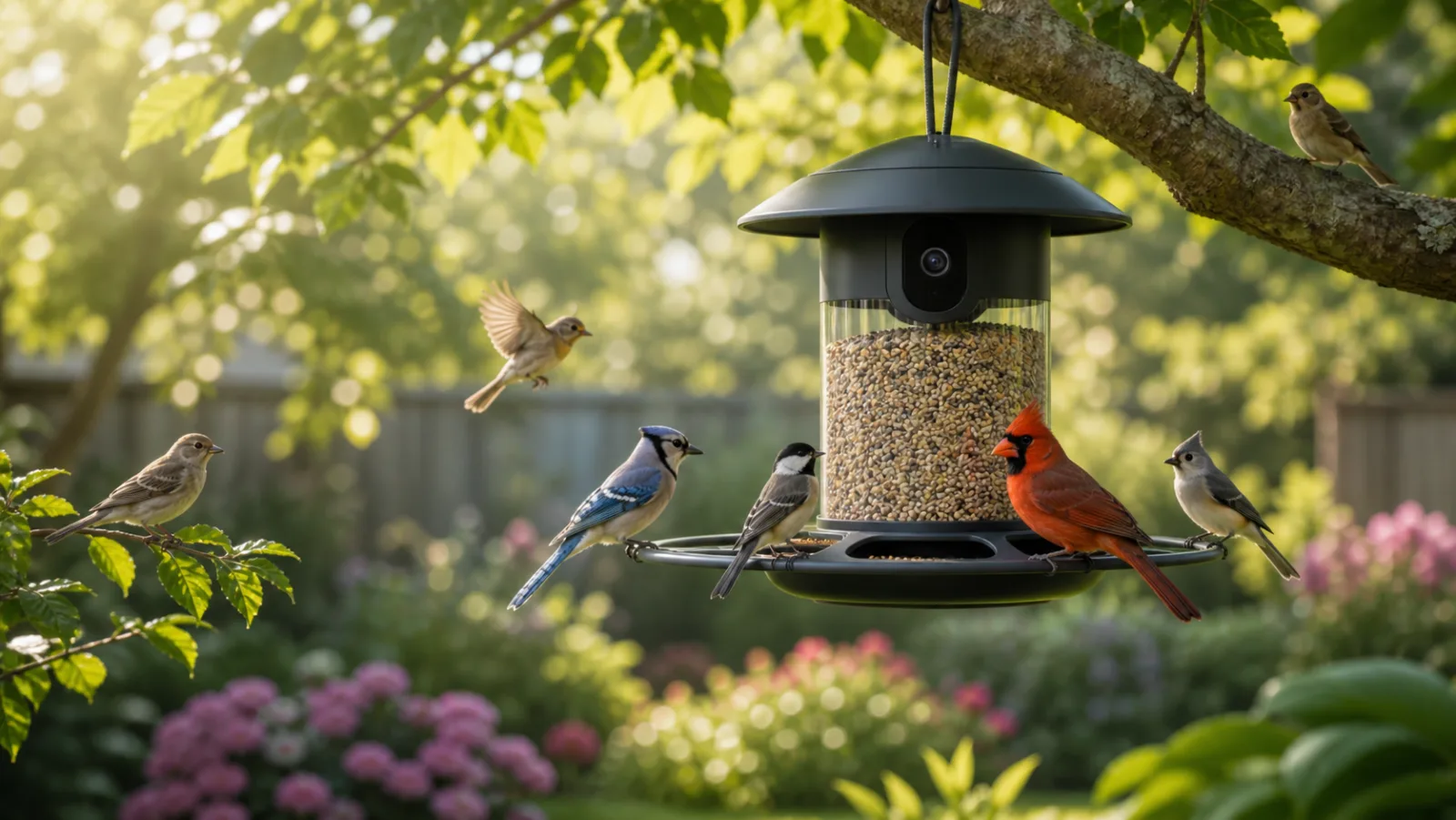
Smart Bird Feeders and Backyard Birdwatching Gear: 2026 Guide for U.S. Homes
Birds
Best Bird Baths and Solar Fountains for Backyard Birding (2026)
Birds
Best Hummingbird Feeders That Stay Clean, Full, and Pest-Free (2026)
Birds
Best Large Parrot & Macaw Flight Cages (2026)
Birds
Best Squirrel-Proof Bird Feeders That Actually Hold the Line (2026)
Birds
Best Bird Feeder Pole Systems and Squirrel Baffles for a Raid-Proof Station (2026)
Birds