Cats & Dogs
How to Stop Pets Stealing Each Other's Food (Microchip Feeders & Feeding Stations)
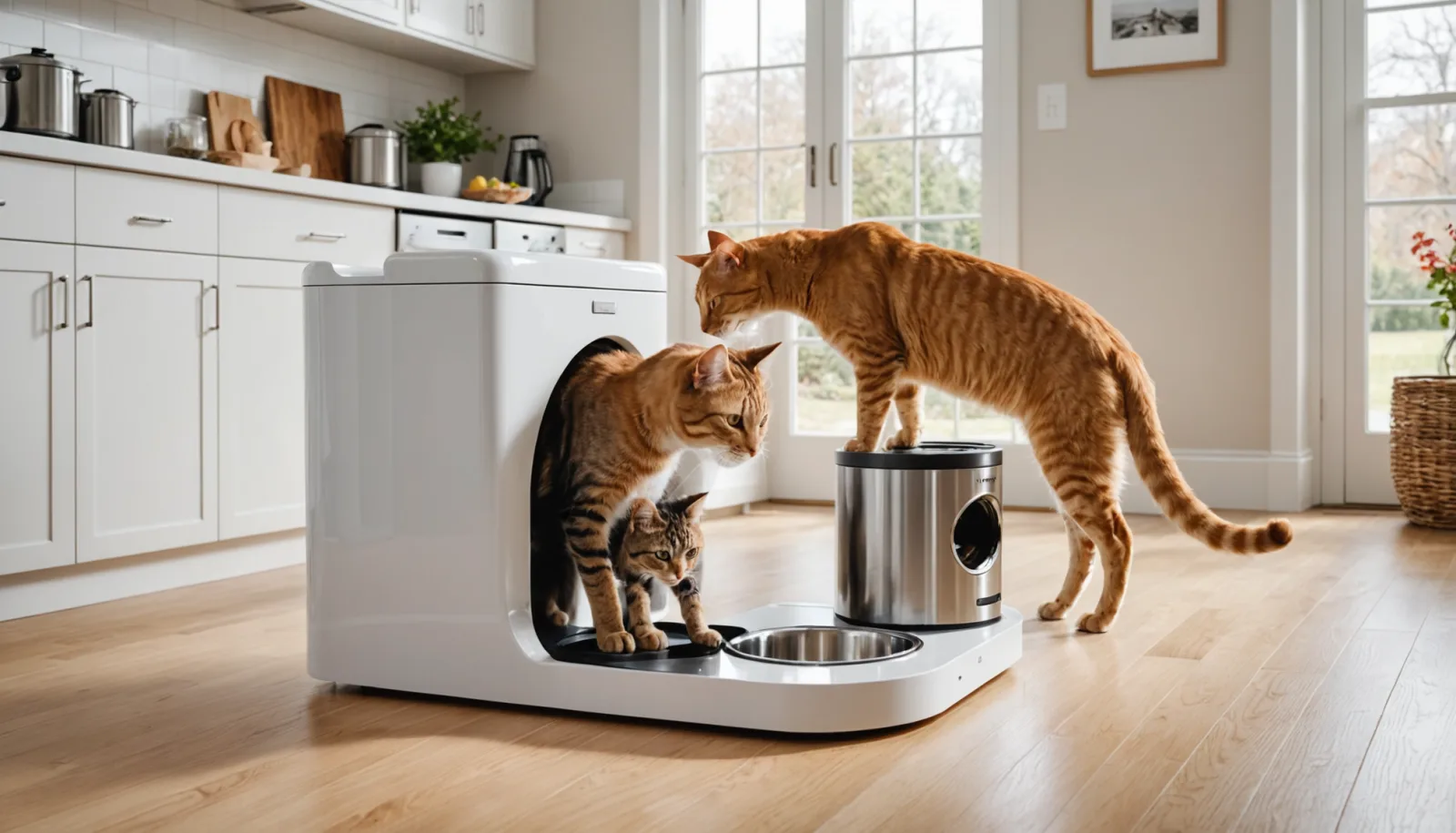
This is not a training guide about teaching pets to share — it is the access-control plan for a home where one pet keeps eating the other's food. The picks below are the feeding-station kit: a microchip feeder that opens for one registered pet, an app-connected version, a camera feeder that schedules portions, a slow bowl for the gulper, and a multi-pet fountain. Work the cheap levers first, because a closed door is free and a schedule costs nothing, and both solve more cases than any feeder before you spend on hardware.
By Nick Miles · Updated September 26, 2026 · 10 min read
PetPalHQ is reader-supported. We may earn a commission from qualifying Amazon purchases at no extra cost to you.
Evidence at a Glance
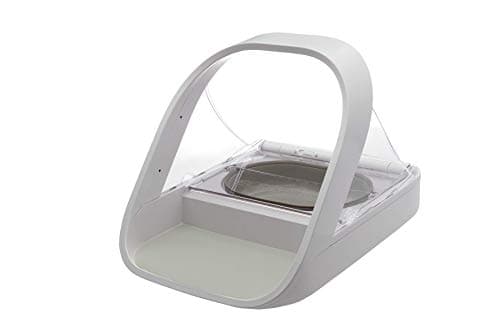
Sure Petcare SureFeed Microchip Pet Feeder
The access anchor — a sealed feeder that opens its lid only for the registered pet's implanted microchip or RFID collar tag, so a second pet cannot reach a protected diet per Sure Petcare.
Sources: Sure Petcare manufacturer documentation, Sure Petcare support guidance on feeder food-stealing, Multi-pet-household feeding consensus
Verified Jul 16, 2026
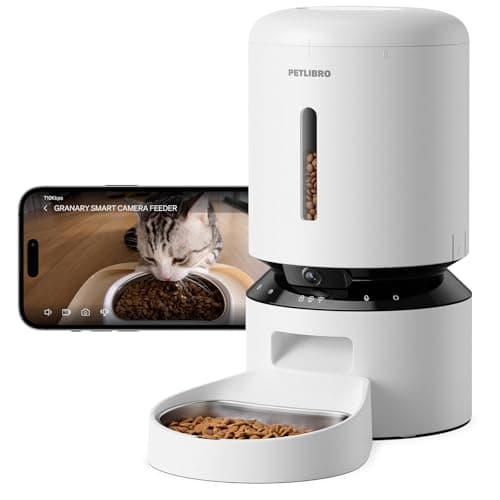
PETLIBRO Granary Smart Camera Feeder
The schedule-and-verify pick — dispenses up to ten portioned meals a day and adds a camera so an owner can see which pet approaches the bowl per PETLIBRO, replacing the free-feeding that enables grazing.
Sources: PETLIBRO manufacturer documentation, Small-frequent-meal feeding guidance, Multi-pet-household feeding consensus
Verified Jul 16, 2026
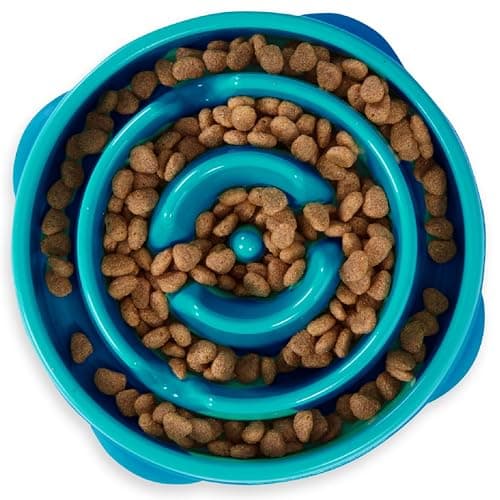
Outward Hound Fun Feeder Slo Bowl
The gulper fix — molded maze ridges that lengthen a fast eater's meal so both pets finish at the same time, which removes the window a bully uses to move on to the other bowl per Outward Hound.
Sources: Outward Hound manufacturer documentation, Veterinary nutrition guidance (Tufts Petfoodology), Multi-pet-household feeding consensus
Verified Jul 16, 2026
Our Picks
Sure Petcare
Sure Petcare SureFeed Microchip Pet Feeder
8.6 / 10
- Reads implanted microchips and RFID collar tags per Sure Petcare
- Sealed lid keeps the registered pet's food covered from raiders
- Compatible with both wet and dry food per the manufacturer
- Battery-powered — no AC cord and no power-cut failure mode
$199.00
Current price · checked Sep 26, 2026
Sure Petcare
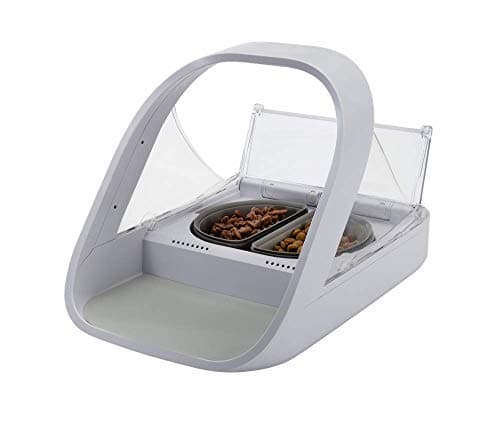
Sure Petcare SureFeed Microchip Pet Feeder Connect
8.5 / 10
- Same sealed microchip and collar-tag access as the standard SureFeed
- Logs feeding sessions and weight through the Sure Petcare app
- Per-pet intake data helps flag when one pet eats less
- Hub sold separately and required for connectivity per Sure Petcare
$216.51
Current price · checked Sep 26, 2026
PETLIBRO
PETLIBRO Granary Smart Camera Feeder
8.4 / 10
- Dispenses up to ten portioned meals a day per PETLIBRO
- 1080p wide-angle camera with night vision for bowl checks
- Two-way audio and app alerts to see who approaches
- 5-liter hopper for kibble or semi-moist food
$139.99
Current price · checked Sep 8, 2026
Outward Hound
Outward Hound Fun Feeder Slo Bowl
8.3 / 10
- Maze ridges lengthen a fast eater's meal per Outward Hound
- Multiple sizes and ridge depths to match muzzle shape
- Non-slip base keeps the bowl still during a meal
- Top-rack dishwasher safe per the manufacturer
$8.63
Current price · checked Sep 8, 2026
PawHut
PawHut Elevated Dog Bowls with Storage Cabinet, 44L
8.2 / 10
- Two removable stainless bowls at raised standing height per PawHut
- 44-liter cabinet below locks bulk food away from raiders
- Magnetic-closure doors keep the food store sealed
- Furniture-style unit tidies the whole feeding corner
$61.70
Current price · checked Sep 27, 2026
PetSafe
PetSafe Drinkwell 360 Stainless Steel Multi-Pet Fountain
8.1 / 10
- 128-ounce stainless reservoir for a long refill cadence per PetSafe
- 360-degree access with up to five interchangeable spouts
- Several pets drink at once, with no single facing-off point
- Adjustable flow plus replaceable carbon and foam filters
$75.99
Current price · checked Sep 8, 2026
The Short Answer
Pets steal each other's food for a plain reason: the food is reachable and the mealtime is unsupervised. The fix is logistics rather than discipline, because controlling who can reach which bowl is what makes the stealing stop. Work the cheapest levers first, in order: scheduled meals end the all-day open bowl, a closed door separates two eaters for free, and a raised station lifts one bowl out of reach. Only then does access-control technology earn its cost. The Sure Petcare SureFeed Microchip Pet Feeder opens for one registered pet, so a second animal cannot raid a prescription diet, and the SureFeed Connect adds app logging of who ate. The PETLIBRO Granary schedules portions and shows a camera view of the bowl. An Outward Hound slow bowl stretches the fast eater's meal so both pets finish together, and a PetSafe Drinkwell 360 lets two pets drink without a standoff. Match the tool to the exact access problem, and confirm current pricing before buying.
Every product on this list has been scored against the PetPal Gear Score, a weighted composite of expert consensus, observed effectiveness, animal safety, long-term durability, and value. Review method: Editorial synthesis of Sure Petcare support guidance on feeder food-stealing and placement, manufacturer documentation (Sure Petcare, PETLIBRO, Outward Hound, PetSafe), veterinary references (Tufts Petfoodology on eating speed, VCA Animal Hospitals on raised feeding and bloat, ISFM / International Cat Care on water-resource guarding), and multi-pet-household consensus. Community consensus was included as consensus, not quotation. No first-hand product testing — PetPalHQ does not run a testing lab.. Synthesized from 6+ expert sources.
Food stealing in a multi-pet home looks like a discipline problem, and it almost never is. Someone with a cat and a dog, or two cats on different diets, watches one animal clean out the other's bowl and assumes the fix is teaching the pets to leave each other's food alone. That training rarely takes, because the behavior is not defiance — it is opportunity. The food is reachable and the mealtime is unsupervised, and any animal will take a free meal that is sitting there. Control who can reach which food, and the problem disappears without a single training session.
That reframing points straight at the fix, and the fix has an order. There is a ladder of separation, and the cheap rungs come first. Time is the cheapest: ending the all-day open bowl and feeding on a schedule removes the grazing window most stealing lives in, and it costs nothing. Space is next: feeding two pets in separate rooms, or behind a plainly closed door, solves a large share of cases for free. Height is the third rung: a dog's raised station and a cat's high perch put two bowls in zones the other animal does not easily reach. Only at the top of the ladder is technology — a microchip feeder that decides who is allowed to eat — and it is worth the money precisely for the cases the free rungs cannot close.
The picks below are that separation kit, not six gadgets ranked against each other. A sealed microchip feeder anchors the access problem, an app-connected version logs who ate, a camera feeder schedules portions and verifies the bowl, a slow bowl fixes the fast-eater timing mismatch, and a multi-pet fountain keeps water from becoming one more guarded resource. Each earns its place by closing a specific access gap, and where a claim rests on a maker's documentation or veterinary guidance, that source is named rather than asserted, because PetPalHQ does not run a testing lab.
One driver sits underneath the whole problem and is worth stating plainly: the reason food theft matters is that diets differ. When both pets eat the same food, a stolen mouthful is a shared meal and little else. The stakes rise when one pet is on a prescription or weight-management diet the other must not touch, because a raided medical diet quietly undoes the care behind it. That is the case the sealed feeder exists for, and it is why the cheap levers of schedule and separation are the foundation rather than the whole answer. Build access control from the bottom of the ladder up, and a multi-pet home eats in peace.
Head-to-Head Comparison
| Feature | Sure Petcare SureFeed Microchip Pet Feeder | Sure Petcare SureFeed Microchip Pet Feeder Connect | PETLIBRO Granary Smart Camera Feeder | Outward Hound Fun Feeder Slo Bowl | PawHut Elevated Dog Bowls with Storage Cabinet, 44L | PetSafe Drinkwell 360 Stainless Steel Multi-Pet Fountain |
|---|---|---|---|---|---|---|
| Separation axis | Access (microchip) | Access + logging | Time / schedule | Meal rate | Height | Water access |
| Theft it solves | Diet raiding | Diet raiding + tracking | Free-feeding grazing | Fast-eater bullying | Cat-dog floor reach | Fountain guarding |
| Cheapest levers first? | Last rung — technology | Last rung — technology | Time lever | Cheapest lever | Space / height lever | Space lever |
| PetPal Feeding-Station Score | 8.6 | 8.5 | 8.4 | 8.3 | 8.2 | 8.1 |
| Check price | Amazon | Amazon | Amazon | Amazon | Amazon | Amazon |
$199.00
Current price · checked Sep 26, 2026
- Reads implanted microchips and RFID collar tags per Sure Petcare
- Sealed lid keeps the registered pet's food covered from raiders
- Compatible with both wet and dry food per the manufacturer
- Battery-powered — no AC cord and no power-cut failure mode
- Access control only — it does not portion meals on a schedule
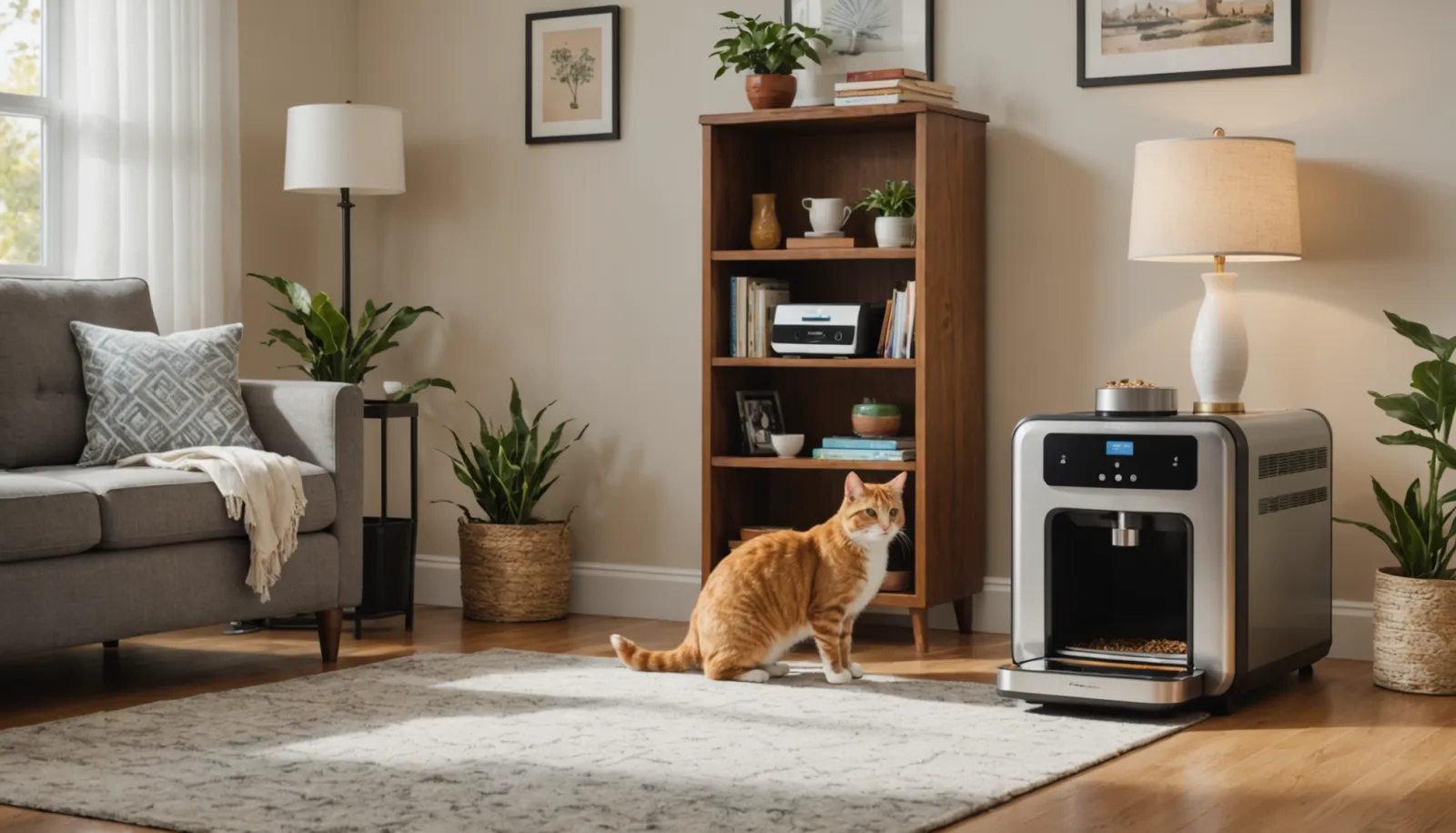
The anchor of a food-theft fix is a feeder that decides who is allowed to eat from it. The Sure Petcare SureFeed Microchip Pet Feeder does exactly that. Sure Petcare documents a sealed feeder that opens its lid only for the registered pet's implanted microchip or RFID collar tag, covers the bowl again when that pet steps away, and works for cats and small dogs on wet or dry food. This is the one problem no schedule, camera, or shared bowl can solve — keeping the wrong nose out of the right pet's food.
Where it fits the logistics: this is technology, the last and most expensive rung of the separation ladder, so reach for it once the free levers fall short. The feeder earns its place when a diet is medical. A prescription or weight-management food fails silently when the other pet grazes it, and a sealed feeder is the reliable way to keep those diets apart in a shared home. One caution follows from the design. Each feeder protects a single bowl, so a home with two protected diets usually needs two units, which doubles the spend. Place stations apart rather than side by side, so a second pet cannot approach the open bowl from behind. For the full field of selective-access models and how they compare, see PetPalHQ's roundup of the best smart pet feeders for multi-pet homes, the companion buying guide to this how-to.
The honest caveats are about scope, scale, and price. This is access control, not meal timing, so it will not portion food while an owner is at work — a household whose real problem is scheduled meals should pair it with a timed feeder for the gated pet. Battery dependence is a long-run operational point worth planning around before a long trip. On price, the feeder sits at $199.00 with no discount running on the current listing, which makes it the second-costliest single item here — budget for the full sticker rather than waiting on a sale that is not there.
What We Love
- Sealed lid stops a second pet reaching a protected or prescription diet
- Reads both implanted chips and collar tags, so a collar is optional
- Battery power means an outage never leaves the bowl open
- Handles wet or dry food for cats and small dogs
What Could Be Better
- Access control only — it does not schedule or portion meals
- One bowl per unit, so two protected diets means buying two
- Battery dependence is a long-term upkeep consideration
The Verdict
Reach for the microchip feeder when a diet is medical and a second pet keeps raiding it — that is the case no cheaper lever fully closes. Budget for a second unit if two pets are on protected diets, place stations well apart, and confirm the current price before buying.
Sources
- Sure Petcare (Amazon product listing, SureFeed Microchip Pet Feeder): opens its lid only for the registered pet's implanted microchip or RFID collar tag, keeps the sealed bowl covered from other pets, and suits cats and small dogs on wet or dry food
- Multi-pet feeding-station consensus (Sure Petcare support guidance and multi-pet households): a sealed microchip feeder protects one diet per unit, so a home with two protected diets usually needs a second feeder, and stations work best placed apart so a second pet cannot shoulder in over the open bowl
$216.51
Current price · checked Sep 26, 2026
- Same sealed microchip and collar-tag access as the standard SureFeed
- Logs feeding sessions and weight through the Sure Petcare app
- Per-pet intake data helps flag when one pet eats less
- Hub sold separately and required for connectivity per Sure Petcare
The connected version keeps the same access control and adds a data layer on top. The SureFeed Microchip Pet Feeder Connect fits the household that wants to know who ate, and how much, over time. Sure Petcare documents the connected SureFeed as running the same microchip and collar-tag access logic, with feeding sessions and weight surfaced through the Sure Petcare app. In a multi-pet home with different diets, that per-pet record turns a theft problem into a monitored one.
Where it fits the logistics: this is the anchor feeder with a memory. Access alone stops the raiding, and the logging tells an owner when a pattern changes — for instance, when one pet's intake quietly drops, which is a welfare cue worth raising with a veterinarian. The data is evidence for that conversation, not a diagnosis the app can hand back. The single most common buying mistake sits in the connectivity: the hub required for the app is sold separately, so an order for the feeder alone arrives as a working access device with no logging until the hub is added.
The honest caveats are about cost and reliance. The Connect asks a real premium over the standard SureFeed, and a home that only needs the food kept apart does not need the app at all. Treat the intake data as monitoring rather than medicine — a change in eating is a reason to see a veterinarian, not a number to self-interpret. And confirm the separately sold hub is in the cart at checkout, because the feeder without it delivers access control and nothing more.
What We Love
- Adds per-pet feeding and weight logging to proven access control
- Intake history is useful evidence for a veterinary conversation
- Same sealed, selective lid as the standard SureFeed
- Strong fit for a home tracking two pets on different diets
What Could Be Better
- Hub is sold separately and required for the app to work
- Commands a clear premium over the standard SureFeed
- App data is monitoring, not a veterinary diagnosis
The Verdict
Choose the Connect when logging who ate is worth the upcharge over plain access control — a home tracking two diets gets real value from the record. Confirm the separately sold hub is in the cart, and treat any intake change as a prompt to call a veterinarian, not a reading to act on alone.
Sources
- Sure Petcare (Amazon product listing, SureFeed Microchip Pet Feeder Connect): the connected version of the SureFeed on the same microchip and collar-tag access model, adding app logging of feeding sessions and weight through a separately sold hub
- Multi-pet feeding-station consensus (Sure Petcare support guidance and multi-pet households): per-pet intake logging helps an owner notice when one animal suddenly eats less, which is a welfare signal worth a veterinary call rather than a reading the app itself can diagnose
$139.99
Current price · checked Sep 8, 2026
- Dispenses up to ten portioned meals a day per PETLIBRO
- 1080p wide-angle camera with night vision for bowl checks
- Two-way audio and app alerts to see who approaches
- 5-liter hopper for kibble or semi-moist food
- Schedules and verifies — but does not gate access by pet
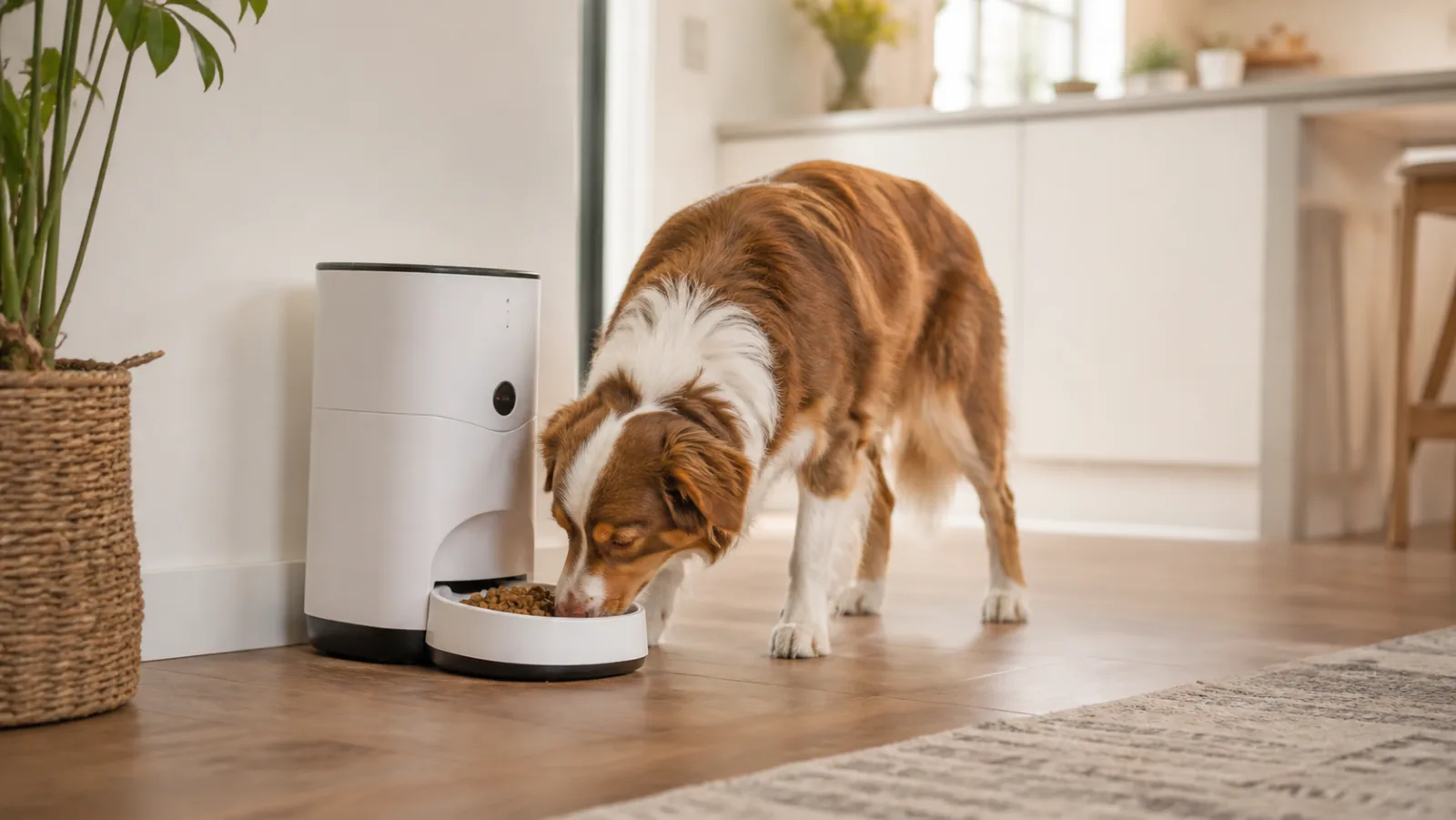
The next lever is time, and a scheduled feeder is how a home closes the all-day open bowl. The PETLIBRO Granary Smart Camera Feeder does the scheduling and lets an owner watch the result. PETLIBRO documents up to ten portioned meals a day from a 5-liter hopper, plus a 1080p wide-angle camera with night vision and two-way audio for checking who is at the bowl. Set meals replace grazing, and the camera shows whether the right pet actually ate.
Where it fits the logistics: free-feeding is the quiet enabler of stealing, and scheduled portions take that away. A bowl that is only full at set times is a bowl an owner can supervise, and the camera turns "I think the dog is eating the cat's breakfast" into a fact rather than a guess. That verification is the Granary's real edge in a mixed home. For the wider field of timed and app-controlled models, see the full roundup of the best automatic pet feeders, which ranks the scheduling options in depth.
The honest caveats are about what a schedule cannot do. This feeder verifies and times; it does not gate access, so it will not physically stop a determined pet that reaches the bowl during the feeding window — that is the microchip feeder's job. It is dry-food-first, built for kibble and semi-moist food rather than canned wet meals. On price, the Granary lists at $139.99 and the buy box matched list on our August 18, 2026 check, so budget the full price rather than an earlier discount that has since ended.
What We Love
- Scheduled portions end the free-feeding that enables grazing
- Camera confirms which pet actually ate at each meal
- Two-way audio and alerts for a remote mealtime check
- Large hopper covers a long workday without a refill
What Could Be Better
- Verifies and schedules — it does not gate access by pet
- Dry-food-first, so it is not a wet-food answer
- App and firmware reliability vary by home and update
The Verdict
Use the Granary to replace free-feeding with supervised, timed meals and to see who is really eating. It is the time lever, not the access lever, so pair it with a sealed feeder if a pet still raids during the window, and confirm current price before buying while the discount stands.
Sources
- PETLIBRO (Amazon product listing, Granary Smart Camera Feeder): schedules up to ten portioned meals a day from a 5-liter hopper and adds a 1080p wide-angle camera with night vision and two-way audio to see which pet approaches the bowl
- Multi-pet feeding-station consensus (small-frequent-meal feeding guidance): scheduled portioned meals replace the all-day open bowl that lets one pet graze another's food, and a supervised meal window is far easier to police than free-feeding
$8.63
Current price · checked Sep 8, 2026
- Maze ridges lengthen a fast eater's meal per Outward Hound
- Multiple sizes and ridge depths to match muzzle shape
- Non-slip base keeps the bowl still during a meal
- Top-rack dishwasher safe per the manufacturer
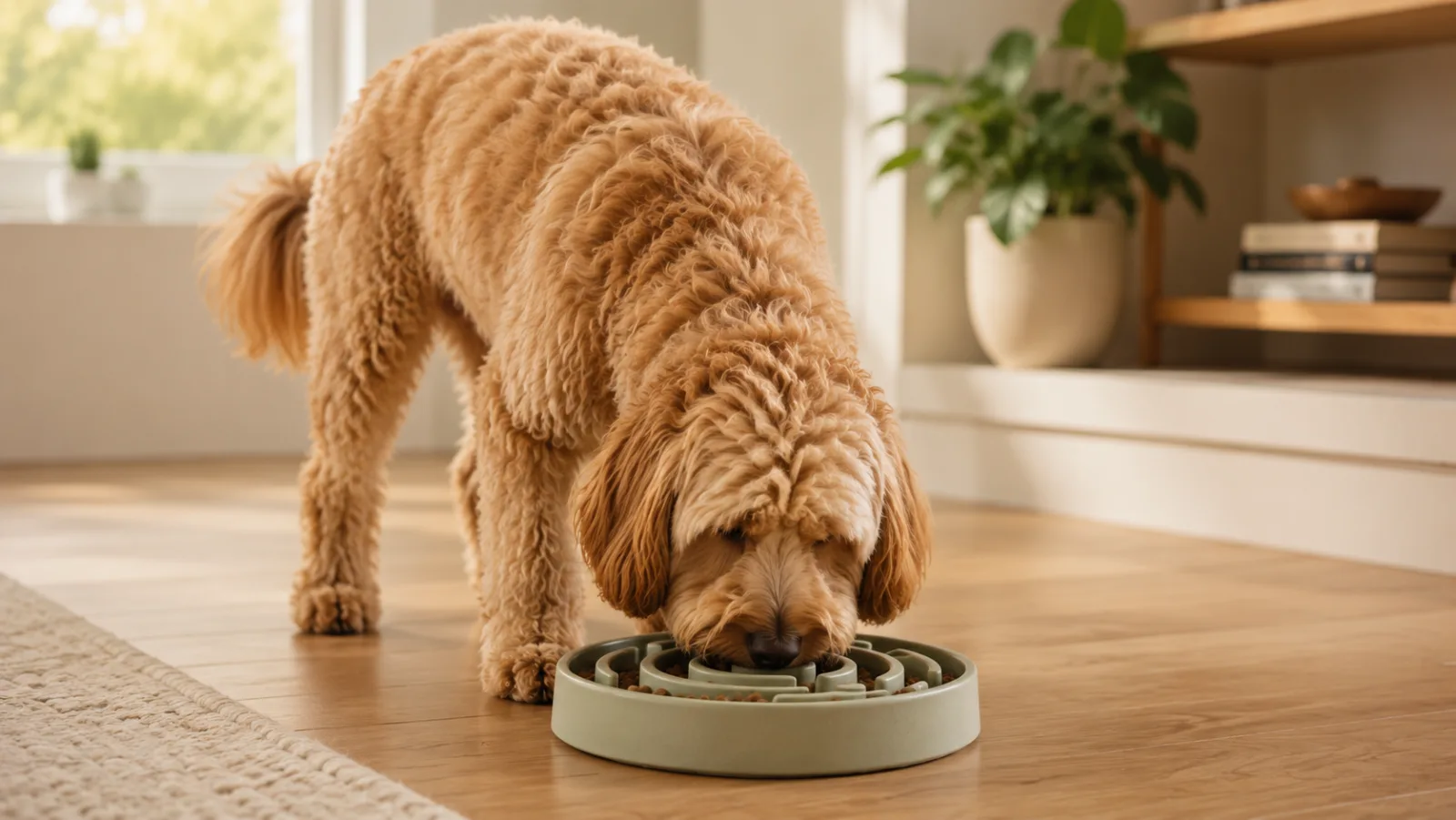
Some theft is really a timing mismatch: one pet inhales its meal, then turns to the slower eater's bowl. The Outward Hound Fun Feeder Slo Bowl closes that gap for a few dollars. Outward Hound documents molded maze ridges that stretch a fast meal, in several sizes and ridge depths to suit different muzzles, on a non-slip, dishwasher-safe base. Slowing the gulper is not about the gulper's stomach here; it is about making both pets finish together.
Where it fits the logistics: the raiding window is the problem, and a slow bowl shrinks it. When the fast eater takes as long as the slow one, there is no idle minute in which to wander over and clean out the second bowl. That timing fix pairs naturally with separated stations, since both pets are still eating when the meal ends. As a bonus, slower eating carries a health rationale — veterinary nutrition guidance notes that bolting food raises the odds of choking, vomiting, and swallowed air. For the broader field of anti-gulp designs and how to size them, see PetPalHQ's roundup of the best slow feeders and anti-gulp bowls.
The honest caveats are about fit and reach. A deep maze that suits a Labrador will frustrate a flat-faced breed or a small cat, so match the ridge depth to the muzzle rather than the brand. The plastic build will not please a household that prefers steel. And a slow bowl manages meal rate; it does nothing to gate access, so a determined raider that finishes anyway still needs separation or a sealed feeder. It is the cheapest lever here, and it earns that place by fixing a timing problem outright.
What We Love
- Cheapest lever here for a common food-theft cause
- Maze ridges make both pets finish close together
- Sized variants suit different muzzles and species
- Non-slip, dishwasher-safe, and simple to maintain
What Could Be Better
- Deep ridges frustrate flat-faced breeds and small cats
- Plastic build is not for steel-only households
- Manages meal rate only — it does not gate access
The Verdict
Add a slow bowl when the theft is really a speed gap — the fast eater that finishes first and moves to the other bowl. Match the ridge depth to your pet's muzzle, and remember it fixes timing, not access, so pair it with separation if a raider still finishes early.
Sources
- Outward Hound (Amazon product listing, Fun Feeder Slo Bowl): molded maze ridges that lengthen a fast eater's meal, in multiple sizes and ridge depths to match muzzle shape, with a non-slip base and top-rack dishwasher cleaning
- Veterinary nutrition guidance (Tufts Petfoodology): eating too fast raises the risk of choking, vomiting, and swallowed air, and a maze bowl is a low-cost way to slow the gulper so it finishes alongside the slower pet instead of moving on to that bowl
$61.70
Current price · checked Sep 27, 2026
- Two removable stainless bowls at raised standing height per PawHut
- 44-liter cabinet below locks bulk food away from raiders
- Magnetic-closure doors keep the food store sealed
- Furniture-style unit tidies the whole feeding corner
- Fixed height suits one dog size — not adjustable
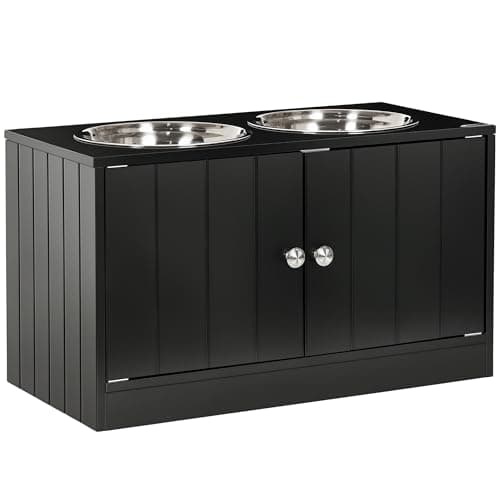
Height is a real separation axis, and it works both ways in a cat-and-dog home. The PawHut Elevated Dog Bowls with Storage Cabinet uses it. PawHut documents a furniture-style stand with two removable stainless bowls at standing height, over a 44-liter cabinet with magnetic-closure doors for food and supplies. The dog eats up at station height, out of easy reach of a floor-level raider, and the sealed cabinet keeps the bulk food out of reach too.
Where it fits the logistics: separation does not have to be a wall — a difference in height is often enough. A dog's raised station is awkward for a cat working the floor, and the cat's own high perch is off-limits to most dogs, so the two feeding zones stop overlapping. The locked cabinet handles a second front, since bulk food left in an open bag is its own theft target between meals. For the full range of raised and elevated designs, see the roundup of the best elevated and raised dog feeders.
The honest caveats are about health and fit, and one matters more than the rest. The popular idea that raised bowls are healthier is not settled — veterinary guidance treats elevated feeding as a debated possible factor in bloat for large, deep-chested breeds, so an owner of a big dog should ask a veterinarian before switching. Buy the station for the separation and the tidiness it plainly delivers, not as a health upgrade. The height is fixed, so it suits one dog size rather than a growing puppy.
What We Love
- Raised height separates a dog's bowl from a floor raider
- Sealed cabinet locks bulk food away between meals
- Removable stainless bowls are quick to fill and wash
- Furniture-style build tidies a cluttered feeding corner
What Could Be Better
- The 'raised is healthier' claim is unsettled — ask a vet for a big, deep-chested dog
- Fixed height suits one dog size, not a growing puppy
The Verdict
Use height separation when a cat and dog share a room and one keeps working the other's floor-level bowl. Buy the PawHut for the separation and the locked food store, treat the height as tidiness rather than a health claim, and ask a veterinarian first if the dog is large or deep-chested.
Sources
- PawHut (Amazon product listing, Elevated Dog Bowls with Storage Cabinet): a furniture-style raised stand holding two removable stainless-steel bowls at standing height above a 44-liter storage cabinet with magnetic-closure doors for food and supplies
- Veterinary guidance (VCA Animal Hospitals) on raised feeding: whether raised bowls help or harm a large, deep-chested dog is debated as a possible bloat factor, so owners of big breeds should ask a veterinarian before switching to a raised station
$75.99
Current price · checked Sep 8, 2026
- 128-ounce stainless reservoir for a long refill cadence per PetSafe
- 360-degree access with up to five interchangeable spouts
- Several pets drink at once, with no single facing-off point
- Adjustable flow plus replaceable carbon and foam filters
- Stainless surface resists the biofilm plastic bowls trap
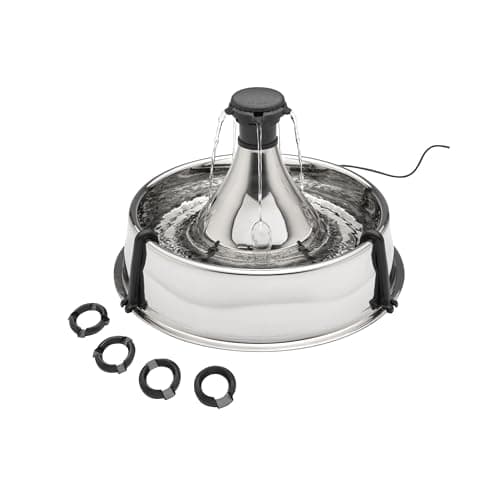
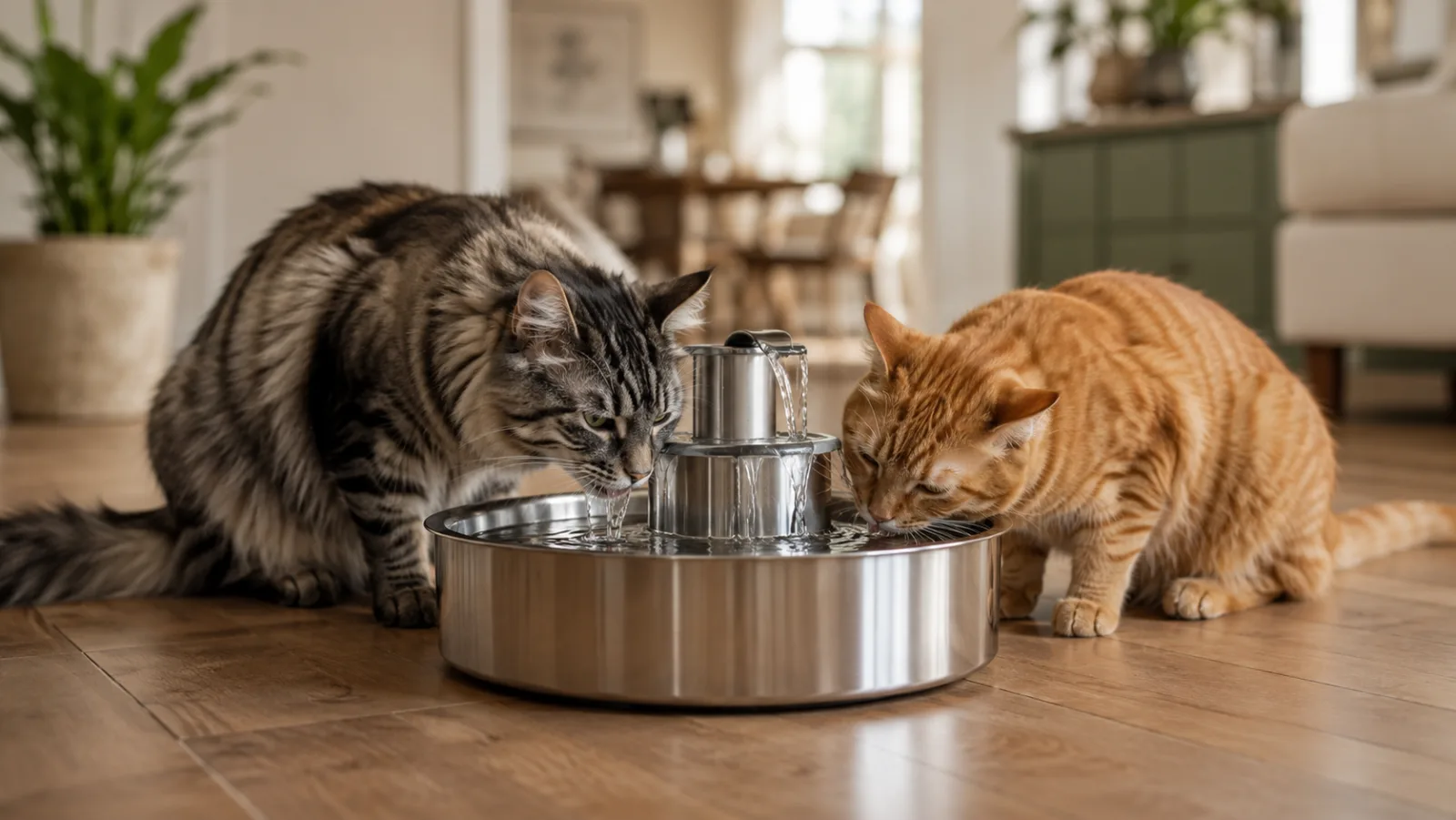
Food is not the only guarded resource — water gets defended too, and the same logic applies. The PetSafe Drinkwell 360 Stainless Steel Multi-Pet Fountain answers it by design. PetSafe documents a 128-ounce stainless fountain with 360-degree access and up to five interchangeable spouts, so several pets drink at once, along with adjustable flow and replaceable filters. The point is not the size of the bowl; it is that no pet has to face another to reach the water.
Where it fits the logistics: a single water source is a chokepoint one pet can sit near and control. Feline welfare guidance describes how a dominant animal's mere presence at a shared source can keep a timid one away, and a fountain with spouts on every side folds several drinking points into one footprint to break that standoff. The large stainless reservoir also stretches the refill cadence, which suits a busy two- or three-pet home. For the wider field of fountains sized for shared use, see PetPalHQ's roundup of the best cat water fountains for multi-cat households.
The honest caveats are about upkeep and footprint. A large reservoir invites complacency, yet the pump housing and tubing still grow biofilm that has to be physically scrubbed, so the stainless surface resists that film rather than removing the chore. The multi-spout assembly has more parts to take apart than a plain bowl, which adds a few minutes to the weekly clean. And the unit has a real footprint, so a home should measure the spot before it lands on the counter.
What We Love
- 360-degree access lets several pets drink without a standoff
- Large stainless reservoir stretches the refill cadence
- Stainless surface resists the biofilm plastic bowls trap
- Adjustable flow and replaceable filters suit a busy home
What Could Be Better
- Multi-spout assembly adds parts to the weekly clean
- Pump still needs scheduled deep-cleaning to avoid clogging
- Large footprint — measure the location before buying
The Verdict
Add the Drinkwell 360 when two pets treat a single water bowl as a resource to guard. The all-around access gives each pet its own drinking point, so neither has to face the other; just plan the weekly clean around its extra parts and measure the spot before it arrives.
Sources
- PetSafe (Amazon product listing, Drinkwell 360 Multi-Pet Fountain): a 128-ounce stainless multi-pet fountain with 360-degree access and up to five interchangeable spouts, giving several pets separate drinking points at once, with adjustable flow and replaceable filters
- Feline welfare guidance (ISFM / International Cat Care): a dominant pet lingering at a single water source can stop a timid one from drinking, so multiple drinking points at one fountain remove the standoff that turns water into a guarded resource
How We Score
Formula
PetPal Feeding-Station Score = (Expert Consensus × 0.35) + (Problem-Fit × 0.25) + (Multi-Pet Logistics Design × 0.20) + (Value × 0.20)
Score Factors
- Expert Consensus · 35%
- Synthesized from Sure Petcare support guidance on feeder food-stealing, manufacturer documentation, and veterinary and feline-welfare references (Tufts Petfoodology, VCA Animal Hospitals, ISFM / International Cat Care). The PetPal Feeding-Station Score is a composite of expert opinion — PetPalHQ does not run a testing lab.
- Problem-Fit · 25%
- How directly the item closes a specific food-theft access gap — a raided prescription diet, an all-day open bowl, a fast eater that moves to the other bowl, a floor-level raid, or a guarded water source — rather than how it performs as a standalone product.
- Multi-Pet Logistics Design · 20%
- How well the item supports a correct separation plan: controlling who reaches which bowl, placing stations apart, and working the cheap levers of time and space before the expensive lever of technology, so access is controlled rather than pets retrained.
- Value · 20%
- Cost relative to the theft it solves, including ongoing consumables like hubs and filters. This kit is the equipment cost, not the ongoing cost of running a multi-pet feeding routine of scheduled meals and separation.
| Rank | Product | Score |
|---|---|---|
| #1 | Sure Petcare Sure Petcare SureFeed Microchip Pet Feeder | 8.6 |
| #2 | Sure Petcare Sure Petcare SureFeed Microchip Pet Feeder Connect | 8.5 |
| #3 | PETLIBRO PETLIBRO Granary Smart Camera Feeder | 8.4 |
| #4 | Outward Hound Outward Hound Fun Feeder Slo Bowl | 8.3 |
| #5 | PawHut PawHut Elevated Dog Bowls with Storage Cabinet, 44L | 8.2 |
| #6 | PetSafe PetSafe Drinkwell 360 Stainless Steel Multi-Pet Fountain | 8.1 |
When NOT to Buy
Before buying anything, spend nothing first. The most common mistake in a food-theft home is reaching for a $200 feeder before trying the levers that cost zero. A closed door is free, and feeding two pets in separate rooms solves a large share of cases outright. A schedule is free too, and ending the all-day open bowl removes the grazing window that most stealing depends on. Work the cheap axes in order: time, then space, then height. Buy access-control technology only for the cases those levers cannot reach. In practice that means a real prescription or weight-management diet a second pet keeps raiding.
Match the tool to the exact problem, because the wrong tool disappoints. A camera feeder verifies and schedules, but it does not physically gate access. It will not stop a determined raider inside the feeding window — that is a sealed feeder's job. A slow bowl fixes a timing mismatch, not a reach problem. A microchip feeder protects one bowl, so two protected diets means two units and the spend that implies. Separation still matters more than any single device: place stations apart so a second pet cannot approach an open bowl from behind. A difference in height between a dog's station and a cat's perch often does the work of a wall.
Finally, the honest scope and health notes. When nobody is home for a weekend, the whole system only holds if the automation runs without you. PetPalHQ's weekend-away pet automation checklist covers keeping scheduled meals, separation, and access control working while the house is empty. On health, eating each other's food is not automatically dangerous, but it matters when diets differ, because a species-inappropriate meal or a raided prescription diet can undo medical care. So talk to a veterinarian about any diet that must not be shared. This kit is the equipment, not the routine, and the real work is free and daily. Confirming current price and availability before buying is part of it, since prices and sellers move over time.
Frequently Asked Questions
- Why does my cat or dog steal the other pet's food in the first place?
- Two things usually combine to cause it. The first is free-feeding: a bowl that sits out all day is a standing invitation, and a pet that finishes its own portion simply wanders over to the one still full. The second is a diet mismatch, where the food that is being stolen is more appealing, or where one pet is a naturally fast eater that finishes early and goes looking for more. Neither is a discipline failure. The reliable fix is to remove the opportunity rather than correct the pet: feed on a schedule so bowls are not sitting out, separate the eaters by room or by height, and if a specific diet must be protected, use a feeder that only opens for the right animal. Change the access, and the behavior changes with it.
- Do microchip feeders actually stop a determined dog?
- They are reliable at the scale they are built for — cats and small dogs — and less so against a large, motivated dog. A sealed microchip feeder opens its lid only for the registered pet and closes it again when that pet leaves, which physically covers the food from a raider. A big dog, though, can bully or shove a lightweight unit, or simply learn to wait for the cat to trigger it and then push in. So the feeder is not a standalone fortress against a large dog. Placement and rooms do the rest of the work: put the protected feeder somewhere the cat can reach but the dog does not go, use a height difference, or feed the animals in separate spaces so the dog is not standing over the unit when it opens. Treat the feeder as one layer in a separation plan, not the entire plan.
- How many microchip feeders do I need?
- Plan on one feeder per protected diet, not one per household. Each sealed feeder covers a single bowl and opens for the pets registered to it, so if only one animal is on a diet the others must not eat, a single unit does the job. The count rises when more than one diet has to be kept apart — two pets on two different prescription foods generally means two feeders, because a single unit cannot serve two protected diets separately. That doubling is a real cost worth planning for before buying, and it is a good reason to first confirm the cheaper levers of schedule and separation cannot solve the problem on their own. Buy the number the diets require, and place each unit where the wrong pet is least likely to be standing when it opens.
- What is the cheapest way to stop food stealing before I buy any technology?
- Time and space, in that order, and both are free. Start by ending free-feeding: put food down at set mealtimes and lift the bowls when the meal is over, so there is no standing bowl to raid for most of the day. Then add separation for the meals themselves — feed the two pets in different rooms, or behind a closed door, so neither can reach the other's bowl while eating. A slow bowl for a few dollars handles the specific case of a fast eater that finishes first and moves on, by stretching its meal until the slower pet is done too. Most food-theft problems in a home where both pets are healthy resolve at this level, without any powered feeder. Reserve the spend on access-control technology for the case that truly needs it, which is usually a medical diet a second pet keeps raiding.
- Is it dangerous for pets to eat each other's food?
- It depends entirely on the diets, and the honest answer is that it is often harmless but sometimes not. If both pets are healthy adults on complete, species-appropriate food, an occasional stolen mouthful is usually a minor issue. The picture changes in two situations. The first is species mismatch — cat food and dog food are formulated differently, and a steady diet of the wrong one is not balanced for that animal over time. The second, and more serious, is a prescription or weight-management diet: when one pet is eating a medical food to manage a condition, a housemate raiding it, or that pet stealing richer food elsewhere, can quietly work against the treatment. Because the stakes turn on the specific diets involved, the right move for any medical or weight-controlled feeding plan is to talk to a veterinarian about how strictly the foods need to be kept apart, and then set up the access control to match.
Bottom Line
Start with the cheap levers, not the gadget. A closed door and a set feeding schedule cost nothing and solve most food theft before any hardware — reach for technology only when a medical diet is being raided.
Buy access control for the case nothing else closes. The Sure Petcare SureFeed opens only for the registered pet, so a second animal cannot raid a prescription diet, and the SureFeed Connect adds per-pet logging for a home tracking two diets.
Fix timing and reach cheaply. The PETLIBRO Granary replaces free-feeding with supervised scheduled meals and shows who ate, while a few-dollar Outward Hound slow bowl makes a fast eater finish alongside the slow one.
Separate by space and height, and do not forget water. Height is the free lever — a cat fed on a counter or a shelf is simply out of a dog's reach — and a PetSafe Drinkwell 360 gives two pets their own drinking points so water stops being guarded.
Match the tool to the exact access gap. A camera verifies but does not gate, a slow bowl fixes timing not reach, and one sealed feeder protects one bowl — name the problem first, then buy the lever that closes it.
Sources & Methodology
Methodology
PetPal Feeding-Station Score = (Expert Consensus × 0.35) + (Problem-Fit × 0.25) + (Multi-Pet Logistics Design × 0.20) + (Value × 0.20)
Expert review sources
- Sure Petcare — support guidance on feeder food-stealing and placement
- Sure Petcare, PETLIBRO, Outward Hound, and PetSafe product documentation
- Veterinary nutrition guidance — Tufts Petfoodology on eating speed
- VCA Animal Hospitals — raised feeding and bloat (gastric dilatation-volvulus)
- ISFM / International Cat Care — water-resource guarding in multi-pet homes
- Multi-pet-household feeding consensus on separation and diet segregation
Community sources
- Multi-pet-household owner consensus on feeder placement and food theft
Prices and specs verified July 16, 2026.
About the author
Nick Miles is the chief editor of PetPalHQ. This feeding-station plan and its kit are editorial synthesis of Sure Petcare support guidance on feeder food-stealing, manufacturer documentation, and veterinary and feline-welfare references — PetPalHQ does not run a testing lab. The PetPal Feeding-Station Score is a composite of expert opinion, not a measurement. Sources are cited by name throughout.
PetPalHQ is a participant in the Amazon Services LLC Associates Program. We may earn commissions from qualifying purchases — at no extra cost to you.
More Guides
Cats & Dogs
Best Smart Pet Feeders for Multi-Pet Homes: Microchip, RFID, and Wet-Food Picks (2026)
Cats & Dogs
Best Automatic Pet Feeders for Busy Families (2026)
Cats & Dogs
Best Slow Feeders and Anti-Gulp Bowls for Dogs and Cats (2026)
Cats & Dogs
Best Elevated & Raised Dog Feeders 2026
Cats & Dogs
Best Cat Water Fountains for Multi-Cat Households (2026)
Cats & Dogs