Reptile
Best Reptile Heat Lamps & Basking Fixtures (2026)
The Zoo Med Repti Basking Spot is the mainstream default most keepers buy first; the Exo Terra Sun Glo is the halogen step up for deep-tissue basking heat. Editorial recommendations grounded in veterinary references and the Ferguson Zone / UV-Tool framework.
By Nick Miles · Updated August 21, 2026 · 12 min read
PetPalHQ is reader-supported. We may earn a commission from qualifying Amazon purchases at no extra cost to you.
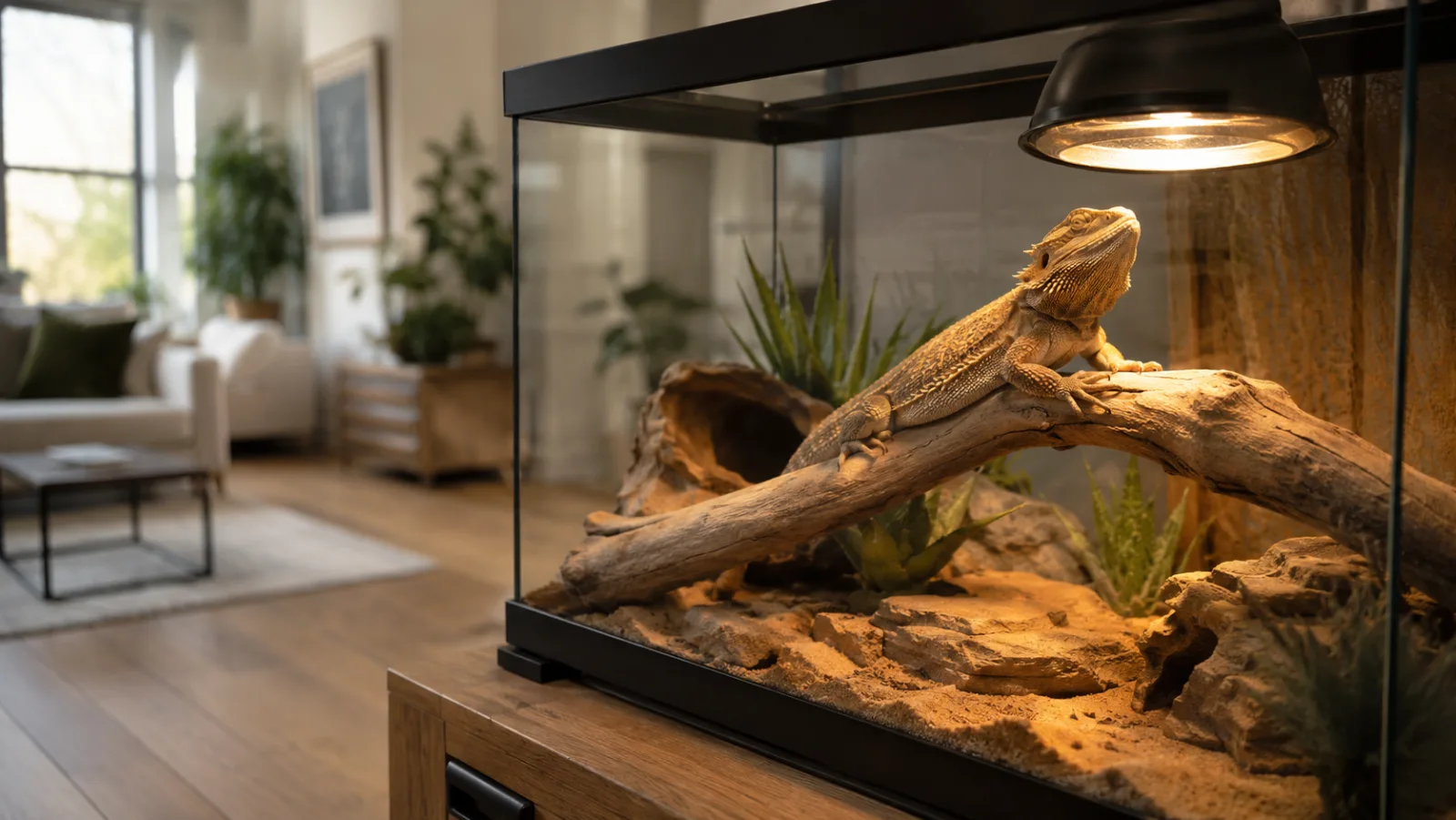
Evidence at a Glance
Arcadia GoldenSun Basking Halogen Heat Lamp
Halogen basking lamp with a high IR-A fraction for deep-tissue warming — the synthesis pick for desert and high-basking species when run on a dimming thermostat.
Sources: Arcadia Reptile (John Courteney-Smith, MRSB) lighting guide, LafeberVet — UVB Lighting for Reptiles (Baines), Journal of Zoo and Aquarium Research — UV-Tool (Baines et al., 2016)
Verified Jun 21, 2026
Zoo Med Repti Basking Spot Lamp
The mainstream incandescent basking bulb most keepers reach for first — a tight reflector concentrates a hot spot, and it is among the most widely stocked basking lamps in the US.
Sources: Zoo Med Laboratories — Repti Basking Spot product documentation, ReptiFiles temperature and lighting care guidance, Merck Veterinary Manual — reptile husbandry
Verified Jun 21, 2026
REPTI ZOO Reptile Light Fixture with Dimming Thermostat
Deep-dome ceramic-socket fixture with an integrated dimming thermostat — solves the halogen on/off-flicker problem and the burn-risk recess in one unit.
Sources: Reptiles and Research — comprehensive guide to reptile thermostats, Zoo Med Laboratories — Deep Dome fixture documentation, ARAV — husbandry and thermal-environment guidance
Verified Jun 21, 2026
Our Picks
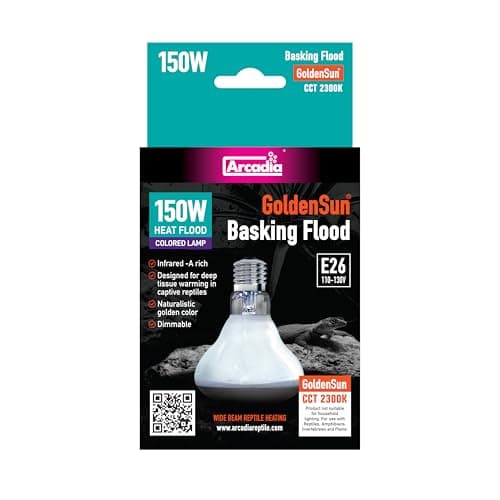
Arcadia Reptile
Arcadia GoldenSun Basking Halogen Heat Lamp
9.3 / 10
- Halogen technology with a high IR-A fraction for deep-tissue, sunlight-like warming
- Wide-beam metal reflector spreads heat across a usable basking platform
- Standard E26 screw base fits common deep-dome ceramic-socket fixtures
- Available in 50W, 75W, and 100W to match species basking-surface targets
$13.99
Amazon's price may vary; check the current price.
Last Amazon read 2026-08-21
Zoo Med
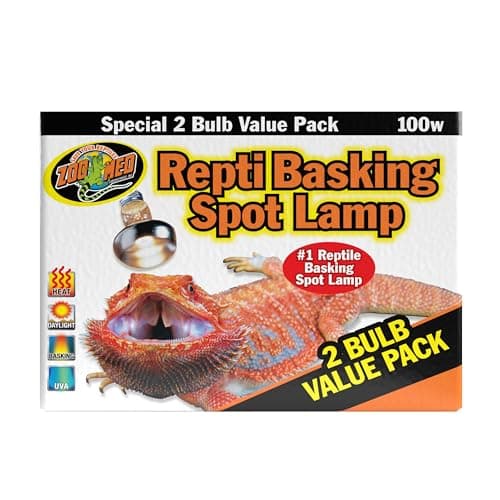
Zoo Med Repti Basking Spot Lamp
8.6 / 10
- Tight double-reflector beam concentrates a hot basking spot for desert species
- The default herp-keeper recommendation and a long-running ubiquity benchmark
- Available in 50W, 75W, 100W, and 150W for a wide range of enclosures
- Standard E26 screw base for common ceramic-socket dome fixtures
$24.97
Last Amazon read 2026-09-08
Exo Terra
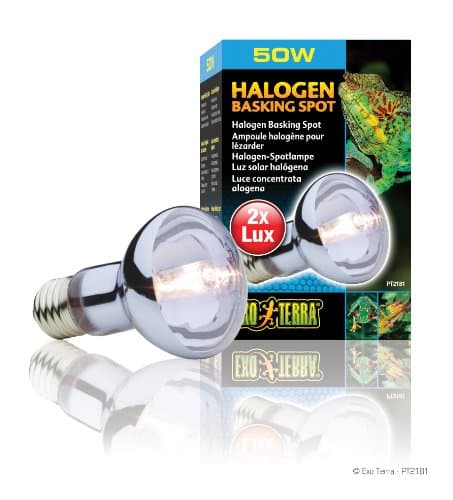
Exo Terra Sun Glo Halogen Basking Spot Lamp
8.4 / 10
- Broad-spectrum halogen with a neodymium-coated envelope for color rendering
- Stronger heat penetration than a plain incandescent basking bulb
- Widely stocked at major US retailers in 50W and 75W
- Standard E26 base for common deep-dome ceramic fixtures
$19.85
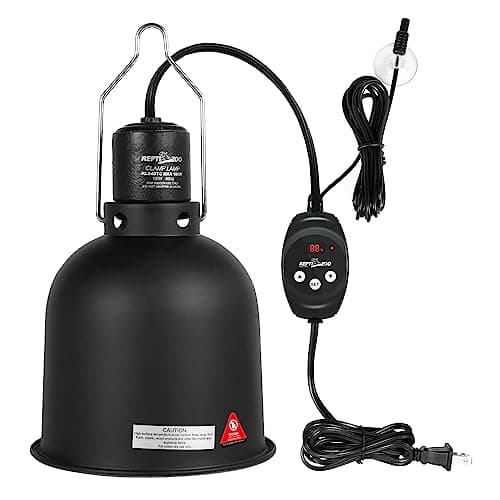
REPTI ZOO
REPTI ZOO Reptile Light Fixture with Dimming Thermostat (5.5" Deep Dome, max 100W)
8.2 / 10
- Deep-dome reflector recesses the bulb to reduce climbing-burn risk
- Integrated PID dimming thermostat — no separate controller needed
- Heat-resistant ceramic socket rated to a 100W maximum bulb
- 5.5-inch dome suited to small and medium enclosures
$39.99
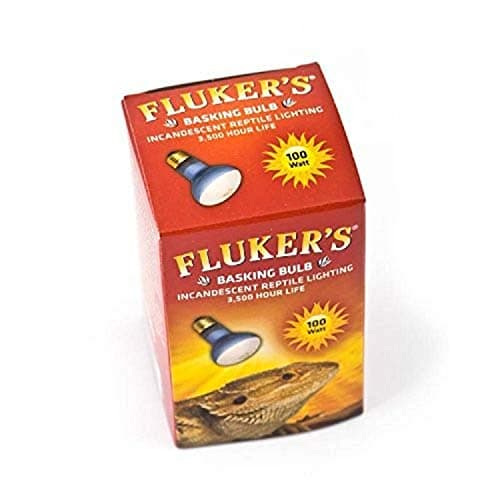
Fluker's
Fluker's Repta-Sun / Sun Spot Basking Bulb (Incandescent)
7.4 / 10
- Inexpensive incandescent basking bulb carried at most US retailers
- Standard E26 base fits common ceramic-socket dome fixtures
- Available in common basking wattages for a quick replacement
- Lowest sticker price of any pick in this guide
$4.96
The Short Answer
A basking heat lamp gives a reptile heat, visible light, and UVA — but no UVB, so it never replaces a separate UVB source. The Zoo Med Repti Basking Spot is the mainstream default and the bulb most keepers buy first. Step up to the Exo Terra Sun Glo halogen if you want the deeper heat penetration halogens are valued for over plain incandescents. Either bulb must sit in a ceramic-socket fixture rated above the bulb's wattage, and any halogen or incandescent basking bulb must run on a dimming thermostat rather than an on/off one. Size the wattage to your species' basking-surface target, measured with an infrared temperature gun at the basking spot.
Every product on this list has been scored against the PetPal Gear Score, a weighted composite of expert consensus, observed effectiveness, animal safety, long-term durability, and value. Review method: Editorial synthesis of veterinary references (Merck Veterinary Manual, ARAV, LafeberVet), peer-reviewed lighting research (Journal of Zoo and Aquarium Research UV-Tool, Frances Baines / UV Guide UK), and manufacturer-technical documentation (Arcadia Reptile, Zoo Med Laboratories, Exo Terra) — no first-hand product testing.. Synthesized from 9+ expert sources.
For most reptile keepers, the first decision about a heat lamp is not "how many watts?" — it is understanding what a basking lamp does and does not do. The Merck Veterinary Manual, the Association of Reptile and Amphibian Veterinarians, and Frances Baines' LafeberVet article all converge on the same point: a basking heat lamp supplies heat, visible light, and UVA, but it does not supply UVB. Mistaking a basking bulb for a UVB lamp is the most common beginner error in this category, and it is a serious welfare gap because UVB drives vitamin D3 synthesis. The second universal point is just as important: basking targets are surface temperatures measured with an infrared temperature gun at the basking spot, not the ambient air temperature on a dial thermometer.
The picks below are editorial synthesis. PetPalHQ does not run a testing lab — every product on this page was selected by reading manufacturer-technical documentation from Arcadia Reptile, Zoo Med Laboratories, and Exo Terra, peer-reviewed lighting research from the Journal of Zoo and Aquarium Research UV-Tool and Frances Baines, veterinary references from the Merck Veterinary Manual and ARAV, and care guidance from ReptiFiles, Reptiles Magazine, and The Bio Dude. PetPalHQ.com earns affiliate commissions from qualifying purchases; our recommendations are based on that expert consensus, and commission rates never influence our editorial picks.
This guide is the buying-side companion to the Reptile Habitat and Environmental Control hub. The hub explains how the heating, lighting, and humidity systems fit together; this article covers which basking bulb and which fixture to buy, and how to pair them safely with a thermostat.
Wattage, basking temperature, and species targets — set the heat to the animal
The wattage on the box is not a temperature. The basking-surface temperature a reptile actually experiences depends on the bulb's wattage, the distance from the bulb to the basking surface, the fixture's reflector, and the ambient room temperature. The correct method, consistent across ReptiFiles and the veterinary references, is to choose a target surface temperature for the species, then select and adjust the wattage to hit it — verified with an infrared temperature gun at the basking spot.
Species targets differ widely, and matching the heat to the animal is the whole game. Bearded dragons need roughly 100–110°F at the basking surface, with juveniles toward the higher 105–110°F end. Tortoises and other desert baskers want about 95–100°F. Leopard geckos are not true baskers and rely mostly on belly heat; a warm spot around 90–95°F is appropriate. Ball pythons sit lower at roughly 88–92°F. At the far end, crested geckos do best cool — around 72–78°F and never much above 80°F — which means an over-powered basking lamp can actively harm a low-zone species. The Journal of Zoo and Aquarium Research UV-Tool and Frances Baines' Ferguson Zone framework formalize this idea: match basking output to a species' natural sunlight-use pattern, not to its body size. Baines and colleagues' preliminary, research-stage work suggests basking zones may target roughly 250–350 W/m² of IR-A, a figure to treat as an active research direction rather than a settled specification.
Halogen vs incandescent, deep domes, and dimming thermostats — the three choices that matter
Three technical choices separate a safe basking setup from a risky one, and the source set is clear on each.
Halogen versus incandescent. Halogen basking lamps emit a higher fraction of short-wavelength IR-A than standard incandescent or tungsten bulbs. IR-A penetrates deeper into tissue and more closely mimics sunlight, which is why Arcadia Reptile, The Bio Dude, and Reptiles Magazine all favor halogen as the better basking technology. Arcadia states its halogens give roughly 30% more heat and light than a standard tungsten lamp — a manufacturer claim worth treating as such, but one that aligns with the broader consensus that halogen heat quality beats plain incandescent. An incandescent like the Zoo Med Repti Basking Spot is still a perfectly functional, budget-friendly choice; it simply sits a tier below halogen on heat quality and service life.
Why deep domes prevent burns. A deep-dome fixture fully recesses the bulb inside an extended reflector so the hot glass cannot protrude toward a climbing reptile. A shallow dome leaves the bulb exposed at the rim, where an animal scaling the screen can press against it. For extra protection, a wire safety guard or cage can be added over the basking lamp. Equally important and easy to overlook: the fixture must use a ceramic socket rated above the bulb's wattage. A 100W bulb belongs in a fixture rated to 150–160W; plastic sockets and under-rated domes are a melt and fire hazard, not a place to save money.
Dimming versus on/off thermostats. Halogen and incandescent basking bulbs must run on a dimming thermostat, not an on/off one. An on/off thermostat slams full power on and off repeatedly, and that cycling stresses the filament and burns these bulbs out fast. A dimming thermostat varies the power smoothly to hold the target temperature, which protects the bulb and produces a steadier basking zone. This is the single most common reason a basking bulb fails prematurely. Our reptile thermostat guide covers the dimming-versus-pulse decision in depth, and it is the companion purchase to every bulb in this guide. The ARAV notes that a large share of reptile health problems seen in clinics trace to improper environmental management, including incorrect temperatures — which is the strongest possible argument for treating the thermostat and the infrared thermometer as core husbandry equipment, not optional accessories.
What We Passed On
The Zoo Med Repti Deep Dome Lamp Fixture is the deep-dome fixture most keepers name by default, and its extra-deep ceramic-socket reflector (rated to around 160W) is exactly the burn-prevention recess this guide recommends. We left it out of the numbered picks because it carries no thermostat — it needs a separate dimming controller to be safe with a halogen — and the REPTI ZOO all-in-one fixture covers the same recess-plus-dimming job in a single box for a beginner. A bare Deep Dome plus a dedicated external thermostat remains the more flexible, more serviceable path for experienced keepers; it simply was not the right one-box recommendation here.
The Fluker's Repta-Clamp Lamp with Dimmer is a heavy-duty clamp lamp with a ceramic socket rated to 150W and a built-in dimmer switch. The catch is that a manual dimmer is not a thermostat: it lets you set a fixed power level, but it cannot sense temperature and auto-regulate the basking zone. That makes it a half-measure next to a true dimming thermostat, so it ranks below any thermostat-paired option and stayed off the main list.
Colored red and blue "night" heat bulbs are a hard pass regardless of price. Herp consensus discourages them because reptiles can perceive the colored light, which disrupts the day/night cycle and sleep. If a room genuinely drops too cold at night, the correct supplemental heat comes from a non-light source — a ceramic heat emitter or a deep heat projector on a thermostat — never a colored bulb. We also passed on under-powered fixtures and plastic-socket clamp lamps that cannot safely hold a real basking-bulb wattage.
Head-to-Head Comparison
| Feature | Arcadia GoldenSun Basking Halogen Heat Lamp | Zoo Med Repti Basking Spot Lamp | Exo Terra Sun Glo Halogen Basking Spot Lamp | REPTI ZOO Reptile Light Fixture with Dimming Thermostat (5.5" Deep Dome, max 100W) | Fluker's Repta-Sun / Sun Spot Basking Bulb (Incandescent) |
|---|---|---|---|---|---|
| Type / technology (halogen vs incandescent bulb; deep-dome vs clamp fixture) | Halogen bulb | Incandescent bulb | Halogen bulb | Deep-dome fixture + thermostat | Incandescent bulb |
| Wattage options or fixture max-wattage rating | 50 / 75 / 100W | 50 / 75 / 100 / 150W | 50 / 75W | 100W max (8.5" version 150W) | Common basking wattages |
| Beam pattern & heat spread (tight spot vs wide flood) | Wide-beam flood | Tight reflector spot | Spot / broad-spectrum | Depends on fitted bulb | Spot |
| IR-A / heat quality (deep-tissue warming vs surface heat) | High IR-A — deep-tissue | Lower IR-A — surface | Halogen — deeper than incandescent | Depends on fitted bulb | Lower IR-A — surface |
| Socket & build (ceramic socket, deep-dome recess, build materials) | E26 bulb, needs ceramic fixture | E26 bulb, needs ceramic fixture | E26 bulb, needs ceramic fixture | Ceramic socket, deep-dome recess | E26 bulb, needs ceramic fixture |
| Thermostat / dimming compatibility (dimming-required, built-in, or none) | Dimming thermostat required | Dimming thermostat required | Dimming thermostat required | Dimming thermostat built in | Dimming thermostat required |
| Check price | Amazon | Amazon | Amazon | Amazon | Amazon |
$13.99
Amazon's price may vary; check the current price.
Last Amazon read 2026-08-21
- Halogen technology with a high IR-A fraction for deep-tissue, sunlight-like warming
- Wide-beam metal reflector spreads heat across a usable basking platform
- Standard E26 screw base fits common deep-dome ceramic-socket fixtures
- Available in 50W, 75W, and 100W to match species basking-surface targets
- Arcadia's lighting science (John Courteney-Smith, MRSB) is the most-cited basking authority
The Arcadia GoldenSun is the editorial synthesis pick for keepers who want the heat quality that current basking science favors. Arcadia's lighting guide, authored under John Courteney-Smith, MRSB, makes the case that halogen basking lamps emit a larger fraction of short-wavelength IR-A than standard incandescent or tungsten bulbs. IR-A penetrates deeper into tissue and more closely mimics the spectral profile of sunlight reaching a basking reptile. The LafeberVet article by Frances Baines and the Journal of Zoo and Aquarium Research UV-Tool paper both frame basking output around a species' natural sunlight-use pattern, which is the same logic that puts a high-IR-A halogen at the top of this list.
Heat output and safety carry the next-largest weight, and the GoldenSun earns it with a wide-beam metal reflector that spreads warmth across a usable platform rather than a pinprick hot spot. That matters for animals that bask with the whole body flat — bearded dragons, tortoises, and similar desert species — where a broad, even warm zone beats a narrow scorching one. The 50W, 75W, and 100W options let you size the bulb to the species' basking-surface target instead of guessing.
What the spec sheet doesn't tell you: Arcadia's own documentation states that halogen basking lamps should be run on a dimming thermostat, not an on/off one. The repeated on/off cycling of an on/off thermostat stresses the filament and burns a halogen out fast; a dimming thermostat varies power smoothly and protects the bulb. So the GoldenSun's real cost is not just the bulb — it is the bulb plus a compatible dimming controller. Our reptile thermostat guide covers the dimming-versus-pulse decision in detail, and pairing this lamp with the right controller is the difference between a bulb that lasts and one that fails in weeks.
One more practical note: the GoldenSun is a heat-and-light source only. It emits UVA and visible light alongside the heat, but no UVB. Mistaking a basking bulb for a UVB lamp is the single most common beginner error in the source set, and it is a serious welfare gap because UVB drives vitamin D3 synthesis. Pair this lamp with a separate UVB fixture sized to the species, and confirm the basking-surface temperature with an infrared temperature gun rather than trusting the wattage label.
What We Love
- High IR-A fraction delivers deep-tissue, sunlight-like basking heat
- Wide-beam reflector creates an even warm platform, not a single hot point
- Three wattages let you match the species' basking-surface target
- Backed by the most-cited basking-science authority in the source set
- Affordable per-bulb price relative to its heat quality
What Could Be Better
- Must run on a dimming thermostat — an on/off controller burns it out fast
- Provides no UVB, so a separate UVB source is non-negotiable
- Halogen runs hot; the fixture must fully recess the bulb to prevent burns
The Verdict
The synthesis pick for desert and high-basking species that benefit from deep-tissue IR-A heat. Buy it alongside a dimming thermostat and a separate UVB lamp — never as a standalone fix.
Sources
- Arcadia Reptile (John Courteney-Smith, MRSB): Arcadia states its halogen lamps give roughly 30% more heat and light than a standard tungsten lamp, with a higher IR-A fraction that penetrates deeper into tissue (manufacturer claim)
- LafeberVet — UVB Lighting for Reptiles (Baines): a basking lamp supplies heat, visible light, and UVA but not UVB, so it must be paired with a separate UVB source; basking targets are surface temperatures, not air temperature
- Journal of Zoo and Aquarium Research — UV-Tool (Baines et al., 2016): the Ferguson Zone framework matches basking output to a species' natural sunlight-use pattern rather than to body size
$24.97
Last Amazon read 2026-09-08
- Tight double-reflector beam concentrates a hot basking spot for desert species
- The default herp-keeper recommendation and a long-running ubiquity benchmark
- Available in 50W, 75W, 100W, and 150W for a wide range of enclosures
- Standard E26 screw base for common ceramic-socket dome fixtures
- Often sold in a 2-count value pack, so the per-bulb cost stays low
The Zoo Med Repti Basking Spot is the mainstream pick and the bulb most keepers reach for first. It is the ubiquity benchmark of the category: a tight double-reflector beam that concentrates a hot spot for desert baskers, sold in every wattage from 50W to 150W, available at essentially every reptile retailer in the US. Zoo Med has built this line for decades, and the broad expert and keeper consensus around it is exactly why it scores high on the heaviest factor even though it is an incandescent rather than a halogen. The listing we found is a 2-count pack of 100W bulbs, so the listed price covers two bulbs rather than a single one — useful, since these are bulbs you will replace.
Where it gives ground to a halogen is heat quality. As a standard incandescent it emits a lower fraction of IR-A and has a shorter service life. For most keepers and most common species that distinction is acceptable, and the tight reflector beam genuinely concentrates a usable hot spot — useful for a species that wants a focused, intense basking point rather than a broad platform. The Repti Basking Spot is the safe, simple first buy when the goal is a proven working basking zone.
What the spec sheet doesn't tell you: the wattage on the box is not a temperature. The basking-surface temperature a reptile actually experiences depends on wattage, the distance from bulb to basking surface, the fixture's reflector, and ambient room temperature. ReptiFiles and the broader keeper consensus are firm that you set the target by measuring the basking surface with an infrared temperature gun — bearded dragons want roughly 100–110°F at the surface, juveniles toward the higher end — and then choose or adjust the wattage to hit it, never the other way around.
The other requirement, and the one most often missed, is the fixture. This bulb must sit in a fixture with a ceramic socket rated above the bulb's wattage; a 100W bulb belongs in a fixture rated to 150–160W. Like every basking bulb here it runs on a dimming thermostat, and like every basking bulb here it supplies heat, light, and UVA but no UVB. The Merck Veterinary Manual ties a large share of clinic-seen reptile illness to incorrect temperatures, which is the strongest argument for spending the saved money on a good thermostat and an infrared thermometer rather than a fancier bulb.
What We Love
- Lowest-friction premium basking bulb — sold everywhere in every wattage
- Tight reflector concentrates an intense hot spot for desert baskers
- Four wattages (50–150W) cover small terrariums to large enclosures
- Decades of expert and keeper consensus behind the line
- Leaves budget for the thermostat and thermometer that actually matter
What Could Be Better
- Incandescent — lower IR-A fraction and shorter life than a halogen
- Must sit in a ceramic-socket fixture rated above its wattage
- No UVB output, and still requires a dimming thermostat
The Verdict
The mainstream default for most keepers and most common species. Buy it when the priority is a proven, widely stocked basking spot, and put the rest of the budget into a thermostat and an infrared thermometer.
Sources
- Zoo Med Laboratories — Repti Basking Spot documentation: a double-reflector design concentrates heat into a tight basking spot; the line has been Zoo Med's default basking bulb since the company started in 1977
- ReptiFiles: basking targets are surface temperatures measured with an infrared temperature gun at the basking spot — bearded dragons need roughly 100–110°F at the surface, higher for juveniles
- Merck Veterinary Manual: incorrect temperatures are a leading cause of reptile health problems seen in clinics, making an accurate basking setup a core husbandry requirement
$19.85
- Broad-spectrum halogen with a neodymium-coated envelope for color rendering
- Stronger heat penetration than a plain incandescent basking bulb
- Widely stocked at major US retailers in 50W and 75W
- Standard E26 base for common deep-dome ceramic fixtures
- Emits heat, visible light, and UVA — but no UVB
The Exo Terra Sun Glo Halogen is the halogen bulb on this page, and the easiest halogen to find on a shelf in the US. It is a broad-spectrum halogen with a neodymium-coated glass envelope that Exo Terra positions for better heat penetration and color rendering. Reptiles Magazine and The Bio Dude both place halogen basking lamps a step above plain incandescent bulbs for heat quality, which is why this lamp sits in its own tier rather than alongside the incandescent Zoo Med pick.
What it does not carry is a published IR-A basking study of its own — that research sits with a rival halogen line. The Sun Glo is an excellent, widely stocked halogen without quite the same documented IR-A story, which is a citation gap rather than a welfare one. For a keeper who wants to buy a halogen off a shelf in person, or who already runs the Exo Terra ecosystem, it is the sensible choice.
What the spec sheet doesn't tell you: the neodymium coating is a color-rendering and marketing feature first, a heat feature second. It makes the basking animal's colors look truer under the lamp and trims some of the yellow cast of a plain incandescent, but the headline reason to choose a halogen over an incandescent is the IR-A heat profile, not the glass tint. Don't pay a premium expecting the coating itself to transform basking performance.
The same three rules apply that govern every bulb here. The Sun Glo emits UVA and visible light but no UVB, so a separate UVB source is mandatory. It runs hot and must be fully recessed in a deep-dome ceramic-socket fixture rated above its wattage. And it must run on a dimming thermostat — an on/off controller will cycle it to an early death. Set the wattage by measuring the basking surface with an infrared gun, not by reading the box.
What We Love
- Halogen heat profile penetrates better than a plain incandescent
- Neodymium coating renders the animal's colors more naturally
- Easy to find at major US retailers in 50W and 75W
- Drops into the same deep-dome ceramic fixtures as the other bulbs
- Easy to buy in person when you would rather not order a bulb online
What Could Be Better
- No published IR-A basking study of its own, unlike a rival halogen line
- Only 50W and 75W — no high-wattage option for large enclosures
- No UVB, runs hot, and requires a dimming thermostat like every halogen
The Verdict
The widely stocked halogen on this page. Reach for it when you want halogen heat penetration rather than a plain incandescent, or when you already buy into the Exo Terra ecosystem.
Sources
- Exo Terra: a broad-spectrum halogen with a neodymium-coated glass envelope intended to improve heat penetration and color rendering; emits heat, visible light, and UVA
- Reptiles Magazine: halogen basking lamps emit heat plus UVA and visible light, but no UVB, and are valued for stronger heat penetration than plain incandescent bulbs
- The Bio Dude: halogen basking bulbs are recommended over standard incandescent for closer-to-sunlight heat output and longer life when run on a dimming thermostat
$39.99
- Deep-dome reflector recesses the bulb to reduce climbing-burn risk
- Integrated PID dimming thermostat — no separate controller needed
- Heat-resistant ceramic socket rated to a 100W maximum bulb
- 5.5-inch dome suited to small and medium enclosures
- An 8.5-inch 150W version exists for larger setups
The REPTI ZOO fixture is the one-box answer to the two problems every basking bulb above creates: it needs a deep, ceramic-socketed dome that recesses the hot glass, and it needs a dimming thermostat. This fixture combines both. The deep-dome reflector fully recesses the bulb so it cannot protrude toward a climbing reptile, and the integrated PID dimming thermostat varies power smoothly instead of cycling on and off — exactly the controller behavior Reptiles and Research recommends for halogen and incandescent basking bulbs.
For a beginner, that integration is the value. Buying a bare deep-dome fixture and a separate dimming thermostat is the more flexible path, but it is two purchases, two cords, and a probe to position. The REPTI ZOO collapses that into a single convenient unit at a fair price, and the dimming circuit removes the flicker and rapid burnout that plague a halogen on a cheap on/off controller. For a first basking setup, fewer points of failure is a real advantage.
What the spec sheet doesn't tell you: a built-in thermostat is convenient but less precise and less serviceable than a dedicated external one. Serious keepers generally prefer a separate, dedicated dimming thermostat because the probe can be placed exactly on the basking surface, the readout is easier to verify, and a failed controller does not mean replacing the whole fixture. The ARAV's point that temperature errors drive a large share of clinic visits cuts both ways here — an all-in-one unit is only as safe as its sensor placement and calibration.
Mind the wattage ceiling, too. The 5.5-inch version caps at 100W, which suits small and medium enclosures and pairs cleanly with a 100W basking bulb but leaves no headroom for a 150W one. For larger desert enclosures, step up to the 8.5-inch 150W version or move to a separate fixture-and-thermostat system. As always, verify the actual basking-surface temperature with an infrared gun rather than trusting the dial.
What We Love
- Deep-dome recess reduces the burn risk of a protruding hot bulb
- Built-in dimming thermostat removes a separate purchase and on/off flicker
- Ceramic socket safely tolerates basking-bulb wattages
- Convenient single-box setup for first-time keepers
- Larger 8.5-inch 150W version available for bigger enclosures
What Could Be Better
- Built-in thermostat is less precise and serviceable than a dedicated unit
- 5.5-inch version caps at 100W — no headroom for a 150W bulb
- If the controller fails, the whole fixture is affected, not just a cord
The Verdict
The convenient one-box pick for a beginner's first basking setup, pairing a burn-reducing deep dome with built-in dimming. Step up to a separate dedicated thermostat once precision and serviceability matter more than convenience.
Sources
- Reptiles and Research: a dimming thermostat smoothly varies power and is the correct controller for halogen and incandescent basking bulbs, unlike an on/off thermostat which cycles and shortens bulb life
- Zoo Med Laboratories — Deep Dome documentation: a deep-dome reflector fully recesses the bulb so the hot glass cannot protrude toward a climbing reptile, and the ceramic socket tolerates basking-bulb wattages
- Association of Reptile and Amphibian Veterinarians (ARAV): a large share of reptile health problems seen in clinics trace to improper environmental management, including incorrect temperatures, making thermostat control a core husbandry requirement
$4.96
- Inexpensive incandescent basking bulb carried at most US retailers
- Standard E26 base fits common ceramic-socket dome fixtures
- Available in common basking wattages for a quick replacement
- Lowest sticker price of any pick in this guide
- Functional stopgap when you need a basking bulb the same day
The Fluker's basking bulb is the backup — the bulb you grab when a premium lamp is sold out and the basking zone has to come back online today. It is an inexpensive incandescent carried at nearly every pet retailer, and at this price it is a defensible stopgap rather than a long-term centerpiece. We list it precisely because availability emergencies happen, and an animal needs its basking heat restored faster than a premium bulb can ship.
The trade-offs are the reason it ranks last among bulbs. As a plain incandescent it emits a lower fraction of IR-A than the Arcadia GoldenSun or the Exo Terra Sun Glo halogens, and its service life is shorter, so the per-bulb savings erode as you replace it more often. On the heaviest factor — expert and keeper consensus — it trails the leaders, which name halogen as the preferred basking technology. The Fluker's is fine; it is simply not the bulb the source set recommends as a primary choice.
What the spec sheet doesn't tell you: a low sticker price can be a false economy on a bulb you cycle frequently. A cheaper incandescent that you replace two or three times a year can cost more over time than a halogen you replace once, and each swap is a window where the basking temperature drifts before you notice. If the Fluker's becomes your permanent bulb, treat that as a signal to budget up to a halogen rather than re-buying the stopgap.
The universal rules still apply without exception. The Fluker's supplies heat, light, and UVA but no UVB, so a separate UVB source is mandatory. It must sit in a ceramic-socket fixture rated above its wattage, run on a dimming thermostat, and be sized by measuring the basking surface with an infrared gun. It clears the bar as a backup; it does not clear the bar as a first choice.
What We Love
- Cheapest bulb here — easy to keep one on hand as a spare
- Carried at most US retailers for a same-day replacement
- Standard E26 base fits the same dome fixtures as the other bulbs
- Available in common basking wattages
- A legitimate stopgap when the basking zone has to come back online today
What Could Be Better
- Incandescent — lower IR-A fraction than a halogen basking lamp
- Shorter service life means more frequent replacement and temperature drift
- Trails the halogen leaders on expert and keeper consensus
- No UVB, and still requires a ceramic socket and dimming thermostat
The Verdict
Keep one as a spare and use it to keep the basking zone running in an availability pinch. If it becomes your permanent bulb, budget up to a halogen — the cheap bulb is a false economy over time.
Sources
- Reptiles Magazine: standard incandescent basking bulbs provide heat, visible light, and UVA but emit no UVB and have a shorter service life than halogen lamps
- ReptiFiles: an inexpensive incandescent basking bulb works as a functional stopgap, but the basking-surface temperature must still be set by measurement, not by wattage
How We Score
Formula
PetPal Gear Score = (Expert / Herp Consensus × 0.35) + (Heat Output & Safety × 0.25) + (Fixture Build & Compatibility × 0.20) + (Value × 0.20)
Score Factors
- Expert / Herp Consensus · 35%
- Synthesized from veterinary references (Merck Veterinary Manual, ARAV, LafeberVet), peer-reviewed lighting research (Journal of Zoo and Aquarium Research UV-Tool, Frances Baines / UV Guide UK), and manufacturer-technical documentation (Arcadia Reptile, Zoo Med Laboratories, Exo Terra). The PetPal Gear Score is a composite of expert opinion, not a measurement - PetPalHQ does not run a testing lab.
- Heat Output & Safety · 25%
- Heat quality and burn safety together. Halogen lamps score higher for their larger IR-A fraction, which penetrates deeper into tissue and more closely mimics sunlight than a standard incandescent. Safety credit goes to wide, even basking zones over scorching pinpoints, to bulbs that pair with a deep-dome recess, and to setups that demand a dimming thermostat rather than an on/off controller.
- Fixture Build & Compatibility · 20%
- Whether the fixture uses a ceramic socket rated above the bulb's wattage, whether a deep-dome reflector fully recesses the bulb to prevent climbing burns, and how cleanly the product pairs with a dimming thermostat. Bulbs are judged on socket fit and the fixtures they require; fixtures are judged on socket rating, recess depth, and built-in controls.
- Value · 20%
- Cost across realistic service life, not just sticker price. A cheaper incandescent that burns out faster can cost more over a year than a halogen replaced once, and a fixture's value includes whether it saves a separate thermostat purchase. The best value puts money into heat quality and safe control, the parts that protect the animal.
| Rank | Product | Score |
|---|---|---|
| #1 | Arcadia Reptile Arcadia GoldenSun Basking Halogen Heat Lamp | 9.3 |
| #2 | Zoo Med Zoo Med Repti Basking Spot Lamp | 8.6 |
| #3 | Exo Terra Exo Terra Sun Glo Halogen Basking Spot Lamp | 8.4 |
| #4 | REPTI ZOO REPTI ZOO Reptile Light Fixture with Dimming Thermostat (5.5" Deep Dome, max 100W) | 8.2 |
| #5 | Fluker's Fluker's Repta-Sun / Sun Spot Basking Bulb (Incandescent) | 7.4 |
When NOT to Buy
Skip a basking heat lamp entirely if your species is a low-temperature animal rather than a basker. Crested geckos do best cool, around 72–78°F and never above roughly 80°F, and an over-powered basking lamp can actively harm them. Match the heat to the species before buying any wattage.
Skip a halogen or incandescent basking bulb on an on/off thermostat. The repeated cycling stresses the filament and burns these bulbs out rapidly. If your controller is on/off only, either buy a dimming thermostat first or choose the all-in-one dimming fixture.
Skip a colored red or blue "night" basking bulb in all cases. Herp consensus discourages them because reptiles can perceive the light, which disrupts the day/night cycle and sleep. If supplemental night heat is genuinely needed, use a non-light source such as a ceramic heat emitter or deep heat projector on a thermostat instead.
Skip an under-rated or plastic-socket fixture. A 100W bulb belongs in a ceramic-socket fixture rated to 150–160W; an under-rated dome is a melt and fire hazard, not a saving.
Frequently Asked Questions
- What wattage basking bulb do I need to hit my reptile's basking temperature?
- There is no fixed wattage-to-temperature answer, because the basking-surface temperature depends on wattage, the distance from the bulb to the basking surface, the fixture's reflector, and the room temperature. Set the target first — bearded dragons around 100–110°F at the surface, tortoises about 95–100°F, leopard geckos a 90–95°F warm spot, ball pythons roughly 88–92°F — then choose a wattage and adjust it until an infrared temperature gun reads the target at the basking spot. A 50–100W halogen covers most common enclosures, but always confirm by measuring the surface rather than trusting the box.
- Do reptile basking heat lamps also provide UVB, or do I need a separate UVB light?
- A basking heat lamp provides heat, visible light, and UVA only — it does not provide UVB. This is the most common beginner mistake, and it is a real welfare problem because UVB drives vitamin D3 synthesis and calcium metabolism. You need a separate UVB source matched to the species, in addition to the basking lamp. The one partial exception across reptile lighting generally is a mercury-vapor bulb, which combines UVB and heat, but a standard halogen or incandescent basking bulb is heat-and-light only.
- Should I use a dimming thermostat or an on/off thermostat with a halogen basking bulb?
- Use a dimming thermostat. Halogen and incandescent basking bulbs have filaments that are stressed by the repeated full-power on/off cycling of an on/off thermostat, which burns them out rapidly. A dimming thermostat varies the power smoothly to hold the target temperature, protecting the bulb and producing a steadier basking zone. On/off and pulse-proportional thermostats are appropriate for non-light heat sources such as ceramic heat emitters and heat mats, but not for light-emitting basking bulbs.
- Are colored red or blue "night" heat bulbs safe for reptiles?
- Herp consensus discourages them. Reptiles can perceive red and blue light, so a colored "night" bulb disrupts their day/night cycle and sleep rather than providing invisible heat. If a room genuinely gets too cold at night, supplemental heat should come from a non-light source such as a ceramic heat emitter or a deep heat projector, ideally on a thermostat. For most setups in a normally heated home, no nighttime heat source is needed at all, and a natural temperature drop overnight is appropriate.
- Why does a deep-dome fixture prevent burns, and what wattage should the fixture be rated for?
- A deep-dome fixture fully recesses the bulb inside an extended reflector so the hot glass cannot protrude toward a climbing reptile that scales the screen top, and a wire safety guard can add further protection. Just as important, the fixture must use a ceramic socket rated above the bulb's wattage — a 100W bulb belongs in a fixture rated to 150–160W. Plastic sockets and under-rated domes are a melt and fire hazard, so always check the fixture's wattage rating before fitting a bulb.
Bottom Line
Get the Zoo Med Repti Basking Spot if you want the proven, lowest-friction mainstream bulb most keepers buy first. Its tight reflector concentrates a hot spot, and the rest of the budget is best spent on a thermostat and an infrared thermometer.
Get the Exo Terra Sun Glo halogen if you want a halogen rather than an incandescent — better heat penetration, widely stocked in 50W and 75W, and it drops into the same deep-dome ceramic fixture. Pair it with a dimming thermostat and a separate UVB lamp, never on its own.
Get the REPTI ZOO dimming fixture if you want a one-box beginner setup that pairs a burn-reducing deep dome with built-in dimming control. Step up to a separate dedicated thermostat once precision matters.
Sources & Methodology
Methodology
PetPal Gear Score = (Expert / Herp Consensus × 0.35) + (Heat Output & Safety × 0.25) + (Fixture Build & Compatibility × 0.20) + (Value × 0.20)
Expert review sources
- Frances Baines / UV Guide UK — Ferguson Zone and UV-Tool basking framework
- LafeberVet — UVB Lighting for Reptiles (Frances Baines)
- Association of Reptile and Amphibian Veterinarians (ARAV) — husbandry care sheets and thermal-environment guidance
- Journal of Zoo and Aquarium Research — How much UVB does my reptile need? The UV-Tool (Baines et al., 2016)
- Merck Veterinary Manual — reptile husbandry and thermal-environment guidance
- Reptiles Magazine — reptile lighting information
- ReptiFiles — temperature and lighting care guidance
- The Bio Dude — reptile and amphibian lighting FAQs
- Reptiles and Research — comprehensive guide to reptile thermostats
Community sources
- Arcadia Reptile (John Courteney-Smith, MRSB) — lighting guide and IR-A halogen documentation
- Zoo Med Laboratories — Repti Basking Spot and Deep Dome product documentation
- Exo Terra — Sun Glo halogen basking spot product documentation
Prices and specs verified June 21, 2026.
About the author
Nicholas Miles is the chief editor of PetPalHQ. The picks above are editorial synthesis of veterinary references, peer-reviewed lighting research, and manufacturer-technical documentation — PetPalHQ does not run a testing lab. The PetPal Gear Score is a composite of expert opinion, not a measurement. Sources are cited by name throughout.
PetPalHQ is a participant in the Amazon Services LLC Associates Program. We may earn commissions from qualifying purchases — at no extra cost to you.
More Guides
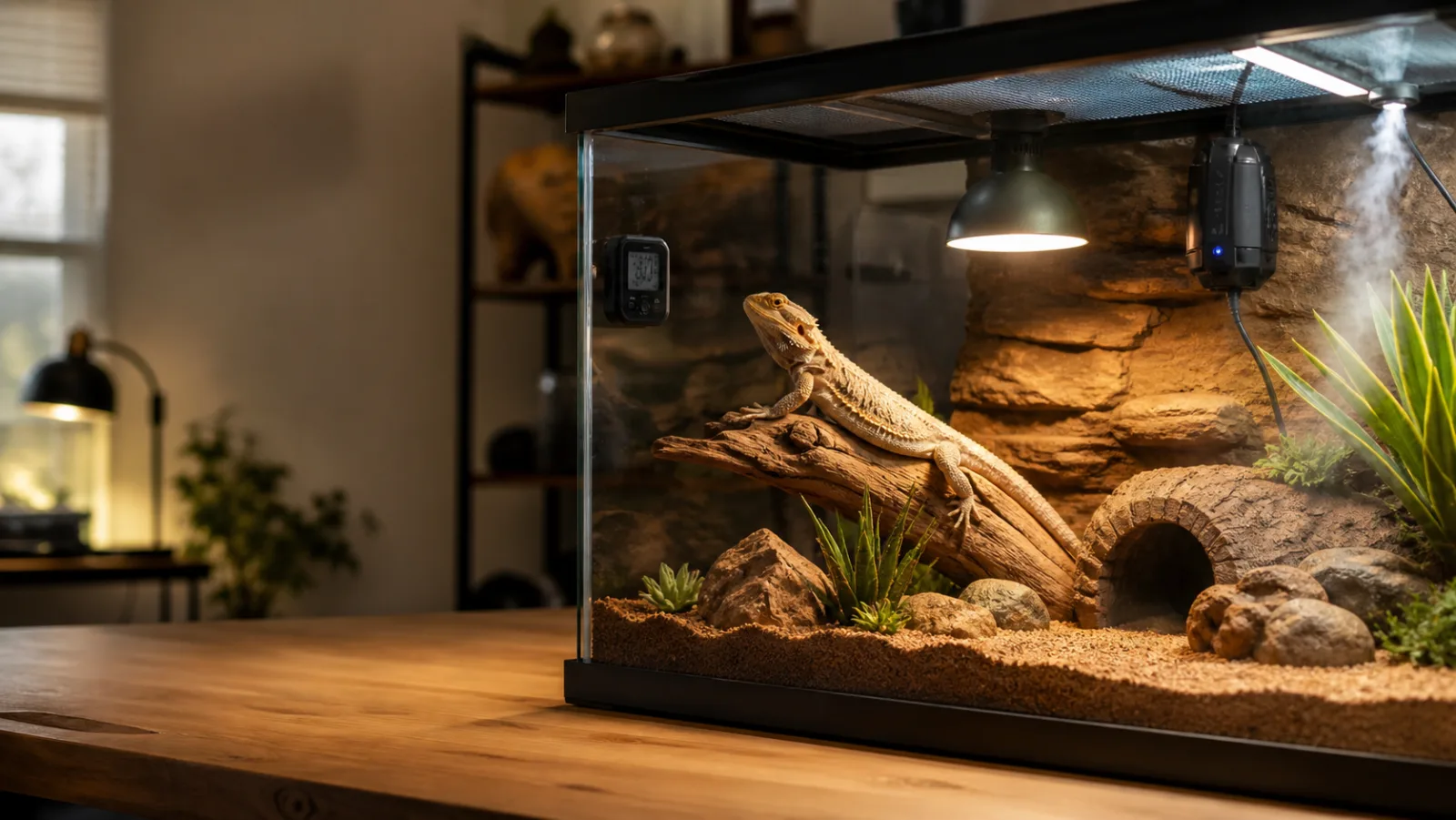
Reptile
Reptile Habitat Setup and Environmental Control: 2026 Guide for Heat, Humidity, and Safety
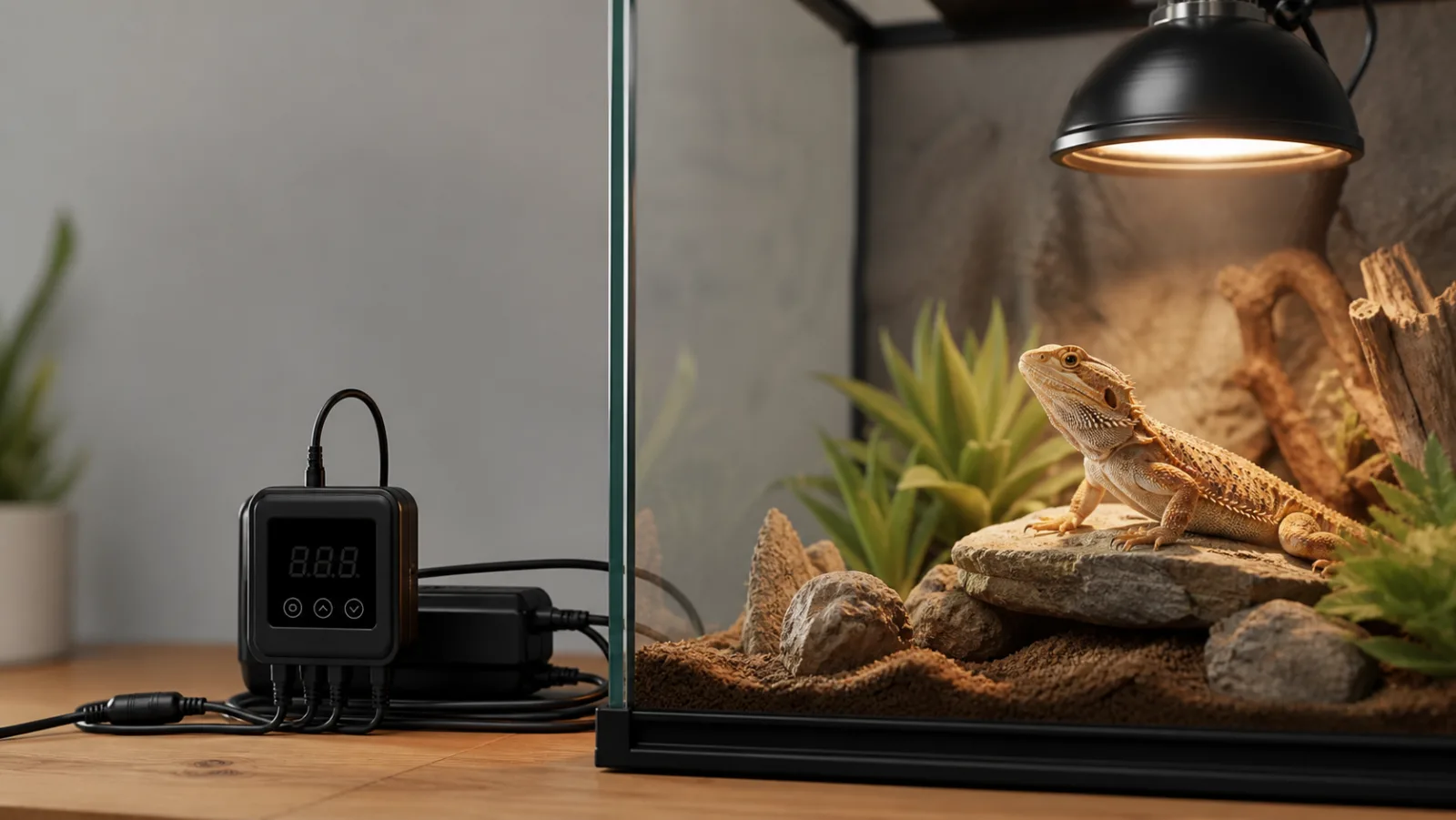
Reptile
Best Reptile Thermostats for Heat Mats, CHEs & Heating Elements (2026)
Reptile
Best Reptile UVB Bulbs for Safe Lighting (2026)
Reptile
Best Bearded Dragon Starter Kits (2026)
Reptile