Reptile
Best Indoor Tortoise Enclosures and Tables 2026: Open-Top Houses That Breathe
Most wooden tortoise houses on Amazon are starter and small-species sizes, not adult forever-homes. These six open-top enclosures and tables earn their place on airflow, build quality, and floor space — with the shallow-substrate trade-off flagged on every pick.
By Nick Miles · Updated September 8, 2026 · 11 min
PetPalHQ is reader-supported. We may earn a commission from qualifying Amazon purchases at no extra cost to you.
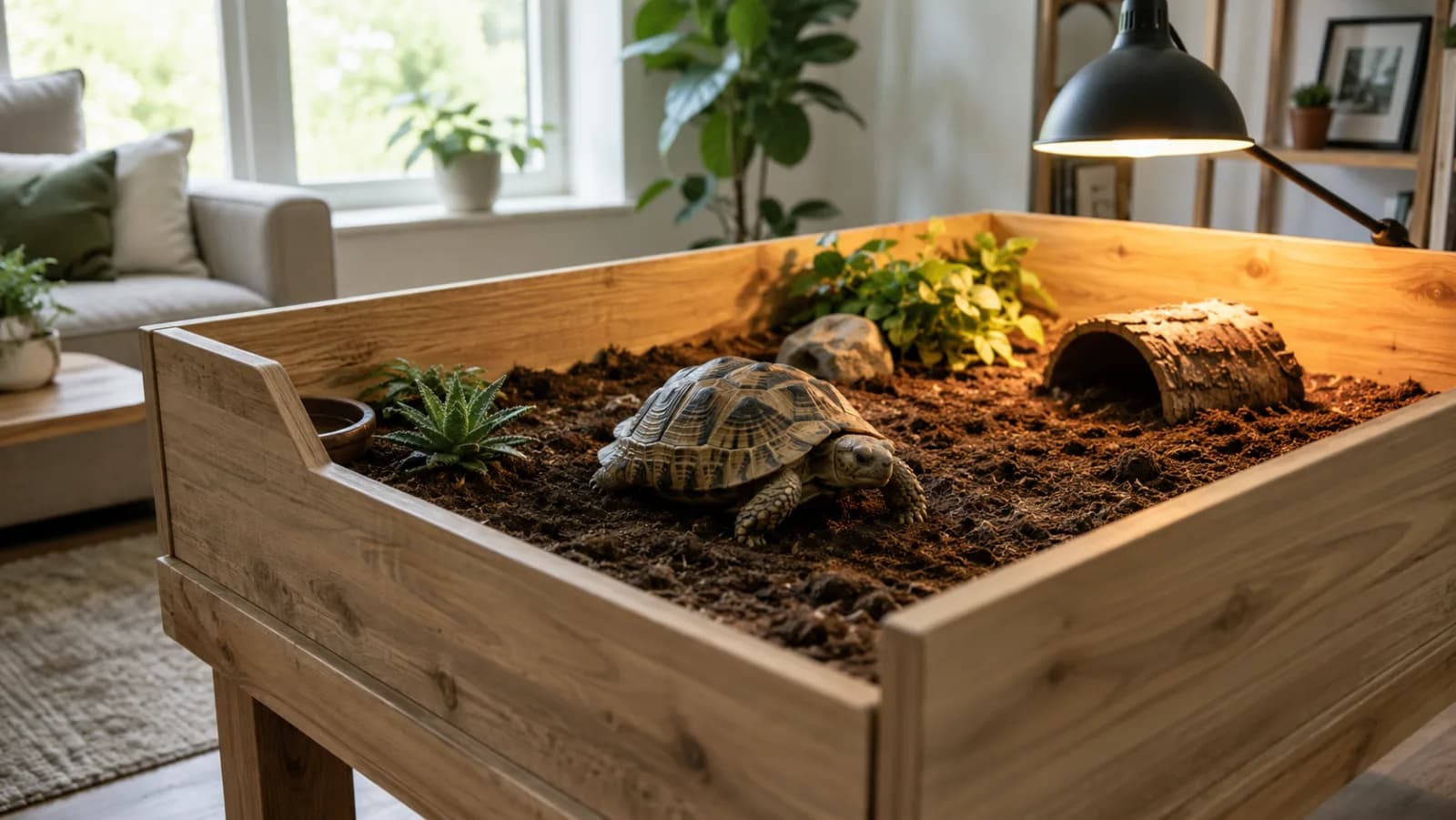
Evidence at a Glance
Zoo Med Tortoise House
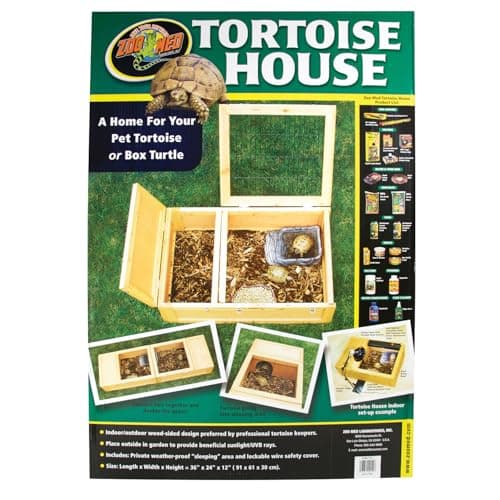
The roomiest open floor of the simpler single-room builds here, at 36 by 24 inches — close to 6 square feet for a ground-dwelling tortoise. Fir-wood build with a private weatherproof sleeping room, a lockable wire safety cover that vents heat and humidity, and a modular design that joins a second unit to double the space.
Sources: Zoo Med manufacturer documentation, The Tortoise Spot enclosure size guide
Verified Jun 25, 2026
Aivituvin Wooden Tortoise House Large
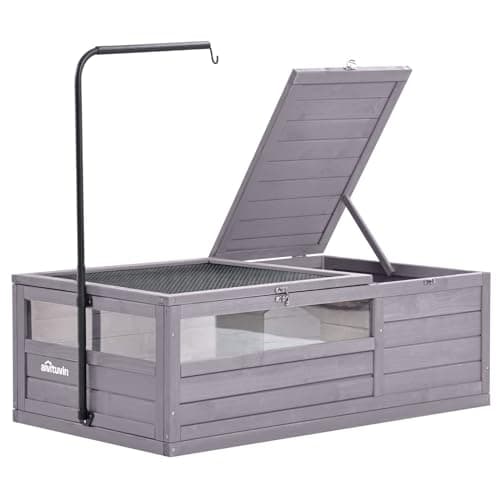
The lowest price in the guide for a large open-top floor. Built from solid wood rather than rot-prone plywood, with an upgraded waterproof plastic bottom, acrylic viewing panels on two sides, and a dense wire top lid over a two-room private-and-public layout.
Sources: Aivituvin manufacturer documentation, Northampton Reptile Centre table-versus-vivarium comparison
Verified Jun 25, 2026
Aivituvin Tortoise Habitat with Detachable Legs
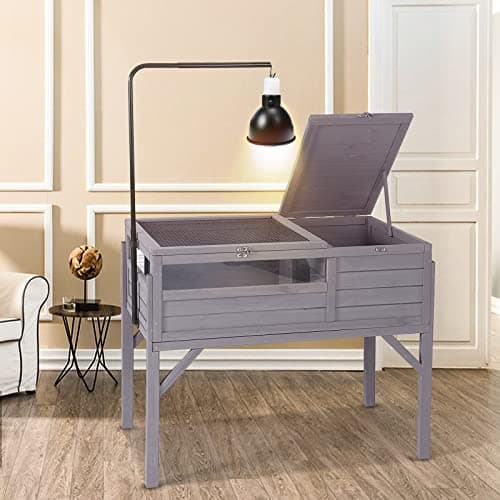
Detachable legs raise the floor to working height — about 31 inches tall — or come off so the box sits on a table. A detachable, telescopic, 360-degree lamp holder positions a basking or UVB bulb over the open run, with two top-opening roof panels for reach-in cleaning.
Sources: Aivituvin manufacturer documentation, The Tortoise Spot enclosure size guide
Verified Jun 25, 2026
Our Picks
Zoo Med
Zoo Med Tortoise House
9.0 / 10
- 36 by 24-inch footprint — about 6 square feet, the largest open floor of the simpler single-room builds here
- Built from fir wood with a private, weatherproof sleeping room
- Lockable wire safety cover vents heat and humidity while keeping the tortoise secure
- Modular design — remove an end panel and join a second house to double the space
$139.99
Current price · checked Sep 8, 2026
Aivituvin
Aivituvin Wooden Tortoise House Large, Indoor Tortoise Enclosure with Upgraded Weatherproof Bottom
8.6 / 10
- Large open-top floor at the lowest price in this guide
- Built from solid wood, not cheap plywood that rots from damp soil
- Upgraded waterproof plastic bottom keeps moisture off the floor
- Acrylic viewing panels on two sides for easy observation
$89.99
Current price · checked Sep 8, 2026
Aivituvin
Aivituvin Tortoise Habitat, Wooden Tortoise House with Detachable Legs and Lamp Holder
8.3 / 10
- Detachable legs raise it to working height — about 31 inches tall, or set the box on a table
- Footprint near 38 by 22 inches in the open run
- Adjustable, 360-degree lamp holder positions a basking or UVB bulb
- Two-room design with a private hide and an open basking zone
$109.99
Current price · checked Sep 8, 2026
VEVOR
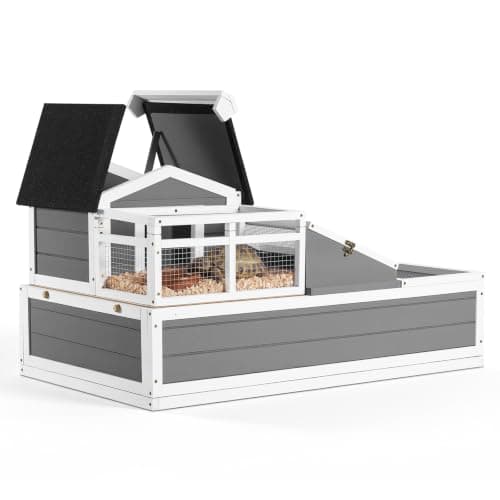
VEVOR Tortoise Habitat 4-Room Wooden Tortoise House with Balcony and 2 Stories
8.0 / 10
- Largest footprint here — 44.09 by 25.59 inches across a two-story layout per VEVOR
- Four rooms plus a balcony and a built-in ramp between the floors
- Every top cover section opens for feeding, handling, and observation
- Fir wood and wire mesh body, 34.39 lb assembled per VEVOR
$134.90
Current price · checked Sep 25, 2026
PawHut
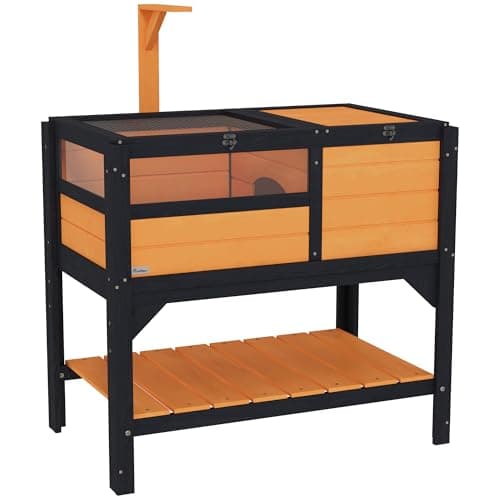
PawHut Tortoise Habitat with Shelf Storage and Light Support Frame
7.9 / 10
- Built-in storage shelf below holds substrate, food, and supplies
- Tall light support frame mounts a heat or UVB lamp above the basking area
- Two-room layout — a hide box plus a steel-grated basking spot
- Observation windows on each side and a mesh screen over the living space
$94.99
Current price · checked Sep 8, 2026
PetsCosset
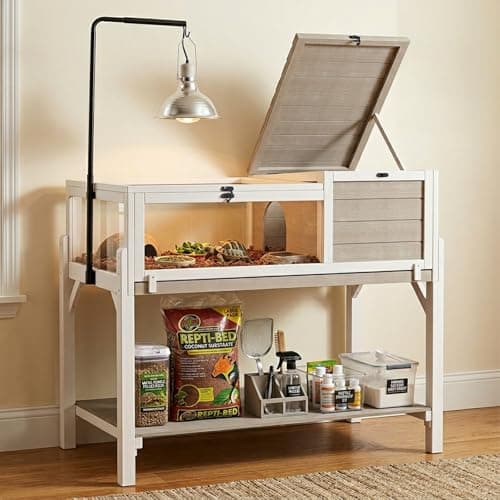
PetsCosset Tortoise Habitat with Storage Shelf and Adjustable Light Stand
7.8 / 10
- Large lower storage shelf built into the elevated table for substrate and supplies
- All-metal lamp stand adjusts for both height and length over the basking area
- Three-sided clear acrylic windows for full-brightness viewing
- Two-room layout — a resting area plus an open activity area
$112.99
Current price · checked Sep 8, 2026
The Short Answer
For an indoor tortoise, buy an open-top wooden house or table sized to the animal, then add the heat, UVB lighting, and deep substrate yourself. The Zoo Med Tortoise House at $139.99 is the best overall choice. It pairs the largest open floor of the simpler single-room builds, at 36 by 24 inches, with a trusted build and a modular design you can expand later. The Aivituvin Large at $89.99 is the best value, delivering a solid-wood, waterproof-bottomed enclosure for under $90. The Aivituvin raised table at $109.99 adds working-height legs and an adjustable, built-in lamp arm. The VEVOR 4-room at $134.90 packs the largest footprint and four enrichment zones, though its second-story balcony and ramp are a fall hazard you must supervise carefully. One honest caveat runs through every option. Each model here measures roughly 3 feet long, which makes them starter, juvenile, and small-species enclosures, not permanent adult forever-homes.
Every product on this list has been scored against the PetPal Gear Score, a weighted composite of expert consensus, observed effectiveness, animal safety, long-term durability, and value. Review method: Editorial synthesis of tortoise-table husbandry guidance from two main sources. The Tortoise Spot enclosure size guide and the Northampton Reptile Centre table-versus-vivarium comparison anchor the sizing standard, with open-top airflow consensus from UK tortoise keepers added on top. Manufacturer documentation from Zoo Med, Aivituvin, and PawHut was reviewed for dimensions, materials, and lamp-mount specs. Care-sheet sizing standards and Tortoise Forum sentiment informed pick selection and the honest starter-size framing. PetPalHQ does not run a reptile testing lab.. Synthesized from 6+ expert sources.
An indoor tortoise needs floor space, airflow, and a safe warm-to-cool gradient — and a wooden tortoise house or table is the classic way to provide them. We synthesized six husbandry and manufacturer sources for this guide, from The Tortoise Spot size charts to the Northampton Reptile Centre's table-versus-vivarium breakdown. PetPalHQ.com earns affiliate commissions from qualifying purchases. Our picks come from expert consensus — we synthesize professional guidance and keeper-community data, not hands-on testing — and commission rates never shape our editorial choices.
This guide covers two open-top formats. The first is the floor house, a low wooden box you set on the ground or a table. The second is the raised table, the same idea on legs at working height. Both share the open-top advantage: a wire or mesh lid vents heat and damp air, which suits arid species like Hermann's, Greek, and Russian tortoises. Stagnant, humid air raises the risk of respiratory infection, so airflow is a real welfare feature, not a frill.
One honest standard anchors every ranking here. The Tortoise Spot sets the indoor minimum for a single small tortoise at 4 feet by 2 feet, and adults of larger species need far more. Every wooden house in this price band is about 3 feet long. That makes these starter, juvenile, and small-species enclosures — strong first homes, not adult forever-homes. We rank by build quality, floor space, and keeper convenience, not by raw size alone, and we flag the shallow substrate trays that cap natural burrowing on each pick.
Head-to-Head Comparison
| Product | Footprint & format | TortoiseHabitat Score |
|---|---|---|
| Zoo Med Tortoise House | 36 by 24 in, two-room, modular | 9.0 |
| Aivituvin Wooden Tortoise House Large, Indoor Tortoise Enclosure with Upgraded Weatherproof Bottom | ~38 by 22 in open-top, acrylic sides | 8.6 |
| Aivituvin Tortoise Habitat, Wooden Tortoise House with Detachable Legs and Lamp Holder | ~38 by 22 in on legs + lamp arm | 8.3 |
| VEVOR Tortoise Habitat 4-Room Wooden Tortoise House with Balcony and 2 Stories | 44.1 by 25.6 in, 4-room, 2-story | 8.0 |
| PawHut Tortoise Habitat with Shelf Storage and Light Support Frame | 33 by 20 in + storage shelf | 7.9 |
| PetsCosset Tortoise Habitat with Storage Shelf and Adjustable Light Stand | elevated table + lamp + storage shelf | 7.8 |
$139.99
Current price · checked Sep 8, 2026
- 36 by 24-inch footprint — about 6 square feet, the largest open floor of the simpler single-room builds here
- Built from fir wood with a private, weatherproof sleeping room
- Lockable wire safety cover vents heat and humidity while keeping the tortoise secure
- Modular design — remove an end panel and join a second house to double the space
- Two-room layout gives a shaded hide plus an open basking area
The Zoo Med Tortoise House is the pick for keepers who want a trusted brand and a roomy single-level floor. Zoo Med lists the footprint at 36 by 24 inches, which works out to nearly 6 square feet of ground for a tortoise to walk across. Among the simpler single-room builds here, that is the largest open floor; the VEVOR 4-room packs a larger footprint, but it splits the space across a two-story layout. Construction is fir wood, with a private, weatherproof sleeping room on one end and an open basking area on the other.
The lockable wire safety cover is the husbandry highlight. It vents both heat and damp air, which matters for arid species that suffer in stagnant humidity, and it keeps the tortoise contained and curious pets out. A basking lamp and a UVB tube mount above the mesh without any modification.
The modular design ages well over time: remove an end panel, and you can join a second Zoo Med house to double the run. That buys valuable headroom as a young tortoise grows toward maturity.
The catch is size, not floor quality. The 36-inch length is still a starter size, and The Tortoise Spot sets 4 feet by 2 feet as the indoor floor for a single small tortoise. So the Zoo Med house suits juveniles and smaller species, not a large adult. The 12-inch side walls also limit substrate depth, and dedicated burrowers will outgrow the tray. At $139.99, it is the priciest single-unit pick before any heat, UVB, or substrate.
What We Love
- Largest open floor of the simpler single-room builds — about 6 square feet at 36 by 24 inches
- Trusted reptile brand with a private weatherproof sleeping room
- Lockable wire cover vents heat and humidity and keeps the tortoise secure
- Modular — join a second unit to double the floor as the tortoise grows
- Overhead basking and UVB fixtures mount above the mesh with no changes
What Could Be Better
- 36-inch length is starter sizing — below the 4 by 2-foot adult-small minimum
- 12-inch walls cap substrate depth, so deep burrowers outgrow the tray
- Priciest single-unit pick at $139.99 before heat, UVB, or substrate
- Heating, UVB, and substrate are all separate purchases
The Verdict
The Zoo Med house is the best-built single-room starter here, with the largest open floor of that simpler group. It makes a strong juvenile and small-species home, provided you treat the purchase price as the start of the setup budget, not the end.
Sources
- Zoo Med Laboratories: the Tortoise House measures 36 by 24 by 12 inches, is built from fir wood, and uses a lockable wire safety cover over a private weatherproof sleeping area
- Zoo Med Laboratories: the modular design lets you remove the end panel and join two Tortoise Houses to double the amount of space
- The Tortoise Spot: a single small tortoise needs a minimum indoor enclosure of 4 feet by 2 feet
Aivituvin Aivituvin Wooden Tortoise House Large, Indoor Tortoise Enclosure with Upgraded Weatherproof Bottom
$89.99
Current price · checked Sep 8, 2026
- Large open-top floor at the lowest price in this guide
- Built from solid wood, not cheap plywood that rots from damp soil
- Upgraded waterproof plastic bottom keeps moisture off the floor
- Acrylic viewing panels on two sides for easy observation
- Dense wire top lid plus a two-room private-and-public layout
Value is where the Aivituvin Large earns its place in this guide. At just $89.99 it is the cheapest open-top house featured here, and it spends the budget on floor space rather than on accessories. The footprint is large and low, which is the right shape for a ground-dwelling tortoise. Aivituvin builds the box from solid wood instead of cheap plywood, because plywood swells and rots once damp soil and droppings sit against it.
The upgraded waterproof bottom is the headline improvement. A sealed plastic base keeps moisture off your flooring and makes the tray easy to wipe clean. Acrylic panels on two sides let you observe the tortoise at eye level, while the dense wire top lid vents heat and humidity as an overhead lamp does its job above the mesh.
The interior layout divides into a private sleeping room and a public viewing-and-basking area, giving the animal both a shaded hide and a warm, open zone inside a single box.
What you give up is ruggedness. This is still a small-species and juvenile size, not an adult forever-home, and the wire lid and acrylic sides feel less rugged than the Zoo Med build. The shallow tray limits how deep you can layer the substrate, and like every pick here, the large Aivituvin ships bare, so heat, UVB, and substrate all cost extra.
What We Love
- Lowest price in the guide for a large open-top floor
- Solid-wood build resists rot better than plywood rivals
- Upgraded waterproof plastic bottom protects flooring and wipes clean
- Acrylic side panels make eye-level viewing easy
- Wire top lid vents humidity and takes an overhead lamp
What Could Be Better
- Small-species and juvenile sizing — not an adult forever-home
- Shallow tray limits substrate depth for burrowing
- Wire lid and acrylic sides feel less rugged than the Zoo Med
- Ships bare — heat, UVB, and substrate cost extra
The Verdict
This is the best dollars-to-floor-space buy in the guide, a solid-wood and waterproof-bottomed starter that handles the fundamentals well for under $90.
Sources
- Aivituvin: the house is built from 100 percent solid wood that resists rot from moisture, with a sealed plastic bottom that keeps flooring dry for indoor or outdoor use
- Northampton Reptile Centre: an open-top tortoise table gives excellent ventilation, which suits European species that struggle in high humidity
- The Tortoise Spot: a single small tortoise needs a minimum indoor enclosure of 4 feet by 2 feet
$109.99
Current price · checked Sep 8, 2026
- Detachable legs raise it to working height — about 31 inches tall, or set the box on a table
- Footprint near 38 by 22 inches in the open run
- Adjustable, 360-degree lamp holder positions a basking or UVB bulb
- Two-room design with a private hide and an open basking zone
- Two top-opening roof panels for easy reach-in cleaning
Raising the enclosure changes how you live with it day to day. The Aivituvin raised table positions the floor at roughly working height on detachable legs, so you can tend the tortoise without bending down to the ground; remove those legs, and the same box sits directly on a tabletop. Aivituvin lists the legged version at close to 31 inches tall, with a footprint near 38 by 22 inches across the open run.
The built-in lamp arm is the genuine draw here. It is detachable, telescopic, and rotates a full 360 degrees, so you can slide a basking or UVB bulb to the right height above the open section. The product notes call out balancing burn risk against UVB output, and an adjustable arm is how you dial that in. The two-room layout keeps a shaded hide separated from the warmer basking end.
Two top-opening roof panels make routine cleaning simple, so you lift a lid and reach straight in rather than fishing through one awkward opening.
The cost of working height is floor area. The legs raise the height, not the floor, so this is still small-species and juvenile sizing, and the open run near 38 by 22 inches sits under The Tortoise Spot's 4 by 2-foot small-tortoise floor. Raised legs also place more weight on the joints, so assemble it squarely. The shallow tray limits substrate depth, and the lamp bulb is a separate purchase on top of the $109.99.
What We Love
- Detachable legs bring the floor to working height — no bending to the ground
- Integrated 360-degree lamp arm positions basking and UVB bulbs precisely
- Converts to a tabletop box when the legs come off
- Two top-opening roof panels make reach-in cleaning easy
- Two-room layout separates a shaded hide from the basking zone
What Could Be Better
- Legs add height, not floor area — still small-species and juvenile sizing
- Roughly 38 by 22-inch run sits under the 4 by 2-foot small-tortoise floor
- Raised legs stress the joints, so careful square assembly matters
- Shallow tray caps substrate depth, and the bulb is a separate buy
The Verdict
The detachable-leg Aivituvin is the pick to choose when working height and an integrated lamp arm matter more to you than maximizing raw floor area.
Sources
- Aivituvin: the habitat includes a detachable, telescopic, 360-degree rotatable lamp holder and removable legs that raise it to about 31 inches tall, over a roughly 38 by 22-inch run
- The Tortoise Spot: a single small tortoise needs a minimum indoor enclosure of 4 feet by 2 feet
$134.90
Current price · checked Sep 25, 2026
- Largest footprint here — 44.09 by 25.59 inches across a two-story layout per VEVOR
- Four rooms plus a balcony and a built-in ramp between the floors
- Every top cover section opens for feeding, handling, and observation
- Fir wood and wire mesh body, 34.39 lb assembled per VEVOR
- Full-coverage plastic tray shields the wood and speeds cleaning
Enrichment is the VEVOR four-room's pitch to keepers. VEVOR publishes the shell at 44.09 by 25.59 by 23.62 inches, the largest footprint on this list, and the layout divides into four rooms across two floors with a balcony and a built-in ramp linking the levels. A tortoise gets distinct zones to explore rather than one flat box.
Access is the practical upgrade. VEVOR states that every top cover section opens, so you can reach any room to feed, spot-clean, or lift the animal out without disassembly, and a full-coverage plastic tray underneath catches spilled water, sand, and waste. The body is fir wood with wire mesh, which VEVOR lists as the main material, and the mesh panels vent the moisture that a damp substrate gives off.
Be clear about the wood. Fir is solid softwood, not the cedar this slot used to hold, and softwood is less naturally rot-resistant against a substrate you keep slightly damp. The plastic tray is doing the real waterproofing here, so keep it seated and dry the wood if the tray overflows.
The cost of the balcony is the balcony itself. Tortoises are not climbers, and a flipped tortoise stranded on its back can be in real danger, so watch the ramp for fall risk and block the slope if your animal struggles with it. The floor is genuinely the most generous here, but the upper rooms are stacked above the ground level, so the walkable run is not one continuous ground-level gradient. Like the others, this is starter and small-species sizing despite the larger footprint. Add your own deep substrate, and budget heat and UVB on top of the $134.90 price.
What We Love
- Largest footprint here — 44.09 by 25.59 inches per VEVOR
- Four zones across two floors add genuine enrichment for a curious tortoise
- Every top section opens, so there is no disassembly for daily access
- Wire mesh panels vent moisture; full-coverage tray speeds cleaning
- Handles supervised indoor and patio use
What Could Be Better
- Two-story balcony and ramp add a fall risk for non-climbing tortoises
- Run splits across two levels, so it is not one continuous ground gradient
- Fir wood is less rot-resistant than cedar against damp substrate
- Still starter and small-species sizing despite the bigger footprint
- Bare setup — deep substrate, heat, and UVB cost extra
The Verdict
The VEVOR four-room offers the most footprint and the most enrichment here, and every lid opens for daily access. Supervise the balcony and ramp closely, because tortoises are not built to climb or to survive a fall onto their backs.
Sources
- VEVOR (vevor.com, Tortoise Habitat 4-Room, model SWG005): product dimensions 44.09 x 25.59 x 23.62 in / 1120 x 650 x 600 mm, main material Fir Wood + Wire Mesh, product weight 34.39 lbs / 15.6 kg, item model number SWG005, four rooms across two stories
- VEVOR (vevor.com, Tortoise Habitat 4-Room, model SWG005): all top cover sections of this wooden tortoise habitat can be opened for easier interaction and close-up observation; a full-coverage plastic tray shields the wood and extends the life of the enclosure; assembly uses pre-drilled holes with an instruction manual included
$94.99
Current price · checked Sep 8, 2026
- Built-in storage shelf below holds substrate, food, and supplies
- Tall light support frame mounts a heat or UVB lamp above the basking area
- Two-room layout — a hide box plus a steel-grated basking spot
- Observation windows on each side and a mesh screen over the living space
- Openable lid for quick reach-in access
Storage is the defining angle here. The PawHut storage habitat tucks a full shelf underneath the enclosure, so substrate, food, and supplies live in one place instead of scattered across a closet, and for a small room that built-in tidiness is worth real money. A tall support frame rises over the box to hold a heat or UVB lamp above the basking spot.
The living area divides into a hide box and a steel-grated basking zone. Observation windows on each side let you check the tortoise without opening anything. A mesh screen across the top vents heat and damp air, and the openable lid still gives quick reach-in access.
The compromise is raw floor. The footprint is the smallest of the floor models, at only 33 by 20 inches, which suits a hatchling or a small species but runs out of room soonest as the tortoise grows. The tall frame also makes the unit top-heavy for the floor it provides. The basking area sits on steel grating, so soften it with substrate or a flat tile.
This is firmly a juvenile and small-species starter. The substrate depth is shallow, and, as with every pick here, heat, UVB, and bedding remain separate from the $94.99 price.
What We Love
- Built-in shelf stores substrate, food, and supplies under the cage
- Tall frame mounts a heat or UVB lamp over the basking area
- Side observation windows let you check in without opening the lid
- Mesh screen top vents heat and humidity
- Openable lid gives fast reach-in access
What Could Be Better
- Smallest floor of the models at 33 by 20 inches
- Tall frame makes the unit top-heavy for the floor it offers
- Steel-grated basking spot needs softening with substrate or tile
- Shallow tray and bare setup — heat, UVB, and bedding cost extra
The Verdict
The shelf-storage PawHut is the pick for genuinely cramped rooms, trading away floor area in exchange for tidy under-cage storage and a convenient built-in lamp frame.
$112.99
Current price · checked Sep 8, 2026
- Large lower storage shelf built into the elevated table for substrate and supplies
- All-metal lamp stand adjusts for both height and length over the basking area
- Three-sided clear acrylic windows for full-brightness viewing
- Two-room layout — a resting area plus an open activity area
- Pull-out tray slides free for quick substrate changes
Storage and lighting are the PetsCosset build's pitch. It combines an elevated working-height table, an adjustable all-metal lamp stand, three-sided acrylic viewing, and a large lower storage shelf into one unit. If you want a single piece that handles the stand, the lamp mount, and supply storage together, this is the candidate — substrate, food, grass mats, and cleaning supplies live on the shelf below instead of scattered across a closet.
The metal lamp stand adjusts for both height and length, so you can fine-tune the basking distance over the open activity area. The three-sided acrylic keeps the space bright and easy to watch from multiple angles. The layout pairs a resting area with an open activity zone, and a pull-out tray slides free for quick substrate replacement.
What you pay for is the stand, not the floor. Those features sit on a footprint no larger than the cheaper picks, so you pay $112.99 mostly for the storage shelf and the all-in-one frame. The same floor area imposes the same small-species and juvenile ceiling. An elevated, loaded stand also sits taller, so place it where it will stay put.
For a keeper who values one tidy, do-everything table, the storage-shelf PetsCosset earns its spot. For pure floor space per dollar, the cheaper picks win.
What We Love
- Combines an elevated table, adjustable lamp stand, acrylic viewing, and storage
- All-metal lamp stand adjusts for height and length over the basking area
- Three-sided acrylic windows give a clear view from multiple angles
- Large lower shelf keeps substrate and supplies organized
- Pull-out tray speeds substrate changes and cleaning
What Could Be Better
- Same small footprint as cheaper picks at a higher price
- Small-species and juvenile sizing — not an adult forever-home
- Elevated, loaded stand sits tall and needs a stable spot
- Bare setup — deep substrate, heat, and UVB cost extra
The Verdict
The storage-shelf PetsCosset is the do-everything table, and it is worth choosing if integrated storage and an adjustable lamp stand matter more to you than maximizing floor area per dollar.
How We Score
Formula
TortoiseHabitat Score = (Floor Space & Thermal Gradient × 0.30) + (Ventilation vs Humidity × 0.25) + (Material Safety & Cleaning × 0.25) + (Substrate Depth Capacity × 0.20)
Score Factors
- Floor Space & Thermal Gradient · 30%
- This factor measures the open floor a tortoise can actually walk, and how well that length supports a warm-to-cool gradient. Tortoises are ground-dwellers that need room to roam, not vertical height. A longer single-level run lets a basking lamp heat one end while the far end stays cool. We discount floor that is split across a second story, because a tortoise cannot use it as one continuous gradient. The Tortoise Spot sets 4 feet by 2 feet as the indoor floor for a single small tortoise, so houses near 3 feet score as starter or juvenile sizing, not adult forever-homes.
- Ventilation vs Humidity · 25%
- Open-top wooden tables ventilate extremely well, and that steady airflow suits arid species like Hermann's, Greek, and Russian tortoises. Stagnant, damp air raises the risk of respiratory infection. A wire or mesh lid scores highest here, because it vents excess moisture while keeping the animal securely contained. Fully enclosed boxes hold humidity better but trap stale air, so they suit hatchlings or humid-climate species instead.
- Material Safety & Cleaning · 25%
- This factor rates build quality against moisture and rot, plus how easily you clean the enclosure. Tortoise substrate stays slightly damp, and wet plywood swells and grows mold, so solid wood with a sealed, waterproof tray scores highest. A plastic or coated base that wipes clean protects both the flooring and the animal, while open or hinged tops and a slide-out tray speed daily maintenance. Thin, uncoated particleboard and heavy one-piece lids score lowest.
- Substrate Depth Capacity · 20%
- Tortoises instinctively dig, and a properly deep substrate layer runs about 4 inches for juveniles and 6 inches or more for adults. Most wooden houses rely on shallow side walls or trays, which caps how deep you can realistically fill them. Models with taller walls or a deeper tray therefore score higher. Shallow trays lose points because they restrict natural burrowing.
| Rank | Product | Score |
|---|---|---|
| #1 | Zoo Med Zoo Med Tortoise House | 9.0 |
| #2 | Aivituvin Aivituvin Wooden Tortoise House Large, Indoor Tortoise Enclosure with Upgraded Weatherproof Bottom | 8.6 |
| #3 | Aivituvin Aivituvin Tortoise Habitat, Wooden Tortoise House with Detachable Legs and Lamp Holder | 8.3 |
| #4 | VEVOR VEVOR Tortoise Habitat 4-Room Wooden Tortoise House with Balcony and 2 Stories | 8.0 |
| #5 | PawHut PawHut Tortoise Habitat with Shelf Storage and Light Support Frame | 7.9 |
| #6 | PetsCosset PetsCosset Tortoise Habitat with Storage Shelf and Adjustable Light Stand | 7.8 |
When NOT to Buy
Skip these wooden houses entirely if you keep a large adult tortoise. Every model featured here is only about 3 feet long. The Tortoise Spot sets the indoor minimum for a single small tortoise at 4 feet by 2 feet. Big grazing species need considerably more — ideally a custom-built table or a spacious outdoor pen. Buying a 3-foot box for a full-grown sulcata or leopard tortoise simply means replacing it within months. And if you actually keep a leopard gecko rather than a tortoise, that animal wants a glass terrarium, not a wooden table — see our leopard gecko tank kits guide.
Skip the open-top format if you keep a humidity-loving species inside a cool, drafty home. Open tables ventilate beautifully, which suits arid Hermann's, Greek, and Russian tortoises. A tropical red-foot is different. It needs steady moisture, and a vented top actively fights you on that. In a genuinely cold room, a closed wooden vivarium will hold heat and humidity far better. Match the format to the animal, not the other way around.
Skip any of these enclosures if the purchase price represents your entire budget. None of them include a heat source, a UVB tube, a thermostat, or substrate. That supporting gear is not optional. A healthy tortoise needs a basking lamp, dedicated UVB for proper bone development, and a deep, slightly damp substrate. A thermostat to govern that heat source matters just as much. So if $139.99 for the Zoo Med house empties the fund, buy a cheaper box. Redirect the savings into proper lighting and bedding.
Skip the multi-level VEVOR 4-room specifically if your tortoise is clumsy or heavy-bodied. Tortoises are not climbers, and a fall onto the back can be genuinely dangerous. The balcony and ramp add real enrichment for a sure-footed animal. For one that struggles with slopes, they become a hazard. When in doubt, choose a single-level floor house and add ground-level enrichment instead.
Frequently Asked Questions
- Are wooden tortoise houses big enough for an adult tortoise?
- Usually not for a large adult, because every model in this guide measures only about 3 feet long. The Tortoise Spot sets 4 feet by 2 feet as the indoor minimum for one small tortoise, and bigger species genuinely need much more than that. So these houses work best as starter, juvenile, and small-species homes. A growing tortoise will eventually need a larger table or an outdoor pen, which is why you should always buy to the adult size of your species, not to the hatchling in front of you.
- Is an open-top tortoise table better than a glass vivarium?
- For most arid species, the answer is yes. The Northampton Reptile Centre notes that an open-top table provides excellent ventilation, which suits European tortoises that struggle in high humidity. The stagnant, damp air inside a sealed box, by contrast, raises the risk of respiratory infection. The trade-off is heat retention, because a closed vivarium holds warmth and humidity considerably better, so it can suit hatchlings or tropical species in a cool, drafty home. The sensible approach is to match the format to your species and room conditions.
- How deep should the substrate be in a tortoise enclosure?
- Aim for roughly 4 inches for juveniles and 6 inches or more for adults. Tortoises dig and burrow to rest and to regulate their temperature, and deeper bedding lets them follow that natural instinct. Most wooden houses use shallow trays or low side walls, which caps how deep you can realistically fill them, and that limitation is the main weakness of the whole category. If your species is a keen burrower, choose a model with taller walls, or plan an upgrade in advance.
- Do these tortoise houses come with a heat lamp or UVB?
- No. Every pick here ships as a completely bare enclosure, so you add the heat source, the UVB tube, a thermostat, and the substrate yourself. Several models do include a lamp holder or a support frame that positions a bulb over the basking area, but that hardware is only a mount, not the light itself. Budget for a basking lamp and a separate UVB source on day one. Tortoises genuinely need both to digest their food and to build healthy bone.
- Can I keep a tortoise house outdoors?
- Some of these models do allow supervised outdoor time. Several use water-resistant paint or a moisture-proof finish that handles dry, warm days on a patio, and natural sunlight is excellent for tortoises. Even so, these enclosures are not all-weather pens, so bring the animal indoors before cold, wet, or very hot weather arrives. And never leave a tortoise unsupervised anywhere predators can reach it. Treat outdoor use as an occasional bonus, not a permanent home.
- Which tortoise species suit an open-top wooden house?
- Open-top tables fit dry-climate species best, which means Hermann's, Greek, Russian, and marginated tortoises all benefit from the good airflow and lower humidity. These starter-sized houses suit hatchlings and juveniles of those species, plus some smaller adults. Tropical, humidity-loving species such as red-foots do better in a setup that actively holds moisture. Always confirm your species' adult size and humidity needs before buying, because adult dimensions vary very widely across tortoises.
Bottom Line
Buy the Zoo Med Tortoise House for the best-built starter from a trusted brand. It gives the largest open floor of the simpler single-room builds — roughly 6 square feet — plus a vented, lockable lid and an expandable modular design. Just add the heat, UVB, and substrate separately, since it ships without them.
Buy the Aivituvin Large to secure a solid-wood, waterproof-bottomed open-top house for under $90, since it delivers the best floor-space value here while staying sized for juveniles and smaller species.
Buy the Aivituvin raised table if working height and a built-in lamp arm matter to you, because the legs lift the floor well off the ground and the same box converts to a tabletop unit.
Buy the VEVOR 4-room for the largest footprint and four distinct enrichment zones, but supervise the balcony carefully, because a tortoise can easily flip and struggle on a raised ramp.
Remember the spine running through this guide: every model here is only about 3 feet long, which makes them starter, juvenile, and small-species homes. Buy to your species' eventual adult size, and plan for a larger table or outdoor pen as the tortoise grows.
Sources & Methodology
Methodology
TortoiseHabitat Score = (Floor Space & Thermal Gradient × 0.30) + (Ventilation vs Humidity × 0.25) + (Material Safety & Cleaning × 0.25) + (Substrate Depth Capacity × 0.20)
Expert review sources
- The Tortoise Spot — indoor and outdoor enclosure size guide and habitat setup
- Northampton Reptile Centre — tortoise table versus tortoise vivarium comparison
- Tortoises For Sale — UK keeper guidance on open-top tables and airflow
- Reptiles Plus — tortoise tables versus enclosed vivariums for ventilation
- Manufacturer documentation — Zoo Med, Aivituvin, and PawHut dimensions, materials, and lamp-mount specs
- ReptiFiles — care-sheet sizing and substrate-depth standards for arid species
Community sources
- Tortoise Forum — keeper discussion on table versus vivarium and starter-enclosure experiences
- Tortoise-keeper consensus on substrate depth, burrowing, and open-top ventilation
Prices and specs verified June 25, 2026.
About the author
Nick Miles is the chief editor of PetPalHQ. The picks above are editorial synthesis of tortoise-husbandry references, manufacturer specifications, and verified keeper-community sentiment. PetPalHQ does not run a reptile testing lab. The TortoiseHabitat Score is a composite of expert opinion and documented design factors, not a measurement.
PetPalHQ is a participant in the Amazon Services LLC Associates Program. We may earn commissions from qualifying purchases — at no extra cost to you.
More Guides
Reptile
Best Leopard Gecko Tank Kits 2026: Complete Setups That Actually Work
Reptile
Best Bearded Dragon Substrates 2026: Safe Loose & Solid Options
Reptile
Best Reptile Thermostats for Heat Mats, CHEs & Heating Elements (2026)
Reptile
Best Reptile Heat Lamps & Basking Fixtures (2026)
Reptile