Cats & Dogs
Best Cat Ramps and Steps for Senior Mobility (2026)
The PetSafe Happy Ride Folding Dog Ramp wins because it is the only pick here whose listing states high-traction treads, side rails and rubber feet together — a continuous incline with edges, for a cat who no longer trusts a jump. The PetSafe CozyUp Wooden Pet Bed Ramp is the permanent bedroom answer at a published 25-inch height, and the Pet Gear Easy Step II is one of only two stepped picks that publishes its rise — and the only one that also publishes its landing depths. VCA Animal Hospitals recommends this whole category by name: provide a ramp or stool/step for getting onto higher surfaces.
By Nick Miles · Updated September 14, 2026 · 14 min read
PetPalHQ is reader-supported. We may earn a commission from qualifying Amazon purchases at no extra cost to you.
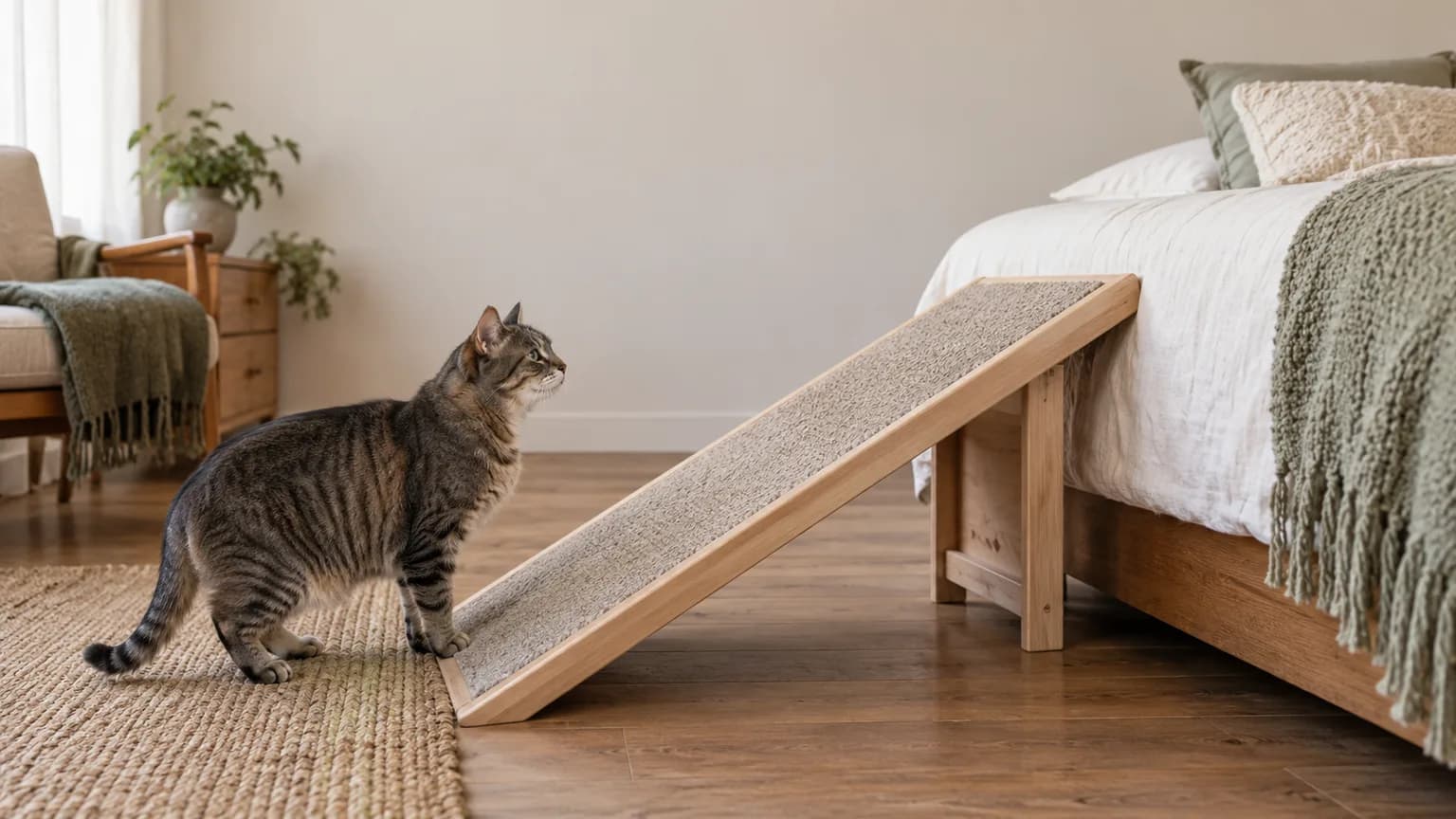
Evidence at a Glance
PetSafe Happy Ride Folding Dog Ramp
A continuous 62-inch incline with high-traction treads, side rails and rubber feet, rated to 150 pounds and folding in half with a safety latch.
Sources: VCA Animal Hospitals — Arthritis in Cats, Cornell Feline Health Center — Is Your Cat Slowing Down?, Merck Veterinary Manual — Joint Disorders in Cats
Verified Sep 14, 2026
PetSafe CozyUp Wooden Pet Bed Ramp, White
A fixed wooden bed ramp that publishes the number most listings hide — 70 inches of run to reach 25 inches of height, under a non-slip carpet cover.
Sources: VCA Animal Hospitals — Arthritis in Cats, Cornell Feline Health Center — Is Your Cat Slowing Down?, Merck Veterinary Manual — Joint Disorders in Cats
Verified Sep 14, 2026
Pet Gear Easy Step II Pet Stairs, Wheat, 2 Step
One of only two stepped picks on this page that publishes a rise — 5 inches per step — and the only one that also publishes its landing depths, at 8.5 and 9.5 inches, with rubber grippers underneath.
Sources: VCA Animal Hospitals — Arthritis in Cats, Cornell Feline Health Center — Is Your Cat Slowing Down?, Merck Veterinary Manual — Joint Disorders in Cats
Verified Sep 14, 2026
Our Picks
PetSafe
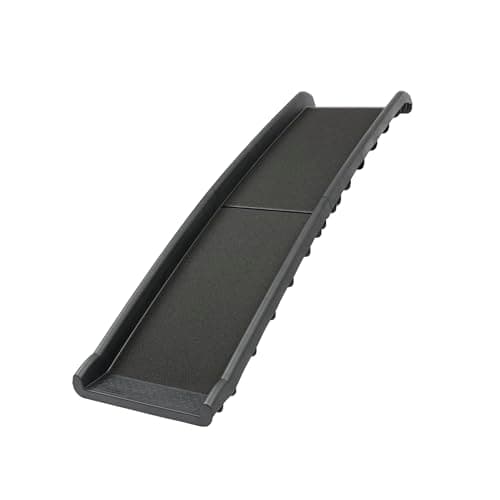
PetSafe Happy Ride Folding Dog Ramp
9.1 / 10
- Continuous incline — 62"L x 16"W x 4"H, with no step for the cat to hop
- High-traction treads, side rails and rubber feet named on the listing
- Rated to 150 pounds, the highest published capacity on this page
- Folds in half and locks with a safety latch; weighs 10 pounds
$59.99
PetSafe
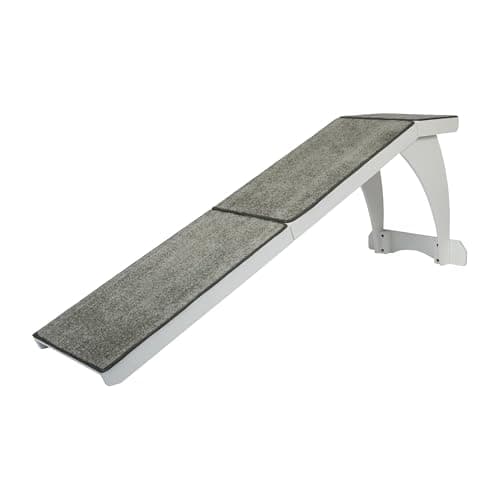
PetSafe CozyUp Wooden Pet Bed Ramp, White
8.4 / 10
- 70"L x 16"W x 25"H — the only pick that publishes both its run and the height it reaches
- Non-slip grip from a heavy duty carpet cover
- Rated for pets up to 120 pounds
- Wood construction in two finishes, built to stay in the room
$139.95
Pet Gear
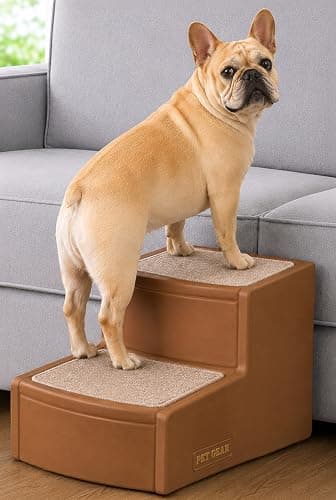
Pet Gear Easy Step II Pet Stairs, Wheat, 2 Step
7.2 / 10
- Step height 5"; first step depth 8.5", second step depth 9.5"
- Rubber grippers on the bottom to keep the unit in place
- Carpet tread removes easily and is machine washable
- Snaps together easily
$44.80
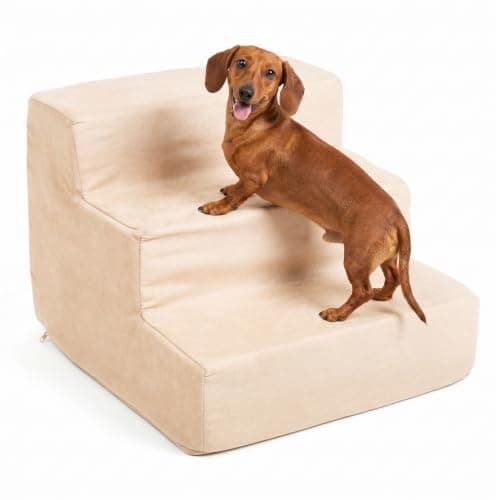
PETMAKER
3-Step Pet Stairs — Nonslip Foam Dog and Cat Steps
7.1 / 10
- Step height 4" — the lowest published rise on this page
- 16"L x 15"W x 12"H, the smallest footprint here
- Weight capacity 25 pounds, published
- Zippered microfiber cover removes for machine washing
$30.10
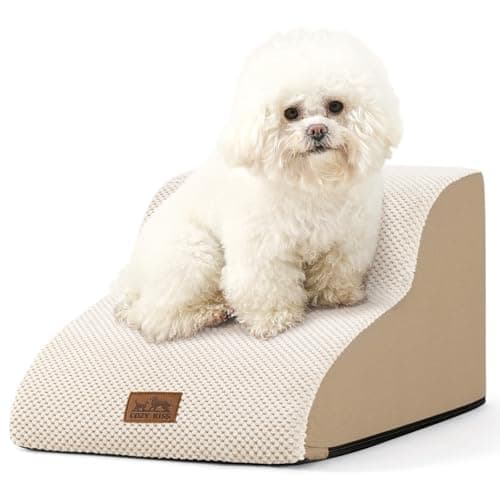
COZY KISS
COZY KISS Dog Stair for Small Dog 11.8" H, 2 Step Pet Ramp for Chair
6.3 / 10
- 11.8 inches of total height across two steps
- 80-pound capacity from 30D high-density sponge, published
- Non-slip nylon bottom; corduroy cover with a TPU waterproof layer
- Carry handle at the back; sides in cotton and linen for claw use
$32.99
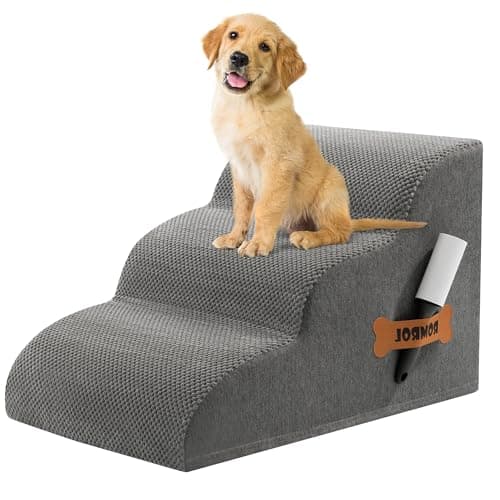
ROMROL
Romrol Dog Stairs Ramp for High Bed, 3-Step
5.8 / 10
- 15.7" x 23.6" x 15.7" in the 3-step configuration
- Non-slip waterproof fabric cover, machine washable
- 33D rebound high-density foam core
- Offered from a MINI 3-step at 13" up to a 5-step at 24"
$29.99
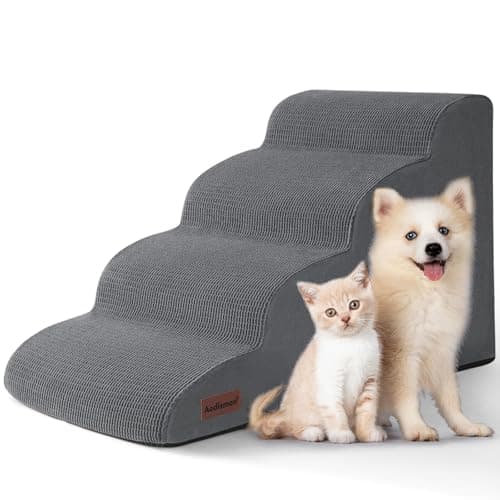
aodisman
Aodisman Dog Steps for Bed or Couch, 4-Step Pet Stairs Ramp
5.7 / 10
- Four steps, described as wider steps with a gentle slope
- Durable friction-resistant fabric on the walking surface
- Non-slip bottom to keep the unit in place
- High-rebound foam core with a zippered washable cover
$35.99
The Short Answer
Buy the PetSafe Happy Ride Folding Dog Ramp — it is the only pick whose listing states high-traction treads, side rails and rubber feet on one continuous incline.
Every product on this list has been scored against the PetPal Gear Score, a weighted composite of expert consensus, observed effectiveness, animal safety, long-term durability, and value. Review method: Editorial synthesis of veterinary guidance — the Cornell Feline Health Center, the Merck Veterinary Manual and VCA Animal Hospitals — read against manufacturer-supplied Amazon listing specifications checked September 14, 2026. Rankings follow the published PetPal Cat Mobility Score weights. No first-hand product testing.. Synthesized from 3+ expert sources.
A cat who stops jumping onto the bed is usually not slowing down. She is usually in pain, and she is hiding it, because that is what cats evolved to do. The Cornell Feline Health Center puts a number on how common this is: X-rays revealed that 90 percent of cats over the age of 12 showed evidence of degenerative joint disease. The Merck Veterinary Manual gives a similar range, stating that approximately 60% to 90% of older cats have osteoarthritis. VCA Animal Hospitals reports that about 90% of cats over 10 years old experience osteoarthritis in at least one joint. These are three different studies with three different age cutoffs, and they converge on the same uncomfortable conclusion.
The masking is the part owners miss. Cornell explains the behaviour as a deeply ingrained feline instinct for self-protection — a cat may want to conceal its disability for fear of alerting a potential predator to its vulnerability. Merck says the same thing more bluntly: the condition is common in cats but it may not be noticed because cats often hide signs of pain. So the signal is rarely a limp. It is a cat who used to sleep on the bed and now sleeps on the chair, and a household that reads the change as personality rather than arthritis.
That is why this category exists, and VCA recommends it explicitly. Among the home changes it lists for an arthritic cat is a plain instruction: provide a ramp or stool/step for getting onto higher surfaces. This page is the ranked version of that sentence — seven ramps and step sets scored on the six things that decide whether a cat will actually use one.
These picks are editorial synthesis. PetPalHQ does not run a feline mobility testing lab, and nothing here has been tested with a cat on it. Every product was selected by reading manufacturer-supplied Amazon listing specifications against veterinary guidance, and the ranking follows the published score weights exactly. Where a listing does not state a specification, that absence is recorded as an absence rather than filled in with an estimate.
Why Has Your Cat Stopped Jumping?
Because jumping got expensive, and cats are relentless economists about their own bodies. A healthy cat clears five or six times her own height without appearing to think about it. An arthritic cat still can, once, painfully — so she budgets. The bed becomes a place she visits less often, then a place she visits when someone lifts her, then a place she has given up. Nothing about that sequence looks like an injury from the outside, which is precisely why it gets misread.
VCA's list of signs is the most useful diagnostic checklist an owner can carry, because it describes behaviour rather than pathology. Reluctance to jump up or down, onto or off furniture, sits at the top of it. Hiding more than usual is on it. So is poor coat condition, because self-grooming becomes difficult when twisting hurts. Cornell adds a detail that catches a lot of households by surprise: an affected cat may seem lethargic and may increasingly seek out comforting places to nap, in a warm corner of your home or in a spot of sunshine near a window. If your cat has relocated her entire day to the floor, the floor is not a preference. It is an accommodation she made without telling you.
The scale is worth sitting with. Cornell's second figure is the one that should change how younger households think: another study suggested that 20 percent of all cats one year of age and older are already arthritic to some extent. One cat in five, from the age of one. This is not a condition that arrives at fourteen with a bang; it accumulates quietly for years before the first missed jump.
Ramp or Steps: Which Does an Arthritic Cat Actually Need?
A ramp asks a cat to walk. Steps ask a cat to jump, repeatedly, in smaller increments. That is the whole distinction, and it explains why both ramps on this page outrank all five stepped products despite costing more and taking up more floor. If the underlying problem is that a single lift has become painful, replacing one large lift with three small ones helps less than removing the lift entirely.
Steps still win on practical grounds often enough to matter. A 62-inch or 70-inch ramp needs a run of clear floor that many bedrooms simply do not have, especially against the side of a bed. Steps occupy a footprint closer to a nightstand. They are also easier to introduce, because a cat can take one step and stop, which is a much smaller commitment than committing to a slope. For a cat in early-stage joint disease who is hesitating rather than failing, a low-rise step set is often the more realistic purchase.
The compromise most households end up making is a ramp at the destination the cat cares about most and steps elsewhere. In practice that means the bed, because that is where the cat wants to be at night and where the height differential is largest. Whichever you choose, the specification that decides everything is the one three of these seven listings never publish: how much vertical the cat has to produce in one movement.
What Incline Is Safe? Nobody Publishes a Number
Here is the finding that should change how you read every other article on this subject: no veterinary authority we could verify publishes a safe incline gradient or a maximum step rise for cats. We checked Cornell, Merck and VCA directly. VCA recommends a ramp or a step by name and gives no angle and no height. Merck is silent on the question entirely. Cornell covers signs and treatment without touching product geometry.
This matters because the retail internet is full of confident numbers. You will find pages specifying a maximum incline in degrees, or an ideal rise in inches, presented with the tone of established clinical guidance. None of the three veterinary sources behind this guide supports any of them, and we are not going to repeat a figure we cannot attribute. If you see a specific angle quoted somewhere, ask which veterinary body published it, and notice how rarely that question has an answer.
What can be said without a source behind it is modest and obvious: gentler is better, particularly for a cat whose pain is already advanced, and a rise you can see your cat clear comfortably today is more trustworthy than any number. That is why the score below weights published rise height above everything else. Not because a threshold exists, but because a manufacturer who publishes the rise lets you make the judgement yourself, and a manufacturer who does not has handed you a guess.
How Do You Get a Cat to Use a Ramp?
Slowly, and by not making it a project. Cats are suspicious of new furniture, and a cat in pain is more suspicious than most because unfamiliar surfaces carry risk. The failure mode is an owner who installs a ramp, watches the cat ignore it for two days, and concludes the cat does not need one — when what actually happened is that nothing invited her onto it.
Put it in place before you need it, if you can. The most reliable installations are the ones that went in while the cat could still jump, so the ramp became ordinary furniture rather than an intervention arriving alongside a decline. Feed treats at the bottom of it, then partway up, then at the top, over a week rather than an afternoon. Let the cat approach it with all four feet on the floor, which is how she assesses whether a surface will hold. And if she tries it once, slips, and never returns, that is usually a traction problem rather than a refusal — which is why surface traction is the second-heaviest factor in the score below.
Height matters to cats in a way that is easy to underestimate, and this is the site's own editorial read rather than a sourced claim: the elevated spots a cat chooses are not arbitrary, and losing access to them is a bigger event than losing access to a piece of furniture. When a cat gives up the windowsill, she gives up the view, the sunlight and the vantage point in one move. Restoring that access is worth more patience than most owners give it.
What This Guide Deliberately Does Not Cover
This page covers freestanding ramps, steps and stairs for furniture access, and nothing else. Mobility problems in an ageing cat touch almost every part of the home, and treating all of it in one buying guide would produce a worse answer on each individual question. So the boundaries here are deliberate, and the rest of the picture lives in specific places.
Litter box access is a genuinely separate specification — entry height, not step rise — and it is covered in Best Standard Litter Boxes for Cats (2026). Bowl height, flooring traction, bedding and the general shape of an age-friendly home belong to Senior Cat Accessibility Setup: Low-Entry Litter, Raised Bowls, Steps & Traction, which is the right starting point if you want the whole audit rather than one purchase. Climbing furniture bought for enrichment rather than for pain relief is a different product class again, handled in Best Cat Trees for Large Cats and Multi-Cat Homes (2026) and, for permanent installations, in Best Cat Wall Shelf Systems for Vertical Territory (2026). And if the patient is a dog, Best Dog Ramps and Stairs for Senior Dogs (2026) runs the equivalent analysis at dog weights.
One more boundary worth stating. Four veterinary and welfare bodies were approached as sources for this guide and could not be reached — their pages returned access errors, empty shells or redirect loops during research. None of them is cited anywhere on this page, and no claim here rests on them. Three sources are cited because three sources could be verified.
Head-to-Head Comparison
| Feature | PetSafe Happy Ride Folding Dog Ramp | PetSafe CozyUp Wooden Pet Bed Ramp, White | Pet Gear Easy Step II Pet Stairs, Wheat, 2 Step | 3-Step Pet Stairs — Nonslip Foam Dog and Cat Steps | COZY KISS Dog Stair for Small Dog 11.8" H, 2 Step Pet Ramp for Chair | Romrol Dog Stairs Ramp for High Bed, 3-Step | Aodisman Dog Steps for Bed or Couch, 4-Step Pet Stairs Ramp |
|---|---|---|---|---|---|---|---|
| Type | Folding incline ramp | Fixed incline ramp | 2-step rigid stairs | 3-step foam stairs | 2-step foam stairs | 3-step foam stairs | 4-step foam stairs |
| Published height it reaches | None published | 25" | About 10" (two 5" steps) | 12" | 11.8" | 15.7" | None published |
| Published rise per step | None — continuous incline | None — continuous incline | 5" | 4" | None published (11.8" over 2 steps) | None published (15.7" over 3 steps) | None published |
| Traction stated on the listing | High-traction treads, side rails, rubber feet | Non-slip heavy duty carpet cover | Carpet tread; rubber grippers on the bottom | Non-slip bottom and backside only | Non-slip nylon bottom; leak-proof climbing surface | Non-slip waterproof fabric cover | Friction-resistant fabric; non-slip bottom |
| Published weight capacity | 150 lb | 120 lb | None published | 25 lb | 80 lb | None published | None published |
| Footprint and storage | 62"L x 16"W; folds in half and latches | 70"L x 16"W x 25"H; no fold described | 2-step unit; snaps together easily | 16"L x 15"W x 12"H | 11.8" tall, 2 steps; carry handle | 15.7" x 23.6" x 15.7" | None published |
| Amazon price (checked September 14, 2026) | $59.99 | $139.95 | $44.80 (low stock) | $30.10 (low stock) | $32.99 | $29.99 | $35.99 |
| Check price | Amazon | Amazon | Amazon | Amazon | Amazon | Amazon | Amazon |
$59.99
- Continuous incline — 62"L x 16"W x 4"H, with no step for the cat to hop
- High-traction treads, side rails and rubber feet named on the listing
- Rated to 150 pounds, the highest published capacity on this page
- Folds in half and locks with a safety latch; weighs 10 pounds
Read the listing for the Happy Ride and count the features that matter to a wobbly cat rather than to a Labrador. PetSafe states high-traction treads, side rails, and rubber feet on a single 62-inch panel, and describes the rails and feet as being there to ensure stability and prevent wobbling. No other product on this page names all three. The side rails are the quiet standout, because an arthritic cat does not simply lack lifting power — she places her feet badly, and a raised edge is what stops a misplaced paw from becoming a fall off the side of a ramp.
The geometry is the other half of the argument. This is a continuous incline, so there is no rise to clear at any point on the climb. Every stepped product below asks the cat to produce a vertical hop, however small, several times per trip. A ramp asks for a walk. That distinction is the single biggest weighting in the score below, and it is why the two ramps finish first and second even though five of the step picks cost less.
It is worth saying plainly what this product was built for. PetSafe markets it as a travel ramp for SUVs, vans, cars and trucks, and publishes no furniture height it is matched to. You are repurposing it, leaning 62 inches of ramp against a bed or a sofa and accepting whatever gradient that produces in your room. The 150-pound rating and the small, medium and large dog language are dog specs. The compensation is that it folds in half, latches, and weighs ten pounds, so it does not have to live in the bedroom permanently.
What We Love
- Continuous incline — no step rise anywhere on the climb
- High-traction treads, side rails and rubber feet all named on the listing
- 150-pound rating, the highest published capacity here
- Folds in half with a safety latch and weighs only 10 pounds
- Cheapest of the two true ramps at $59.99
What Could Be Better
- Designed and marketed for vehicles — PetSafe publishes no furniture height the 62-inch run is geometrically matched to
- 62 inches of deployed ramp is a lot of bedroom floor, and no minimum clearance is stated
- Every capability on the listing is specified for dogs; cat-specific tread spacing or rail height is never published
- The tread material is never stated, and the listing does not say how a cat's claws behave on it
- Folding only halves it — roughly 31 inches of stored panel still needs a closet or a wall
The Verdict
This is the pick if your cat has already slipped, not just stopped jumping. The Happy Ride is the only product here whose own listing names treads, rails and rubber feet together, and a continuous incline removes the hop entirely rather than shrinking it. Buy it knowing you are borrowing a car ramp for a bedroom, and check that 62 inches of floor actually exists where you need it.
Sources
- VCA Animal Hospitals — Arthritis in Cats: Provide a ramp or stool/step for getting onto higher surfaces
- Cornell Feline Health Center — Is Your Cat Slowing Down?: The X-rays revealed that 90 percent of cats over the age of 12 showed evidence of DJD.
- Merck Veterinary Manual — Joint Disorders in Cats: The condition is common in cats but it may not be noticed because cats often hide signs of pain.
$139.95
- 70"L x 16"W x 25"H — the only pick that publishes both its run and the height it reaches
- Non-slip grip from a heavy duty carpet cover
- Rated for pets up to 120 pounds
- Wood construction in two finishes, built to stay in the room
The CozyUp publishes the number almost every competitor omits: 70 inches of ramp to reach 25 inches of height. That single pairing lets you calculate the gradient before you buy, compare it against your own bed frame, and decide whether the climb is gentle enough. Nothing else on this page gives you both halves of that arithmetic. For a category sold almost entirely on adjectives, a published run and a published height are worth more than any marketing claim about slope.
The surface is the second reason it ranks here. PetSafe describes a non-slip grip from a heavy duty carpet cover, and carpet is a genuinely different proposition from a moulded plastic tread for an animal that climbs with claws. The frame is wood rather than foam, so it does not compress under a paw mid-stride, and it is finished to look like bedroom furniture instead of medical equipment — which matters more than it should, because a ramp that gets put away in a closet is a ramp the cat cannot use at three in the morning.
The deductions are real and they are mostly about what the listing does not say. There are no rubber feet named, no side rails, and no description of how the bottom end grips a hardwood floor; the only non-slip claim attaches to the tread surface. The carpet cover is not described as removable or washable, unlike three of the foam step picks below, so a cat with a litter-dust habit will be scrubbing it in place. And at $139.95 it is more than double the price of anything else here, for 70 inches of permanent floor occupation that does not fold.
What We Love
- Publishes both its run and its reach — 70 inches of ramp to 25 inches of height
- Non-slip heavy duty carpet cover, a claw-friendly surface rather than moulded plastic
- Rigid wood frame that does not compress underfoot like foam
- Rated to 120 pounds, so a dog in the household can share it
- Finished in two wood tones to live in a bedroom permanently
What Could Be Better
- No rubber feet, no side rails and no floor-grip claim appear anywhere on the listing
- 70 inches long with no folding or storage mode described
- The carpet cover is never described as removable or washable
- $139.95 is more than double any other pick here, and no wear rating is published for the carpet
- The 120-pound rating and the sizing copy are written around dogs; no cat-specific rail or tread geometry is given
The Verdict
Buy the CozyUp when the ramp needs to be permanent and the bed is the destination. It is the only pick that lets you do the gradient arithmetic before ordering, and a carpeted wooden deck is the most forgiving surface on this page. The price and the 70-inch footprint are the cost of a ramp that looks like furniture and never gets folded away.
Sources
- VCA Animal Hospitals — Arthritis in Cats: Reluctance to jump up or down (e.g., onto or off furniture)
- Cornell Feline Health Center — Is Your Cat Slowing Down?: The findings of another study suggested that 20 percent of all cats one year of age and older are already arthritic to some extent.
- Merck Veterinary Manual — Joint Disorders in Cats: Approximately 60% to 90% of older cats have osteoarthritis.
$44.80
- Step height 5"; first step depth 8.5", second step depth 9.5"
- Rubber grippers on the bottom to keep the unit in place
- Carpet tread removes easily and is machine washable
- Snaps together easily
One line in this listing does more work than every paragraph of marketing copy on the foam products below: step height 5 inches, first step depth 8.5 inches, second step depth 9.5 inches. That is a published rise, a published landing, and the ability to picture your cat making the move before you spend anything. Three of the five stepped picks publish no per-step rise at all. The Easy Step II does, and it is the reason a two-step unit outranks taller and cheaper competitors.
The rest of the design is sober. Rubber grippers on the bottom keep the unit from sliding when a cat lands on it, which is the failure mode that turns a mobility aid into a hazard. The carpet tread pulls off and goes in the washing machine — a small thing until you own a fourteen-year-old cat who no longer grooms well, at which point a washable tread becomes the difference between a clean bedroom and a replaced unit. Pet Gear also states wider and deeper landings, which gives a stiff cat somewhere to pause mid-climb instead of committing to the whole ascent in one motion.
Two honest problems. Two 5-inch steps reach about 10 inches of total height, which is short of most bed frames and suits a sofa, a low chair or a window seat far better. And the listing publishes no weight capacity anywhere, which for a cat is academic but means you cannot credit the product on that factor, and cannot let a small dog share it on the strength of a stated number. It also read as low stock at our September 14, 2026 check rather than freely available, so confirm before you plan a bedroom around it.
What We Love
- One of only two stepped picks here that publishes a rise — 5 inches per step — and the only one that also publishes landing depths
- Landing depths published too: 8.5 inches and 9.5 inches
- Rubber grippers on the bottom keep the unit from sliding under a landing cat
- Carpet tread removes easily and is machine washable
- Rigid snap-together construction that does not compress like foam
What Could Be Better
- Read as low stock rather than freely available at our September 14, 2026 check
- No weight capacity published anywhere on the listing
- Two 5-inch steps reach only about 10 inches — short of most bed frames
- The wider, deeper landings are specified for small and large dogs, with no cat-specific depth given
- Snap-together assembly is described, but no stability or tip test is published
The Verdict
Choose the Easy Step II when a ramp will not fit and you still want to know what you are asking the cat to do. A published 5-inch rise and a published landing depth are rare in this category, and the washable tread and rubber grippers are the right details. Buy it for a sofa or a window seat rather than a tall bed, and check stock first.
Sources
- VCA Animal Hospitals — Arthritis in Cats: Provide a ramp or stool/step for getting onto higher surfaces
- Cornell Feline Health Center — Is Your Cat Slowing Down?: it may avoid going up and down stairs
- Merck Veterinary Manual — Joint Disorders in Cats: Approximately 60% to 90% of older cats have osteoarthritis.
$30.10
- Step height 4" — the lowest published rise on this page
- 16"L x 15"W x 12"H, the smallest footprint here
- Weight capacity 25 pounds, published
- Zippered microfiber cover removes for machine washing
Four inches is the number that earns this pick its place. The 3-Step Pet Stairs publishes a step height of 4 inches, which is the lowest rise anywhere on this page, and for a cat whose hips hurt the difference between a four-inch and a six-inch hop is not a rounding error. Three of those steps reach 12 inches of total height in a footprint of 16 by 15 inches — a genuinely small object, cheap enough to buy as an experiment before you commit to a ramp.
That experimental role is worth taking seriously. Plenty of cats simply refuse mobility furniture on first contact, and finding out for thirty dollars is better than finding out for a hundred and forty. The high-density polyurethane foam core means it weighs almost nothing, so it can be moved between a sofa in the evening and a bed at night while you work out where the cat actually wants access. The cover unzips and goes in the machine, which matters for the same grooming reason that applies to every product here.
The limitations are specific rather than vague. The listing's non-slip claim covers the bottom and the backside only — the climbing surface is described as microfiber, with no traction claim attached to it at all. Foam compresses underfoot and the listing publishes no firmness or long-term compression spec, so the fourth-year behaviour of this product is unknown. The 25-pound capacity is ample for a cat and rules out sharing with a dog. And it read as low stock at our September 14, 2026 check, not as a freely available item.
What We Love
- 4-inch step height, the lowest published rise on this page
- 25-pound capacity is published, which most foam picks here do not manage
- 16" x 15" x 12" — the smallest published footprint here
- Zippered microfiber cover comes off for machine washing
- Light enough to move between rooms while you find the right spot
What Could Be Better
- Read as low stock rather than freely available at our September 14, 2026 check
- The non-slip claim covers the bottom and backside only — no traction claim on the climbing surface
- Foam compresses underfoot and no firmness or compression spec is published
- 25 pounds is the lowest capacity here, ruling out a shared small dog
- Three steps reach 12 inches total, which is short of a standard bed frame
The Verdict
The 3-Step Pet Stairs is the cheapest honest way to find out whether your cat will use furniture at all. A published 4-inch rise and a published 25-pound capacity put it ahead of every foam competitor below, and the tiny footprint fits where nothing else does. Confirm stock before ordering, and treat the microfiber climbing surface as the open question it is.
$32.99
- 11.8 inches of total height across two steps
- 80-pound capacity from 30D high-density sponge, published
- Non-slip nylon bottom; corduroy cover with a TPU waterproof layer
- Carry handle at the back; sides in cotton and linen for claw use
The COZY KISS is the narrow-space answer, and it publishes more than most of its foam rivals. Two steps reach 11.8 inches, the 30D sponge core is rated to 80 pounds, and the cover is corduroy over a TPU waterproof layer with a non-slip nylon bottom. A carry handle sits at the back. For a studio apartment, a bedside gap of a few inches, or an armchair a cat has quietly stopped using, this is a sensible shape.
Two of its features are unusually thoughtful for the price. The waterproof layer is aimed at accidents, which is not a small consideration in a product bought specifically for cats with mobility problems — a cat who cannot get somewhere in time is a real scenario, and a cover that wipes rather than soaks is worth having. The side panels are wear-resistant cotton and linen that the brand intends for claw use, so the unit is designed to absorb scratching rather than be destroyed by it.
Now the arithmetic the listing does not do for you. Eleven point eight inches across two steps works out to roughly six inches of rise per step, the steepest per-step climb of any stepped pick here, and COZY KISS publishes no individual step height to confirm or contradict that. The brand also states directly that the staircase is not suitable for large and older dogs, which is an odd sentence on a product marketed for joint relief and should slow down any senior-pet buyer. The climbing surface is described as leak-proof; the non-slip claim is for the nylon bottom.
What We Love
- 80-pound capacity published, well above what any cat needs
- TPU waterproof layer under the cover handles accidents
- Non-slip nylon bottom to limit movement on hard floors
- Carry handle and a light sponge core make it easy to reposition
- Side panels in wear-resistant cotton and linen intended for claw use
What Could Be Better
- 11.8 inches across two steps is roughly a 6-inch rise per step — the steepest stepped climb here
- No individual step height is published anywhere on the listing
- COZY KISS states the stairs are not suitable for large and older dogs, on a product sold for joint relief
- The climbing surface is described as leak-proof, not as high-traction; the non-slip claim covers the bottom
- Vacuum-compressed — the brand says 24 to 48 hours to regain shape, and wrinkles may need ironing
The Verdict
Take the COZY KISS when floor space decides the purchase and the target is a chair rather than a bed. The published 80-pound capacity and the waterproof layer are genuine strengths at this price. The six-inch effective rise is the reason it sits mid-table — that is a real hop for the cat you are buying it for.
$29.99
- 15.7" x 23.6" x 15.7" in the 3-step configuration
- Non-slip waterproof fabric cover, machine washable
- 33D rebound high-density foam core
- Offered from a MINI 3-step at 13" up to a 5-step at 24"
The Romrol is the cheapest unit here that both publishes a height and offers a taller version. The 3-step configuration measures 15.7 by 23.6 by 15.7 inches, and the size chart runs from a 13-inch MINI up to a 24-inch 5-step, so a household with a genuinely high bed can buy a size that reaches instead of buying a size that nearly reaches. That sizing honesty is rarer than it should be, and it is the main reason this pick appears at all.
The cover is the other credit. ROMROL describes a durable non-slip waterproof fabric cover on the climbing surface itself rather than only on the base, which puts the traction claim where the cat's feet actually go. The cover is machine washable and the inner foam is not, which is the standard arrangement across every foam product on this page. A pet hair roller ships in the box.
Then there is the marketing arithmetic, and it deserves scepticism. The listing leads with 63 percent faster rebound versus standard foam and a claim that the ramp design reduces impact on paws by 58 percent. Neither number is attached to a test method, a reference product, or any stated measurement, and no independent source in this guide supports either figure. Treat them as advertising. There is also no weight capacity published anywhere, no per-step rise, and a 24 to 72 hour expansion window after unboxing, so you cannot judge the product on the day it arrives.
What We Love
- Publishes a height for the 3-step version — 15.7 inches
- Size range from a 13-inch MINI to a 24-inch 5-step for taller beds
- Non-slip waterproof fabric on the climbing surface, not just the base
- Cover is machine washable; a pet hair roller is included
- Cheapest pick on this page at $29.99
What Could Be Better
- The headline 63% rebound and 58% paw-impact figures carry no test method or reference product
- No weight capacity published anywhere on the listing
- No per-step rise published — 15.7 inches across three steps is all the geometry you get
- Vacuum-compressed with a 24 to 72 hour expansion window and possible fabric wrinkles
- Sold and shipped by ROMROL rather than by Amazon, so returns run through a third-party seller
The Verdict
The Romrol earns its spot on sizing rather than on specification. If your bed is tall enough that the shorter picks here are pointless, this is the cheapest range that actually offers a taller unit with a published height. Ignore the percentage claims entirely and go in knowing no weight capacity is stated.
$35.99
- Four steps, described as wider steps with a gentle slope
- Durable friction-resistant fabric on the walking surface
- Non-slip bottom to keep the unit in place
- High-rebound foam core with a zippered washable cover
The Aodisman does the right things in prose and almost nothing in numbers. The listing describes wider steps and a gentle slope intended to reduce joint pressure, names cats explicitly among the animals who may have trouble jumping, and specifies a durable friction-resistant fabric on the walking surface with a non-slip bottom underneath. On traction language alone it is stronger than two picks above it, because the grip claim sits on the tread rather than only on the base.
What it will not tell you is anything measurable. There is no published overall height, no step rise, no footprint, and no weight capacity. Four steps could reach fourteen inches or twenty-two, and the listing does not say. For a product category where the entire question is whether a specific cat can make a specific move onto a specific piece of furniture, that silence is disqualifying at the top of a ranking, and it is why a well-written listing finishes last here.
Everything else follows the foam-product pattern. It arrives vacuum-sealed and takes 24 to 48 hours to expand into shape, the outer cover unzips for hand or machine washing, and the inner foam cannot be washed at all. It ships from the brand rather than from Amazon. If you like the four-step configuration and your furniture is a standard height you have already measured, it is a reasonable thirty-six dollars — just understand that you are buying on description rather than on specification.
What We Love
- Friction-resistant fabric on the walking surface, not just a non-slip base
- Four steps, the most of any pick here, for taller furniture
- Listing names cats specifically among the pets who struggle to jump
- Zippered cover comes off for hand or machine washing
- High-rebound foam core rather than a soft filler
What Could Be Better
- Publishes no dimensions at all — no overall height, no step rise, no footprint
- No weight capacity published anywhere on the listing
- Gentle slope is the only description of the geometry, with no rise or run behind it
- Vacuum-sealed and needs 24 to 48 hours to expand before it can be used or judged
- Sold and shipped by aodisman rather than by Amazon
The Verdict
Buy the Aodisman only if you have already measured your furniture and the four-step shape is what you need. The traction language is better than its rank suggests, but a mobility product that publishes no height and no rise cannot be recommended above one that does. It finishes last on missing information, not on obvious faults.
How We Score
Formula
PetPal Cat Mobility Score = (Rise Height × 0.22) + (Surface Traction × 0.20) + (Incline Continuity × 0.18) + (Stability and Tip Resistance × 0.18) + (Published Weight Capacity × 0.12) + (Footprint and Storage × 0.10)
Score Factors
- Rise Height · 22%
- How much vertical lift the cat must produce in a single movement, taken from the listing's published step height where one exists. A continuous ramp scores at the top of this factor because it asks for no lift at all. Products that publish no per-step rise cannot earn full credit — an unstated rise is not a low rise. This factor carries the most weight because the reason an arthritic cat stops using furniture is that a single jump has become too expensive, and shrinking that jump is the entire purpose of the category.
- Surface Traction · 20%
- What the manufacturer states about the climbing surface specifically, not the floor contact underneath. Carpet, moulded treads and friction-resistant fabric all earn credit; a non-slip claim that applies only to the base of the unit does not, because a cat slipping on the tread is the failure this factor exists to prevent. VCA's advice to provide non-skid floor surfaces for arthritic cats is the guidance behind the weight.
- Incline Continuity · 18%
- Whether the climb is one uninterrupted surface or a series of discrete lifts, and whether the listing publishes enough geometry — run and reach — to work out the gradient before buying. Continuous ramps score highest. Stepped products are capped here by design, and capped harder when no height is published at all.
- Stability and Tip Resistance · 18%
- Stated rubber feet, side rails, grippers, rigid framing and anything else that stops the unit sliding, rocking or tipping when a cat lands on it off-centre. Foam cores lose ground because they compress underfoot and because compression behaviour over time is almost never published. Credit is given only for mechanisms the manufacturer actually documents.
- Published Weight Capacity · 12%
- A stated, numeric load rating. Every cat is comfortably inside every rating on this page, so this factor is not really about weight — it is a proxy for whether the manufacturer has engineered and tested the product or merely sewn a cover over some foam. Listings that publish no capacity score low here on transparency grounds, not on strength.
- Footprint and Storage · 10%
- Deployed floor area and whether the unit folds, stacks or carries. Weighted last on purpose, because a ramp that fits the room but not the cat is worthless, while an awkward ramp the cat will actually climb still works. It breaks ties between products that are otherwise close.
| Rank | Product | Score |
|---|---|---|
| #1 | PetSafe PetSafe Happy Ride Folding Dog Ramp | 9.1 |
| #2 | PetSafe PetSafe CozyUp Wooden Pet Bed Ramp, White | 8.4 |
| #3 | Pet Gear Pet Gear Easy Step II Pet Stairs, Wheat, 2 Step | 7.2 |
| #4 | PETMAKER 3-Step Pet Stairs — Nonslip Foam Dog and Cat Steps | 7.1 |
| #5 | COZY KISS COZY KISS Dog Stair for Small Dog 11.8" H, 2 Step Pet Ramp for Chair | 6.3 |
| #6 | ROMROL Romrol Dog Stairs Ramp for High Bed, 3-Step | 5.8 |
| #7 | aodisman Aodisman Dog Steps for Bed or Couch, 4-Step Pet Stairs Ramp | 5.7 |
When NOT to Buy
Do not buy anything here if the change in your cat was sudden. Osteoarthritis develops over months and years; a cat who was jumping onto the counter last week and cannot manage the sofa today needs a veterinary appointment, not a ramp, because acute lameness, injury and neurological problems all look like this from across the room. Do not buy a ramp or steps as a substitute for that appointment either — VCA, Cornell and Merck all treat environmental modification as one part of a plan that also includes weight management, pain control and veterinary supervision, and nothing on this page is analgesia. Skip this category entirely if the access problem is the litter box, because entry height there is a different specification with different products; read Best Standard Litter Boxes for Cats (2026) instead. If what you actually need is a whole-home audit rather than one purchase — traction on the hallway floor, bedding, bowl height, the lot — start with Senior Cat Accessibility Setup: Low-Entry Litter, Raised Bowls, Steps & Traction, which covers the full picture at a shallower depth than this page covers ramps. If your cat is healthy and you are shopping for climbing and play rather than for pain, you want Best Cat Trees for Large Cats and Multi-Cat Homes (2026) or Best Cat Wall Shelf Systems for Vertical Territory (2026), not a mobility aid. And if the animal in question is a dog, Best Dog Ramps and Stairs for Senior Dogs (2026) runs the same analysis against dog weights and dog step geometry.
Frequently Asked Questions
- How do I know my cat has arthritis and is not just getting old?
- You mostly do not, from the hallway, which is the problem. Cornell reports that 90 percent of cats over the age of 12 show evidence of degenerative joint disease on X-ray, and Merck estimates that approximately 60 to 90 percent of older cats have osteoarthritis, so the base rate is high enough that suspicion is reasonable in any older cat. The behavioural signs VCA lists are reluctance to jump onto or off furniture, hiding more than usual, and poor coat condition because self-grooming becomes difficult. None of that is a diagnosis. A vet with a set of X-rays gives you one, and that visit should come before the shopping.
- What incline is safe for a cat ramp?
- No veterinary authority we could verify publishes one. Cornell, Merck and VCA were all checked directly for this guide. VCA recommends providing a ramp or stool or step for getting onto higher surfaces and gives no angle whatsoever; Merck does not address product geometry at all. Any specific degree figure you find online is coming from a retailer or a blog rather than from a veterinary body, and we are not repeating one. The practical substitute is to buy a product that publishes its run and its reach, work out the gradient yourself, and watch your own cat on it.
- Is a ramp better than steps for an arthritic cat?
- Usually, on the mechanics. A ramp is one continuous surface, so the cat walks up it and never produces a vertical lift. Steps break one big jump into several smaller ones, which helps, but does not eliminate the movement that hurts. That is why both ramps rank above all five step sets on this page. Steps win on floor space, on ease of introduction, and on price, and for a cat who is hesitating rather than failing they are often the more realistic purchase. A household with room for a ramp at the bed and steps elsewhere has the best of both.
- My cat will not go near the ramp I bought. What now?
- Give it two weeks rather than two days, and make the approach worth something. Treats at the base, then partway up, then at the top, repeated in short sessions, works better than any amount of lifting the cat onto it. Leave it in position permanently so it stops being an event. If she tries it once and backs off immediately, look at the surface rather than the slope — a tread the claws cannot grip reads as dangerous to an animal who already does not trust her own footing. And if nothing works, a shorter unit at a lower destination is a legitimate retreat.
- What weight capacity does a cat ramp actually need?
- Far less than any product here provides, which is exactly why the number is still worth reading. The heaviest domestic cats sit around twenty pounds; the published capacities on this page run from 25 pounds to 150. No cat is going to stress any of them. What a published capacity tells you is that somebody specified and rated the product rather than sewing a cover over a block of foam, and three of these seven listings publish no capacity at all. Treat the number as a transparency signal rather than a strength requirement.
- Should I be doing anything besides buying a ramp?
- Yes, and the ramp is the smallest part of it. VCA lists environmental changes alongside veterinary care, and the ones relevant to this page are providing non-skid floor surfaces and soft, padded bedding. None of that is treatment. Feline osteoarthritis is managed with a plan a veterinarian builds — weight, pain control, monitoring — and access equipment removes one daily insult rather than addressing the disease. Buy the ramp, and book the appointment, in that order of urgency reversed.
Bottom Line
Get the PetSafe Happy Ride Folding Dog Ramp if you buy one thing. It is the only pick whose listing names high-traction treads, side rails and rubber feet together, on a continuous 62-inch incline that removes the jump entirely, for $59.99.
Get the PetSafe CozyUp Wooden Pet Bed Ramp when the ramp has to be permanent and the destination is the bed. Seventy inches of run to reach a published 25 inches is the only geometry on this page you can check against your own furniture before ordering.
Get the Pet Gear Easy Step II Pet Stairs when a ramp will not fit. A published 5-inch rise and published 8.5-inch and 9.5-inch landings make it the only stepped pick that publishes both — one of only two stepped picks that publish a rise at all — but it read as low stock on September 14, 2026, so check first.
Get the 3-Step Pet Stairs at $30.10 as the cheap experiment, because a published 4-inch rise is the lowest here and thirty dollars is the right price to discover whether your cat will use furniture at all. It also read as low stock at our September 14, 2026 check.
Get the COZY KISS for a chair in a tight corner. The 80-pound capacity and waterproof layer are strong for the money, but 11.8 inches across two steps is close to a 6-inch rise, which is a real hop for a stiff cat.
Get the Romrol only for a tall bed, because its size range runs up to a 24-inch 5-step. Ignore the 63 percent and 58 percent claims on the listing — neither has a test method behind it — and note that no weight capacity is published.
Get the Aodisman last, and only if you have measured your furniture already. The traction language is good, but a mobility product that publishes no height, no rise and no capacity cannot outrank one that does.
Sources & Methodology
Methodology
PetPal Cat Mobility Score = (Rise Height × 0.22) + (Surface Traction × 0.20) + (Incline Continuity × 0.18) + (Stability and Tip Resistance × 0.18) + (Published Weight Capacity × 0.12) + (Footprint and Storage × 0.10)
Expert review sources
- Cornell Feline Health Center — Is Your Cat Slowing Down?
- Merck Veterinary Manual — Joint Disorders in Cats
- VCA Animal Hospitals — Arthritis in Cats
- Manufacturer-supplied Amazon listing specifications for PetSafe, Pet Gear, COZY KISS, ROMROL and aodisman, checked September 14, 2026
Prices and specs verified September 14, 2026.
About the author
Nick Miles is the chief editor of PetPalHQ. Every pick above is editorial synthesis of published veterinary guidance from the Cornell Feline Health Center, the Merck Veterinary Manual and VCA Animal Hospitals, read against manufacturer-supplied Amazon listing specifications. PetPalHQ does not run a feline mobility testing lab. The PetPal Cat Mobility Score is a weighted composite of published guidance and published specifications, not a measurement, and the ranking follows the weights exactly as published. Sources are cited by name throughout. Four further authorities were attempted for this guide and could not be reached, so none of them is cited here.
PetPalHQ is a participant in the Amazon Services LLC Associates Program. We may earn commissions from qualifying purchases — at no extra cost to you.
More Guides
Cats & Dogs
Senior Cat Accessibility Setup: Low-Entry Litter, Raised Bowls, Steps & Traction
Cats & Dogs
Best Dog Ramps and Stairs for Senior Dogs (2026)
Cats & Dogs
Best Orthopedic Dog Beds for Senior Pets (2026)
Playground
Best Cat Trees for Large Cats and Multi-Cat Homes (2026)
Playground
Best Cat Wall Shelf Systems for Vertical Territory (2026)
Cats & Dogs