Cats & Dogs
Best Hypoallergenic Cat Food (2026)
The over-the-counter cat foods that actually limit allergen exposure — the shortest, fish-free single-novel-protein rabbit and duck decks first, with the vet-trusted mainstream brands ranked honestly below them. We mark the line between a clean maintenance food and the vet-led elimination trial that diagnoses a real food allergy.
By Nick Miles · Updated August 17, 2026 · 13 min read
PetPalHQ is reader-supported. We may earn a commission from qualifying Amazon purchases at no extra cost to you.
Evidence at a Glance
Instinct Limited Ingredient Diet Grain-Free Real Rabbit Dry Cat Food
Rabbit as the single named animal protein, made without chicken, beef, fish, dairy, eggs, potato, corn, wheat, or soy and with no fish-derived oil — the shortest, most genuinely novel, and only fully fish-free deck on the page.
Sources: Mueller, Olivry & Prelaud (BMC Veterinary Research, 2016), Merck Veterinary Manual, Instinct manufacturer documentation
Verified Jun 23, 2026
Natural Balance Limited Ingredient Adult Grain-Free Dry Cat Food - Reserve Duck & Green Pea Recipe
Duck as the named animal protein over a legume base of peas, chickpeas, and lentils, with no corn, wheat, or soy — the most widely stocked, easiest-to-find duck deck for a cat with a simple, known sensitivity (note: it includes a little menhaden fish oil, so it is not strictly fish-free).
Sources: Mueller, Olivry & Prelaud (BMC Veterinary Research, 2016), Tufts Cummings Petfoodology, Natural Balance manufacturer documentation
Verified Jun 23, 2026
Hill's Science Diet Adult Sensitive Stomach & Skin Chicken & Rice Dry Cat Food
The most frequently vet-suggested mainstream sensitive-stomach-and-skin cat formula — prebiotic fiber and an omega-6 and vitamin E blend for coat. Built on chicken, a top feline allergen, so it suits a sensitive cat that tolerates chicken, not one avoiding it.
Sources: Tufts Cummings Petfoodology, Mueller, Olivry & Prelaud (BMC Veterinary Research, 2016), Hill's Pet Nutrition manufacturer documentation
Verified Jun 23, 2026
Our Picks
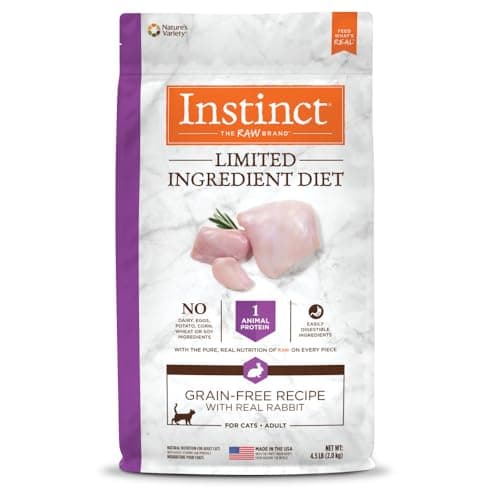
Instinct
Instinct Limited Ingredient Diet, Natural Dry Cat Food, Grain Free Recipe - Real Rabbit, 4.5 lb. Bag
9.0 / 10
- Rabbit as the single named animal protein — the shortest deck on the page
- Made without chicken, beef, fish, dairy, eggs, potato, corn, wheat, or soy
- The only pick here with no fish-derived oil, so it is genuinely fish-free
- Rabbit is a genuinely novel protein for most cats
$29.59
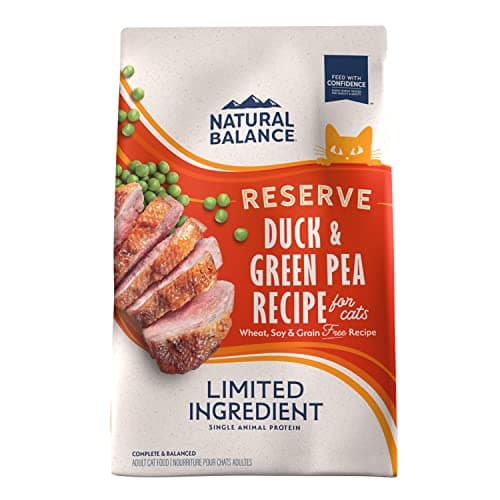
Natural Balance
Natural Balance Limited Ingredient Adult Grain-Free Dry Cat Food - Balanced Nutrition - Soy-Free, Corn-Free Limited Ingredient Formula - 4 lb - Reserve Duck & Green Pea Recipe
8.6 / 10
- Duck as the named animal protein over a legume base of peas, chickpeas, and lentils
- Grain-free deck with no corn, wheat, soy, or artificial colors
- Includes a little menhaden fish oil, so it is not strictly fish-free
- Long-standing, mainstream over-the-counter limited-ingredient line for cats
$29.98
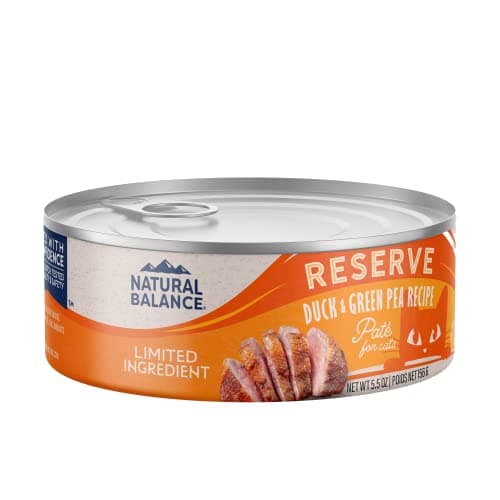
Natural Balance
Natural Balance Limited Ingredient Adult Grain-Free Wet Cat Food - Balanced Nutrition - Wheat-Free, Soy-Free, Corn-Free Limited Ingredient Formula - 5.5 oz - Reserve Duck & Green Pea Recipe
8.3 / 10
- Duck-based canned format in the same product family as the dry duck pick
- Added water intake for cats prone to lower-urinary-tract issues
- No corn, wheat, or soy on the panel
- Includes salmon oil, cranberries, and gelling agents (carrageenan, guar gum), so the deck is not minimal
$66.72
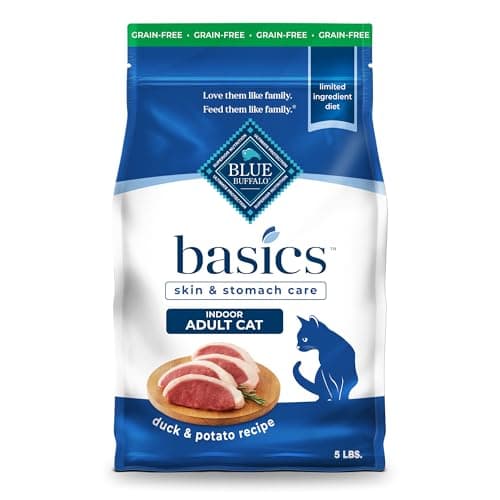
Blue Buffalo
Blue Buffalo Basics Grain-Free Dry Cat Food, Skin & Stomach Care, Limited Ingredient Diet for Indoor Cats, Duck & Potato Recipe, 5-lb. Bag
8.0 / 10
- Real duck as the single named animal protein, with peas, tapioca, and potato as the carbohydrates
- No chicken or poultry by-product meals
- Grain-free indoor formula with a simplified deck
- Includes fish oil for omega-3s, so it is not strictly fish-free
$32.99
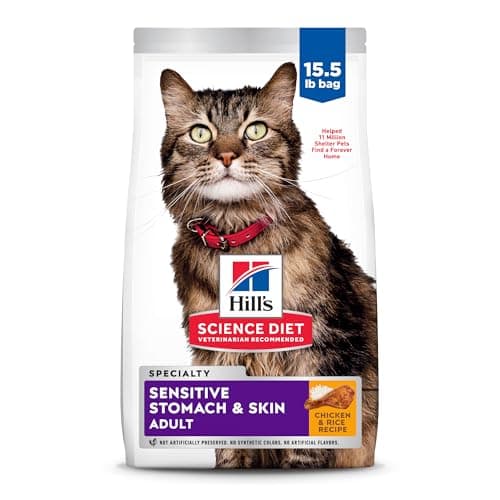
Hill's Science Diet
Hill's Science Diet Adult Sensitive Stomach & Skin Dry Cat Food, Chicken & Rice, 15.5 lb. Bag (Updated Formula)
7.4 / 10
- Prebiotic fiber for the gut microbiome
- Omega-6 and vitamin E blend for skin and coat
- Made by a maker that staffs nutritionists and runs feeding trials
- Built on chicken, a top reported feline allergen
$67.99
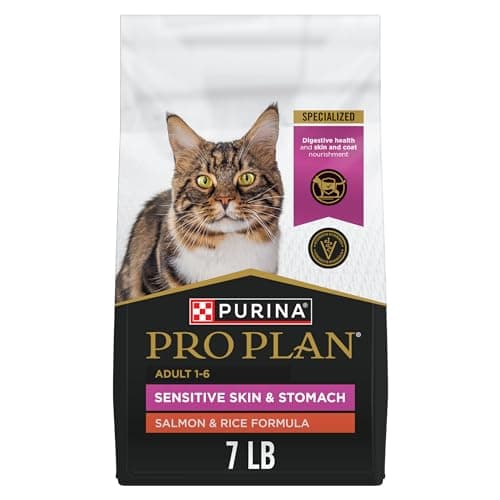
Purina Pro Plan
Purina Pro Plan Sensitive Skin and Stomach Adult Cat Food Salmon and Rice Formula - 7 lb.
7.2 / 10
- Real salmon as the first ingredient
- Guaranteed live probiotics plus prebiotic fiber
- A single fish protein that avoids chicken and beef
- Built on fish, a top reported feline allergen
$28.08
The Short Answer
For a cat with a simple, known sensitivity, the cleanest over-the-counter pick is a single-novel-protein limited-ingredient food. The Instinct Limited Ingredient Real Rabbit dry food leads. It has the shortest, most genuinely novel deck on the page — rabbit as the single animal protein, no chicken, beef, fish, dairy, or eggs, and no fish-derived oil. The Natural Balance L.I.D. Reserve Duck & Green Pea dry food ranks just behind it on the strength of wide availability; its deck is duck plus several legumes and a touch of menhaden fish oil, so it is not strictly fish-free. For urinary-prone or finicky cats, the Natural Balance L.I.D. Duck wet food adds water in a duck deck of its own. The mainstream brands rank lower here on purpose. The Mueller review names beef, fish, and chicken as the top feline food allergens. So the Hill's chicken formula and the Purina salmon formula suit a sensitive stomach and skin, not a cat avoiding chicken or fish. None of these is a diagnostic diet. A true food allergy is confirmed only by an 8-to-12-week strict elimination trial on a vet diet. This is expert-consensus synthesis, not veterinary advice.
Every product on this list has been scored against the PetPal Gear Score, a weighted composite of expert consensus, observed effectiveness, animal safety, long-term durability, and value. Review method: This guide is an editorial synthesis. We read the Mueller, Olivry, and Prelaud systematic review of feline food allergens, Tufts Cummings Petfoodology, the Cornell Feline Health Center, Today's Veterinary Practice, the Merck Veterinary Manual, and AAFCO labeling rules. We also read manufacturer documentation and verified buyer review sentiment. We did no first-hand product testing. PetPalHQ does not run a testing lab. This guide does not diagnose a food allergy. It does not replace a vet visit.. Synthesized from 5+ expert sources.
Most owners who go looking for a "hypoallergenic" cat food are reacting to something real. The cat is vomiting, or scratching, or over-grooming a bald patch. The smartest first move is to slow down before assuming the cause is a food allergy. Food allergy is real in cats, but it is less common than flea-allergy and environmental allergy. The published feline-allergen literature is consistent: the most commonly reported food allergens in cats are beef, fish, and chicken, with dairy also implicated. A limited-ingredient diet shrinks the number of ingredients a cat eats so a suspected trigger is easier to avoid. It does not make a food "allergen-free," and it cannot, on its own, diagnose anything.
The picks below are editorial synthesis. PetPalHQ does not run a testing lab and does not diagnose food allergies. Every food on this page was chosen by reading the published sources first. Those include the Mueller systematic review of feline food allergens, Tufts Petfoodology, the Cornell Feline Health Center, Today's Veterinary Practice, the Merck Veterinary Manual, AAFCO labeling standards, and manufacturer documentation. The ranking follows one rule: a food that limits and avoids the common feline allergens scores higher than a mainstream "sensitive" food built on chicken or fish. An over-the-counter limited-ingredient diet can be a sensible maintenance food for a cat with a known, mild sensitivity. It is not a diagnostic tool, and it is not a substitute for veterinary care when signs are chronic, severe, or involve the skin and ears.
This guide is the cat-specific companion to our broader roundup of limited-ingredient diets for dogs and cats. That guide is dog-led; this one fills the feline gap with cat foods, cat allergen data, and the wet-food angle that matters for urinary-prone cats. One disambiguation belongs up front, because owners confuse it constantly. Purina Pro Plan LiveClear is not a hypoallergenic cat diet. It reduces Fel d 1, the allergen cats shed that triggers symptoms in people. It does nothing for the cat's own food allergy. This guide is expert-consensus synthesis, not veterinary advice.
Head-to-Head Comparison
| Feature | Instinct Limited Ingredient Diet, Natural Dry Cat Food, Grain Free Recipe - Real Rabbit, 4.5 lb. Bag | Natural Balance Limited Ingredient Adult Grain-Free Dry Cat Food - Balanced Nutrition - Soy-Free, Corn-Free Limited Ingredient Formula - 4 lb - Reserve Duck & Green Pea Recipe | Natural Balance Limited Ingredient Adult Grain-Free Wet Cat Food - Balanced Nutrition - Wheat-Free, Soy-Free, Corn-Free Limited Ingredient Formula - 5.5 oz - Reserve Duck & Green Pea Recipe | Blue Buffalo Basics Grain-Free Dry Cat Food, Skin & Stomach Care, Limited Ingredient Diet for Indoor Cats, Duck & Potato Recipe, 5-lb. Bag | Hill's Science Diet Adult Sensitive Stomach & Skin Dry Cat Food, Chicken & Rice, 15.5 lb. Bag (Updated Formula) | Purina Pro Plan Sensitive Skin and Stomach Adult Cat Food Salmon and Rice Formula - 7 lb. |
|---|---|---|---|---|---|---|
| Price | $36.99 | $29.98 | $66.72 | $32.99 | $67.99 | $28.08 |
| Single protein (novelty) | Rabbit — most novel, shortest deck, fish-free | Duck — novel, legume base, has fish oil | Duck — high-moisture, has salmon oil | Duck — novel, budget, has fish oil | Chicken — top allergen | Fish — top allergen |
| Allergen-Avoidance Score | 9.0 | 8.6 | 8.3 | 8.0 | 7.4 | 7.2 |
| Check price | Amazon | Amazon | Amazon | Amazon | Amazon | Amazon |
Instinct Instinct Limited Ingredient Diet, Natural Dry Cat Food, Grain Free Recipe - Real Rabbit, 4.5 lb. Bag
$29.59
- Rabbit as the single named animal protein — the shortest deck on the page
- Made without chicken, beef, fish, dairy, eggs, potato, corn, wheat, or soy
- The only pick here with no fish-derived oil, so it is genuinely fish-free
- Rabbit is a genuinely novel protein for most cats
- Carries an AAFCO complete-and-balanced statement for the labeled life stage
The Instinct Limited Ingredient Real Rabbit is the formula that pares the ingredient deck down the furthest of anything here, and it is the one pick that lives up to the page's own standard. The verified panel leads with rabbit meal, peas, and tapioca, then canola oil, rabbit, natural flavor, and coconut oil ahead of the vitamins and minerals — rabbit as the single named animal protein, with the brand explicit about what it leaves out: no chicken, beef, fish, dairy, eggs, potato, corn, wheat, or soy. Just as important for an allergen-avoidance pick, it carries no fish-derived oil, so it is the only genuinely fish-free deck on the page.
Rabbit is the real differentiator, because the Merck Veterinary Manual defines a novel protein as one the individual cat has not previously eaten. For a cat raised on chicken and fish, rabbit genuinely qualifies as novel. The Mueller systematic review names beef, fish, and chicken as the top reported feline allergens, and this deck leaves all three of them out without slipping fish back in through the oil. That is why we rank it first on allergen avoidance, narrowly ahead of the duck deck below, which leans on several legumes and a little menhaden fish oil.
Here is the honest trade-off you should understand. A very short deck only helps if the chosen protein actually avoids the cat's real trigger, and if it does not, there is nowhere to hide inside a single-protein formula. "Novel" is also relative to the individual cat, because rabbit treats and foods have become common enough that a cat with a varied diet history may already have eaten it. Reconstruct your cat's diet history honestly before you decide to call rabbit novel. It is also less widely stocked than the duck pick, so availability is the one place it gives ground.
What the spec sheet does not tell you: a short ingredient list is not the same as a guaranteed-pure one. The same cross-contamination research that applies to every over-the-counter novel-protein diet applies here, because shared manufacturing facilities can introduce trace proteins that a label does not name. The minimalism is genuinely useful for managing a known sensitivity, but it remains a maintenance strategy rather than a diagnosis.
What We Love
- Shortest ingredient deck on the page — rabbit as the single named protein
- Leaves out chicken, beef, fish, dairy, eggs, potato, corn, wheat, and soy
- The only pick here with no fish-derived oil — genuinely fish-free
- Rabbit is a genuinely novel protein for most cats
- Carries an AAFCO complete-and-balanced statement to verify
What Could Be Better
- A short deck offers no fallback if rabbit is the trigger
- 'Novel' is relative — a cat with a varied history may already have had rabbit
- Less widely stocked than the duck pick below
- Still not a validated elimination trial diet, and over-the-counter cross-contamination risk applies despite the short list
The Verdict
Choose the Instinct Limited Ingredient Real Rabbit as the best over-the-counter limited-ingredient cat food for a simple, known sensitivity — the shortest, most genuinely novel, and only fully fish-free deck on the page. It is a maintenance food, not an allergy test; if signs are chronic or severe, the next step is a vet visit, not another bag.
Sources
- Merck Veterinary Manual: Intact dietary proteins, not carbohydrates, are the usual allergens in cutaneous food reactions; a novel protein is one the pet has not eaten before.
- Mueller, Olivry & Prelaud (BMC Veterinary Research, 2016): Beef, fish, and chicken are the three most commonly reported feline food allergens in the published literature.
Natural Balance Natural Balance Limited Ingredient Adult Grain-Free Dry Cat Food - Balanced Nutrition - Soy-Free, Corn-Free Limited Ingredient Formula - 4 lb - Reserve Duck & Green Pea Recipe
$29.98
- Duck as the named animal protein over a legume base of peas, chickpeas, and lentils
- Grain-free deck with no corn, wheat, soy, or artificial colors
- Includes a little menhaden fish oil, so it is not strictly fish-free
- Long-standing, mainstream over-the-counter limited-ingredient line for cats
- Broad Amazon and retail availability, with an AAFCO complete-and-balanced statement to verify
The Natural Balance L.I.D. Reserve Duck & Green Pea is the duck deck most owners can actually find on a shelf, which is why it ranks right behind the rabbit pick. The verified panel is duck and duck meal over a legume base — peas, chickpeas, and lentils, plus pea protein and pea starch — with canola oil, flaxseed, and a little menhaden fish oil rounding it out. So this is not a strict one-protein, one-carbohydrate recipe; it is a named duck protein over several legumes. Duck is still an uncommon protein for most cats, and that is the part that earns its place here.
For a cat with a mild, steady sensitivity, the appeal is reach. Tufts Petfoodology is clear on the underlying logic: fewer ingredients make a suspected trigger easier to avoid, but fewer ingredients do not make a food "hypoallergenic." We rate this pick highly on availability rather than on having the cleanest or cheapest deck — the label is honest about what it is, and the formula is stocked almost everywhere. It is not the bargain of the dry picks, in fact; at roughly $7.50 a pound it runs higher per pound than the rabbit pick above. The Mueller systematic review names beef, fish, and chicken as the most commonly reported feline allergens; this deck steps around beef and chicken, but the menhaden fish oil means it is not the fish-free choice the rabbit pick is.
Here is the honest trade-off that owners deserve to hear. A retail limited-ingredient formula is a maintenance food, not a diagnostic test, so if you want to confirm or rule out a food allergy in your cat, this is not the product for that particular job. That work is a strict elimination trial conducted on a veterinary diet. We treat this as a strong, easy-to-buy over-the-counter option for a cat whose sensitivity you already understand, and it is not a substitute for a complete veterinary workup.
What the spec sheet does not tell you: "limited ingredient" is a marketing phrase, not a regulated legal one. AAFCO sets the nutrient profiles a food must meet to claim it is complete and balanced for a species and life stage; the manufacturer formulates to those profiles and makes that statement on the bag, so that statement is the line to verify. But no one certifies any over-the-counter food as trial-grade, and veterinary research keeps finding stray proteins in limited diets produced in shared manufacturing facilities. So purchase this formula for what it genuinely is, and confirm the manufacturer's complete-and-balanced statement for your cat's life stage before you switch.
What We Love
- Named duck protein over a legume base, with no corn, wheat, soy, or artificial colors
- Duck steps around beef and chicken, two of the top three feline allergens
- The most widely stocked duck deck here — easy to find in stores and online
- Long-standing limited-ingredient line with an AAFCO complete-and-balanced statement to verify
- Flaxseed and fish oil add omega-3s for skin and coat
What Could Be Better
- Not strictly fish-free — the deck includes menhaden fish oil
- Several legumes (peas, chickpeas, lentils) rather than a single clean carbohydrate
- A maintenance food, not a diagnostic elimination diet — it cannot confirm a food allergy
- A cat can still react to duck itself if duck is the actual trigger, and over-the-counter limited diets carry a documented cross-contamination risk
The Verdict
Choose the Natural Balance L.I.D. Reserve Duck & Green Pea as the most widely stocked, easiest-to-find duck deck for a simple, known sensitivity — not as the strictest, cheapest, or most fish-free option, and not as proof of a food allergy. If you want the cleaner, lower-per-pound deck, step up to the rabbit pick; if signs are chronic or severe, the next step is a vet visit.
Sources
- Mueller, Olivry & Prelaud (BMC Veterinary Research, 2016): Beef, fish, and chicken are the three most commonly reported feline food allergens in the published literature.
- Tufts Cummings Petfoodology: An over-the-counter limited-ingredient diet cuts the number of ingredients a cat eats, which makes a trigger easier to avoid but does not make the food hypoallergenic.
Natural Balance Natural Balance Limited Ingredient Adult Grain-Free Wet Cat Food - Balanced Nutrition - Wheat-Free, Soy-Free, Corn-Free Limited Ingredient Formula - 5.5 oz - Reserve Duck & Green Pea Recipe
$66.72
- Duck-based canned format in the same product family as the dry duck pick
- Added water intake for cats prone to lower-urinary-tract issues
- No corn, wheat, or soy on the panel
- Includes salmon oil, cranberries, and gelling agents (carrageenan, guar gum), so the deck is not minimal
- 5.5 oz cans, sold as a 24-pack case, with an AAFCO complete-and-balanced statement to verify
The Natural Balance L.I.D. Duck wet food is the duck pick's canned sibling, but it is not the same recipe in a different shape. The verified panel leads with duck, duck broth, and duck liver over pea flour and pea protein, then adds salmon oil, cranberries, and the gelling agents carrageenan and guar gum. So it shares the duck protein and the no-corn, no-wheat, no-soy posture, but it carries more co-ingredients than the dry bag and is not a one-protein, one-carbohydrate deck. What the wet format genuinely adds is water, and that moisture is the reason this pick exists as its own separate slot.
Water intake matters more for some cats than others, because cats prone to lower-urinary-tract issues do better on a high-moisture diet. The Cornell Feline Health Center frames moisture as a real lever in feline urinary and kidney health. A finicky cat that refuses kibble is a second reason to reach for a can, since many cats eat wet food more readily than dry, so this pick covers two distinct groups that the dry bag does not serve as well.
We rank it below the two dry picks for one straightforward reason, which is cost. Wet food runs higher per calorie than kibble, and a 24-can case is a real budget commitment over time. The allergen logic is close to the dry duck formula — it steps around beef and chicken — but it also carries salmon oil, so a fish-avoiding cat should not treat it as fish-free. You are paying here for moisture and palatability rather than a cleaner deck.
What the spec sheet does not tell you: an open can spoils faster than a bag of kibble, so wet food demands more feeding discipline. Refrigerate the leftovers and watch how long food sits out at room temperature. Like every pick here, this is a maintenance food rather than a diagnostic trial, and a urinary-prone cat with active signs needs a veterinarian, not merely a switch to wet food.
What We Love
- Duck-based canned format with the moisture a urinary-prone cat needs
- Wet format helps cats prone to lower-urinary-tract issues
- Often eaten more readily by finicky cats than kibble
- No corn, wheat, or soy, with an AAFCO complete-and-balanced statement to verify
- Steps around beef and chicken, two top feline allergens
What Could Be Better
- Not fish-free — the panel includes salmon oil
- Carries cranberries and gelling agents (carrageenan, guar gum), so the deck is not minimal
- Per-calorie cost of wet food runs higher than dry kibble over time, and an open can spoils faster
- A maintenance food, not a diagnostic elimination diet — and a cat can still react to duck itself
The Verdict
Reach for the Natural Balance L.I.D. Duck wet food for a urinary-prone or finicky cat who needs a duck deck with more water. It carries salmon oil and gelling agents, so it is not the minimal deck the rabbit pick is; pair or alternate it with the dry duck bag, and route active urinary signs to your vet.
Sources
- Cornell Feline Health Center / Today's Veterinary Practice: Increased moisture intake is a recognized lever in feline lower-urinary-tract and kidney health, so wet diets matter for urinary-prone cats.
- Mueller, Olivry & Prelaud (BMC Veterinary Research, 2016): Beef, fish, and chicken are the three most commonly reported feline food allergens in the published literature.
Blue Buffalo Blue Buffalo Basics Grain-Free Dry Cat Food, Skin & Stomach Care, Limited Ingredient Diet for Indoor Cats, Duck & Potato Recipe, 5-lb. Bag
$32.99
- Real duck as the single named animal protein, with peas, tapioca, and potato as the carbohydrates
- No chicken or poultry by-product meals
- Grain-free indoor formula with a simplified deck
- Includes fish oil for omega-3s, so it is not strictly fish-free
- Widely stocked at a mid-tier price, with an AAFCO complete-and-balanced statement to verify
The Blue Buffalo Basics Duck & Potato is the budget pick for a single-novel-protein diet, built around real duck as the named animal protein. Despite the "Duck & Potato" name, the verified panel carries several carbohydrate sources — pea protein, peas, tapioca starch, and potatoes — rather than one clean carbohydrate, plus a little fish oil for omega-3s. The recipe deliberately leaves out chicken and poultry by-product meals, which makes it a sensible starting point for a cat avoiding chicken, a top reported feline allergen.
We scored it in the upper-middle of the field, because it is strong on duck protein and availability while sitting behind the tighter decks above on overall strictness. The peas, tapioca, potato, and broader indoor recipe add co-ingredients that a pure single-protein, single-vegetable formula does not carry. The Mueller review's allergen list is the underlying reason a duck deck is a reasonable choice at all, since it steps around chicken and beef, and the lower price is the real draw here.
Here is the honest trade-off you should weigh. The Basics deck is simplified rather than minimal, so it is a fair everyday food for a cat avoiding chicken, although it is not the shortest list available and the fish oil means it is not fish-free. For a stricter single-protein effort, the Instinct Real Rabbit is tighter, fish-free, and more genuinely novel. As with every pick here, it remains a maintenance food rather than a diagnostic trial diet, and a duck-sensitive cat can still react to it.
What the spec sheet does not tell you: the "limited ingredient" claim is not an AAFCO-defined or certified term. What you can actually verify is the manufacturer's complete-and-balanced statement for your cat's life stage, because that statement is the line that carries genuine regulatory weight. Read the panel carefully, match the labeled life stage, and treat the marketing language as a starting filter rather than a guarantee. If the signs are persistent or involve the skin and ears, that situation is a veterinary conversation.
What We Love
- Single named novel protein (duck) at a lower price than the premium duck picks
- No chicken or poultry by-product meals
- Widely stocked from a familiar brand
- Mid-tier price that is reasonable for long-term feeding
- Carries an AAFCO complete-and-balanced statement to verify
What Could Be Better
- Simplified rather than minimal — several carbohydrates (peas, tapioca, potato), not the shortest deck
- Not fish-free — the panel includes fish oil
- A maintenance food, not a diagnostic elimination diet, and a duck-sensitive cat can still react to it
- 'Limited ingredient' is a marketing claim, not an AAFCO-certified term
The Verdict
Use the Blue Buffalo Basics Duck & Potato as a budget single-novel-protein food for a cat avoiding chicken. For the strictest, most novel, fish-free deck, step up to the Instinct rabbit; for any allergy diagnosis, see your vet.
Hill's Science Diet Hill's Science Diet Adult Sensitive Stomach & Skin Dry Cat Food, Chicken & Rice, 15.5 lb. Bag (Updated Formula)
$67.99
- Prebiotic fiber for the gut microbiome
- Omega-6 and vitamin E blend for skin and coat
- Made by a maker that staffs nutritionists and runs feeding trials
- Built on chicken, a top reported feline allergen
- Carries an AAFCO complete-and-balanced statement for the labeled life stage
The Hill's Science Diet Sensitive Stomach & Skin Chicken & Rice is the most frequently veterinarian-suggested mainstream formula in this particular lane, and we include it for the owners that distinction matters to. It is not a single-protein limited-ingredient diet, but rather a gentle, fiber-supported food from a maker that veterinarians genuinely trust. Tufts Petfoodology points owners toward makers that staff board-certified nutritionists and conduct controlled feeding trials, and Hill's clearly clears that bar.
We scored it lower than the novel-protein picks for one clear reason, which is that it is built on chicken. The Mueller systematic review names chicken as one of the top three reported feline allergens, so this food is the wrong tool for a cat avoiding chicken, although it is the right tool for a different cat entirely. A cat with a sensitive stomach and itchy skin that already eats chicken without trouble does well on a gentle, prebiotic-supported food, and that is precisely the cat this pick is intended for.
Read the positioning honestly, because "sensitive stomach and skin" is not the same thing as "hypoallergenic." This food does not limit allergen exposure the way a duck or rabbit deck does, but it does manage everyday digestive and coat sensitivity effectively. For a cat whose signs are loose stool and a dull coat rather than a suspected protein allergy, that profile does genuine work, although for a cat actively avoiding chicken or fish, it does not.
What the spec sheet does not tell you: brand trust is a real, defensible reason to buy a food, but it is not a substitute for allergen avoidance. If you are trying to dodge a suspected chicken trigger, this is the wrong formula, however reputable the manufacturer. Match the food carefully to the actual problem: a sensitive-stomach cat that tolerates chicken is the correct fit, while a chicken-avoider should step to the duck or rabbit picks above.
What We Love
- Most frequently vet-suggested mainstream sensitive-stomach-and-skin formula
- Prebiotic fiber plus an omega-6 and vitamin E blend for coat
- Made by a maker that staffs nutritionists and runs feeding trials
- Broad availability in large, value-sized bags
- Carries an AAFCO complete-and-balanced statement to verify
What Could Be Better
- Built on chicken, a top reported feline allergen — wrong for a chicken-avoider
- Not a single-protein limited-ingredient diet, so it cannot isolate a trigger
- 'Sensitive stomach and skin' is not the same as hypoallergenic
- Still a maintenance food, not a diagnostic elimination diet
The Verdict
Pick the Hill's Science Diet Sensitive Stomach & Skin Chicken & Rice for a cat with a sensitive stomach and skin that already tolerates chicken. For a cat avoiding chicken or fish, choose a novel-protein deck instead.
Sources
- Tufts Cummings Petfoodology: Vets are taught to favor makers that staff board-certified nutritionists and run feeding trials; Hill's clearly meets that bar.
- Mueller, Olivry & Prelaud (BMC Veterinary Research, 2016): Beef, fish, and chicken are the three most commonly reported feline food allergens in the published literature.
Purina Pro Plan Purina Pro Plan Sensitive Skin and Stomach Adult Cat Food Salmon and Rice Formula - 7 lb.
$28.08
- Real salmon as the first ingredient
- Guaranteed live probiotics plus prebiotic fiber
- A single fish protein that avoids chicken and beef
- Built on fish, a top reported feline allergen
- Carries an AAFCO complete-and-balanced statement for the labeled life stage
The Purina Pro Plan Sensitive Skin & Stomach Salmon & Rice is the premium mainstream pick with the strongest digestive-support specification on the page. It leads with real salmon and adds guaranteed live probiotics alongside prebiotic fiber. It comes from Purina, a manufacturer that funds its own nutrition research and meets the same trust criteria veterinarians apply to Hill's, and for digestive and skin support, the probiotic claim is genuinely real and source-documented.
We scored it lowest of the picks, and the reason is the protein itself. The Mueller systematic review names fish as one of the top three reported feline allergens, so a salmon food does not limit allergen exposure the way a novel-protein deck does. It does avoid chicken and beef, which genuinely helps a cat reacting to those proteins, but it leans heavily on fish, which is itself a common trigger, and that is why this pick suits a sensitive cat that tolerates fish rather than a cat with a suspected fish allergy.
Read it the way you would read the Hill's pick above. The probiotics and the omega-rich fish are genuine features for everyday digestive and coat sensitivity, but they are not the same thing as allergen avoidance. For a cat whose signs are loose stool or a dull coat and who eats fish without any trouble, this is a strong, research-backed maintenance food, and for a chicken-and-beef-avoider who tolerates fish, it is a reasonable fit as well.
What the spec sheet does not tell you: a single fish protein is not a novel protein for most cats. Many cat foods are fish-based, so a cat with a varied diet history has very likely eaten fish before. If fish is the suspected trigger, this is the wrong formula despite the probiotics, so match the protein carefully to your cat's history. A fish-sensitive cat should step to the duck or rabbit picks above.
What We Love
- Real salmon first with guaranteed live probiotics and prebiotic fiber
- Avoids chicken and beef, two common feline allergens
- From a maker that funds its own nutrition research
- Fairly priced for a premium mainstream line
- Carries an AAFCO complete-and-balanced statement to verify
What Could Be Better
- Built on fish, a top reported feline allergen — wrong for a fish-avoider
- Fish is not a novel protein for most cats with a varied history
- Not a single-protein limited-ingredient diet, so it cannot isolate a trigger
- Still a maintenance food, not a diagnostic elimination diet
The Verdict
Pick the Purina Pro Plan Sensitive Skin & Stomach Salmon & Rice for a sensitive cat that tolerates fish and needs probiotic digestive support. For a cat avoiding fish, choose a novel-protein deck instead.
How We Score
Formula
Allergen-Avoidance Score = (Protein Simplicity & Novelty × 0.35) + (Clean Label & Carbohydrate Control × 0.25) + (Digestive & Skin Support × 0.25) + (Availability, Value & Acceptance × 0.15)
Score Factors
- Protein Simplicity & Novelty · 35%
- How cleanly the recipe limits its animal-protein sources. We also weigh whether that protein is genuinely novel for most cats. Rabbit, duck, and venison are uncommon. Chicken, beef, and fish are common triggers. The Mueller review names beef, fish, and chicken as the top reported cat allergens. One named protein with no hidden meat meals scores highest. Fewer and less familiar proteins shrink the field of possible triggers. That is why the duck and rabbit picks lead and the chicken and salmon picks rank lower.
- Clean Label & Carbohydrate Control · 25%
- The length and honesty of the full ingredient deck beyond protein. We look for one clearly named carbohydrate. We want no corn, wheat, soy, or artificial colors. We check for a real AAFCO complete-and-balanced statement. Shorter, fully disclosed labels score higher. A shorter list means fewer co-ingredients that could provoke or confuse a sensitive cat.
- Digestive & Skin Support · 25%
- The functional extras that help the cats sending owners shopping. Those are the cats with loose stool, vomiting, or itchy skin. We reward guaranteed live probiotics or prebiotic fiber. We reward an omega balance for coat and high digestibility. We weight published maker data and vet-nutrition coverage over marketing. We also treat wet formats kindly for the water they add to urinary-prone cats.
- Availability, Value & Acceptance · 15%
- Whether the food is genuinely buyable over the counter on Amazon, not prescription-gated. We judge price per pound across bag sizes. We reward formats finicky cats will actually eat. We reward a stable, widely stocked product line. Prescription hydrolyzed diets are left out of this score. We cover them separately as vet-directed options.
| Rank | Product | Score |
|---|---|---|
| #1 | Instinct Instinct Limited Ingredient Diet, Natural Dry Cat Food, Grain Free Recipe - Real Rabbit, 4.5 lb. Bag | 9.0 |
| #2 | Natural Balance Natural Balance Limited Ingredient Adult Grain-Free Dry Cat Food - Balanced Nutrition - Soy-Free, Corn-Free Limited Ingredient Formula - 4 lb - Reserve Duck & Green Pea Recipe | 8.6 |
| #3 | Natural Balance Natural Balance Limited Ingredient Adult Grain-Free Wet Cat Food - Balanced Nutrition - Wheat-Free, Soy-Free, Corn-Free Limited Ingredient Formula - 5.5 oz - Reserve Duck & Green Pea Recipe | 8.3 |
| #4 | Blue Buffalo Blue Buffalo Basics Grain-Free Dry Cat Food, Skin & Stomach Care, Limited Ingredient Diet for Indoor Cats, Duck & Potato Recipe, 5-lb. Bag | 8.0 |
| #5 | Hill's Science Diet Hill's Science Diet Adult Sensitive Stomach & Skin Dry Cat Food, Chicken & Rice, 15.5 lb. Bag (Updated Formula) | 7.4 |
| #6 | Purina Pro Plan Purina Pro Plan Sensitive Skin and Stomach Adult Cat Food Salmon and Rice Formula - 7 lb. | 7.2 |
When NOT to Buy
Skip every food here and call your vet first if your cat has these signs: ongoing vomiting, weight loss, constant itch, over-grooming, scabs, or recurrent ear and skin trouble. The Mueller review and Cornell both treat those as reasons to seek care, not to shop. Skip the idea that an over-the-counter limited-ingredient diet can diagnose a food allergy in a cat. The only reliable test is a strict 8-to-12-week elimination trial. You feed it alone, with zero treats, no flavored meds, and no table scraps. The trial-grade formulas are vet diets you ask your vet about. Hill's Prescription Diet z/d uses hydrolyzed protein. Royal Canin Veterinary Diet Selected Protein uses an intact novel protein. Both are vet-directed, not picks here, and not bags you buy on a whim. Tufts found that over-the-counter limited diets carry a real cross-contamination risk from shared plants, which is why vets do not trust them for a diagnosis. Skip the mainstream chicken and salmon picks if your cat is avoiding chicken or fish — those are top reported feline allergens, so match the protein to your cat's history. Above all, skip Purina Pro Plan LiveClear as a food-allergy diet. LiveClear reduces Fel d 1, the allergen cats trigger in people. It is for human allergy to cats, not for the cat's own food allergy. Skip an abrupt food switch. Fast weight loss during a change carries a liver-disease risk in cats, so go slow and watch intake. A cat that stops eating needs a vet, not a new bag. Important: this guide is expert-consensus synthesis, not veterinary advice. A suspected food allergy belongs with your vet.
Frequently Asked Questions
- What is the best hypoallergenic cat food for a cat with food sensitivities?
- For a cat with a simple, known sensitivity, the cleanest over-the-counter pick is a single-novel-protein limited-ingredient food. The Instinct Real Rabbit leads on our page. It has the shortest deck — rabbit as the single named protein, no chicken, beef, fish, dairy, or eggs, and no fish-derived oil. The Natural Balance L.I.D. Reserve Duck & Green Pea ranks just behind it for wide availability, though its deck adds several legumes and a little menhaden fish oil, so it is not strictly fish-free. Both step around beef and chicken, two of the top reported cat allergens. But neither is a diagnostic diet. They are maintenance foods for a sensitivity you already know about.
- Are over-the-counter limited-ingredient cat foods enough, or do I need a prescription diet?
- For a real test, you need a vet diet. Tufts Petfoodology flags a problem with over-the-counter limited foods. They are made in shared plants. Veterinary research keeps finding stray proteins not listed on the label. So they are not safe to trust for a diagnosis. An over-the-counter bag can be a fine maintenance food for a known, mild case. But the strict 8-to-12-week elimination trial that answers the allergy question uses a vet diet under care.
- Is Purina Pro Plan LiveClear a hypoallergenic cat food?
- No, and this is the most common mix-up in the category. LiveClear reduces Fel d 1, the major cat allergen in hair and dander. That is the allergen that triggers symptoms in people who are allergic to cats. Purina reports an average 47 percent reduction starting in the third week of daily feeding. That result is about human allergen exposure. It does nothing for a cat's own food allergy. If your cat is the one with the sensitivity, LiveClear is not the answer. Reach for a single-novel-protein diet instead.
- What proteins are best for a cat with suspected food allergies?
- A novel protein is one your cat has not eaten before. So it depends on diet history. For a cat raised on chicken and fish, rabbit, duck, or venison can all be novel. The Mueller review names beef, fish, and chicken as the top reported cat allergens. The Merck Veterinary Manual notes that intact proteins, not carbohydrates, are the usual triggers. So the logic is simple: move to a protein your cat has never had. Trace the diet history first before you decide what counts as novel.
- How long does a cat food-elimination trial take, and how do I run it correctly?
- Cornell and Today's Veterinary Practice put a strict trial at 8 to 12 weeks. The trial only works if you feed the diet alone. That means no other food, no flavored treats, no flavored meds, and no table scraps. The top reason trials fail is a snack the owner forgets about. The trial-grade diets are vet products like Hill's z/d and Royal Canin Selected Protein. This work belongs with your vet, not a shelf bag.
- My cat has urinary problems and is a picky eater. Does wet food help?
- Often, yes. The Cornell Feline Health Center frames moisture as a real lever in feline urinary and kidney health. A wet food adds water that a urinary-prone cat needs. Many finicky cats also eat wet food more readily than kibble. The Natural Balance L.I.D. Duck wet food gives a duck deck in a high-moisture can — it shares the duck protein with the dry version but adds salmon oil and gelling agents, so it is not the minimal deck the rabbit pick is. Pair or alternate it with a dry diet. But a cat with active urinary signs needs a vet, not just a switch to wet food.
- Is there such a thing as allergen-free cat food?
- No — "allergen-free" is a marketing phrase, not a food that exists. Any protein can be an allergen for a cat sensitized to it, so no diet can be free of allergens in general; a diet can only avoid particular ones. That is what the real categories do. Limited-ingredient diets shorten the deck so a known trigger is avoidable. Novel-protein diets move to a protein your cat has never eaten. Hydrolyzed veterinary diets break proteins into fragments small enough that the immune system is less likely to react — the closest science gets to the phrase, and still not absolute. If a bag literally promises "allergy free," treat the claim as marketing overreach and read the rest of the label with matching skepticism.
- Have any of the cat foods in this guide been recalled, and where are the real recalls in this category?
- None of the picks here. Reading the FDA's public "Recalls, Market Withdrawals, & Safety Alerts" list on August 17, 2026 with the Animal & Veterinary filter applied, and checking every brand rostered on this page — Instinct, Natural Balance, Blue Buffalo, Hill's Science Diet, and Purina Pro Plan — none appears in any 2025 or 2026 entry. The cat-food recalls in that window are all raw or freeze-dried, and two of them matter more than usual for the exact shopper reading this page. The first is thiamine. Go Raw LLC recalled Quest Cat Food Chicken Recipe freeze-dried nuggets on February 17, 2026, expanded to frozen Quest chicken on February 26, then to Steve's Real Food Freeze Dried Chicken Recipe cat and dog food on June 8. The explanation of why the species matters comes from Go Raw LLC's own announcement, which FDA hosts as a public service without endorsing the company or product: cats are more susceptible to thiamine deficiency than dogs because they need more of it and compensate poorly when intake falls short, and the progression runs from poor appetite and drooling to neck ventroflexion, wobbling, circling, and seizures. The company states that caught early it is generally reversible with supplementation, and that advanced deficiency can be life-threatening. The second is avian influenza. Wild Coast Raw recalled a frozen chicken cat formula on March 1, 2025 and Savage Pet recalled Cat Food Chicken on March 15, 2025, both for possible H5N1 — and in the Savage Pet case, cats had already been sickened. Blue Ridge Beef's kitten mixes were recalled for Salmonella in January and April 2025. The through-line is that raw and freeze-dried novel-protein cat food is where this category's safety failures actually happen, which is worth weighing when a food-sensitivity search steers you toward "minimally processed" as if it were the same thing as "fewer ingredients." Check the current list yourself at fda.gov/safety/recalls-market-withdrawals-safety-alerts before any reorder.
Bottom Line
Start with the Instinct Real Rabbit for a cat with a simple, known sensitivity — the shortest, most genuinely novel deck on the page, with rabbit as the single named protein, no chicken, beef, fish, dairy, or eggs, and no fish-derived oil.
Pick the Natural Balance L.I.D. Reserve Duck & Green Pea when you want the most widely stocked, easiest-to-find duck deck — duck over a legume base of peas, chickpeas, and lentils, no corn, wheat, or soy, though it carries a little menhaden fish oil, so it is not strictly fish-free.
Choose the Natural Balance L.I.D. Duck wet food for a urinary-prone or finicky cat who needs a duck deck with more water (it carries salmon oil and gelling agents, so it is not minimal); reach for the Blue Buffalo Basics Duck & Potato for budget single-novel-protein duck.
The Hill's chicken and Purina salmon picks rank lower because chicken and fish are top reported feline allergens. They suit a sensitive cat that tolerates those proteins, not a cat avoiding them. None of these is a diagnostic diet. A true food allergy is confirmed only by an 8-to-12-week strict elimination trial on a vet hydrolyzed or novel-protein diet — this is consensus synthesis, not veterinary advice.
This page is the feline spoke: the dog-led limited-ingredient diets roundup covers the same avoid-the-trigger logic across both species, with the elimination-trial framework in more depth.
Sources & Methodology
Methodology
Allergen-Avoidance Score = (Protein Simplicity & Novelty × 0.35) + (Clean Label & Carbohydrate Control × 0.25) + (Digestive & Skin Support × 0.25) + (Availability, Value & Acceptance × 0.15)
Expert review sources
- Mueller, Olivry & Prelaud (BMC Veterinary Research, 2016) — systematic review of the most commonly reported food allergens in cats
- Tufts Cummings Petfoodology — why OTC limited-ingredient diets are maintenance foods, not diagnostic elimination diets
- Cornell Feline Health Center / Today's Veterinary Practice — the 8-to-12-week strict elimination trial as the diagnostic standard
- Merck Veterinary Manual — cutaneous food allergy in cats, novel-protein and hydrolyzed elimination diets
- Purina (LiveClear product science) — Fel d 1 reduction for human cat-allergy, not a feline food-allergy diet
- AAFCO — nutritional-adequacy and complete-and-balanced labeling standards
- FDA Center for Veterinary Medicine — Recalls, Market Withdrawals, & Safety Alerts Animal & Veterinary listing, read 2026-08-17 — recall-status check for every brand on this page, the Go Raw LLC low-thiamine cat-food recalls of 2026-02-17/02-26/06-08, and the Wild Coast Raw and Savage Pet H5N1 cat-food recalls of 2025-03-01/03-15
Community sources
- r/CatAdvice and r/cats threads on elimination diets and limited-ingredient foods for itchy or vomiting cats
- TheCatSite forums — wet hypoallergenic food discussion threads
- Chewy and Amazon verified-purchase review sentiment for Natural Balance L.I.D., Instinct LID Rabbit, and Hill's Sensitive Stomach & Skin cat formulas
- Cats.com limited-ingredient and hypoallergenic cat-food roundups
Prices and specs verified June 23, 2026.
About the author
Nick Miles is the chief editor of PetPalHQ. The picks above are editorial synthesis of the feline food-allergen literature, veterinary-nutrition references, regulator labeling standards, manufacturer documentation, and verified community sentiment. PetPalHQ does not run a testing lab and does not diagnose food allergies. The Allergen-Avoidance Score is a composite of expert opinion and manufacturer-documented design factors, not a measurement. Sources are cited by name throughout. This guide is not veterinary advice; a suspected food allergy or any persistent skin or digestive sign belongs with your own veterinarian.
PetPalHQ is a participant in the Amazon Services LLC Associates Program. We may earn commissions from qualifying purchases — at no extra cost to you.
More Guides
Cats & Dogs
Best Limited-Ingredient Diets for Dogs and Cats With Food Sensitivities (2026)

Cats & Dogs
Best Vet-Recommended Senior Diets for Dogs and Cats (2026)
Cats & Dogs
Best Sensitive-Stomach Foods and Diet-Transition Tools for Dogs and Cats (2026)

Cats & Dogs
Cat and Dog Nutrition, Hydration, and Digestive Health: 2026 Guide for Pet Owners

Cats & Dogs