Aquarium
Best Aquarium Heaters 2026: Reliable Picks That Won't Cook Your Tank
A heater is the one standard aquarium device that can kill everything in the tank overnight. These four picks carry the strongest documented reliability records — plus the verification habits that keep any heater honest.
By Nick Miles · Updated June 10, 2026 · 12 min
PetPalHQ is reader-supported. We may earn a commission from qualifying Amazon purchases at no extra cost to you.
Evidence at a Glance
EHEIM Jager Aquarium Thermostat Heater 150W
The reliability benchmark of the category — German-made with UL-listed electronics, temperature accuracy within 0.5°F of set point per Aquarium Source, a TruTemp recalibration ring for dialing out thermostat drift, and a run-dry safety shutoff. FishLore owners report individual Jagers running reliably for 15 years.
Sources: Aquarium Source 2026 heater recommendations, Spec-Tanks construction comparison, FishLore heater forum longevity reports
Verified Jun 10, 2026
Fluval E200 Advanced Electronic Heater (A773)
The monitoring pick — dual temperature sensors feed a constant LCD readout of actual water temperature, with color-coded alerts when the tank drifts off set point. The integrated fish guard keeps slow-moving species off the heating element, and the 5-year warranty is the longest in this guide.
Sources: Aquarium Source Fluval E series recommendation, Aquarium Blueprints low-flow error documentation
Verified Jun 10, 2026
hygger 200W Titanium Aquarium Heater with External IC Thermostat Controller
The unbreakable specialist — a corrosion-resistant titanium element with no glass anywhere in the build, run from an external dual-LCD thermostat controller that shows set and actual temperature simultaneously. Overheat protection and run-dry auto shut-off back up the controller in freshwater or saltwater.
Sources: hygger manufacturer specifications, Modest Fish hygger line review
Verified Jun 10, 2026
Our Picks
EHEIM
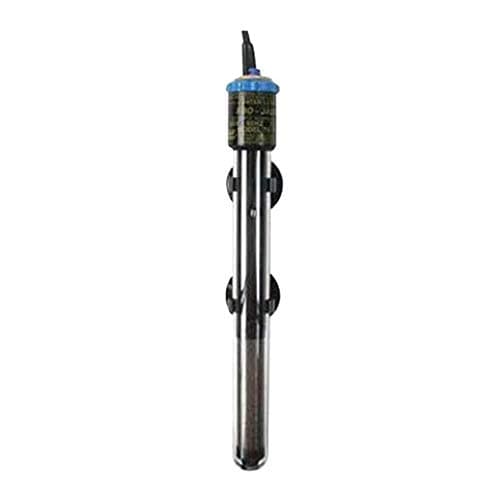
EHEIM Jager Aquarium Thermostat Heater 150W
9.1 / 10
- 150 W covers roughly 30-50 gallon freshwater tanks at the 3-5 watts-per-gallon rule
- Adjustable thermostat dial with a 64.4-93.2°F set range
- TruTemp red recalibration ring dials out thermostat drift against a reference thermometer
- Run-dry safety shutoff cuts power if water drops below the marked fill line
$45.98
Aqueon
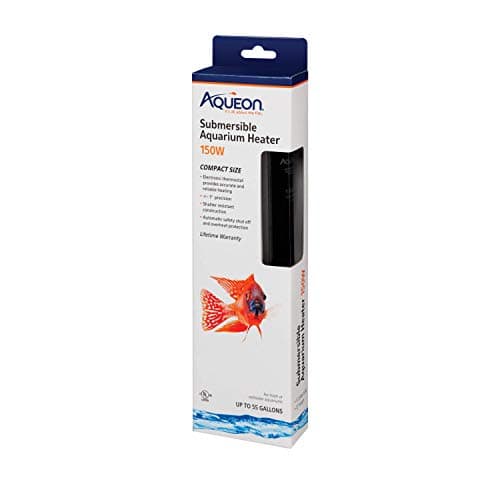
Aqueon Submersible Aquarium Heater 150 Watts
7.9 / 10
- 150 W sized for roughly 30-50 gallon freshwater tanks at 3-5 watts per gallon
- Adjustable electronic thermostat with a 68-88°F set range
- Shatter-resistant quartz glass construction designed to absorb impacts
- Auto shut-off cuts the element when the heater is not properly submersed
$29.99
Amazon's price may vary; check the current price.
Last Amazon read 2026-06-10
Fluval
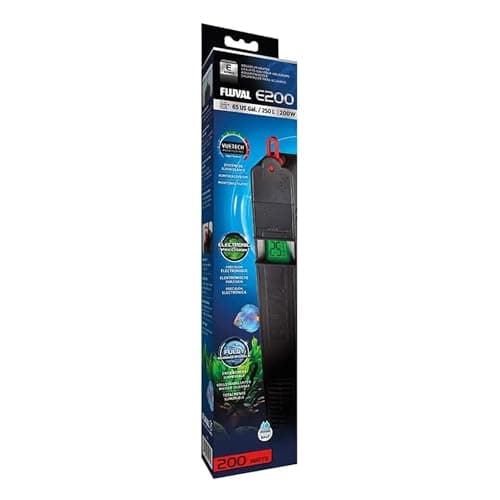
Fluval E200 Advanced Electronic Heater (A773)
8.5 / 10
- Dual temperature sensors feed a constant LCD readout of actual water temperature
- Color-coded display alerts — green at set temperature, changing color when the water drifts
- Integrated fish guard keeps fish and invertebrates off the heating element
- 68-93°F set range with a 5-year manufacturer warranty, rated for tanks up to 65 gallons
$63.53
hygger
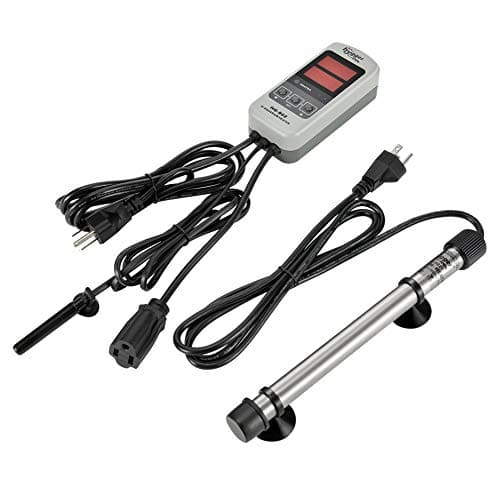
hygger 200W Titanium Aquarium Heater with External IC Thermostat Controller
8.2 / 10
- 200 W, rated by hygger for 20-45 gallon tanks, freshwater and saltwater
- Corrosion-resistant titanium heating element — no glass anywhere in the build
- External IC thermostat controller with dual LCD showing set and actual temperature simultaneously
- Overheat protection plus run-dry auto shut-off when the element leaves the water
$54.99
The Short Answer
The Eheim Jager 150W at $35.99 is the pick for most 30-to-50-gallon freshwater and marine tanks. Aquarium Source credits it with temperature accuracy within 0.5°F of set point, and FishLore owners report individual units still running after 15 years. The Aqueon Submersible 150W at $29.99 is the budget alternative with shatter-resistant quartz glass and an auto shut-off. The Fluval E200 at $59.99 adds dual sensors, a constant LCD temperature readout, a fish guard, and a 5-year warranty. The hygger 200W Titanium at $54.99 eliminates glass entirely and moves adjustment to an external controller. Whichever you buy, run an independent thermometer. Thermostat drift is documented on every brand in this guide, and a stuck-on failure can push a tank past 90°F in hours.
Every product on this list has been scored against the PetPal Gear Score, a weighted composite of expert consensus, observed effectiveness, animal safety, long-term durability, and value. Review method: Editorial synthesis of expert reviews and manufacturer documentation — no first-hand product testing. We drew on Aquarium Source's 2026 heater recommendations, Spec-Tanks' construction comparison of the Eheim Jager against competing glass heaters, Modest Fish's review of the hygger heater line, FishLab's Aqueon Pro coverage, Aquarium Blueprints' documentation of the Fluval E-series low-flow error, and the Petco aquarium heater sizing guide. Manufacturer specifications from Aqueon and hygger were reviewed directly. Owner reliability data comes from the FishLore heater forums, Reef2Reef failure-analysis and long-term review threads, MonsterFishKeepers, BC Aquaria, The Planted Tank Forum, and the Aquarium Co-Op Forum. PetPalHQ does not run an aquarium equipment testing lab.. Synthesized from 8+ expert sources.
An aquarium heater is the one standard piece of fish-tank equipment that can kill every animal in the tank in a single night. A thermostat that fails stuck-on can push a tank past 90°F in hours, and even a swing that stops short of lethal will immunosuppress fish and invite an ich outbreak. We read 8 expert sources for this guide, plus the long-running heater threads on FishLore, Reef2Reef, and The Planted Tank Forum, because heater reliability only shows up in multi-year owner data.
PetPalHQ.com earns affiliate commissions from qualifying purchases. Our recommendations are based on expert consensus — we synthesize professional reviews from veterinarians, aquarists, herpetologists, and ornithologists, plus multi-year owner durability data, to find pet gear that's worth your investment. Commission rates never influence our editorial recommendations.
The four picks sort by what you want the heater to survive. The Eheim Jager is the reliability benchmark — the analog heater owners measure in decades. The Aqueon Submersible is the budget quartz-glass pick that holds temperature nearly as well for $6 less. The Fluval E200 is the monitoring pick, with a constant LCD readout and the only fish guard in the group. And the hygger Titanium is the specialist for saltwater and rowdy tanks, because a heater with no glass in it cannot shatter. We rank by buyer fit — which pick best serves your tank type and risk tolerance — not by raw PetPal Gear Score, so a specialist pick can outscore picks ranked above it.
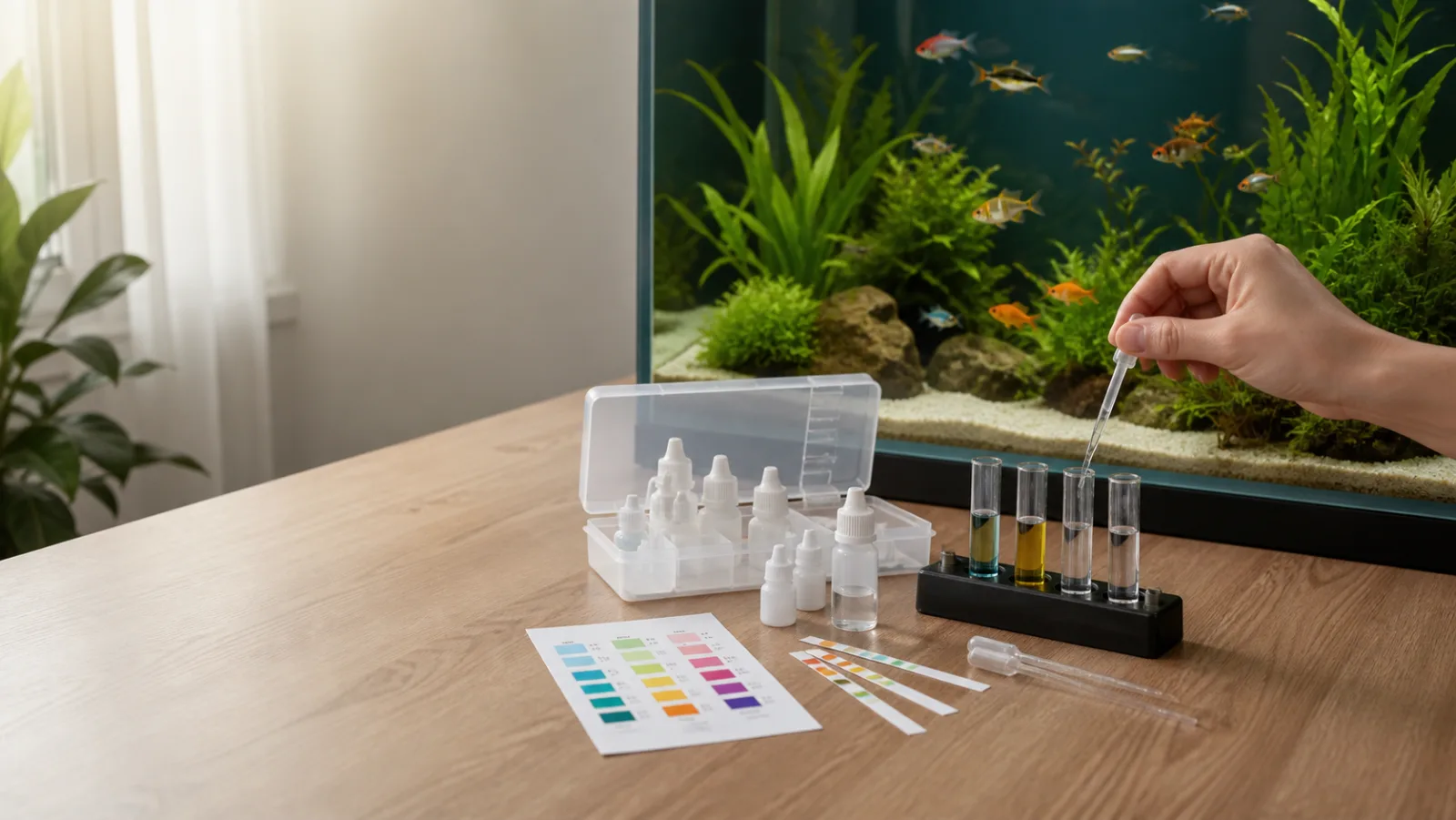
This guide is written for tropical freshwater community tanks holding 74-80°F, with marine notes where a pick carries a saltwater rating — the Jager and the hygger do. A heater is also only one leg of a stable system: circulation moves the heat, so a properly sized filter matters as much as wattage, and a water test kit catches the stress chemistry that temperature swings trigger. Keepers running tanks under 20 gallons should size down well below the 150-watt class — our nano aquarium kits guide covers the small-tank side.
Heater Safety: Protecting the Livestock From the Hardware
Every safety habit in this section exists because heater protections fail in documented, named threads. The review record behind this guide includes an auto shut-off that did not stop a 10-gallon tank from passing 100°F and an external controller that failed stuck-on. Treat every built-in protection as a backstop, never as the plan.
The first rule costs $5: always run an independent thermometer, and never trust the heater's own dial or display. Drift is documented on every brand in this guide — that is why Eheim ships a recalibration ring and why one hygger controller read 1.8°F off after 8 months. The second rule is sizing: 3 to 5 watts per gallon for freshwater, with the low end fine for rooms near 70°F, stepping up a wattage size for roughly every 9°F of gap between room and tank temperature.
For tanks of 50 gallons and up, split the heating across two smaller heaters instead of one large unit. A single stuck-on heater at half the wattage warms the tank far more slowly — often the difference between catching the failure and losing the stock — and a single failed-off heater cannot crash the temperature alone.
Water changes are when most heaters die. Unplug the heater 10 to 15 minutes before draining, because running an element dry cracks glass bodies, and a still-hot heater thermal-shocks fish when cool conditioned water pours back in. Run-dry shutoffs like the Jager's and the hygger's are backstops for the day you forget, not a license to skip the habit.
Two final habits round out the setup. Put a drip loop in every heater cord so water cannot track down into the outlet, and consider an inexpensive temperature alarm or controller as redundancy for irreplaceable livestock. If you keep slow-moving or resting species — bettas and plecos are the classic cases — a fish guard like the E200's matters, because element-sitters take contact burns on bare heater bodies.
What We Passed On
Two heaters made the research shortlist and were cut, and both cuts trace to the same premise as the rest of this guide: the heater is the one device that cannot be allowed to fail weird.
The Orlushy Submersible 150W is the cheapest live option we verified at $17.99, and that is the whole case for it. It is a generic import — a bad fit for a guide whose entire premise is avoiding stuck-on failures. Community heater threads consistently steer buyers toward Eheim, Fluval, and Aqueon over no-name glass, and the listing's own copy ('Fish Tahk') does not inspire confidence in the one device that can cook your livestock.
The Aqueon Pro Adjustable 150W was the harder cut. The shatterproof aluminum-composite housing and limited lifetime warranty earn genuine praise — FishLab reviewed it positively — but it is listed at $64.95 on Amazon right now, above our $25-60 band and well over typical retail. Planted Tank Forum threads also document that the 'lifetime' warranty is a one-time replacement, and longtime owners report quality control slipped after manufacturing changed hands.
$45.98
- 150 W covers roughly 30-50 gallon freshwater tanks at the 3-5 watts-per-gallon rule
- Adjustable thermostat dial with a 64.4-93.2°F set range
- TruTemp red recalibration ring dials out thermostat drift against a reference thermometer
- Run-dry safety shutoff cuts power if water drops below the marked fill line
- Shock-resistant laboratory glass, fully submersible, freshwater and marine rated, roughly 6-foot cord
The Eheim Jager is the closest thing the aquarium hobby has to a default heater, and the reliability record is the reason. Aquarium Source names it a top reliable budget heater for 2026, crediting the German-made build, UL-listed electronics, and temperature accuracy within 0.5°F of set point. On the FishLore heater forums, owners report individual Jagers running continuously for 15 years, and low-wattage units sell for as little as $15. The 150 W version covers roughly 30 to 50 gallons under the 3-5 watts-per-gallon rule. At $35.99, the Jager costs barely more than generic imports with no track record at all.
The TruTemp recalibration ring is the feature that separates the Jager from every other analog heater here. All heater thermostats drift over time. Most force you to memorize an offset — set 76 to get 78. The Jager's red ring lets you recalibrate the dial against a reference thermometer, so the markings stay honest for the life of the unit. The run-dry shutoff adds a second layer: if the water line falls below the marked minimum during a water change, the element cuts power before the glass overheats.
Construction is genuinely better than the price implies. Spec-Tanks found the Jager's shock-resistant laboratory glass thicker and more durable than the competing Hydor Theo, with a robust full 6-foot cord, and the unit is rated for both freshwater and marine systems.
Here's the honest trade-off: there is no heater guard and no independent overheat sensor. The Jager's safety story is the run-dry shutoff plus a decades-long reliability record, not redundant electronics. The analog dial has no display, so verification against a separate thermometer is mandatory. The body also runs noticeably longer than competing heaters of the same wattage, which gets awkward in smaller tanks. And a minority of keepers in FishLore's heater-debate thread report recent units failing randomly, which suggests the legendary quality control is no longer flawless.
What We Love
- Aquarium Source-documented accuracy within 0.5°F of set point
- TruTemp ring recalibrates the dial against a reference thermometer as the thermostat ages
- FishLore owners report individual units running reliably for 15 years
- Thicker, more durable glass than the competing Hydor Theo per Spec-Tanks
- Run-dry shutoff plus freshwater and marine rating at a $35.99 price
What Could Be Better
- Analog dial with no temperature display — verification against a separate thermometer is mandatory
- No heater guard and no independent overheat sensor, unlike the Fluval E series
- Noticeably longer than competing heaters in its wattage class, awkward in smaller tanks
- Scattered recent reports of random failures suggest QC has slipped slightly from its peak
The Verdict
If you want the most proven heater in the category for a 30-to-50-gallon tank, buy the Jager and a separate thermometer to keep it honest. Owners measuring its lifespan in decades is the whole argument.
Sources
- Aquarium Source: names the Eheim Jager a top reliable budget heater for 2026, citing German-made, UL-listed electronics and temperature accuracy within 0.5°F of set point
- Spec-Tanks: found the Jager's glass thicker and more durable than the competing Hydor Theo, with a robust full 6-foot cord
- Spec-Tanks: notes the Jager has no heater guard and no independent overheat sensor — its safety story is the run-dry shutoff plus a decades-long reliability record
- FishLore heater forums: owners report individual Jagers running reliably for 15 years, and low-wattage units sell for as little as ~$15
- FishLore 'Debate On Best And Worst Heaters' thread: a minority of keepers report recent Eheim units failing randomly, suggesting QC is no longer flawless
$29.99
Amazon's price may vary; check the current price.
Last Amazon read 2026-06-10
- 150 W sized for roughly 30-50 gallon freshwater tanks at 3-5 watts per gallon
- Adjustable electronic thermostat with a 68-88°F set range
- Shatter-resistant quartz glass construction designed to absorb impacts
- Auto shut-off cuts the element when the heater is not properly submersed
- Red LED indicator shows when the unit is actively heating; UL approved, fully submersible
The Aqueon Submersible 150W is the budget pick that does not behave like one in daily operation. Amazon owner reviews overwhelmingly praise stable temperatures within about half a degree of the set point — the same accuracy band Aquarium Source documents for the Jager. The quartz glass is the differentiator at this price. Aqueon builds the line from thermal shatter-resistant quartz designed to absorb impacts, where generic budget heaters use thin standard glass that cracks against rockwork.
The safety hardware is reasonable for $29.99. The unit is UL approved and programmed to shut the element off when it is not properly submersed, which covers the most common failure scenario — a heater left running dry during a water change. The red LED tells you at a glance whether the element is actively heating, a small thing that makes spotting a stuck-on unit faster, since an LED that never turns off is an early warning sign.
Across the reviews we surveyed, the complaints cluster on the dial rather than the element. Owners report the dial markings drifting from true temperature, and the consistent advice is to trust a separate thermometer and treat the dial as approximate. Unlike the Jager, there is no recalibration ring, so once the dial drifts you are memorizing an offset.
Here's the honest trade-off: rare but documented runaway failures exist in the review record. One owner's 10-gallon tank was pushed past 100°F when the auto shut-off failed to intervene. That is the worst-case failure mode for any heater, and it is why we would pair the Aqueon with an inexpensive temperature alarm or controller for irreplaceable livestock. The LED only reports that the element is on, not how warm the water is, and Aqueon's standard line carries a shorter warranty story than Fluval's 5-year E-series coverage.
What We Love
- Owner reviews report stability within about half a degree of set point
- Thermal shatter-resistant quartz glass absorbs impacts that crack standard glass
- Auto shut-off covers the run-dry failure scenario; UL approved
- Red heating LED makes a stuck-on element easier to spot early
- Cheapest pick in this guide at $29.99
What Could Be Better
- Dial markings can drift from true temperature, with no recalibration ring to correct them
- Rare but documented runaway failures where the shut-off did not save the tank
- No temperature display — the LED reports element state, not water temperature
- Shorter warranty story than Fluval's 5-year E-series coverage
The Verdict
Buy the Aqueon to heat a freshwater community tank for $6 less than the Jager, and budget the savings toward a thermometer alarm. It earns the value slot on stability per dollar, not on redundancy.
Sources
- Aqueon (manufacturer): Submersible Glass Heaters use thermal shatter-resistant quartz glass, are UL approved, and are programmed to shut off when not properly submersed to avoid overheating
- Amazon owner reviews: customers overwhelmingly praise stable temperatures within about half a degree of the set point
- Amazon owner reviews: a few owners report dial calibration drift that requires verification with an external thermometer, and rare runaway failures (one reported a 10-gallon pushed past 100°F when the shutoff failed)
- KensFish and Petco product listings: confirm the LED heating indicator and submersible quartz-glass design across the Aqueon glass heater line
$63.53
- Dual temperature sensors feed a constant LCD readout of actual water temperature
- Color-coded display alerts — green at set temperature, changing color when the water drifts
- Integrated fish guard keeps fish and invertebrates off the heating element
- 68-93°F set range with a 5-year manufacturer warranty, rated for tanks up to 65 gallons
- Sold as Fluval model A773 — the Amazon listing title contradicts itself on wattage, so confirm the variant at checkout
The Fluval E200 is the heater for keepers who want the tank's actual temperature visible every time they walk past. Dual sensors feed a constant LCD readout, and the color-coded display turns from green to a warning color the moment the water drifts above or below set point. Aquarium Source recommends the Fluval E series for most freshwater tanks as the best combination of accuracy and reliability in the category, and the 5-year warranty is the longest coverage in this guide by a wide margin.
The integrated fish guard is the safety feature the cheaper picks skip. Slow-moving and resting species — bettas, plecos, and similar element-sitters — will park against a hot heater body and take contact burns. The E200's guard physically blocks that contact, which Aquarium Source highlights as genuinely effective for fish and invertebrates alike.
Here's the honest trade-off, and it is a real one: the E200 is flow-dependent. Aquarium Blueprints documents the E-series 'LF' low-flow error — when circulation across the heater body is poor, the unit keeps heating, but inefficiently, and the warning blinks until flow improves. Owners on MonsterFishKeepers and FishLore describe spending days repositioning the heater near filter intakes to stop the constant blinking. One report describes the tank overheating a few degrees alongside the low-flow message. The BC Aquaria community consensus is blunt: the Fluval E works well only when it gets strong water flow across the body. Treat placement next to a filter output or powerhead as effectively mandatory, not optional.
Two more cautions before checkout. The Amazon listing title contradicts itself — it says both 'E200' and '100-Watt' — so double-check that the variant in your cart is the A773 you intend to buy. And some owners report temperature readings jumping erratically within the first two months, which is exactly what the 5-year warranty is for. At $59.99, the E200 also costs nearly twice as much per watt as the Jager.
What We Love
- Constant LCD readout of actual water temperature from dual sensors
- Color-coded drift alerts catch problems before livestock show stress
- Fish guard prevents contact burns on element-sitting species like bettas and plecos
- 5-year warranty — the longest coverage in this guide
What Could Be Better
- Flow-dependent — the 'LF' low-flow error makes placement next to a filter output effectively mandatory
- Costs nearly twice as much as the Jager per watt of heating
- Contradictory Amazon listing title ('E200' vs '100-Watt') forces buyers to verify the variant
- Owner reports of erratic temperature readings on some units within the first two months
The Verdict
Pick the E200 if you keep element-sitting species or want drift alerts you can read from across the room, and give it strong circulation. In a low-flow tank it becomes its own problem.
Sources
- Aquarium Source: recommends the Fluval E series for most freshwater tanks as the best combination of accuracy and reliability, with an LCD display and 5-year warranty
- Aquarium Source: highlights the effective fish guard that stops fish or invertebrates from contacting the submerged element
- Aquarium Blueprints: documents the E-series 'LF' low-flow error — the heater keeps heating when circulation is poor, but inefficiently, and the warning blinks until flow improves
- MonsterFishKeepers and FishLore owners: some spent days repositioning the heater near filter intakes to stop constant LF blinking; one report of the tank overheating a few degrees alongside the low-flow message
- BC Aquaria community: consensus that the Fluval E works well only when it gets strong water flow across the body
$54.99
- 200 W, rated by hygger for 20-45 gallon tanks, freshwater and saltwater
- Corrosion-resistant titanium heating element — no glass anywhere in the build
- External IC thermostat controller with dual LCD showing set and actual temperature simultaneously
- Overheat protection plus run-dry auto shut-off when the element leaves the water
- Separate in-tank temperature probe; the controller stays outside the aquarium for dry-handed adjustments
The hygger Titanium answers the failure mode no glass heater can: breakage. The 200 W element is corrosion-resistant titanium with no glass anywhere in the build, so there is nothing to shatter against rockwork, nothing to crack during a careless water change, and nothing for a large or boisterous fish to break. hygger rates it for 20-to-45-gallon tanks in both freshwater and saltwater, and the saltwater rating is where titanium earns its keep — salt creep and corrosion kill glass-heater seals long before the element fails.
The external controller changes how you operate the heater day to day. The dual LCD shows the set temperature and the actual water temperature simultaneously, read from a separate in-tank probe, and every adjustment happens dry-handed outside the aquarium. Modest Fish's review of the hygger line credits exactly this — an easy-to-read external controller that reports desired and actual temperature without anyone reaching into the tank. The unit backs the controller with overheat protection and a run-dry auto shut-off when the element leaves the water.
Here's the honest trade-off: the controller is a mitigation, not a guarantee. Reef2Reef hosts a documented failure analysis of an HG-802 hygger controller that failed in the stuck-on state — the precise disaster an external controller exists to prevent. Long-term Reef2Reef review threads also carry scattered reports of corrosion failures and one controller reading 1.8°F off actual after 8 months of service. The practical translation: keep an independent thermometer on the tank and verify the controller's reading monthly, the same discipline every other pick here requires.
The setup is also the fiddliest in this guide. Heater body, temperature probe, and controller all need mounting, which means three cords to route and a drip loop on each. And hygger is a budget importer with a shorter track record than Eheim or Fluval, so long-term quality control is less proven than the 15-year Jager record.
What We Love
- Titanium element cannot shatter — the failure mode that ends most glass heaters
- Dual-LCD external controller shows set and actual temperature without wet hands
- Rated for both freshwater and saltwater, where corrosion kills glass-heater seals
- Overheat protection plus run-dry auto shut-off behind the controller
What Could Be Better
- Reef2Reef documented an HG-802 controller failing stuck-on — pair it with an independent thermometer alarm
- Reported controller drift of roughly 1.8°F after 8 months in one long-term review
- Three pieces to mount and three cords to route — the fiddliest install in this guide
- Budget importer with a shorter reliability track record than Eheim or Fluval
The Verdict
Buy the hygger for saltwater systems, rowdy tanks, or anywhere glass breakage has already cost you a heater. Verify the controller against a reference thermometer monthly — Reef2Reef's stuck-on teardown is the reason.
Sources
- hygger (manufacturer): the titanium heater carries run-dry protection, auto shut-off out of water, and overheating protection, with the external controller handling all adjustment
- Modest Fish: reviewed the hygger heater line, crediting the easy-to-read external dual-LCD controller that shows desired and actual temperature without reaching into the tank
- Reef2Reef 'Failure analysis: Hygger heater controller, stuck on (HG-802)': a documented teardown of a controller that failed in the stuck-on state — proof the external controller is a mitigation, not a guarantee
- Reef2Reef long-term review threads: scattered reports of corrosion failures and one controller reading 1.8°F off actual after 8 months of service
How We Score
Formula
Tank Guardian Score = (Thermostat Reliability × 0.30) + (Failure-Mode Safety × 0.25) + (Temperature Accuracy × 0.25) + (Build Durability × 0.20)
Score Factors
- Thermostat Reliability · 30%
- The probability the thermostat keeps doing its job year after year, weighted by documented owner history rather than spec-sheet claims. Multi-year owner threads are the evidence base here. FishLore keepers report individual Eheim Jagers running for 15 years, while Reef2Reef hosts a teardown of a hygger controller that failed stuck-on. A heater fails this factor when its track record is short, when failure reports cluster early in ownership, or when the brand has no documented longevity history at all. This is the heaviest weight because a stuck-on thermostat is the single failure that kills entire tanks.
- Failure-Mode Safety · 25%
- What the heater does when something goes wrong. Run-dry shutoffs, independent overheat sensors, external controllers, and fish guards each cover a distinct failure path. Those paths are dry operation, thermostat runaway, and contact burns on element-sitting species like bettas and plecos. Redundant protections score highest; a bare element with one safety layer scores lowest. We treat every protection as a mitigation rather than a guarantee, because the review record documents shut-offs that failed to fire and a controller that failed in the stuck-on state.
- Temperature Accuracy · 25%
- How close the water stays to the number on the dial, and whether drift can be corrected. Aquarium Source documents the Jager within 0.5°F of set point, and Aqueon owners report similar half-degree stability. Drift correction matters as much as initial accuracy: the Jager's TruTemp ring recalibrates the dial, the Fluval E200 reports actual temperature on a constant LCD, while the Aqueon offers no correction path once its dial markings wander. Heaters with documented drift and no correction mechanism lose points here.
- Build Durability · 20%
- How well the physical unit survives real aquarium service — impacts from rockwork, water changes, large fish, and corrosion in marine systems. Titanium construction tops this factor because there is nothing to shatter; the hygger carries it. Spec-Tanks' finding that the Jager's laboratory glass runs thicker than the competing Hydor Theo earns the second tier, with Aqueon's shatter-resistant quartz close behind. Standard thin glass, which dies against hardscape, is the floor the whole category is measured against.
| Rank | Product | Score |
|---|---|---|
| #1 | EHEIM EHEIM Jager Aquarium Thermostat Heater 150W | 9.1 |
| #2 | Fluval Fluval E200 Advanced Electronic Heater (A773) | 8.5 |
| #3 | hygger hygger 200W Titanium Aquarium Heater with External IC Thermostat Controller | 8.2 |
| #4 | Aqueon Aqueon Submersible Aquarium Heater 150 Watts | 7.9 |
When NOT to Buy
Skip a heater entirely if you keep coldwater species in a temperature-stable room. Goldfish and white cloud minnows thrive at room temperatures most homes already hold, and adding a heater to a coldwater tank introduces the category's worst failure mode for no benefit. The 74-80°F target this guide is built around applies to tropical community fish, not coldwater setups.
Skip the 150-watt class for tanks under 20 gallons. At the 3-5 watts-per-gallon rule, an oversized heater is not a convenience — it is a faster cook if the thermostat sticks on, because the same runaway wattage heats a smaller water volume in less time. The documented Aqueon runaway that pushed a 10-gallon tank past 100°F is the cautionary case. Size down, and step up wattage only when the gap between room and tank temperature demands it — roughly one size for every 9°F of difference.
Skip any single large heater for tanks of 50 gallons and up. Two smaller heaters split the risk in both directions. A single stuck-on unit heats the tank far more slowly, buying you time to catch it, and a single failed-off unit cannot crash the temperature on its own.
Skip the Fluval E200 specifically if your tank has weak circulation and you are unwilling to add a powerhead. The documented low-flow error is not cosmetic — the heater runs inefficiently while it blinks, and owners report days of repositioning before it settles.
Skip every pick on this page if you will not also run an independent thermometer. Thermostat drift is documented on every brand in this guide. The Jager ships a recalibration ring precisely because drift is expected, and the hygger's controller read 1.8°F off after 8 months in one long-term review. A heater trusted on its own dial is an unverified heater, and unverified heaters are how tanks cook quietly.
Frequently Asked Questions
- How many watts does my aquarium heater need per gallon?
- The working rule is 3 to 5 watts per gallon for freshwater tanks. A 150 W unit like the Jager or the Aqueon covers roughly 30 to 50 gallons, with the low end of the rule fine for rooms that hold near 70°F. The variable most keepers miss is the room itself. Step up roughly one wattage size for every 9°F of gap between room and target tank temperature, because a heater fighting a cold basement works far harder than one in a warm living room. Manufacturer ratings can run more conservative than the rule — hygger rates its 200 W titanium unit for 20-to-45-gallon tanks — so when the rule and the rating disagree, the rating wins.
- What happens if an aquarium heater gets stuck on — can it really cook my fish?
- Yes, and it is the single most dangerous failure in standard aquarium equipment. A thermostat that fails in the on position can push a tank past 90°F in hours. The review record behind this guide includes a 10-gallon tank pushed past 100°F when an auto shut-off failed, plus a Reef2Reef teardown of an external controller that failed stuck-on. Even swings that stop short of lethal immunosuppress fish and trigger ich outbreaks. The defenses are layered: an independent thermometer you actually check, a temperature alarm or controller for irreplaceable livestock, and split heating on larger tanks so one runaway unit heats the water slowly enough to catch.
- Why does my Fluval E heater keep flashing LF?
- LF is the E-series low-flow error, and it means the heater is not getting enough water circulation across its body. Aquarium Blueprints documents the behavior: the unit keeps heating, but inefficiently, and the warning blinks until flow improves. The fix is placement, not replacement — move the heater directly into the path of a filter output or add a powerhead. Owners on MonsterFishKeepers and FishLore report spending days repositioning before the blinking stopped, and the BC Aquaria consensus is that the E series only works well with strong flow across the body. Take the warning seriously: one owner report ties a few degrees of overheating to a persistent low-flow condition.
- Is it better to run two smaller heaters instead of one big one?
- For tanks of 50 gallons and up, yes. The math favors redundancy in both failure directions. If one of two 100 W heaters sticks on, the runaway element heats the tank at half the rate a single 200 W unit would, which often turns a dead tank into a caught failure. If one fails off, the survivor holds the temperature high enough to prevent a crash until you notice. The cost penalty is modest — two mid-wattage units from this guide cost less than one premium controller setup — and the protection works without any electronics making decisions.
- Where should I place the heater in the tank for even heating?
- In the path of moving water. Heat distributes by circulation, not by the heater's position alone, so the best placement is near the filter intake or output where water is constantly passing the element — for the E200 that placement is effectively mandatory because of the low-flow error. Keep the element fully submerged below the manufacturer's marked water line, since run-dry shutoffs on the Jager and the hygger are last resorts rather than operating modes. Route the cord with a drip loop below the outlet. And for the hygger, mount the temperature probe away from the element itself, so the controller reads the tank rather than the heater's own plume.
Bottom Line
Buy the Eheim Jager 150W for most 30-to-50-gallon tanks. Accuracy within 0.5°F, a recalibration ring, and owners measuring lifespan in decades make it the reliability benchmark at $35.99 — just verify the analog dial against a separate thermometer.
Pick the Aqueon Submersible 150W at $29.99 if budget rules. Owner-reported stability is comparable to the Jager, but put the $6 savings toward a temperature alarm, because rare runaway failures are documented in its review record.
Pick the Fluval E200 if you want the actual water temperature on a constant display with color-coded drift alerts, a fish guard, and a 5-year warranty. Give it strong flow — placement next to a filter output is effectively mandatory.
Pick the hygger 200W Titanium for saltwater, rowdy fish, or anywhere glass has already failed you. Nothing shatters, but verify its external controller monthly — Reef2Reef documented one failing stuck-on.
Whatever you buy, run an independent thermometer, put a drip loop in the cord, and unplug the heater 10 to 15 minutes before water changes. For tanks of 50 gallons and up, split the wattage across two smaller heaters so no single failure can cook or crash the tank.
Sources & Methodology
Methodology
Tank Guardian Score = (Thermostat Reliability × 0.30) + (Failure-Mode Safety × 0.25) + (Temperature Accuracy × 0.25) + (Build Durability × 0.20)
Expert review sources
- Aquarium Source — 2026 aquarium heater recommendations and Fluval E series review
- Spec-Tanks — Eheim Jager construction comparison against competing glass heaters
- Modest Fish — hygger heater line review
- FishLab — Aqueon Pro adjustable heater coverage
- Aquarium Blueprints — Fluval E-series low-flow ('LF') error documentation
- Petco — aquarium heater sizing guide
- Aqueon — manufacturer specifications for the Submersible Glass Heater line
- hygger — manufacturer specifications for the 200W titanium heater and IC controller
Community sources
- FishLore heater forums — Jager longevity reports and the 'Debate On Best And Worst Heaters' thread
- Reef2Reef — HG-802 hygger controller stuck-on failure analysis and long-term review threads
- MonsterFishKeepers, BC Aquaria, and The Planted Tank Forum — Fluval E-series flow-placement reports
- Aquarium Co-Op Forum — general heater reliability discussion
Prices and specs verified June 10, 2026.
About the author
Nick Miles is the chief editor of PetPalHQ. The picks above are editorial synthesis of expert reviews, manufacturer specifications, and verified multi-year owner reliability threads. PetPalHQ does not run an aquarium equipment testing lab. The Tank Guardian Score is a composite of expert opinion and documented design factors, not a measurement.
PetPalHQ is a participant in the Amazon Services LLC Associates Program. We may earn commissions from qualifying purchases — at no extra cost to you.