Cats & Dogs
Best Furniture-Style Dog Crates for Large Breeds (2026)
Yafylly's 48-inch XXL crate at $249.99 is the pick — the tallest published exterior height in this class at 37.4 inches, and the only one of the five sold by Amazon.com itself. But the finding that should change how you shop this category is simpler: four of these five crates publish no interior dimension at all, and interior height is exactly where 48-inch furniture crates come up short for the breeds they name.
By Nick Miles · Updated August 16, 2026 · 15 min read
PetPalHQ is reader-supported. We may earn a commission from qualifying Amazon purchases at no extra cost to you.
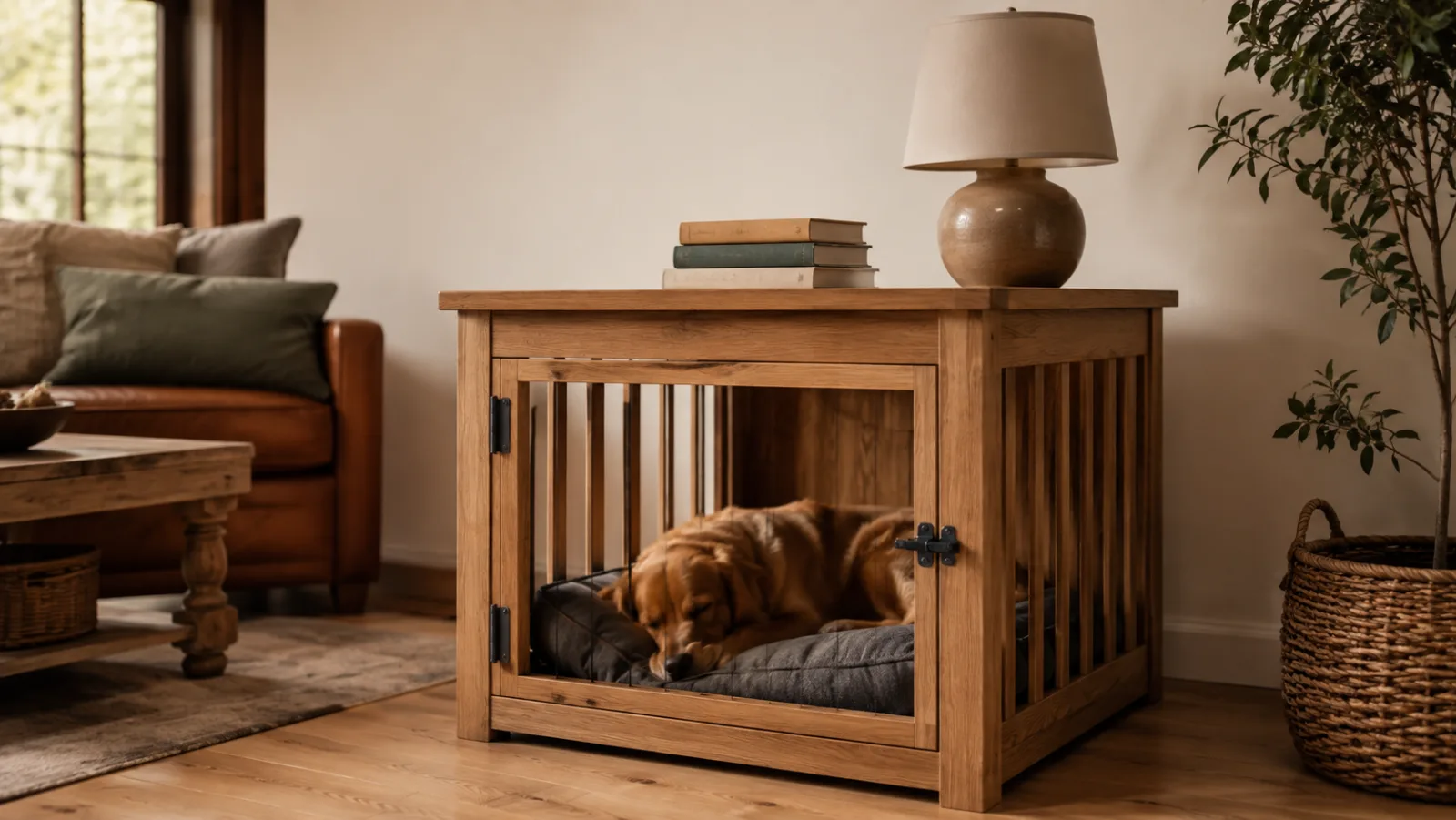
Evidence at a Glance
Yafylly 48 Inch XXL Dog Crate Furniture, Wooden Chewproof Dog Kennel
The tallest published exterior height in this guide at 37.4 inches, and the only pick sold by Amazon.com itself.
Sources: Yafylly manufacturer listing specifications, Amazon Creators API listing B0FKRZGKDH
Verified Aug 16, 2026
HMHTCT 48 Inch Heavy-Duty Dog Crate Furniture, Decorative Wooden End Table Kennel
The only crate in this guide that publishes interior dimensions — 44.7 by 28.0 by 28.9 inches — so you can check the AKC's sizing rule before you buy rather than after.
Sources: HMHTCT manufacturer listing specifications, Amazon Creators API listing B0G2BMMZJZ
Verified Aug 16, 2026
SHUSHIM 48 Inch Dog Crate Furniture, Heavy Duty Wooden Dog Kennel with TV Stand
Reinforced solid wood with metal locking mechanisms and a one-year warranty, on the only pick explicitly built as a television stand.
Sources: SHUSHIM manufacturer listing specifications, Amazon Creators API listing B0FP4PG3T9
Verified Aug 16, 2026
MOLKEI 48" Heavy Duty Dog Crate Furniture for Extra Large Dogs
The widest published footprint here at 30.3 inches, with a wooden back panel the dog can lean against rather than bare wire.
Sources: MOLKEI manufacturer listing specifications, Amazon Creators API listing B0DDL88Z4H
Verified Aug 16, 2026
FentyOE 48" Heavy Duty Dog Crate Furniture with Removable Tray
The only pick with a slide-out waste tray, an openable roof panel and lockable casters — built to be cleaned and moved rather than parked.
Sources: FentyOE manufacturer listing specifications, Amazon Creators API listing B0GY4RKTLS
Verified Aug 16, 2026
Our Picks
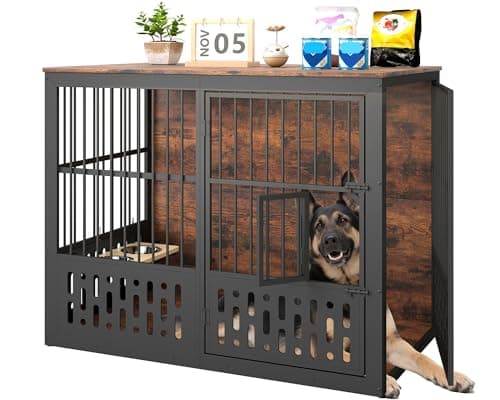
Yafylly
Yafylly 48 Inch XXL Dog Crate Furniture, Wooden Chewproof Dog Kennel with Interactive Window
8.9 / 10
- Published dimensions of 47.24"L x 28.35"W x 37.4"H — the tallest crate in this guide by 3.4 inches
- Thickened metal strip and wooden board construction with two load-bearing metal tubes at the bottom
- Interactive window that lets a dog put its head out, plus a lockable door
- 360-degree rotating feeder with two stainless steel bowls adjustable to five heights
$224.99
Current price · checked Sep 8, 2026
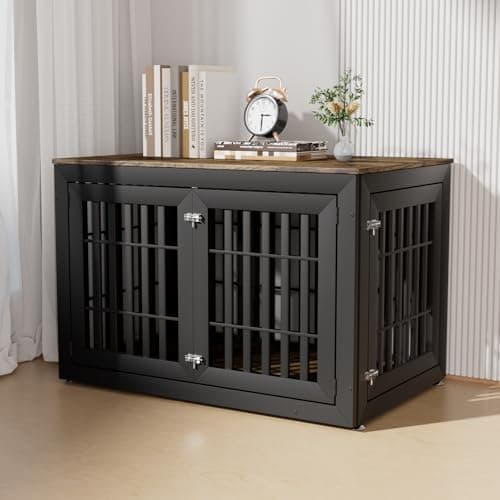
HMHTCT
HMHTCT 48 Inch Heavy-Duty Dog Crate Furniture, Decorative Wooden End Table Kennel
8.7 / 10
- Publishes both interior and exterior dimensions — interior 44.7"L x 28.0"W x 28.9"H, overall 47.2"L x 30.3"W x 31.9"H
- Widened, thickened iron tubes which the maker states are stronger than standard wire bars
- Four sliding locks on the door, aimed at dogs that open latches
- Waterproof particle-board top surface; adjustable feet to stop wobble on uneven floors
$188.99
Current price · checked Sep 8, 2026
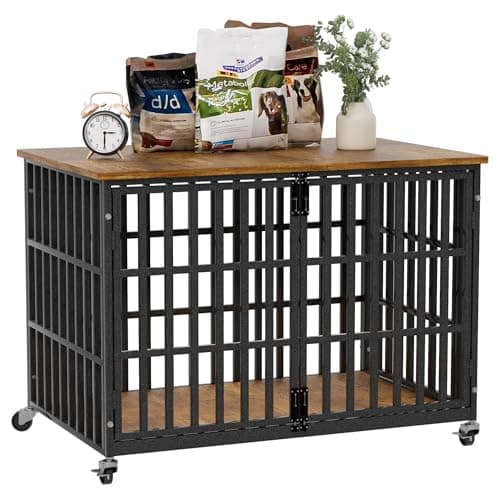
SHUSHIM
SHUSHIM 48 Inch Dog Crate Furniture, Heavy Duty Wooden Dog Kennel with TV Stand
8.4 / 10
- Reinforced solid wood with metal locking mechanisms, built as a console and television stand
- 48-inch class, marketed for large and giant breeds including German Shepherds and Golden Retrievers
- Side door installable on either the left or the right for flexible room layouts
- Scratch-resistant wooden structure, wipe-clean
$269.99
Current price · checked Sep 8, 2026
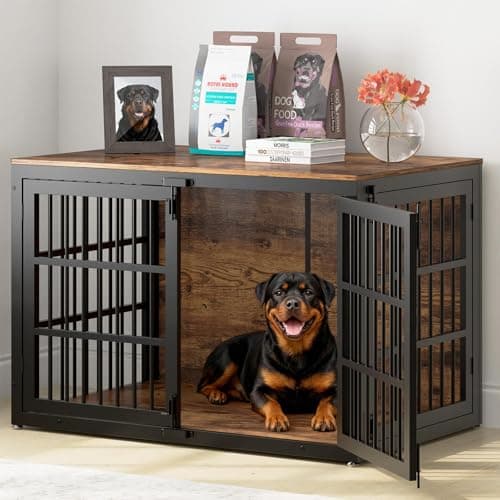
MOLKEI
MOLKEI 48" Heavy Duty Dog Crate Furniture for Extra Large Dogs, Wooden XXL Kennel
8.2 / 10
- Published dimensions of 47.2"L x 30.3"W x 31.9"H — tied widest footprint in this guide
- Corrosion-resistant steel with premium particle board on the top, back and bottom
- Wooden back panel gives the dog a solid surface to lean against rather than bare wire
- Reversible side door plus a front door, both with safety locks
$229.99
Current price · checked Sep 8, 2026
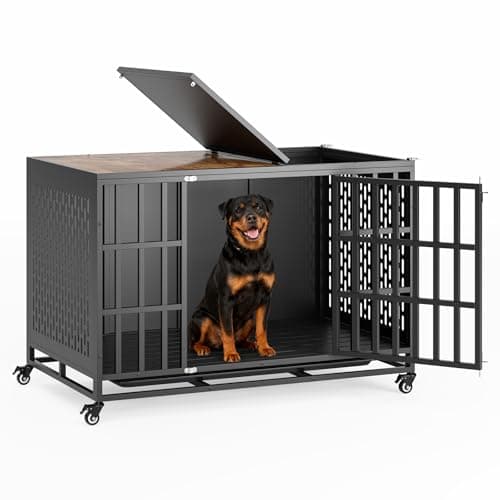
FentyOE
FentyOE 48" Heavy Duty Dog Crate Furniture with Removable Tray
8.0 / 10
- Published dimensions of 48"L x 29"W x 34"H — second tallest in this guide
- Wide-spaced metal plate flooring over a slide-out tray, so waste drops through instead of pooling
- Openable roof panel for feeding, training and extra headroom access
- 360-degree lockable caster wheels — the only pick here designed to be rolled
$179.99
Current price · checked Sep 8, 2026
The Short Answer
Buy the Yafylly 48-inch XXL crate at $249.99. At a published 47.24 by 28.35 by 37.4 inches it is the tallest crate in this guide by 3.4 inches, and height is the dimension this category most often gets wrong for large breeds. It is also the only one of the five sold by Amazon.com itself rather than by a third-party marketplace seller. If you would rather buy on published numbers than inferred ones, the HMHTCT at $209.99 is the only crate here that publishes an interior measurement — 44.7 by 28.0 by 28.9 inches — and that transparency is worth rewarding even though the number it reveals is tight. Before you buy any of them, measure your dog the way the AKC says to: top of head to the floor while standing, nose to tail tip, and add three to four inches to each. Do that first, because four of these five crates will not tell you what is inside them.
Every product on this list has been scored against the PetPal Gear Score, a weighted composite of expert consensus, observed effectiveness, animal safety, long-term durability, and value. Review method: Editorial synthesis measured against published sizing authority rather than brand reputation, because this category has almost no brand reputation to synthesize. Crate-sizing guidance is quoted from the American Kennel Club, the Humane Society's successor organization Humane World for Animals, and VCA Animal Hospitals; breed dimensions are read from the AKC's own official breed-standard documents; the breed-to-crate-size mapping is read from MidWest Homes for Pets' published Size/Breed Reference chart. Crate welfare and duration guidance is quoted from the ASPCA, VCA and AVSAB. Product specifications and prices were pulled per product through the Amazon Creators API on the date below, and every dimension attributed to a product in this guide is one its own listing publishes. PetPalHQ does not run a crate-testing lab and no score here is a measurement.. Synthesized from 6+ expert sources.
A furniture-style dog crate is a wire crate wearing a cabinet. The point of it is that a crate large enough for a German Shepherd is an enormous object to put in a living room, and a wooden console with a lamp on it reads very differently from a steel cage. That is a legitimate thing to want, and this category exists because a lot of people want it.
What makes the category hard to shop is that it has almost no reputation to shop on. The brands at the 48-inch, $200-plus tier are Amazon-native sellers with no independent test history, no published containment ratings, and in most cases no published dimensions beyond a number in the product title. There is no Wirecutter of wooden dog crates because there is nothing established to test against.
So this guide is built on a different axis: what each manufacturer actually publishes, measured against the sizing authorities that do exist. That turns out to be more revealing than a reputation ranking would have been.
The finding that should change how you shop this category
Four of the five crates here publish exterior dimensions or nothing at all. One publishes what is actually inside it. And the number it reveals is the reason the rest stay quiet.
The HMHTCT publishes an interior of 44.7 by 28.0 by 28.9 inches high. Now apply the American Kennel Club's own rule, quoted from its crate-buying guidance: "With your dog standing, measure them from the top of the head to the bottom of the feet to determine height. Next, measure your dog from the tip of the nose to the tip of the tail to determine length. Add 3 to 4 inches to each measurement."
Note the datum. The AKC measures to the top of the head, not the shoulder. Now take the AKC's own breed standards:
| Breed (male) | Height at withers, per AKC standard |
|---|---|
| Doberman Pinscher | 26 to 28 inches |
| Rottweiler | 24 to 27 inches |
| German Shepherd Dog | 24 to 26 inches |
| Labrador Retriever | 22.5 to 24.5 inches |
| Golden Retriever | 23 to 24 inches |
A standing dog's head sits above its withers. So for a standard male German Shepherd at 24 to 26 inches at the shoulder, a 28.9-inch interior height has already spent the AKC's entire three-to-four-inch allowance on the shoulder alone, before the neck and head are counted. For a Doberman at 26 to 28 inches, it fails outright.
We cannot tell you by how many inches it fails, and we are not going to guess: no authority publishes a head-height figure for any breed, only withers height. But the direction is unambiguous, and it almost certainly applies to the crates that decline to publish the number too. This is why exterior height is the specification to compare hardest in this category, and why the tallest crate here wins the guide.
The other thing the manufacturer charts say
Here is a second finding worth more than any brand comparison. MidWest Homes for Pets — the largest name in dog crates — publishes a Size/Breed Reference chart, and it does not put Labradors and Goldens in 48-inch crates.
The chart's x-Large 48-inch row lists Afghan, Akita, Alaskan Malamute, Anatolian Shepherd, Bernese Mountain Dog, Bloodhound, Bullmastiff, Doberman Pinscher, German Shepherd, Giant Schnauzer, Newfoundland, Rottweiler, Samoyed, Siberian Husky and Weimaraner, among others. The Large 42-inch row lists Boxer, Chesapeake Bay Retriever, Dalmatian, Golden Retriever, Labrador Retriever, Rhodesian Ridgeback, Standard Poodle and Vizsla.
A retail sizing chart from Pet Crates Direct independently agrees, assigning 48-inch crates to dogs weighing 91 to 110 pounds and listing Doberman, German Shepherd and Rottweiler — with Labradors and Goldens absent. Cross-check that against the AKC standards again: a Labrador dog is 65 to 80 pounds and a Golden 65 to 75, both well under that band.
Two of the crates in this guide name German Shepherds and Golden Retrievers in the same sentence as the breeds they fit. Per the leading manufacturer's own chart, those two breeds belong in different crate tiers. That does not make those crates bad — it makes the breed lists in this category marketing copy rather than sizing guidance, and it is a good reason to measure your own dog instead of trusting a listing's breed name-check.
MidWest's chart carries its own honest caveat, worth repeating: "Depending on the gender and the possibility of mixed ancestry, your dog may need a home that is larger or smaller than listed."
How much do you actually add? The sources disagree
Worth knowing before you measure, because the spread is wide enough to change which crate you buy:
- AKC: add 3 to 4 inches to standing head height and to nose-to-tail-tip length.
- MidWest Homes for Pets: measure nose to base of tail and head-top to ground, then add "a few inches."
- Pet Crates Direct (retailer): at least 6 inches longer than body length and 6 inches above shoulder height.
- Humane World for Animals: no number — "The crate should be large enough for your dog to stand up and turn around in."
- VCA Animal Hospitals: no number — "enough floor space for your dog to comfortably lie down and stretch and tall enough for your dog to stand comfortably without hitting his head."
Notice that the two veterinary and welfare sources decline to give a number at all, and give you a functional test instead. Notice also the second, quieter disagreement: the AKC measures height to the top of the head, the retail rule measures to the shoulder. Those are not the same measurement, and the shoulder-based version is considerably more permissive. When you are choosing between crates, use the AKC's stricter datum and the largest margin you find.
What this category does not tell you
Three absences worth naming before you spend $200:
No chew test exists. Several crates here use the words "chewproof" or "chew-resistant." None publishes a test, a standard, or a result. The one brand in this class we found that speaks to the question directly, unipaws, says the opposite of the marketing, in a notice on its own listing: "The dog crate is not chew-proof. Recommend for the trained dogs." It offers no durability claim alongside that — only the warning. Read it as the category's honest self-assessment.
No dog weight rating exists. Where furniture-crate makers publish a weight number at all, it is the static load capacity of the tabletop — unipaws states that "the maximum support weight of the top is 200 lbs" — not a containment or dog-size rating. Do not read a tabletop rating as a statement about the dog.
No veterinary evaluation exists. VCA's crate-type comparison covers wire, plastic and metal box-style crates. Wooden and furniture crates are not in it. No welfare or veterinary authority we could reach assesses this format at all.
Head-to-Head Comparison
| Crate | Exterior (L x W x H) | Interior published? | Frame | Sold by |
|---|---|---|---|---|
| Yafylly 48 Inch XXL Dog Crate Furniture, Wooden Chewproof Dog Kennel with Interactive Window | 47.24 x 28.35 x 37.4 in | No | Thickened metal strip + wood | Amazon.com |
| HMHTCT 48 Inch Heavy-Duty Dog Crate Furniture, Decorative Wooden End Table Kennel | 47.2 x 30.3 x 31.9 in | Yes — 44.7 x 28.0 x 28.9 in | Widened thickened iron tube | Third-party seller |
| SHUSHIM 48 Inch Dog Crate Furniture, Heavy Duty Wooden Dog Kennel with TV Stand | Not published | No | Reinforced solid wood + metal | Third-party seller |
| MOLKEI 48" Heavy Duty Dog Crate Furniture for Extra Large Dogs, Wooden XXL Kennel | 47.2 x 30.3 x 31.9 in | No | Corrosion-resistant steel + board | Third-party seller |
| FentyOE 48" Heavy Duty Dog Crate Furniture with Removable Tray | 48 x 29 x 34 in | No | Metal + wood, tray floor | Third-party seller |
Yafylly Yafylly 48 Inch XXL Dog Crate Furniture, Wooden Chewproof Dog Kennel with Interactive Window
$224.99
Current price · checked Sep 8, 2026
- Published dimensions of 47.24"L x 28.35"W x 37.4"H — the tallest crate in this guide by 3.4 inches
- Thickened metal strip and wooden board construction with two load-bearing metal tubes at the bottom
- Interactive window that lets a dog put its head out, plus a lockable door
- 360-degree rotating feeder with two stainless steel bowls adjustable to five heights
- Sold by Amazon.com itself — the only pick here not fulfilled by a third-party marketplace seller
Height is where furniture crates fail large dogs, and this is the tallest one here. Yafylly publishes 47.24 inches long by 28.35 wide by 37.4 high, which is 3.4 inches taller than the next crate in this guide and 5.5 inches taller than the two shortest. For a category sold to German Shepherd and Rottweiler owners, that is not a rounding difference — it is the difference between a dog standing normally and a dog ducking.
The construction claims are also the most specific in the group, which matters when no brand here has an independent test history to lean on. Yafylly describes thickened metal strip and wooden boards with two load-bearing metal tubes at the bottom, and a lockable door. The wooden base is called out as preventing a paw getting stuck, which is a real failure mode on wire-floored crates. There are two genuinely thoughtful touches beyond the box: an interactive window that lets a dog put its head out — Yafylly frames it as relieving the pressure of an enclosed space, and it also lets you touch the dog without opening the door — and a 360-degree rotating feeder with two stainless bowls adjustable across five heights.
Now the honest limits. Yafylly publishes exterior dimensions, not interior ones, so the usable height inside is less than 37.4 inches by the thickness of the base and the top panel, and the company does not tell you by how much. Every crate in this class shares that problem except one, and we have ranked that one second for exactly this reason. The word "chewproof" appears in the product name, and no manufacturer in this category publishes a chew test, a containment rating, or a dog weight limit — the only published weight figures anywhere in this class are static load ratings for the tabletop. Treat it as a sturdier crate than a plain wooden box, not as an escape-proof one. If your dog genuinely defeats crates, the welded-steel tier in our Best Heavy-Duty and Escape-Proof Dog Crates guide is the correct category and this one is not.
What We Love
- Tallest published exterior height in this guide at 37.4 inches — 3.4 inches over the next pick
- Full exterior dimension set published, unlike two of the five picks here
- Thickened metal strip construction with two load-bearing metal tubes at the base
- Wooden base rather than wire flooring, which Yafylly notes prevents a paw getting stuck
- The only pick sold by Amazon.com itself rather than by a third-party marketplace seller
What Could Be Better
- Publishes exterior dimensions only — the usable interior height is lower by an unstated amount
- "Chewproof" is a product-name claim with no published chew test, containment rating or dog weight limit behind it
- The interactive window is an opening in the enclosure, which is the opposite of what a dog seeking a covered den wants
- $70 more than the cheapest pick here for a crate with a comparable footprint
The Verdict
Get the Yafylly if height is your binding constraint, which for a large breed it usually is — it is the tallest crate here and the only one you are buying from Amazon rather than a marketplace seller.
Sources
- Yafylly (manufacturer listing specifications): "With dimensions of 47.24" L x 28.35" W x 37.4" H, the furniture dog crate provides ample space for medium to large dogs to train, stand, turn, play, and rest"; "made from thickened metal strip and wooden boards with 2 load-bearing metal tube at the bottom"; "Lockable door prevents escapes"
- American Kennel Club (How to Choose the Best Crate for Your Dog): "With your dog standing, measure them from the top of the head to the bottom of the feet to determine height. Next, measure your dog from the tip of the nose to the tip of the tail to determine length. Add 3 to 4 inches to each measurement to compute the height and length of the dog crate you'll need."
- Amazon Creators API (live listing): Listed at $249.99, availability IN_STOCK, condition New, Amazon.com buy box at time of check
$188.99
Current price · checked Sep 8, 2026
- Publishes both interior and exterior dimensions — interior 44.7"L x 28.0"W x 28.9"H, overall 47.2"L x 30.3"W x 31.9"H
- Widened, thickened iron tubes which the maker states are stronger than standard wire bars
- Four sliding locks on the door, aimed at dogs that open latches
- Waterproof particle-board top surface; adjustable feet to stop wobble on uneven floors
- Front door plus a side door installable on either the left or the right
This is the only crate in this guide that tells you what is actually inside it: 44.7 inches long, 28.0 wide, 28.9 high, against an overall footprint of 47.2 by 30.3 by 31.9. Its listing also does something none of the others do — it tells you to measure your pet's height and length before purchase. In a category where four of five sellers publish an exterior number and leave you to guess the rest, that transparency is the single most useful thing a manufacturer here does, and it is why this crate ranks second at the second-lowest price.
It also earns the placement on hardware. HMHTCT specifies widened, thickened iron tubes which it states are stronger than standard wire bars and resist bending, chewing and scratching, and a locking system with four sliding locks aimed squarely at dogs that learn to work a single latch. The top is waterproofed particle board, wipeable rather than absorbent, and the feet adjust so the crate does not rock on an uneven floor — a small thing that matters when a 70-pound dog turns around inside a cabinet you have put a lamp on.
Now the finding that transparency buys you, and it cuts against the product. Apply the AKC's own rule — measure from the top of the head to the floor with the dog standing, and add three to four inches — to that 28.9-inch interior height. A standard male German Shepherd is 24 to 26 inches at the shoulder per the AKC breed standard, and a standing dog's head sits above its shoulder. The three-to-four-inch allowance is consumed by the shoulder height alone before the head is counted. A Doberman male at 26 to 28 inches, or a Rottweiler at the top of its 24-to-27-inch range, fails more clearly still. The breeds where 28.9 inches has any real headroom are Labradors at 22.5 to 24.5 inches and Goldens at 23 to 24 — which are precisely the breeds MidWest's own chart assigns to a 42-inch crate, not a 48. This is not a defect unique to HMHTCT. It is almost certainly true of the crates that decline to publish the number. The difference is that this one lets you check.
What We Love
- The only crate here publishing interior dimensions, so the AKC sizing rule can be applied before purchase
- Its own listing instructs buyers to measure the dog first — no other pick does
- Widened, thickened iron tubes stated to resist bending, chewing and scratching
- Four sliding door locks rather than a single latch
- Second-lowest price here at $209.99, with adjustable anti-wobble feet and a waterproof top
What Could Be Better
- The published 28.9-inch interior height does not clear the AKC's rule for a standard male German Shepherd, Doberman or Rottweiler
- 31.9-inch exterior height ties for second-shortest in this guide
- Sold by a third-party marketplace seller rather than by Amazon.com itself
- Particle-board top rather than solid wood
The Verdict
Get the HMHTCT if you would rather buy on a published number than an inferred one — and measure your dog against that 28.9-inch interior height first, because for a full-size male of the breeds this class names, it will not clear.
Sources
- HMHTCT (manufacturer listing specifications): "Inside Dimensions: 44.7"L x 28.0"W x 28.9"H, Overall Dimensions: 47.2"L x 30.3"W x 31.9"H. Please measure your pet's height and length data before purchase."; "Widened,thickened iron tubes (stronger than standard wire bars) resist bending,chewing,and scratching"; "powerful locking system with four sliding locks"
- MidWest Homes for Pets (Size/Breed Reference chart): The x-Large 48" row lists "Afghan, Akita, Alaskan Malamute, Anatolian Shepherd, Bernese Mountain Dog, Bloodhound, ... Doberman Pinscher, ... German Shepherd, ... Rottweiler, Samoyed, Siberian Husky, Weimaraner"; the Large 42" row lists "... Golden Retriever, ... Labrador Retriever, ..."
- American Kennel Club (Official Standard of the German Shepherd Dog): "The desired height for males at the top of the highest point of the shoulder blade is 24 to 26 inches; and for bitches, 22 to 24 inches."
$269.99
Current price · checked Sep 8, 2026
- Reinforced solid wood with metal locking mechanisms, built as a console and television stand
- 48-inch class, marketed for large and giant breeds including German Shepherds and Golden Retrievers
- Side door installable on either the left or the right for flexible room layouts
- Scratch-resistant wooden structure, wipe-clean
- One-year warranty from date of purchase with lifetime customer service support, per the maker
This is the pick for the living room where the crate has to carry a television. SHUSHIM builds it as a console first — a stable, spacious surface for a TV, speakers and the rest — and it is the only crate in this guide that specifies reinforced solid wood rather than particle board or an unnamed composite. It is also the only one publishing a warranty term: one year from purchase, with what the maker describes as lifetime customer service support. In a category where the other four say nothing about warranty at all, that is worth something.
The security story is the most emphatic here too. SHUSHIM describes robust metal locking mechanisms and states the crate is specifically engineered for powerful chewers and dogs with high anxiety or escape tendencies. The double-door design puts the side door on either the left or the right depending on your layout, which is a genuine convenience in a room where the crate has to sit against a specific wall.
Two things keep it out of the top two, and the first is straightforward: at $269.99 it is the most expensive crate here, sold by a third-party marketplace seller rather than Amazon or SHUSHIM directly. The second is more substantive. For all its fit language — generous room for large and giant breeds like German Shepherds and Golden Retrievers to stand, turn and sleep comfortably — this listing publishes no dimensions whatsoever beyond "48 inch" in the title. You cannot check the claim. And the pairing of those two breeds is itself a flag: MidWest's Size/Breed chart puts German Shepherds in the 48-inch tier and Golden Retrievers in the 42-inch tier. One crate cannot be the right size for both, which is a good illustration of why breed lists in this category are marketing rather than sizing. The claim about engineering for powerful chewers has no published test behind it either, from this brand or any other in the class.
What We Love
- The only pick specifying reinforced solid wood rather than particle board or unnamed composite
- The only pick publishing a warranty term — one year from purchase
- Built as a genuine console and television stand with a sturdy top surface
- Reversible side door for awkward room layouts
What Could Be Better
- Publishes no dimensions at all — neither interior nor exterior — despite making specific breed fit claims
- Highest price in this guide at $269.99, from a third-party marketplace seller
- Names German Shepherds and Golden Retrievers together, which MidWest's own chart assigns to different crate tiers
- "Engineered for powerful chewers" is an unsupported claim — no published chew test exists anywhere in this category
The Verdict
Get the SHUSHIM if you want solid wood, a published warranty and a top built to hold a television — and accept that you are buying the only crate here that will not tell you its own measurements.
Sources
- SHUSHIM (manufacturer listing specifications): "Constructed with reinforced solid wood and robust metal locking mechanisms. Specifically engineered for powerful chewers and dogs with high anxiety or escape tendencies"; "Offers generous room for large and giant breeds like German Shepherds and Golden Retrievers to stand, turn, and sleep comfortably"; "We are guaranteed one year warranty from the date of purchase"
- MidWest Homes for Pets (Size/Breed Reference chart): German Shepherd appears in the x-Large 48" row; Golden Retriever appears in the Large 42" row. The chart adds: "Depending on the gender and the possibility of mixed ancestry, your dog may need a home that is larger or smaller than listed."
- Amazon Creators API (live listing): Listed at $269.99, availability IN_STOCK, condition New, sold by the third-party marketplace seller KRST DIRECT at time of check
$229.99
Current price · checked Sep 8, 2026
- Published dimensions of 47.2"L x 30.3"W x 31.9"H — tied widest footprint in this guide
- Corrosion-resistant steel with premium particle board on the top, back and bottom
- Wooden back panel gives the dog a solid surface to lean against rather than bare wire
- Reversible side door plus a front door, both with safety locks
- Four non-slip feet; stated 20-minute assembly with all parts and tools included
Width is the dimension people forget, and this crate has the most of it: 30.3 inches across, tied with the HMHTCT for the widest published footprint here. VCA's guidance describes the functional test as enough floor space for a dog to comfortably lie down and stretch, and stretching is a lateral movement. A deep-chested dog that sleeps on its side needs the width more than it needs another inch of length.
The three-sided board design is the other reason it earns a slot. MOLKEI puts wood on the top, the back and the bottom, describing the back panel as a more comfortable resting surface to lean against — which, in a category where the alternative is a dog pressing its spine against steel bars, is a real design decision rather than a marketing line. The frame is corrosion-resistant steel, both doors carry safety locks, and the side door is reversible for room layout. MOLKEI states assembly takes about 20 minutes with all parts and tools in the box.
The trade-off is height, and by now you know why it matters. At 31.9 inches exterior it ties for the second shortest crate here, 5.5 inches below the Yafylly, and that is before subtracting the base and top panel thickness that MOLKEI does not publish. For a Labrador or a Golden that is workable. For a standing male German Shepherd, Doberman or Rottweiler — the breeds MidWest's chart actually assigns to the 48-inch tier — it is the wrong dimension to compromise on. Note too that the top, back and bottom are particle board rather than solid wood, and that it is sold by a third-party marketplace seller.
What We Love
- Tied widest published footprint here at 30.3 inches, which is the dimension a side-sleeping dog uses
- Three-sided board design gives a solid back panel to lean against instead of bars
- Corrosion-resistant steel frame with safety locks on both doors
- Reversible side door and four non-slip feet; stated 20-minute assembly
- Publishes a full exterior dimension set
What Could Be Better
- 31.9-inch exterior height ties for second shortest in this guide, 5.5 inches below the tallest pick
- Publishes exterior dimensions only, so usable interior height is unstated
- Particle board rather than solid wood on the top, back and bottom
- Sold by a third-party marketplace seller rather than by Amazon.com itself
The Verdict
Get the MOLKEI if your dog is broad rather than tall and sleeps stretched on its side — the width is genuinely the best here, and the solid back panel is a better resting surface than bars.
Sources
- MOLKEI (manufacturer listing specifications): "Measuring 47.2"L x 30.3"W x 31.9"H, this spacious indoor dog kennel furniture is perfect for large to extra large-sized breeds. Made of durable corrosion-resistant steel and premium partical board"; "Crafted with eco-friendly wood on top, back and bottom sides ... The wooden back panel provides a more comfortable resting surface for dogs to lean against."; "Both doors are equipped with safety locks, and four non-slip feet"
- VCA Animal Hospitals (Crate Training Your Dog — An Overview): "The crate should have enough floor space for your dog to comfortably lie down and stretch and tall enough for your dog to stand comfortably without hitting his head." On enclosure, VCA lists "Reduced visual stimulation may reduce over-arousal and fear" as an advantage, and "More difficult to view your dog" as the matching disadvantage.
- Amazon Creators API (live listing): Listed at $229.99, availability IN_STOCK, condition New, sold by the third-party marketplace seller OE DIRECT at time of check
$179.99
Current price · checked Sep 8, 2026
- Published dimensions of 48"L x 29"W x 34"H — second tallest in this guide
- Wide-spaced metal plate flooring over a slide-out tray, so waste drops through instead of pooling
- Openable roof panel for feeding, training and extra headroom access
- 360-degree lockable caster wheels — the only pick here designed to be rolled
- Double doors with secure locks; lowest price in the guide
This is the practical pick, and it is the cheapest. At a published 48 by 29 by 34 inches it is the second tallest crate here — 2.1 inches above the two shortest — and it is built around cleaning rather than around furniture. Wide-spaced metal plate flooring lets waste fall through into a slide-out tray, which for a senior dog, a dog recovering from surgery, or a puppy still learning is a materially different daily experience from lifting a 70-pound dog out to wipe a wooden base.
Two features here exist nowhere else in this guide. The roof panel opens, which gives you overhead access for feeding and training and a way to reach a dog that will not come to a door. And it rides on 360-degree lockable casters, so a crate this size can be rolled away from a wall to clean behind, or moved between rooms without dismantling. In a house where the crate has to move for guests, that is the whole purchase decision.
The trade-off is directly underneath the dog. Wide-spaced metal plate flooring is a drainage design, and it is less comfortable to stand and lie on than the solid wooden bases the other four picks use — you will want a solid mat or platform bed over it, which is an extra purchase and eats some of the price advantage. FentyOE also names German Shepherds and Golden Retrievers together in the same sentence, the same mismatch flagged above: MidWest's chart places those two breeds in different crate tiers. And as with three of the other four, this one comes from a third-party marketplace seller. One more thing worth saying plainly about the casters: wheels make a crate easier to move, not harder to escape. A dog working at a door on a rolling crate is a dog moving the crate.
What We Love
- Second tallest published exterior height here at 34 inches, on the lowest price in the guide
- Slide-out waste tray under wide-spaced flooring — the easiest pick here to keep clean
- Openable roof panel for overhead feeding, training and access
- 360-degree lockable casters, the only pick built to be rolled and repositioned
- $90 less than the most expensive crate here
What Could Be Better
- Wide-spaced metal plate flooring is less comfortable than a solid base and effectively requires a mat on top
- Casters make the crate easier to move, which is not the same as harder to escape
- Names German Shepherds and Golden Retrievers together, breeds MidWest's chart assigns to different tiers
- Publishes exterior dimensions only, and comes from a third-party marketplace seller
The Verdict
Get the FentyOE if cleaning and moving the crate are your real daily problems — just budget for a solid mat to go over that tray floor.
Sources
- FentyOE (manufacturer listing specifications): "Measuring 48"L x 29"W x 34"H, this spacious indoor dog cage furniture is designed for large breeds like German Shepherds or Golden Retrievers"; "Features wide-spaced metal plate flooring that allows waste to fall directly into the slide-out tray"; "The convertible roof offers easy access for interaction, feeding, or training"; "Double doors with secure locks, plus 360 lockable caster wheels"
- ASPCA (Separation Anxiety): "Escape attempts by dogs with separation anxiety are often extreme and can result in self-injury and household destruction, especially around exit points like windows and doors." and "If he shows signs of distress (heavy panting, excessive salivation, frantic escape attempts, persistent howling or barking), crate confinement isn't the best option for him."
- ASPCA (Introducing Your Dog to a Crate): "An adult dog should be crated for no more than four hours at a time, with enough exercise to tire them both before and after crating." The ASPCA's separate destructive-chewing page sets a looser daytime bound: "Do not leave your dog in a crate for lengthy periods of time (more than six hours) to prevent chewing."
- unipaws (manufacturer listing specifications): "NOTICE: The dog crate is not chew-proof. Recommend for the trained dogs." and "The maximum support weight of the top is 200 lbs." Brand "unipaws", title "unipaws 41 Inch Furniture Style Dog Crate for Medium Large Dogs", re-pulled through the Amazon Creators API on the access date.
- Amazon Creators API (live listing): Listed at $179.99, availability IN_STOCK, condition New, sold by the third-party marketplace seller OE1DIR at time of check
How We Score
Formula
Large-Breed Fit Score = (Published Fit & Dimensions × 0.35) + (Containment & Build × 0.25) + (Furniture Function × 0.20) + (Cleaning & Access × 0.10) + (Value × 0.10)
Score Factors
- Published Fit & Dimensions · 35%
- Containment & Build · 25%
- Furniture Function · 20%
- Cleaning & Access · 10%
- Value · 10%
| Rank | Product | Score |
|---|---|---|
| #1 | Yafylly Yafylly 48 Inch XXL Dog Crate Furniture, Wooden Chewproof Dog Kennel with Interactive Window | 8.9 |
| #2 | HMHTCT HMHTCT 48 Inch Heavy-Duty Dog Crate Furniture, Decorative Wooden End Table Kennel | 8.7 |
| #3 | SHUSHIM SHUSHIM 48 Inch Dog Crate Furniture, Heavy Duty Wooden Dog Kennel with TV Stand | 8.4 |
| #4 | MOLKEI MOLKEI 48" Heavy Duty Dog Crate Furniture for Extra Large Dogs, Wooden XXL Kennel | 8.2 |
| #5 | FentyOE FentyOE 48" Heavy Duty Dog Crate Furniture with Removable Tray | 8.0 |
When NOT to Buy
Skip this entire category if your dog has separation anxiety. This is the clearest contraindication in the guide and it is not a matter of build quality. The ASPCA states that escape attempts by dogs with separation anxiety are often extreme and can result in self-injury and household destruction, and that a dog might attempt to dig and chew through doors or windows, resulting in broken teeth, cut and scraped front paws and damaged nails. Its instruction is direct: if a dog shows heavy panting, excessive salivation, frantic escape attempts or persistent howling, crate confinement is not the best option for him. VCA Animal Hospitals agrees — where destructive behavior is caused by separation anxiety, the crate is not the best solution, as these pets may harm themselves trying to escape. A wooden cabinet is not the crate to test that on. Our Back-to-School Dog Separation Anxiety Routine guide covers what to do instead.
Skip the furniture format entirely if your dog genuinely defeats crates. Nothing in this class publishes a chew test, a containment rating, or a dog weight limit — and the one furniture-crate brand we found that addresses the question at all, unipaws, puts a plain notice on its own listings: the crate is not chew-proof, and it is recommended for trained dogs. Take that as the category's honest self-assessment. For a dog that bends bars or works latches, the welded-steel and rotomolded tier in our Best Heavy-Duty and Escape-Proof Dog Crates guide is the correct category, and this one is decoration.
Skip the 48-inch tier if your dog is a Labrador or a Golden Retriever. MidWest's own Size/Breed chart puts both breeds in the 42-inch tier and reserves 48 inches for German Shepherds, Dobermans, Rottweilers, Bernese Mountain Dogs and similar. A crate that is too large is not a welfare problem for a house-trained adult, but you are paying for and housing a footprint you do not need — and if the dog is still house-training, excess space works against you.
Skip any of these if the crate is the plan rather than a tool. VCA states that extended periods of confinement are not healthy for animals, and that the crate should not replace training to correct unwanted behaviors, with the goal of crate training always being the pet's eventual free rein of the house. Humane World for Animals sets the duration limit for puppies under six months at no more than three or four hours at a time, and the ASPCA's crate guidance is stricter than most owners expect: an adult dog should be crated for no more than four hours at a time, with enough exercise to tire them out before and after. Its separate advice on managing destructive chewing tolerates a longer daytime stretch — do not crate a dog for lengthy periods of more than six hours — so read four hours as the standard and six as the outer bound rather than the target. Humane World is also explicit that crates should never be used for punishment. A beautiful cabinet does not change any of that.
Skip the guesswork and measure first, whichever you buy. The AKC's rule is to measure the standing dog from the top of the head to the floor, and from the nose to the tip of the tail, and add three to four inches to each. Do that before you order, because four of the five crates here will not tell you what is inside them, and a return on a 90-pound flat-pack cabinet is a bad afternoon.
For dogs
There is a gap in the evidence for this category that we would rather name than paper over. VCA Animal Hospitals publishes a crate-type comparison covering wire, plastic and metal box-style crates — and furniture or wooden crates are not in it. No veterinary or welfare authority we could reach evaluates furniture-style wooden crates as a category at all. That means the usual synthesis this site runs on is not available here: there is no professional consensus to report, because no professionals have published one.
What can be said comes from the general guidance and applies well enough. VCA's functional test is floor space for the dog to lie down and stretch, and height to stand comfortably without hitting his head. Humane World for Animals sets the bar as large enough for the dog to stand up and turn around in. The AKC adds the arithmetic, at three to four inches over the standing head height and the nose-to-tail length. Note the sources genuinely disagree on the margin — the AKC says three to four inches, MidWest says "a few," a major crate retailer says six, and the two veterinary and welfare sources decline to give a number at all and give you a functional test instead. When authorities disagree, buy for the largest of them.
On the enclosure question — whether solid wooden panels are better for a nervous dog than open wire — the honest answer is a qualified maybe. The AKC notes that dogs are naturally den animals and most enjoy being in small, enclosed places. VCA lists reduced visual stimulation as something that may reduce over-arousal and fear, and immediately lists the matching disadvantage: it is more difficult to view your dog. That is a trade, not an upgrade, and VCA attaches a stop condition to the whole exercise — if a dog salivates, vocalizes persistently, tries to escape, or does not settle, consult your veterinarian before continuing.
One material note, kept narrow because the evidence is narrow. Four of these five crates use particle board or unnamed composite panels rather than solid wood. Composite wood products sold as finished goods in the United States are regulated under the EPA's formaldehyde standards, which set emission limits of 0.09 ppm for particleboard and 0.11 ppm for medium-density fiberboard and require covered finished goods to be labeled as compliant. That is an indoor-air-quality rule written for human inhalation exposure. The EPA says nothing about pets, and nothing about a dog ingesting composite wood, and we are not going to extrapolate a hazard the agency has not stated. The accurate reading is simply that compliant composite panels are regulated for off-gassing, that compliance is a floor rather than a pet-safety certification, and that if your dog chews structural furniture, the material question is the smaller of your problems.
Frequently Asked Questions
- Will a 48-inch furniture crate fit a German Shepherd?
- On length, yes. On height, check before you buy. The one crate here that publishes an interior height gives 28.9 inches, and a standard male German Shepherd is 24 to 26 inches at the shoulder per the AKC breed standard — with the top of the head above that. The AKC's rule asks for three to four inches of clearance over standing head height, and 28.9 inches does not deliver it for a full-size male. The tallest crate in this guide is the Yafylly at 37.4 inches exterior, which is the best odds in this class, though it does not publish its interior figure.
- What size crate does my dog actually need?
- Measure, do not assume. Stand the dog up. Measure from the top of the head to the floor, and from the nose to the tip of the tail. Add three to four inches to each, per the AKC. Then sanity-check against the functional test both VCA and Humane World give: can the dog stand without hitting his head, turn around, and lie down stretched out? If any of those is a no, the crate is too small regardless of what the box says.
- Are furniture dog crates strong enough for a large dog?
- For a calm, crate-trained adult, yes — these are steel-framed crates with wooden panels, not decorative boxes. For a dog that actively works at crates, no, and no manufacturer in this category claims otherwise with any published evidence. The honest benchmark is the notice unipaws puts on its own listings: the crate is not chew-proof, and it is recommended for trained dogs. A dog that bends bars or defeats latches needs the welded-steel category instead.
- Is a wooden crate better for an anxious dog than a wire one?
- Possibly, with caveats worth taking seriously. The AKC notes that dogs are naturally den animals and most enjoy small, enclosed places. VCA lists reduced visual stimulation as something that may reduce over-arousal and fear — a hedge, not an endorsement — and names the direct cost in the same breath: it is more difficult to view your dog. Crucially, for a dog with genuine separation anxiety, the ASPCA and VCA both say a crate is the wrong tool entirely, because these dogs can injure themselves trying to escape. Enclosure helps a dog who is mildly over-stimulated. It does not help a dog who is panicking.
- How long can a dog stay in one of these?
- Not as long as the furniture styling implies. Humane World for Animals states that puppies under six months should not stay in a crate more than three or four hours at a time. The ASPCA is stricter for adults than the cabinetry suggests: an adult dog should be crated for no more than four hours at a time, with enough exercise to tire them out before and after. Its separate destructive-chewing guidance allows daytime confinement of up to six hours and warns against lengthy periods beyond that, which makes six the outer bound rather than the recommendation. VCA is blunter still — extended periods of confinement are not healthy for animals — and frames crate training as management with the goal of the dog eventually having free rein of the house. Humane World also states that crates should never be used for punishment.
- Is particle board safe for a dog crate?
- Composite wood in finished goods sold in the US is regulated under the EPA's formaldehyde emission standards — 0.09 ppm for particleboard, 0.11 ppm for medium-density fiberboard — and covered finished goods must be labeled as compliant. That is an indoor-air rule about human inhalation exposure. The EPA makes no statement about pets and none about ingestion, and no source we could find addresses a dog eating crate wood specifically. So the accurate answer is that compliant panels are regulated for off-gassing and that this is a floor rather than a pet-safety certification. If your dog is eating the furniture, the material is not your main problem.
- Why are all these brands ones I have never heard of?
- Because the recognized names in furniture crates — unipaws, New Age Pet, Casual Home — mostly sit below $200 and below the 48-inch size. unipaws' largest furniture crate is its 41-inch model, listed at 40.9 inches long, and we could find no 48-inch crate anywhere on its storefront. The $200-plus, 48-inch tier is dominated by Amazon-native sellers. That is exactly why this guide ranks on published specifications rather than brand reputation: in this class there is no reputation to rank on, and pretending otherwise would be inventing a consensus that does not exist.
- Should I buy the one with wheels?
- If you need to move the crate regularly, yes — the FentyOE is the only pick here on lockable casters, and rolling a 48-inch cabinet away from a wall to clean behind it is genuinely useful. Just be clear that wheels make a crate easier for you to move, not harder for a dog to shift. And its floor is wide-spaced metal plate over a slide-out tray, which is excellent for cleanup and needs a solid mat on top for comfort.
Bottom Line
Buy the Yafylly 48-inch XXL at $249.99 if you want the best odds of a large dog standing comfortably — 37.4 inches is the tallest here by 3.4 inches, and it is the only pick sold by Amazon.com itself.
Buy the HMHTCT at $209.99 if you want to check the fit before you order rather than after — it is the only crate here publishing interior dimensions, and its own listing tells you to measure the dog first.
Buy the SHUSHIM at $269.99 if you want reinforced solid wood, a published one-year warranty and a top built to carry a television — knowing it publishes no measurements at all.
Buy the MOLKEI at $229.99 if your dog is broad rather than tall — the widest footprint here, with a solid wooden back panel to lean against instead of bars.
Buy the FentyOE at $179.99 if daily cleaning and moving the crate are the real problems — slide-out tray, opening roof and lockable casters, plus a mat you will need to buy for the tray floor.
Whatever you buy, measure the standing dog top-of-head to floor and nose to tail tip and add three to four inches, per the AKC's own rule. And check MidWest's chart before you assume 48 inches is your size — it assigns Labradors and Goldens to 42.
Sources & Methodology
Methodology
Large-Breed Fit Score = (Published Fit & Dimensions × 0.35) + (Containment & Build × 0.25) + (Furniture Function × 0.20) + (Cleaning & Access × 0.10) + (Value × 0.10)
Expert review sources
- American Kennel Club — How to Choose the Best Crate for Your Dog, and the official breed standards for the German Shepherd Dog, Labrador Retriever, Golden Retriever, Doberman Pinscher and Rottweiler
- MidWest Homes for Pets — Size/Breed Reference chart and crate sizing guidance
- Humane World for Animals (formerly The Humane Society of the United States) — Crate Training 101
- VCA Animal Hospitals — Crate Training Your Dog: An Overview, and To Crate or Not to Crate
- ASPCA — Introducing Your Dog to a Crate; Separation Anxiety; and Destructive Chewing
- US Environmental Protection Agency — Formaldehyde Emission Standards for Composite Wood Products (TSCA Title VI)
Community sources
- r/dogs — furniture crate durability and large-breed fit threads
- r/Dogtraining — crate sizing and crate-training duration discussion
Prices and specs verified August 16, 2026.
About the author
Nick Miles is the chief editor of PetPalHQ. This category has no independent test history to synthesize — no veterinary or welfare authority we could reach evaluates furniture-style wooden crates as a class, and no manufacturer in it publishes a chew test, a containment rating or a dog weight limit. So this guide is built on what each maker actually publishes, measured against the AKC's own sizing rule and MidWest's published Size/Breed chart, with product data pulled per item through the Amazon Creators API. Where a manufacturer publishes nothing, this guide says so rather than filling the gap. The Large-Breed Fit Score is a weighting of published specifications, not a measurement.
PetPalHQ is a participant in the Amazon Services LLC Associates Program. We may earn commissions from qualifying purchases — at no extra cost to you.
More Guides
Cats & Dogs
Best Heavy-Duty and Escape-Proof Dog Crates for Powerful Dogs (2026)
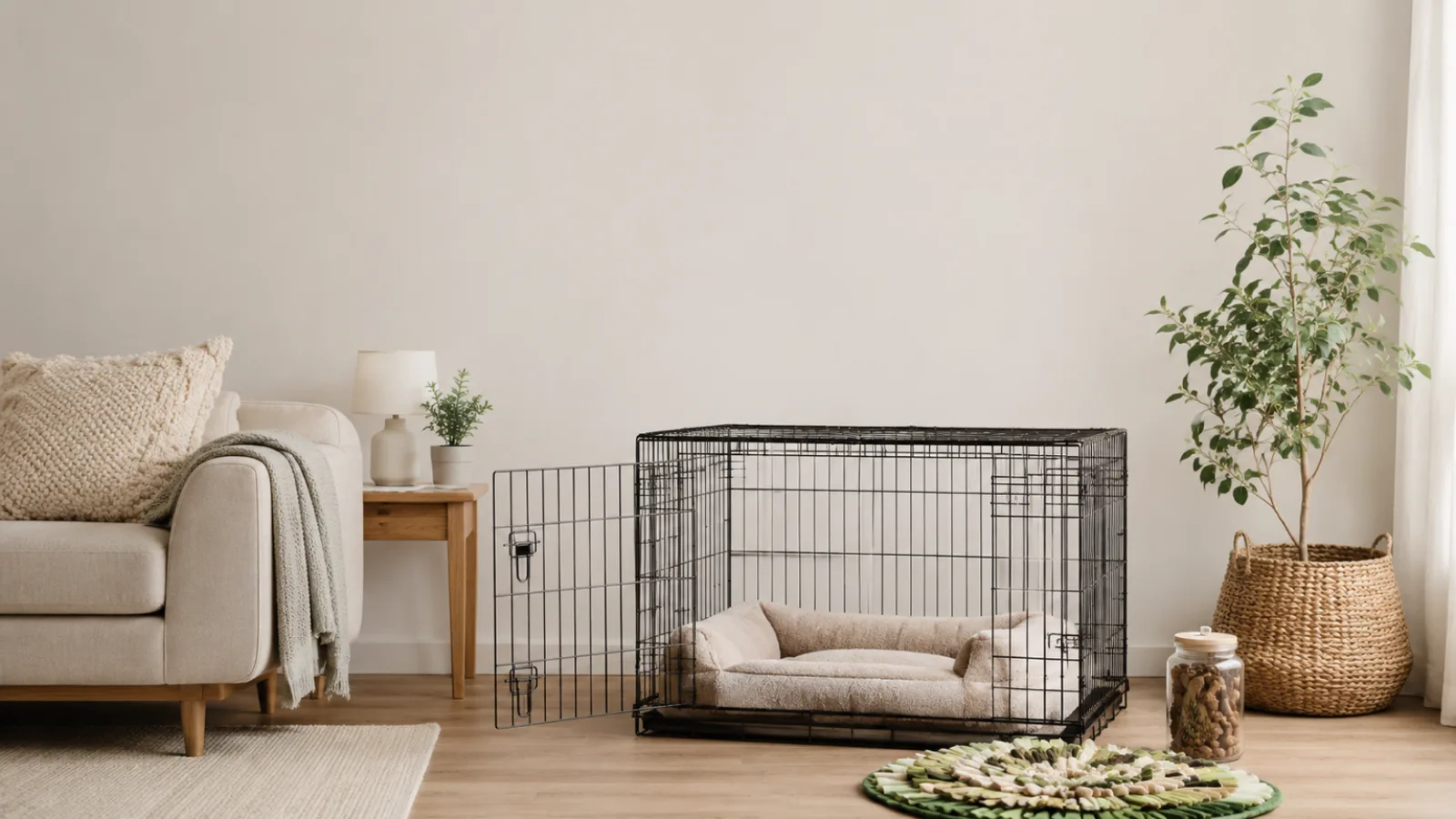
Dogs
Dog Crate Training Setup: A Gear-and-Method Sequence for a Calm, Willing Crate (2026)
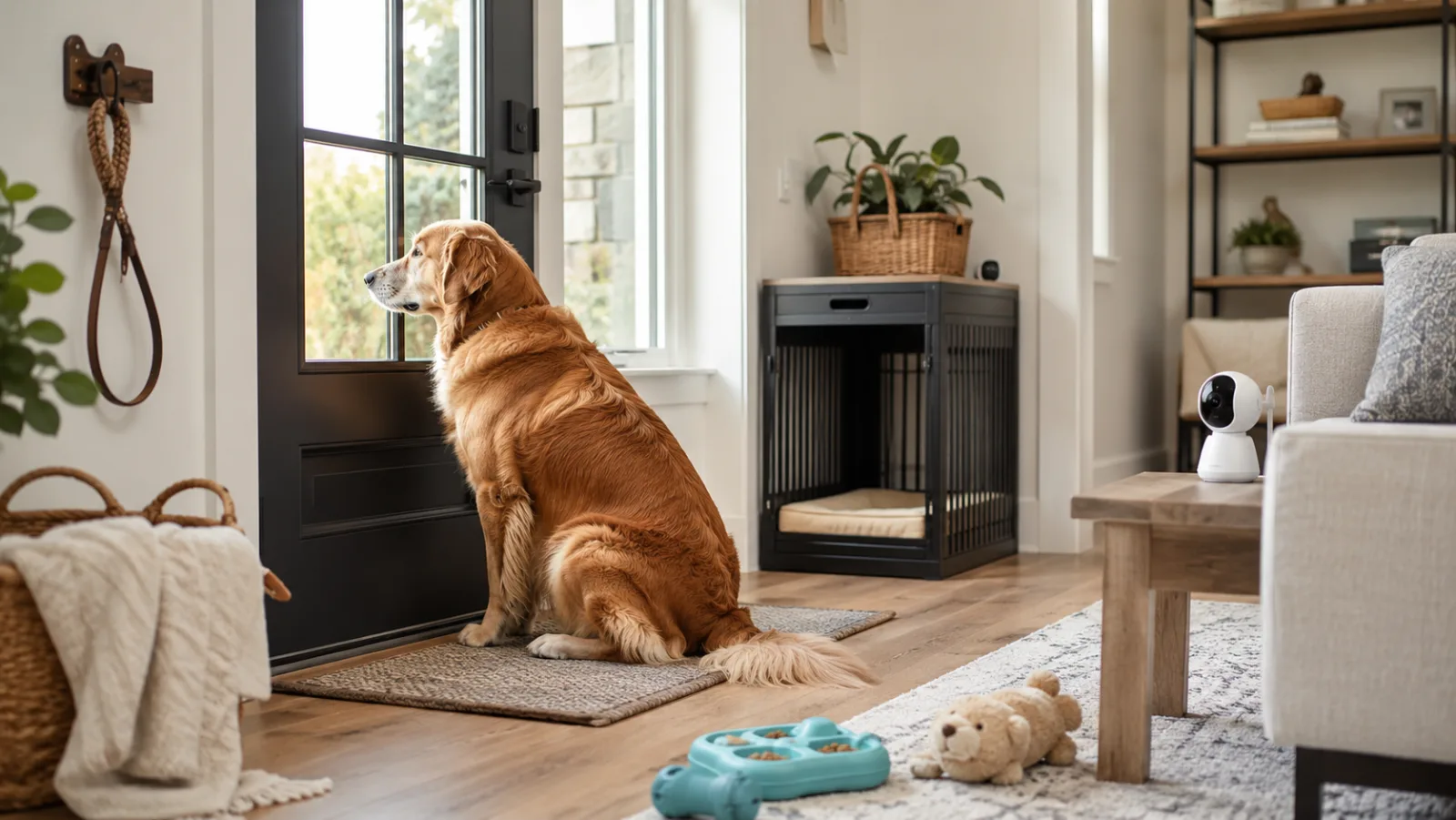
Cats & Dogs
Best Products for Dog Separation Anxiety: Routines, Calming Aids, and Cameras (2026)
Cats & Dogs
Best Crash-Tested Travel Dog Crates (2026)
Cats & Dogs