Cats & Dogs
Best Dog Wheelchairs and Mobility Carts for Senior and Disabled Dogs (2026)
The Walkin' Wheels Large is our top rear-support pick for dogs 70–180 pounds. The Best Friend Mobility FML Elite is the best-value rear pick. The Walkin' Wheels Corgi edition fits small and long-backed breeds. Recommendations are grounded in ACVS IVDD guidance, Cornell DM materials, and Walkin' Pets advisory content — not first-party testing.
By Nick Miles · Updated September 26, 2026 · 13 min read
PetPalHQ is reader-supported. We may earn a commission from qualifying Amazon purchases at no extra cost to you.
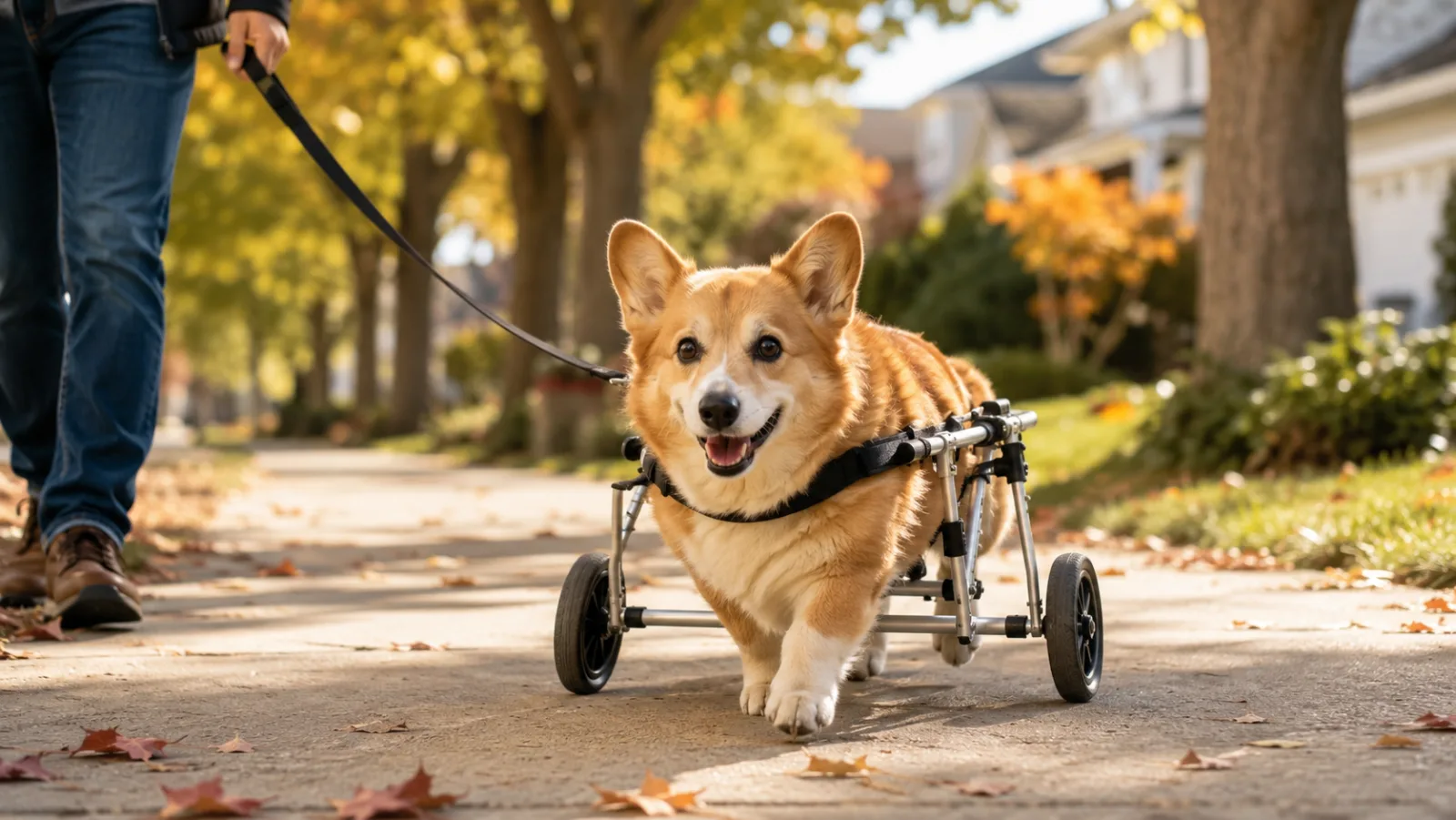
Evidence at a Glance
Walkin' Wheels Dog Wheelchair for Large Dogs 70–180 Pounds
Patented toolless adjustable frame cited as designed with veterinary input — the top pick for large-breed rear paralysis from IVDD, DM, FCE, or advanced hip dysplasia.
Sources: Walkin' Pets veterinary advisory content, American College of Veterinary Surgeons — IVDD owner resource, Cornell University Riney Canine Health Center — degenerative myelopathy
Verified Jun 24, 2026
Best Friend Mobility Standard Rear Support Dog Wheelchair FML Elite, Large
Aircraft-grade 6061 aluminum frame with a padded harness system, designed and tested with a K9 orthopedic surgeon — the best-value rear pick.
Sources: Best Friend Mobility manufacturer documentation, Walkin' Pets veterinary advisory content — rear vs quad selection
Verified Jun 24, 2026
Walkin' Wheels Corgi Dog Wheelchair for Small Dogs 11–44 Pounds
Sized for chondrodystrophic small and long-backed breeds at raised IVDD risk — the pick for Corgis, Dachshunds, and similar breeds.
Sources: Walkin' Pets veterinary advisory content, Cornell University Riney Canine Health Center — degenerative myelopathy breed list, Walkin' Pets — corgi spinal disease content
Verified Jun 24, 2026
Our Picks
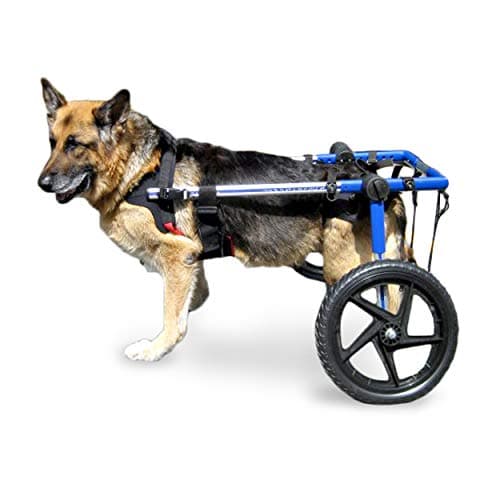
Walkin' Wheels
Walkin' Wheels Dog Wheelchair for Large Dogs 70–180 Pounds
9.4 / 10
- Patented adjustable design fits dogs 70–180 pounds with height, length, and width customization
- Designed with veterinarians and rehabilitation specialists to hold the spine in optimal alignment, per Walkin' Pets documentation
- Extruded aluminum frame with dense foam wheels that will not puncture and are all-terrain capable
- Convertible to a quad four-wheel configuration by adding a front attachment as DM progresses
$529.00
Current price · checked Sep 26, 2026
Best Friend Mobility
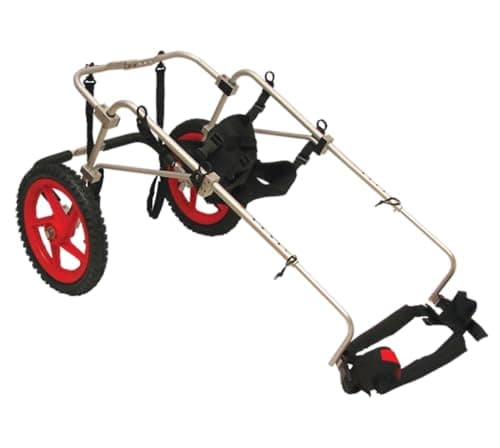
Best Friend Mobility Standard Rear Support Dog Wheelchair FML Elite, Large
9.0 / 10
- Aircraft-grade 6061 aluminum frame with stainless steel hardware, per Best Friend Mobility documentation
- Designed and tested by a K9 orthopedic surgeon, per manufacturer documentation
- Adjustable shoulder harness and padded rear harness for comfort and anti-chafing fit
- Hex-wrench height, width, and length adjustment, per Best Friend Mobility's product page
$256.96
Current price · checked Sep 26, 2026
Walkin' Wheels
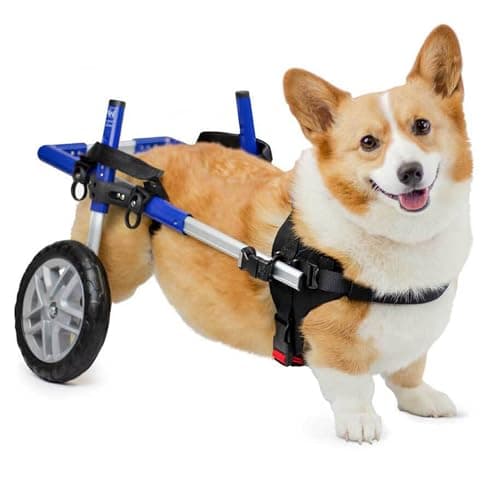
Walkin' Wheels Corgi Dog Wheelchair for Small Dogs 11–44 Pounds
8.9 / 10
- Sized and proportioned for small and long-backed chondrodystrophic breeds, 11–44 pounds, per Walkin' Pets documentation
- Same patented adjustable frame system as the Large model — height, length, and width tunable to body shape
- Veterinarian-approved designation consistent across the Walkin' Wheels product family
- Belly support and harness configuration tuned for low-to-ground body profiles typical of Corgis and Dachshunds
$340.00
Current price · checked Sep 26, 2026
KGIMORLEX
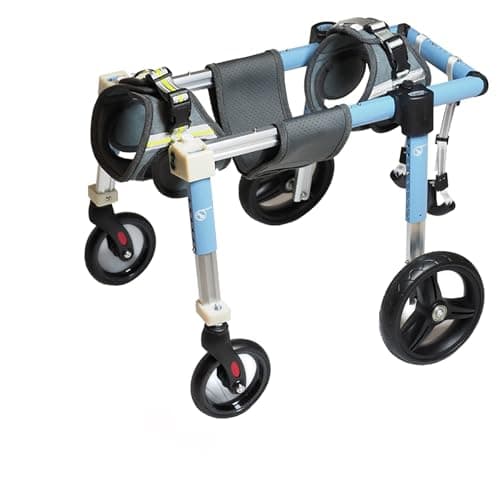
KGIMORLEX 4 Wheel Dog Wheelchair, Adjustable, Full-Support Front and Back Leg
8.5 / 10
- Four-wheel full-body support design for dogs with both front and rear limb weakness, per KGIMORLEX manufacturer documentation
- Lightweight aluminum frame with height, width, and length adjustability to fit multiple breed sizes
- All-terrain wheel design for indoor and outdoor use, per manufacturer documentation
- Soft-padded harness straps designed to prevent chafing during extended daily use
$208.98
Current price · checked Sep 26, 2026
LetPetRun
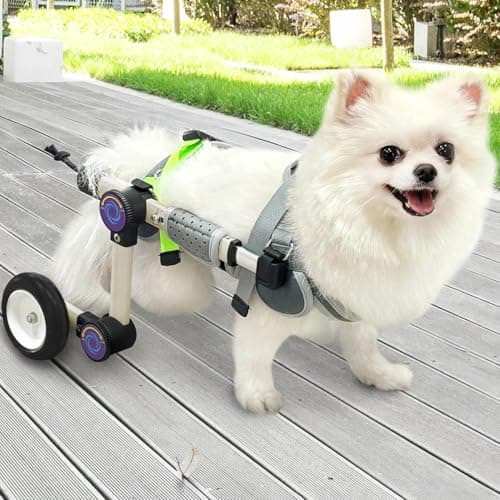
LetPetRun Adjustable Dog Wheelchair for Back Legs, Lightweight
8.0 / 10
- Lightweight aluminum frame with adjustable height, width, and length for rear-support use
- Foldable design for portability and car transport, per LetPetRun manufacturer documentation
- Soft padded harness straps for comfort in daily use
- Assembles in under five minutes per manufacturer documentation
$69.93
Current price · checked Sep 26, 2026
The Short Answer
Buying for a large rear-support dog? Start with the Walkin' Wheels Large (70–180 lb, B01BT7UJ1W), the strongest rear-support choice for paralysis from IVDD, degenerative myelopathy, or advanced hip dysplasia. It adjusts in three dimensions without tools, and it converts to a quad configuration as a disease progresses. On a tighter budget, the Best Friend Mobility FML Elite (B005FALBEE) delivers a 6061 aircraft-grade aluminum frame for considerably less. For small or long-backed breeds like Corgis and Dachshunds, choose the Walkin' Wheels Corgi edition (B07MG84PYX). For dogs weak in both the front and rear legs, the KGIMORLEX 4-wheel quad cart (B0DQ12Y2TG) supports the entire body, and the LetPetRun (B0DSVHY2W6) is the budget rear-support pick. A wheelchair replaces lost limb function rather than assisting a dog that can still walk. It is not a ramp or a stroller. Have a veterinarian evaluate any new mobility loss before you buy.
Every product on this list has been scored against the PetPal Gear Score, a weighted composite of expert consensus, observed effectiveness, animal safety, long-term durability, and value. Review method: Editorial synthesis, not lab testing. We reviewed the American College of Veterinary Surgeons (ACVS) resource on intervertebral disc disease (IVDD). We read the Cornell University Riney Canine Health Center materials on degenerative myelopathy (DM) and fibrocartilaginous embolism (FCE). We reviewed VCA Animal Hospitals' FCE page. We drew on Walkin' Pets advisory content, including its DM guide and its wheelchair-fitting guide. We checked Best Friend Mobility, KGIMORLEX, and LetPetRun product pages. PetPalHQ does not run a testing lab. The Canine Mobility Restoration Score is a composite of published specs and expert guidance, not a measurement. All five picks had a confirmed live listing, seller, and price on September 2, 2026, and every one of them is sold on Amazon by an outside seller rather than by Amazon itself. A sixth pick, a front-leg-only amputee cart, was dropped on that date because Amazon showed no seller offering it. Prices on all five picks were re-read through Amazon's Creators API on September 26, 2026. This guide is informational, not veterinary advice. Ask a veterinarian or a Certified Canine Rehabilitation Practitioner (CCRP) before buying a cart for a dog with new or worsening mobility loss.. Synthesized from 9+ expert sources.
A dog wheelchair is not a ramp, a stroller, or a harness. It is a locomotion-replacement device. It stands in for hind-limb or multi-limb function when a dog can no longer move those legs on its own. The conditions behind it are serious. Intervertebral disc disease (IVDD) compresses the spinal cord. Degenerative myelopathy (DM) slowly destroys the nerves' protective sheaths. Fibrocartilaginous embolism (FCE) blocks blood flow to part of the spinal cord. Advanced hip dysplasia can end weight-bearing entirely. Amputation removes a limb after cancer or trauma. The ACVS resource warns that major rear paralysis, or lost deep pain sensation, needs urgent evaluation — the surgical window closes fast. Cornell's DM materials call a wheelchair a management tool for a disease with no cure. VCA's FCE page describes walking carts as devices that aid healing and early mobility. These are the clinical roots of the category.
This guide is also clear about what a wheelchair is not. It is not a ramp or a set of stairs. Those help dogs that still walk but need help with height changes. It is not a stroller, which carries a dog that cannot walk far but does not need its legs replaced. Those are separate categories, covered in sibling guides in this hub. A dog still walking, even slowly, usually belongs in the ramps or strollers discussion. A dog dragging paralyzed hind legs belongs here.
Before any purchase, the position of this guide is plain. A vet should assess any dog with new or worsening mobility loss first. A Certified Canine Rehabilitation Practitioner (CCRP) can run the towel test and other checks to decide whether rear, quad, or front support fits. The diagnosis shapes not just which cart to buy, but whether a cart should come before or after rest, surgery, or rehab.
The picks below are editorial synthesis. PetPalHQ does not run a testing lab and has not used these carts on our own dogs. Each one was chosen by reviewing manufacturer specs, the ACVS IVDD resource, Cornell's DM and FCE materials, VCA's FCE page, Walkin' Pets advisory and fitting guides, Best Friend Mobility specs, and CorgiAid's mobility program. The Canine Mobility Restoration Score rewards adjustability, support-type match, frame durability, and caregiver ease. It is a composite of expert guidance and published specs, not a measurement.
One thing to know before you click through to any of these. Dog wheelchairs are a small, specialist category, and none of the five picks here is sold by Amazon itself. Every one of them comes from an outside seller running a storefront on Amazon — Walkin' Wheels through a store called Veterinary Preferred, Best Friend Mobility through Sylvan Company, the KGIMORLEX quad through another outside store, and the LetPetRun under its own brand name. The Best Friend Mobility is the one we could confirm ships out of an Amazon warehouse; the two Walkin' Wheels carts ship from the Veterinary Preferred store, and for the other two the listing did not show us who does the shipping. In practice that means the return window, the shipping time, and anyone you contact with a sizing question are likely to belong to that seller rather than to Amazon, and it is worth reading the return terms on the listing before you order a cart that has to fit a specific dog. We checked every price and seller here on September 2, 2026, and re-read the prices on September 26, 2026. Prices on these listings move, so treat the figures below as what we saw on that date rather than a standing quote.
Choosing a Wheelchair for a Dog's Back Legs
Most shoppers are looking for a wheelchair for a dog's back legs, and that matches the clinical picture. The American Kennel Club's guide to wheelchairs for dogs says: "Most wheelchairs for dogs are made for dogs having mobility issues with their rear limbs." Walkin' Pets' dog wheelchair buying guide gives the reason: "Most pets with mobility problems experience hind leg weakness or paralysis." Four of the five picks here are rear-support carts — the Walkin' Wheels Large, the Best Friend Mobility FML Elite, the Walkin' Wheels Corgi edition, and the LetPetRun — and the KGIMORLEX is the full-support quad.
Rear support or full support comes down to the front legs. AKC puts the split this way: "Rear-support wheelchairs are ideal for dogs who have conditions like severe hip dysplasia, which can cause weakness and discomfort in a dog’s back legs. Quad-support wheelchairs are ideal for dogs with quadriplegia, meaning they experience a lack of mobility in all four legs." The towel test in the FAQ below is the field check for which side of that line a dog is on, and a veterinarian or CCRP should confirm it.
Sizing is where most carts go wrong. Walkin' Pets says: "You only need two pieces of information to determine what size Walkin' Wheels dog wheelchair is best for your pet: their weight and a measurement of their rear leg height." Other brands size differently. AKC's general checklist has owners measure hip width, body length, and height at the withers, and it gives a simple strap test: "Ideally, you should be able to slide two fingers underneath a strap." A dog whose hind legs are fully paralyzed also needs its feet kept off the ground. Walkin' Pets recommends its stirrups only for dogs whose hind legs are fully paralyzed and need to be lifted off the ground. On why fit matters, AKC quotes its chief veterinarian, Dr. Jerry Klein: "Proper size and fit are important to prevent pain or sores developing on the dog," he says.
Head-to-Head Comparison
| Feature | Walkin' Wheels Dog Wheelchair for Large Dogs 70–180 Pounds | Best Friend Mobility Standard Rear Support Dog Wheelchair FML Elite, Large | Walkin' Wheels Corgi Dog Wheelchair for Small Dogs 11–44 Pounds | KGIMORLEX 4 Wheel Dog Wheelchair, Adjustable, Full-Support Front and Back Leg | LetPetRun Adjustable Dog Wheelchair for Back Legs, Lightweight |
|---|---|---|---|---|---|
| Best use case | Large rear paralysis — DM/IVDD/FCE | Rear support, value tier | Small & long-backed breeds | Multi-limb / quad support | Budget rear-support / recovery |
| Support type | Rear only (convertible to quad) | Rear only | Rear only (convertible to quad) | Full quad — front and rear | Rear only |
| Weight range | Size attribute: 70–180 lb, 20–22-in leg | Style attribute: Large = 21–26-in hindquarters (XS–XL tiers) | Title says 11–44 lb; size attribute says 18–39 lb, 8–11-in leg | Listing description: small through large — size-dependent | Size-dependent per listing variant |
| Frame material | Extruded aluminum, per Walkin' Pets | Aircraft-grade 6061 aluminum, per BFM | Extruded aluminum, per Walkin' Pets | Aluminum per KGIMORLEX documentation | Aluminum per LetPetRun documentation |
| Adjustment method | Toolless, by hand | Hex wrench, per BFM | Toolless, by hand | Adjustable per documentation | Adjustable per documentation |
| Veterinary endorsement | Veterinarian-approved — vet + rehab specialist input documented | K9 orthopedic surgeon design involvement documented | Veterinarian-approved — same family as Large | None found in our sources | None found in our sources |
| Who sells it on Amazon | Veterinary Preferred store | Sylvan Company, shipped by Amazon | Veterinary Preferred store | Outside seller — check the listing | LetPetRun store |
| Check price | Amazon | Amazon | Amazon | Amazon | Amazon |
$529.00
Current price · checked Sep 26, 2026
- Patented adjustable design fits dogs 70–180 pounds with height, length, and width customization
- Designed with veterinarians and rehabilitation specialists to hold the spine in optimal alignment, per Walkin' Pets documentation
- Extruded aluminum frame with dense foam wheels that will not puncture and are all-terrain capable
- Convertible to a quad four-wheel configuration by adding a front attachment as DM progresses
- Toolless adjustment lets a caregiver re-tune fit by hand, with no wrench or tools
Picture a large or giant dog that can no longer bear weight on either hind leg. The cause is usually IVDD, degenerative myelopathy, FCE, or advanced hip dysplasia. This is the most common scenario in the category, and the Walkin' Wheels Large is built specifically for it. It earns the top rank on the two factors that carry the most weight in the Canine Mobility Restoration Score.
Fit & Adjustability accounts for 30% of the score, and the Walkin' Wheels leads decisively. One frame covers 70 to 180 pounds, and the height, length, and width all adjust by hand without tools. That toolless tuning matters for a degenerative myelopathy dog, because progressive muscle atrophy keeps changing the correct fit. Support-Type Match adds another 25%. A front-wheel attachment converts the rear cart into a full quad configuration as the disease moves into the front legs, per Walkin' Pets documentation. A single frame can therefore follow the disease instead of being replaced entirely.
Best Friend Mobility does win one factor outright. Frame Durability is 20% of the score, and the methodology rewards specification transparency. The named 6061 aircraft-grade aluminum frame beats the Walkin' Wheels frame, which Walkin' Pets lists as extruded aluminum, so we give Best Friend Mobility that point honestly. But Fit & Adjustability and Support-Type Match together represent 55% of the score, and the Walkin' Wheels leads both. That is why it ranks first even though Best Friend Mobility documents the more transparent alloy. The Walkin' Wheels is hardly weak on terrain either, since its dense foam wheels resist punctures across floors, gravel, and grass.
Veterinarians and rehabilitation specialists are cited in the design, and rehab practitioners point to this cart frequently. We treat that endorsement as supporting context, not as the reason for the rank, which rests entirely on the scored factors above. The trade-off is price: at $529.00 on Amazon as of September 2, 2026, this is the most expensive pick here. It is the right answer for a large dog with degenerative myelopathy or chronic IVDD that needs long-term support. It is the wrong answer when the mobility loss is temporary, or when budget is the deciding constraint.
One practical note about buying it. The Amazon listing is run by an outside store, Veterinary Preferred, rather than by Amazon itself, and it names HandicappedPets.com — the company behind Walkin' Pets — as the manufacturer. That is normal for this brand on Amazon, but it means returns and any fitting questions go through that seller's 30-day return window rather than Amazon's own service. The listing also puts the frame at 21 pounds, which is worth knowing before you commit to lifting it on and off a large dog twice a day.
What We Love
- One frame fits 70–180 lb dogs, with toolless height, length, and width adjustment
- Converts to quad support via a front attachment as front-limb weakness develops, per Walkin' Pets
- Toolless tuning keeps the fit right as muscle atrophy changes a DM dog's body
- Dense foam wheels resist punctures on floors, gravel, and grass
- Cited as designed with veterinary and rehab-specialist input, per Walkin' Pets
What Could Be Better
- Highest price in this slate at $529.00 on Amazon as of September 2, 2026 — not the right answer for temporary recovery or budget-constrained households
- Frame is extruded aluminum per Walkin' Pets — a less specific grade than Best Friend Mobility's named 6061 alloy
- The listing puts the frame at 21 pounds — heavy to lift on and off a very large dog every day
- Sold on Amazon by an outside store, Veterinary Preferred, so returns run on that seller's 30-day window rather than through Amazon directly
The Verdict
Our top rear-support pick for large dogs. Best for DM, chronic IVDD, advanced hip dysplasia, or FCE once a vet confirms long-term support is needed. It wins on fit range and support-type, the two heaviest factors in the score.
Sources
- Walkin' Pets (Degenerative Myelopathy and Dog Wheelchairs): A front-wheel attachment can be added to any Walkin' Wheels wheelchair to adapt to DM progression as the back legs weaken and the front legs follow
- American College of Veterinary Surgeons (IVDD): Post-operative recovery includes physical rehabilitation for muscle strength and flexibility plus at least four weeks of strict exercise restriction
- Cornell Riney Canine Health Center (Degenerative Myelopathy): There is no cure for DM; routine physical therapy may delay the clinical progression and help maintain muscle mass
$256.96
Current price · checked Sep 26, 2026
- Aircraft-grade 6061 aluminum frame with stainless steel hardware, per Best Friend Mobility documentation
- Designed and tested by a K9 orthopedic surgeon, per manufacturer documentation
- Adjustable shoulder harness and padded rear harness for comfort and anti-chafing fit
- Hex-wrench height, width, and length adjustment, per Best Friend Mobility's product page
- Rear-support configuration requires normal front-leg strength — appropriate for IVDD and rear-limb paralysis cases
At $256.96 on Amazon as of September 2, 2026, the Best Friend Mobility FML Elite costs about $272 less than the Walkin' Wheels Large, which makes it the best-value rear-support cart in this slate. The frame is 6061 aircraft-grade aluminum with stainless hardware, per the manufacturer's product page, and a K9 orthopedic surgeon helped design and test it. The harness pairs a clip-on front piece with a padded double rear harness to limit chafing during extended daily use.
Height, width, and length all adjust, though the manufacturer's page describes a hex wrench rather than the toolless knobs on the Walkin' Wheels. For most households that is a minor difference at setup rather than a daily inconvenience. Sizing runs from XX-Small through X-Large. The Large model listed here is specified for hindquarters measuring 21 to 26 inches, and the Amazon listing puts the frame at about 13 pounds — roughly eight pounds lighter than the Walkin' Wheels Large, which matters if you are lifting the cart on and off every day.
Sizing deserves care. Buyers should size against the manufacturer's chart, and for very large dogs they should consult the brand's support team directly. Reviewers on Chewy describe dogs walking and spinning on the first day, though a few report fit problems at the top of the weight range, which is one more reason to measure carefully before purchase.
The main limitation versus the Walkin' Wheels is conversion. This cart is a rear-support design, so a degenerative myelopathy dog that later loses front-leg strength needs a different configuration rather than an attachment to this one. For IVDD recovery, or for early-to-mid degenerative myelopathy with no front-leg involvement yet, that limitation rarely matters.
What We Love
- Aircraft-grade 6061 aluminum at about $272 less than the Walkin' Wheels Large — the best construction-per-dollar in the slate
- K9 orthopedic surgeon design involvement cited in manufacturer documentation
- Adjusts in height, width, and length to fit medium-to-large dogs
- Padded rear harness designed to limit chafing in extended daily use, per Best Friend Mobility documentation
What Could Be Better
- Rear-support design — DM households planning for front-limb progression may need to plan a product transition
- Size selection requires working carefully through the brand's sizing chart
- Adjustment needs a hex wrench rather than the toolless knobs on the Walkin' Wheels
- Sold on Amazon by an outside seller, Sylvan Company, though Amazon ships it and its free 30-day return window applies
The Verdict
The best-value rear pick. A well-built 6061 frame at about $272 under the Walkin' Wheels Large. Best for IVDD recovery and early-to-mid DM, where the front legs are still strong and budget matters.
Sources
- Best Friend Mobility (Standard Rear Support): Aircraft-grade 6061 aluminum frame, designed and tested by a K9 orthopedic surgeon, with hex-wrench height, width, and length adjustment and all-terrain polyurethane wheels
- American College of Veterinary Surgeons (IVDD): Dogs that still perceive pain recover in about 90% of surgical cases, and recovery includes physical rehabilitation
$340.00
Current price · checked Sep 26, 2026
- Sized and proportioned for small and long-backed chondrodystrophic breeds, 11–44 pounds, per Walkin' Pets documentation
- Same patented adjustable frame system as the Large model — height, length, and width tunable to body shape
- Veterinarian-approved designation consistent across the Walkin' Wheels product family
- Belly support and harness configuration tuned for low-to-ground body profiles typical of Corgis and Dachshunds
- Convertible to quad support when front-limb weakness develops, consistent with the full Walkin' Wheels line
Corgis carry two spinal risks simultaneously. Cornell's degenerative myelopathy materials list the Pembroke Welsh Corgi among the primary breeds affected, and Walkin' Pets notes that Corgis are also chondrodystrophic, which elevates their IVDD risk through the same disc herniation that affects Dachshunds. Put that dual risk in a long, low-slung body, and a standard frame sits at the wrong height for the dog. The Walkin' Wheels Corgi edition is proportioned specifically for that body shape.
The construction mirrors the Large model in every important respect. It uses the same patented frame, with toolless height, length, and width adjustment and the same dense foam all-terrain wheels. The harness sits lower to match the torso of a Corgi or Dachshund, and fitting follows a rear-leg measurement from paw to torso, the standard Walkin' Wheels method. The 11–44 pound range also covers Dachshunds, Miniature Schnauzers, and similar small breeds.
Why a Corgi-specific edition earns its own slot is straightforward. A Large frame on a low body would misalign the belly support and spoil the dog's stride. CorgiAid's Corgis on Wheels program uses the Walkin' Wheels design and documents hundreds of Corgi wheelchair users.
Two limitations deserve attention before purchase. The 11–44 pound range is relatively narrow, so toy breeds under 11 pounds may need the Mini size, and dogs above 44 pounds should consider the Small or Medium frames instead. Torso length matters as much as weight for these breeds, so measure carefully before you buy.
One inconsistency on the listing is worth flagging, because fit is the whole point of this edition. The product title advertises 11 to 44 pounds, but the listing's own size attribute for the configuration on sale describes 18 to 39 pounds with an 8-to-11-inch rear-leg measurement. Those are not the same range. Treat the leg measurement as the number that decides the fit — it is the measurement Walkin' Pets' own fitting guide asks for — and contact the seller with your dog's paw-to-torso figure before ordering rather than trusting the weight bracket in the title. At $340.00 on Amazon as of September 2, 2026, sold through the Veterinary Preferred store rather than by Amazon itself, this is not a cart you want to size by guesswork.
What We Love
- Purpose-built proportions for chondrodystrophic body shape, per Walkin' Pets documentation
- Same patented adjustable system and veterinarian-endorsed design as the Large model
- Convertible to quad support — appropriate for DM cases in Corgis and other affected breeds as disease progresses
- Covers the 11–44 pound range most applicable to Dachshunds, Corgis, and similar breeds
- Supported by CorgiAid's Corgis on Wheels mobility program community documentation
What Could Be Better
- Narrower weight range (11–44 lb) means large Corgis or mixed-breed long-backed dogs above 44 lb need a different size
- Long-backed fit requires especially precise measurement — torso length matters as much as weight for correct alignment
- The listing's title (11–44 lb) and its size attribute (18–39 lb, 8–11-inch leg) disagree — size by the rear-leg measurement and confirm with the seller
- At $340.00 on Amazon as of September 2, 2026, it is the second-most expensive pick here — only the Large model costs more
The Verdict
Built for Corgis, Dachshunds, and other small long-backed breeds with IVDD or DM. The proportioning is the differentiator. A standard small frame on a Corgi body risks poor harness alignment.
Sources
- Cornell Riney Canine Health Center (Degenerative Myelopathy): Routine physical therapy may delay the clinical progression of DM and help maintain muscle mass
- Walkin' Pets (Degenerative Myelopathy and Dog Wheelchairs): A front-wheel attachment fits any Walkin' Wheels wheelchair, including small-breed sizes, to convert rear support to quad support
$208.98
Current price · checked Sep 26, 2026
- Four-wheel full-body support design for dogs with both front and rear limb weakness, per KGIMORLEX manufacturer documentation
- Lightweight aluminum frame with height, width, and length adjustability to fit multiple breed sizes
- All-terrain wheel design for indoor and outdoor use, per manufacturer documentation
- Soft-padded harness straps designed to prevent chafing during extended daily use
- Compatible with medium and large dogs requiring full-body locomotion support
Some dogs lose strength in all four legs rather than only the rear, and they need a four-point cart instead of a two-wheel rear one. The KGIMORLEX quad is built for exactly that scenario. The usual trigger is advanced degenerative myelopathy, and Walkin' Pets explains that as the disease spreads, a dog eventually needs front wheels or full four-limb support. The field assessment for this is the towel test, which is covered in the FAQ below.
The KGIMORLEX product page describes a lightweight aluminum frame with adjustable height, width, and length. It lists soft padded harness straps and all-terrain wheels for indoor and outdoor use, in sizes from small through large. It sells for $208.98 on Amazon as of September 26, 2026, and the page frames it as support for elderly, injured, or recovering dogs. That is a fraction of what a premium-brand quad setup costs, since the Walkin' Wheels route starts at $340.00 for the Corgi frame, or $529.00 for a large dog, before the front attachment is added on top.
Quad support occupies its own slot for a clear biomechanical reason. A rear cart needs functional front legs to propel the dog forward, whereas a quad cart holds all four limbs, so a globally weak dog can still be mobilized. The two configurations are not interchangeable.
Where the KGIMORLEX trails the leaders is track record. The listing first appeared on Amazon in December 2024 and has drawn 15 customer ratings, against 632 for the Walkin' Wheels Large and 331 for the Best Friend Mobility. It is a newer brand with thinner veterinary endorsement than either, and although its adjustability and terrain claims look credible from the listing, the clinical history is shorter. It is also sold by an outside seller rather than by Amazon, so the return terms are that seller's — read them on the listing before you order. For confirmed advanced degenerative myelopathy, a Walkin' Pets quad carries deeper endorsement, while the KGIMORLEX is the appropriate pick when budget drives a four-wheel decision.
What We Love
- Four-wheel full-body support for multi-limb weakness — addresses the advanced DM scenario rear-only carts cannot serve
- Lightweight aluminum frame at $208.98 on Amazon as of September 26, 2026 — a fraction of what a quad configuration from an established brand costs
- All-terrain wheel design for both indoor and outdoor use, per manufacturer documentation
- Soft-padded harness designed to prevent chafing in extended daily use
What Could Be Better
- Newer brand — the listing dates to December 2024 and carries 15 customer ratings, against 632 for the Walkin' Wheels Large — with less depth of veterinary clinical community endorsement
- Maximum weight capacity and exact fit specifications require careful review of the brand's sizing documentation before purchase
- Full-body fitting complexity is higher than a rear-only cart — vet or CCRP guidance before purchase is more important, not less
The Verdict
The pick when quad support is the clinical need. Best for advanced DM or multi-limb paralysis, once the towel test confirms front-leg involvement and budget is in play.
$69.93
Current price · checked Sep 26, 2026
- Lightweight aluminum frame with adjustable height, width, and length for rear-support use
- Foldable design for portability and car transport, per LetPetRun manufacturer documentation
- Soft padded harness straps for comfort in daily use
- Assembles in under five minutes per manufacturer documentation
- Rear-support configuration for dogs with hind-limb paralysis and intact front-limb strength
Not every paralyzed dog needs a wheelchair for years, since some need only weeks or months of support during recovery. The LetPetRun is the budget anchor for that scenario. At $69.93 on Amazon as of September 2, 2026, it costs roughly an eighth of the Walkin' Wheels Large's $529.00 and just over a quarter of the Best Friend Mobility FML Elite's $256.96. The manufacturer describes a lightweight aluminum frame, adjustable height, width, and length, padded harness straps, a foldable design, and assembly in under five minutes.
The recovery case is genuinely real. A post-surgical IVDD dog may need rear support during the four-to-eight week rehabilitation window the ACVS describes, and FCE dogs, per VCA, often regain most function within three to four months. A light, foldable cart can carry a dog through that recovery arc without committing to a premium-tier purchase it soon outgrows.
The honest limitation is construction tier. At $69.93, this is entry-level aluminum rather than the 6061 frame Best Friend Mobility names, and we found no independent test of frame stiffness under a large, active dog. Reviewers call it effective for light daily use. Sizing is the part to get right: this listing sells several size variants at different prices, and the individual variants carry their own weight ceilings — one of them tops out at 20 pounds — so the price you see and the capacity you get both depend on the size you select. Work through the manufacturer's measurement guide before you choose one. LetPetRun sells it on Amazon under its own store name rather than through Amazon itself.
This pick suits short-term recovery, financially constrained households, and cases where the prognosis is still being evaluated. It is the wrong choice for a 100-pound degenerative myelopathy dog that will depend on a cart every day for years.
What We Love
- Sub-$70 price makes rear-support wheelchair access viable for budget-constrained households
- Foldable design for car transport and easy storage — editorial advantage for temporary recovery use cases
- Under-five-minute assembly per manufacturer documentation reduces caregiver burden
- Adjustable height, width, and length allow fitting across a range of breed sizes
What Could Be Better
- Entry-tier aluminum frame rather than the aircraft-grade 6061 the mid-range picks name
- Not the right answer for large dogs requiring daily, long-term locomotion support from DM or permanent paralysis
- Fewer reviews and less community clinical track record than the established brands in this slate
The Verdict
The budget pick, for when cost decides. Best for IVDD or FCE recovery that needs rear support for weeks to months, not permanent replacement.
How We Score
Formula
Canine Mobility Restoration Score = (Fit Range & Adjustability × 0.30) + (Support-Type Match to Diagnosis × 0.25) + (Frame Durability & Terrain Capability × 0.20) + (Setup Ease & Caregiver Burden × 0.15) + (Amazon Availability & Verified Fit × 0.10)
Score Factors
- Fit Range & Adjustability · 30%
- How well the frame adjusts in height, length, and width, how wide a weight range one size covers, and how easily the fit can be re-tuned. Re-tuning matters because muscle atrophy keeps changing a DM dog's body, per Walkin' Pets. The score rewards patented or well-documented adjustment over fixed frames, and toolless tuning over wrench-based tuning.
- Support-Type Match to Diagnosis · 25%
- Whether the rear, front, or quad setup matches the main diagnosis — IVDD, DM, FCE, hip dysplasia, or amputation — as described by ACVS, Cornell, and VCA. A rear cart scores full marks for IVDD and rear DM. A quad scores full marks for advanced multi-limb DM. A front cart scores full marks for forelimb amputation. A frame that converts across types scores higher, since it can follow a progressive disease. A wrong support type is a major purchase failure.
- Frame Durability & Terrain Capability · 20%
- Frame material, wheel type, and indoor and outdoor terrain capability. A named alloy like 6061 aircraft-grade aluminum scores above generic extruded aluminum, which scores above an unnamed frame. Dense foam all-terrain wheels add points here too. The score rewards spec transparency over marketing language.
- Setup Ease & Caregiver Burden · 15%
- How fast the cart fits and comes off, how clear the fitting guide is, whether it folds for storage, and how easily it cleans. For anyone managing a paralyzed dog every day, this burden is a real clinical factor, not just convenience.
- Amazon Availability & Verified Fit · 10%
- Whether the exact Amazon listing was live, priced, and offered by a named seller on September 2, 2026, checked against the maker's product page. The score gives no points for listings with no seller offering them or for discontinued listings, and a pick that loses its last seller is dropped rather than left standing — which is what happened to the front-leg amputee cart this guide previously ranked fifth.
| Rank | Product | Score |
|---|---|---|
| #1 | Walkin' Wheels Walkin' Wheels Dog Wheelchair for Large Dogs 70–180 Pounds | 9.4 |
| #2 | Best Friend Mobility Best Friend Mobility Standard Rear Support Dog Wheelchair FML Elite, Large | 9.0 |
| #3 | Walkin' Wheels Walkin' Wheels Corgi Dog Wheelchair for Small Dogs 11–44 Pounds | 8.9 |
| #4 | KGIMORLEX KGIMORLEX 4 Wheel Dog Wheelchair, Adjustable, Full-Support Front and Back Leg | 8.5 |
| #5 | LetPetRun LetPetRun Adjustable Dog Wheelchair for Back Legs, Lightweight | 8.0 |
When NOT to Buy
Do not purchase a cart before a veterinary visit if your dog shows new or worsening mobility loss. Warning signs include dragging hind paws, sudden weakness, or any sharp change in gait. The ACVS resource is explicit that a dog with major paralysis or lost deep pain sensation needs urgent evaluation. The surgical window closes rapidly once pain perception is gone. A wheelchair is not a diagnosis, surgery, or rehabilitation. It belongs inside a care plan rather than in place of one.
Skip the Walkin' Wheels Large and the Best Friend Mobility FML Elite until a veterinarian has identified the underlying cause. IVDD, degenerative myelopathy, and other conditions are managed differently. The diagnosis decides whether rest or surgery should come first, not merely which cart to buy. Skip the KGIMORLEX quad until a towel test or clinical exam confirms front-leg weakness. A quad frame on a rear-only dog restricts the front legs and can slow neurological recovery. Skip the LetPetRun for a large dog over 50 pounds that will rely on a cart every day permanently. Its construction tier suits short recovery rather than years of heavy daily load.
And skip anything sold as a front-leg-only cart until you have a specific product a veterinary team has looked at. We searched for one for this guide and could not find a listing we were willing to stand behind — the details are in the FAQ below.
One thing not to delay: a degenerative myelopathy dog that is already dragging paws should begin using a cart early. Walkin' Pets and Cornell both frame early introduction as important. It helps maintain the exercise that supports quality of life and may slow the disease.
Frequently Asked Questions
- When should a dog start using a wheelchair?
- Early rather than late. Walkin' Pets advises introducing a cart at the first signs of rear-leg weakness or paw knuckling, instead of waiting for full paralysis. Early use lets the dog learn the cart while it still has the strength and neurological input to move with it naturally. Walkin' Pets also cites research suggesting that regular wheelchair exercise may slow degenerative myelopathy and extend a dog's active life.
- How is a dog wheelchair different from a dog stroller?
- A wheelchair is a locomotion-replacement device that the dog operates itself, walking forward on its functional limbs while the cart carries the weak ones. A stroller is a passive carrier that the owner pushes, with the dog riding inside. A dog with some remaining ability to walk is usually better served by a wheelchair or a sling than by a stroller. A paralyzed dog that is also too fatigued or unstable to propel a cart may use both — a stroller for long outings and a wheelchair for controlled exercise.
- Rear support or quad wheelchair — how do I choose?
- Use the towel test, which Walkin' Pets describes in its fitting guide. Support the dog's abdomen with a rolled towel while it walks forward on its front legs. If the dog walks forward willingly, rear-only support is likely sufficient, but if the front legs sink, splay, or knuckle, quad support is the clinical indication. A veterinarian or a CCRP can perform this assessment and confirm the configuration before you buy.
- How do I measure my dog for a wheelchair?
- Measurement matters far more than weight alone, and Walkin' Pets treats it as a vet-guided process. The primary number is rear-leg height: lay the dog on its side and measure the back leg from the paw to where it meets the torso, keeping the leg relaxed. Weight brackets provide a starting size, but torso length and girth also affect the fit. Long-backed breeds in particular need extra attention to torso length.
- Is a dog wheelchair appropriate for IVDD recovery?
- That depends on the phase of recovery and the veterinarian's instructions. The ACVS resource describes post-surgical care that includes strict exercise restriction and physical rehabilitation. Used under veterinary guidance, a cart can support controlled movement during that rehabilitation window. A cart introduced before surgery, or instead of needed surgery, is not appropriate, so for IVDD the timing is a veterinary decision.
- Can a wheelchair help a dog with degenerative myelopathy live longer?
- Cornell's degenerative myelopathy materials note that regular exercise and physical therapy can slow the clinical progression of the disease. Walkin' Pets cites research in which dogs kept in regular wheelchair exercise stayed active considerably longer than those that did not. A wheelchair does not treat the underlying disease itself, but it provides the support that makes the beneficial exercise possible.
- What is the towel test?
- It is a simple field assessment described in Walkin' Pets' selection guidance. Roll a towel and hold it under the dog's abdomen while it walks forward on its front legs. If the dog moves forward willingly with that rear support, it is likely a rear-only candidate, but if the front legs sink, splay, or knuckle, quad support is the indication. Perform it with a veterinarian or CCRP to confirm the result before purchasing.
- Are dog wheelchairs covered by pet insurance?
- Coverage varies by policy. Some plans that include rehabilitation and durable medical equipment may pay part of the cost, particularly when accompanied by veterinary documentation of a diagnosis. The specifics depend on the insurer, the policy tier, and whether the cart is prescribed as part of a rehabilitation plan. Contact the insurer with the diagnosis and a price quote before assuming coverage.
- How long does it take a dog to adjust to a wheelchair?
- Adjustment varies considerably from dog to dog. Walkin' Pets reports that many dogs take to a cart within the first session, while others need gradual introduction over several days. Start with short, supervised sessions on a familiar surface such as carpet or grass, then extend the duration as the dog grows comfortable. Both Cornell and Walkin' Pets note that early introduction makes acclimation easier than waiting for full paralysis.
- Can a rear-support wheelchair be converted to quad support?
- For Walkin' Wheels models the answer is yes, including the Large and Corgi editions featured here. Walkin' Pets describes a front-wheel attachment that fits any Walkin' Wheels cart and converts rear support into full quad support. That matters for degenerative myelopathy households, since a single frame can follow the disease without a complete replacement. The Best Friend Mobility FML Elite and the LetPetRun are rear-support designs.
- What about a dog that has lost a front leg — why is there no front-support pick here?
- Because we could not find one we were willing to recommend. An earlier version of this guide ranked a front-leg-only cart in fifth place. When we rechecked it on September 2, 2026, Amazon showed no seller offering it, so we removed it rather than leave a recommendation you cannot act on. We then looked at the front-support carts that had a seller offering them. One had been listed for a year and had collected a single customer review. One was built for small breeds only and carried a frame-weight spec that cannot be right. A third was a small-dog full-body cart from a brand already in this guide, not a front-support design at all. Recommending any of them for a forelimb amputee — a case where harness placement sits directly on a surgical site — would have meant guessing. So the honest answer for now is that this guide has no front-support pick. If your dog is a front-leg amputee, start with the surgical or oncology team that did the amputation. Walkin' Pets also documents a front-wheel attachment that fits its wheelchair frames, which is the route worth asking a rehabilitation practitioner about, and a full quad cart supports the front end as well as the rear. We will add a front-support pick here when a listing clears the same bar the other five did.
- Are these wheelchairs sold by Amazon or by other sellers?
- By other sellers. All five picks in this guide are listed by third-party storefronts on Amazon rather than by Amazon itself, which is normal in a small specialist category like this one. The Best Friend Mobility FML Elite ships from an Amazon warehouse and carries Amazon's free 30-day return window. Both Walkin' Wheels carts ship from the Veterinary Preferred store on a 30-day refund-or-replacement window. For the KGIMORLEX and the LetPetRun we could not read the shipping or return terms off the listing, so check them on the listing page itself before you order. A wheelchair that arrives in the wrong size is the most likely reason you will need those terms.
- What should I do if the wheelchair rubs or causes skin sores?
- The established brands, Walkin' Pets and Best Friend Mobility, use padded harness systems designed to limit chafing. If skin irritation develops, recheck the fit against the manufacturer's guide, since the usual cause is a harness sized or positioned incorrectly rather than a defect. Walkin' Pets advises consulting a CCRP or veterinarian if adjustments do not resolve it, because skin breakdown in a paralyzed dog can escalate quickly.
- What is the best dog wheelchair for back legs?
- For a large dog, the Walkin' Wheels Large, which fits 70 to 180 pounds and converts to quad support if the front legs weaken later. For a tighter budget, the Best Friend Mobility FML Elite. For a Corgi, Dachshund, or other long-backed breed, the Walkin' Wheels Corgi edition. For short-term recovery on a budget, the LetPetRun. All four are rear-support carts, which AKC notes are what most dog wheelchairs are made for. Confirm with a veterinarian that the front legs are strong enough for rear-only support before you buy.
- Do dog wheelchairs need a vet's input, or can I just buy one?
- You can buy one without a prescription, but AKC's guidance leans hard on a professional fitting. It quotes Dr. Jerry Klein: "A veterinarian or certified veterinary physical therapist would best be able to advise on the type of wheelchair suited for that individual dog and its temporary or permanent needs." For a dog with new or worsening weakness, the veterinary visit comes first anyway, because the diagnosis decides whether a cart, rest, or surgery comes next.
Bottom Line
Get the Walkin' Wheels Large (B01BT7UJ1W) for a 70–180 lb dog with rear paralysis from DM, IVDD, or FCE. It is the most adaptable rear cart here.
Get the Best Friend Mobility FML Elite (B005FALBEE) when rear-support quality matters but budget counts. It is 6061 aluminum at about $272 less than the Walkin' Wheels Large.
Get the Walkin' Wheels Corgi edition (B07MG84PYX) for a small long-backed breed. Size it by the rear-leg measurement, not the weight bracket — the listing's own numbers disagree.
Get the KGIMORLEX quad (B0DQ12Y2TG) once front-leg weakness is confirmed and full-body support is the need.
Get the LetPetRun (B0DSVHY2W6) when budget decides and the need is temporary rear support during IVDD or FCE recovery.
Buy nothing yet if your dog is a front-leg amputee. We have no front-support pick to recommend right now — see the FAQ below for what we looked at and why none of it cleared the bar.
Sources & Methodology
Methodology
Canine Mobility Restoration Score = (Fit Range & Adjustability × 0.30) + (Support-Type Match to Diagnosis × 0.25) + (Frame Durability & Terrain Capability × 0.20) + (Setup Ease & Caregiver Burden × 0.15) + (Amazon Availability & Verified Fit × 0.10)
Expert review sources
- American College of Veterinary Surgeons (ACVS) — Intervertebral Disc Disease owner resource
- Cornell University Riney Canine Health Center — Degenerative Myelopathy in Dogs
- Cornell University Riney Canine Health Center — Fibrocartilaginous Embolism (FCE) in Dogs
- VCA Animal Hospitals — Fibrocartilaginous Embolus/Emboli (FCE) in Dogs
- Walkin' Pets — Degenerative Myelopathy and Dog Wheelchairs (veterinary advisory content)
- Walkin' Pets — Differences Between Degenerative Myelopathy and IVDD
- Walkin' Pets — How to Choose the Right Dog Wheelchair (measurement and fitting guide)
- Best Friend Mobility — Standard Rear Support Dog Wheelchair FML Elite product documentation
- CorgiAid — Corgis on Wheels mobility program documentation
- American Kennel Club — Everything You Need to Know About Wheelchairs for Dogs (https://www.akc.org/expert-advice/health/wheelchairs-for-dogs/, read 2026-09-26)
- Walkin' Pets — The Complete Guide to Buying a Dog Wheelchair (https://walkinpets.com/blogs/blog/the-complete-guide-to-buying-a-dog-wheelchair, read 2026-09-26)
Community sources
- r/IVDD — dog wheelchair experience and fitting discussion threads
- r/dogs — rear paralysis management and wheelchair selection threads
- r/DogCare — degenerative myelopathy caregiver discussion threads
Prices and specs verified June 24, 2026.
About the author
Nick Miles is the chief editor of PetPalHQ. The picks above are editorial synthesis of expert consensus, veterinary advisory content, and manufacturer documentation — PetPalHQ does not run a testing lab and has not tested these wheelchairs on our own dogs. The Canine Mobility Restoration Score is a composite of published specifications and veterinary guidance, not a measurement. Sources are cited by name throughout. This guide is not veterinary advice; consult a veterinarian or Certified Canine Rehabilitation Practitioner before purchasing a wheelchair for a dog with new or worsening mobility loss.
PetPalHQ is a participant in the Amazon Services LLC Associates Program. We may earn commissions from qualifying purchases — at no extra cost to you.
More Guides

Cats & Dogs
Senior Pet Mobility and Preventive Care: 2026 Guide for Aging Dogs and Cats
Cats & Dogs
Best Dog Ramps and Stairs for Senior Dogs (2026)

Cats & Dogs
Best Dog Strollers for Senior & Large Dogs (2026)
Cats & Dogs
Best Pet Recovery and Medication Compliance Aids: Slings, Pill Pockets & Recovery Suits (2026)

Cats & Dogs
Best Orthopedic Dog Beds for Senior Pets (2026)

Cats & Dogs