Playground
Best Large Cages for Chinchillas and Rats (2026)
The Critter Nation Double at $329.99 is the pick, and the reason is a number rather than a brand: at a listed 36 by 24 by 63 inches it is the only cage here that meets VCA Animal Hospitals' published minimum for a pair of chinchillas. Two of these four cages are tall but too narrow to meet that footprint at all — which makes this a floor-plan decision, not a height one. For rats, the deciding spec is different again: half-inch bar spacing and a solid floor.
By Nick Miles · Updated September 9, 2026 · 16 min read
PetPalHQ is reader-supported. We may earn a commission from qualifying Amazon purchases at no extra cost to you.
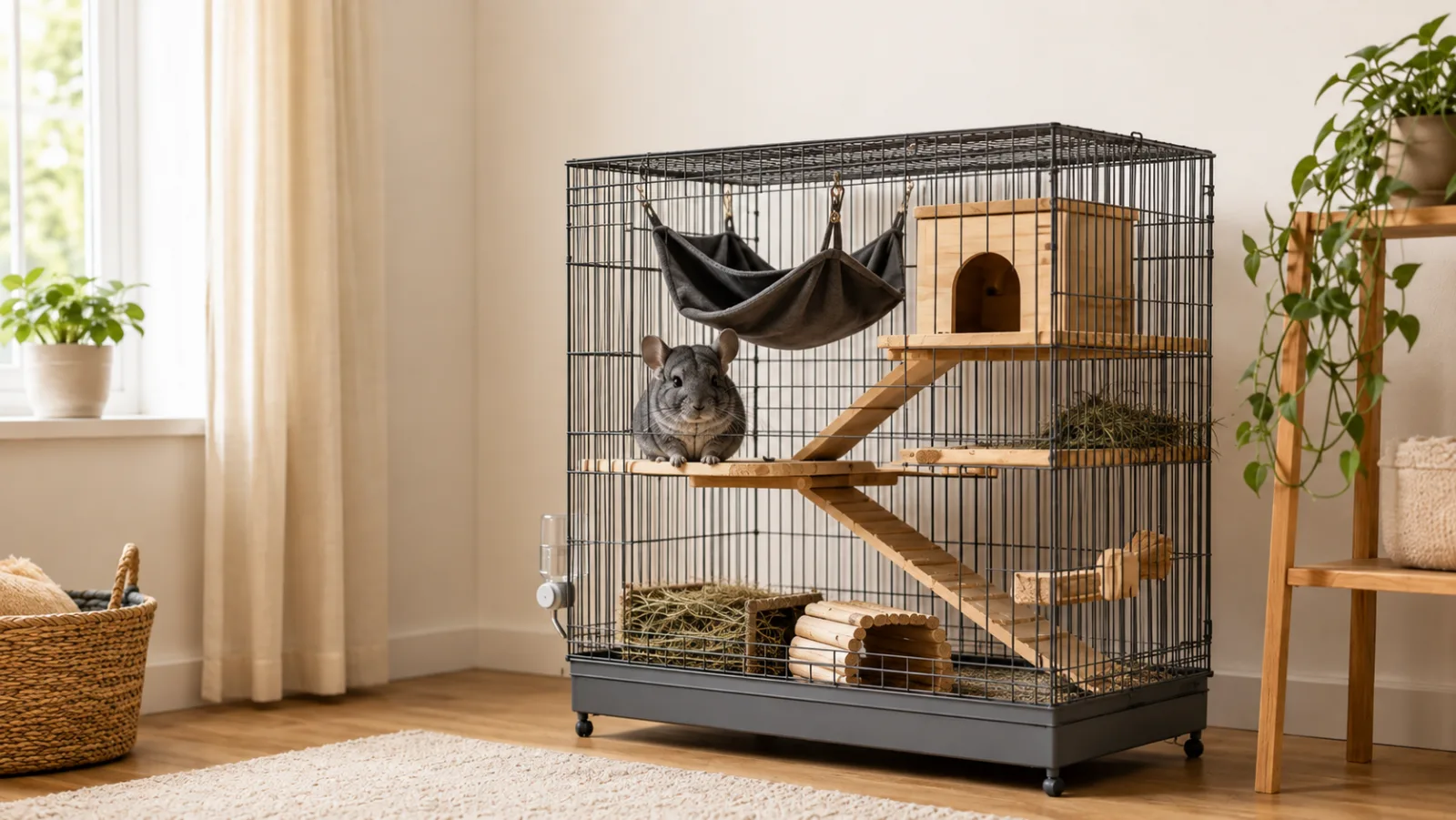
Evidence at a Glance
Critter Nation by MidWest Double Unit Small Animal Cage
The only cage here meeting VCA's published minimum enclosure for a pair of chinchillas, with the half-inch wire spacing AFRMA sets as the rat standard.
Sources: MidWest Homes for Pets product page and Model 162 assembly document, Amazon Creators API listing B001NJ0DAY
Verified Aug 16, 2026
Critter Nation by MidWest Single Unit Small Animal Cage
Clears VCA's single-chinchilla minimum of 3 by 2 by 3 feet on the same half-inch spacing and Happy Feet ramp covers, for $135 less than the Double.
Sources: MidWest Homes for Pets product page and Model 161 assembly document, Amazon Creators API listing B001NJ0DAE
Verified Aug 16, 2026
HABUTWAY 55" Large Metal Rolling Cage for Rats and Chinchillas
55 inches of height on a 25-by-18-inch footprint — the narrowest floor plan here, with half-inch spacing and a removable flannel ramp sleeve.
Sources: HABUTWAY manufacturer listing specifications, Amazon Creators API listing B0GHQ4N79Z
Verified Aug 16, 2026
VIWAT Metal 6-Tier Small Animal Cage
0.4-inch wire spacing — tighter than the half-inch rat standard — across six platforms and six lockable doors.
Sources: VIWAT manufacturer listing specifications, Amazon Creators API listing B0D2H6BM8P
Verified Aug 16, 2026
Our Picks
MidWest Homes for Pets
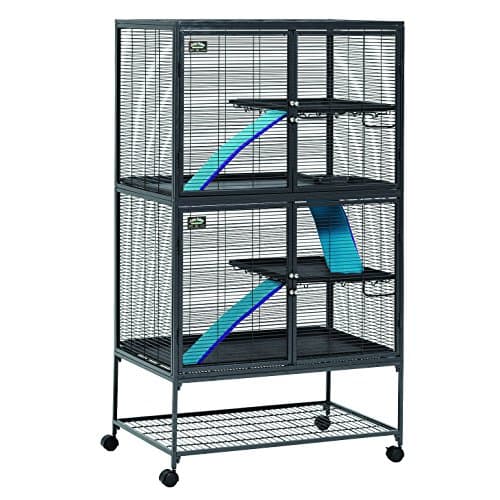
Critter Nation by MidWest Double Unit Small Animal Cage
9.4 / 10
- Listed at 36 x 24 x 63 inches with two full levels — meets VCA's stated minimum for a pair of chinchillas
- Half-inch horizontal wire spacing, the standard AFRMA sets for safely containing rats
- Two removable plastic base pans, three textured ramps with washable Happy Feet covers, two full-width resting shelves
- Swing-up locking ramp separates the top level from the bottom for introductions, quarantine or cleaning
$329.99
Current price · checked Sep 8, 2026
MidWest Homes for Pets
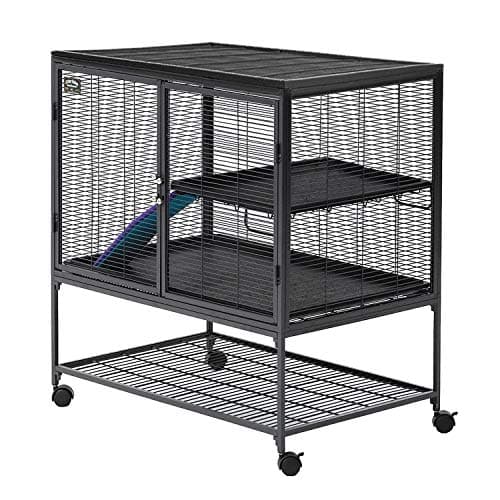
Critter Nation by MidWest Single Unit Small Animal Cage
9.0 / 10
- Listed at 36 x 25 x 38.5 inches — clears VCA's 3-by-2-by-3-foot minimum for a single chinchilla
- Same half-inch horizontal wire spacing as the Double
- One removable base pan, one full-width resting shelf, one textured ramp with a Happy Feet cover
- Compatible with MidWest's Add-On Unit, so the cage can grow into a Double later
$194.99
Current price · checked Sep 8, 2026
HABUTWAY
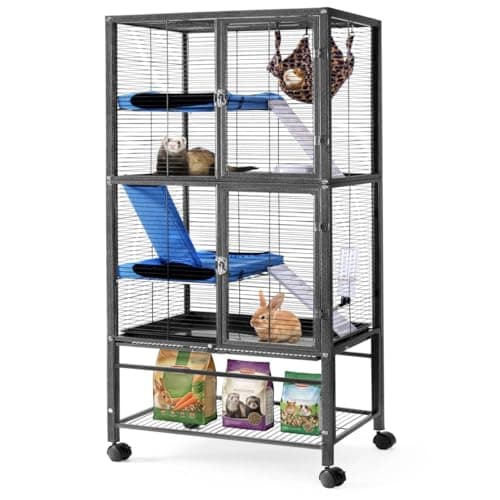
HABUTWAY 55" Large Metal Rolling Ferret Cage for Rats and Chinchillas
8.3 / 10
- Published overall dimensions of 25"L x 18"W x 55"H — the narrowest footprint in this guide
- 0.5-inch metal wire spacing, matching AFRMA's rat standard
- Removable flannel ramp sleeve, described by the maker as protecting feet from injury
- Pull-out bottom tray and four universal wheels; open metal storage shelf beneath
$189.99
Current price · checked Sep 8, 2026
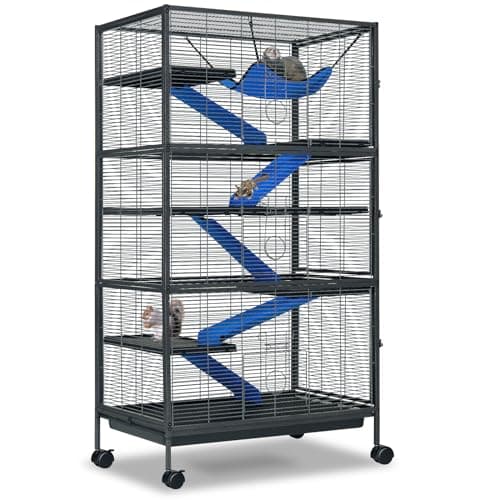
VIWAT
VIWAT Metal 6-Tier Small Animal Cage with Removable Tray
8.1 / 10
- 0.4-inch wire spacing — tighter than the half-inch rat standard
- Published dimensions of 32 x 21 x 59 inches across six climbing platforms
- Six lockable doors for access to multiple levels
- Squared-tube soldered metal frame with a full paint coat, rust and wear resistant
$169.99
Current price · checked Sep 8, 2026
The Short Answer
Buy the Critter Nation Double Unit at $329.99. At a listed 36 by 24 by 63 inches it is the only cage in this guide that meets VCA Animal Hospitals' published minimum enclosure for a pair of chinchillas — 3 feet by 2 feet by 5 feet — and its listed half-inch horizontal wire spacing is exactly the standard the American Fancy Rat and Mouse Association sets for rats. If you keep one chinchilla, or a pair of rats, the Critter Nation Single at $194.99 clears VCA's single-chinchilla minimum for $135 less. The finding that should decide your shortlist is this: the two cheaper cages here are taller than the Critter Nation Single but have footprints smaller than VCA's stated chinchilla minimum, so they are rat cages, not chinchilla cages, whatever the listing title says. Height is the specification this category advertises. Floor plan is the one that decides the purchase.
Every product on this list has been scored against the PetPal Gear Score, a weighted composite of expert consensus, observed effectiveness, animal safety, long-term durability, and value. Review method: Editorial synthesis measured against published veterinary and welfare minimums rather than brand reputation. Chinchilla enclosure dimensions, temperature and humidity limits are quoted from VCA Animal Hospitals; species housing, mesh limits, flooring and respiratory guidance from the Merck Veterinary Manual; rat bar-spacing and shelf-wire standards from the American Fancy Rat and Mouse Association; fall-height, rear-up headroom, solid-floor preference and social-housing guidance from the RSPCA and PDSA. Manufacturer feature and warranty detail is read from MidWest Homes for Pets' own product page and its published Model 161 and 162 assembly documents. Cage dimensions and bar-spacing figures are attributed to the live product listings that publish them, because MidWest does not publish either figure on its own site. Prices and availability were pulled per product through the Amazon Creators API on the date below.. Synthesized from 6+ expert sources.
Chinchillas and rats end up in the same guide for a reason that has nothing to do with them being similar animals. They are not. But they are the two species most often housed in the same product — the tall, powder-coated, multi-level wire cage — and they are the two the rest of the small-mammal shelf quietly skips. PetPalHQ has dedicated cage guides for ferrets, hamsters, guinea pigs and sugar gliders. This one closes the gap.
They also share the specification that decides the purchase, and it is not the one the listings advertise.
Floor plan, not height
Every cage in this category sells on height. Fifty-five inches. Fifty-nine inches. Six tiers. What the listings do not do is measure themselves against a published veterinary minimum, so here is that comparison, because it splits this shortlist in half.
VCA Animal Hospitals states the minimum enclosure for a chinchilla as 3 feet by 2 feet by 3 feet for a single animal, and 3 feet by 2 feet by 5 feet for a pair. That is a floor area of 36 by 24 inches, in both cases.
| Cage | Footprint | Meets the 36 x 24 in floor area? |
|---|---|---|
| Critter Nation Double | 36 x 24 in | Yes — and 63 in tall, clearing the 5-foot pair minimum |
| Critter Nation Single | 36 x 25 in | Yes — and 38.5 in tall, clearing the 3-foot single minimum |
| HABUTWAY 55" | 25 x 18 in | No — 30% shorter and 25% narrower than the minimum |
| VIWAT 6-Tier | 32 x 21 in | No — under on both axes |
Two of these cages name chinchillas in their listings and do not meet the published minimum floor area for one. They are not bad cages — they are rat cages, and for rats they are reasonable. But height does not substitute for floor plan, and no amount of vertical space makes an 18-inch-deep cage into a chinchilla enclosure.
Note also how VCA's pair minimum grows: from 3x2x3 to 3x2x5 feet. The footprint stays identical and the height increases by two feet. Adding a second chinchilla means adding vertical volume, which is precisely what the Critter Nation Double's 63 inches delivers and its 38.5-inch Single does not.
Bar spacing: the number that keeps a rat inside
For rats, the governing spec is different and it is unusually clear-cut. The American Fancy Rat and Mouse Association states that rats should be housed in cages with ½ inch spacing between the bars — and adds the warning that makes the figure load-bearing: "Even an adult rat can still get its head stuck in ¾ inch spacing, so they are really not safe."
Every pick in this guide publishes a spacing figure at or below that standard: half an inch on both Critter Nations and the HABUTWAY, 0.4 inches on the VIWAT. That was a requirement for inclusion here rather than a happy coincidence — a large multi-level cage that does not publish its bar spacing is not one we can recommend for a rat, because the single most important safety number is missing. At least one otherwise well-priced cage in this class is absent from this guide for exactly that reason.
For chinchillas the limits are looser and come from the Merck Veterinary Manual, which sets mesh openings at no wider than 1 by 2 inches on the sides of the cage and ½ by ½ inch on the bottom. All four cages here sit well inside the side limit.
One thing the tight-spacing marketing invites you to assume, which the authority does not support: narrower bars are not the answer for babies. AFRMA's guidance is that wire cages with levels should not be used for moms and young litters at all, because babies can be dragged up shelves, fall, or squeeze through. If you are breeding or fostering, the answer is a different cage type, not a smaller gap.
The floor and the ramps
This is where cheap cages in this category cut corners, and where the veterinary guidance is least ambiguous.
Merck on rats: "The cage floor should be solid; wire mesh or grid flooring can damage rats' feet and legs." Elsewhere it explains the mechanism — rats and mice can trap their feet, especially hindlimbs, in the openings, resulting in fractures and injuries. Merck and AFRMA independently give the same figure for any wire shelf or ramp the animal must walk on: openings no wider than ½ by ½ inch, because a rat's back foot can catch in 1-by-½-inch wire and break a leg.
The RSPCA quantifies how strongly rats feel about this, and the number is remarkable: rats will lift doors weighing up to 83% of their own body weight in order to leave a cage with a grid floor and enter one with a solid floor.
For chinchillas, VCA prescribes covering at least part of a wire cage floor with Plexiglass, non-treated wood or other easily-cleaned solid flooring, to prevent pododermatitis — sore hocks. Merck adds the sharper warning: tibial fractures commonly occur in young chinchillas that catch a hindleg in wide floor-mesh grating.
The practical consequence for shopping: check what solid surface ships in the box. The Critter Nation cages arrive with removable plastic pans, plastic-insert shelves, and reversible washable Happy Feet covers for their three wire ramps — the ramps themselves are bare wire, and the covers are what make them safe. The HABUTWAY ships a removable flannel ramp sleeve for the same purpose. Whatever you buy, the wire the animal stands on needs covering, and spare covers are a sensible first accessory purchase.
Height, falls, and rearing up
Two RSPCA figures turn "multi-level" from a marketing word into something you can actually check.
For chinchillas: "Make sure there are no uninterrupted heights greater than 60cm to stop them from hurting themselves." That is about 23.6 inches of maximum clear drop. A 63-inch cage complies only if you stagger the shelves so no open vertical run exceeds that — which is exactly what the Critter Nation's height-adjustable shelves are for. Buying tall and then leaving the middle empty is the failure mode.
For rats: "this will require an area with a height of around 18 cm for juveniles up to 150g, 22 cm for rats up to 450g and 30 cm for large, adult males" — the headroom needed to rear up on the hind legs, which rats do constantly when exploring. Thirty centimetres is about 11.8 inches.
Put those together and a six-tier cage stops looking like six times the value. Dividing a published 59-inch height across six platforms leaves roughly ten inches per level before platform thickness — under the rear-up figure for a large male. Fewer, taller levels beat more, shorter ones. If a cage arrives with more tiers than headroom, take some out.
Ventilation, and why it is a lifespan question for rats
Rats are prone to chronic respiratory infections, and the housing decision genuinely moves the outcome. Merck is explicit, and thinks the point important enough to repeat in its own Pearls and Pitfalls callout: "Aquariums are not suitable cages for rats and mice, because air circulation is inadequate and therefore ammonia builds up." VCA calls poor environmental ventilation a major cause of respiratory disease in pet rodents, allowing ammonia from the urine to build up and irritate the airways. And Merck states the stakes plainly: "Rats with chronic respiratory disease rarely live longer than 2 years" — against the 18-to-36-month average span Merck publishes for the species, which means a rat that develops it is unlikely to reach the upper half of its own range.
Two practical follow-ons. Bedding matters: Merck states that cedar, pine and other wood shavings contain oils that can irritate rats' sensitive respiratory tracts and are not recommended, and that recycled paper products marketed as bedding are safe and easy to clean. And cleaning frequency matters more than cleaning intensity — Merck's instruction is to avoid a buildup of ammonia by changing litter often enough. Note MidWest's own restriction here, which sits in slight tension with that: its assembly documents specify mild, non-abrasive cleaners and water only, to protect the finish and the pans. Clean often, gently.
The chinchilla constraint that outranks the cage
Before any of this matters, the room has to be cool enough. VCA states the optimal environmental temperature as 55 to 68°F (10 to 20°C), that it is essential to keep household temperatures below 80°F (27°C), and that humidity should stay below 40 to 50 percent — because chinchillas are very susceptible to heat stroke. Merck gives a slightly wider adapted range of 65 to 80°F, notes that higher temperatures combined with high humidity can cause heatstroke, and offers a rule worth memorising: add the unit values of the temperature (Fahrenheit) and humidity, and consider any value above 150 to be dangerous.
Merck also lists the daily requirement no cage includes: a dust bath, 2 to 4 inches deep, for about ten minutes every day. Make sure whatever cage you buy has a shelf that will hold that container.
Head-to-Head Comparison
| Cage | Dimensions (L x W x H) | Bar spacing | Meets VCA chinchilla minimum? | Solid flooring shipped |
|---|---|---|---|---|
| Critter Nation by MidWest Double Unit Small Animal Cage | 36 x 24 x 63 in | 1/2 in | Yes — pair minimum (3x2x5 ft) | 2 pans, 2 shelves, 3 ramp covers |
| Critter Nation by MidWest Single Unit Small Animal Cage | 36 x 25 x 38.5 in | 1/2 in | Yes — single minimum (3x2x3 ft) | 1 pan, 1 shelf, 1 ramp cover |
| HABUTWAY 55" Large Metal Rolling Ferret Cage for Rats and Chinchillas | 25 x 18 x 55 in | 0.5 in | No — footprint below 36 x 24 in | Tray plus flannel ramp sleeve |
| VIWAT Metal 6-Tier Small Animal Cage with Removable Tray | 32 x 21 x 59 in | 0.4 in | No — footprint below 36 x 24 in | Tray plus flanged ramps |
$329.99
Current price · checked Sep 8, 2026
- Listed at 36 x 24 x 63 inches with two full levels — meets VCA's stated minimum for a pair of chinchillas
- Half-inch horizontal wire spacing, the standard AFRMA sets for safely containing rats
- Two removable plastic base pans, three textured ramps with washable Happy Feet covers, two full-width resting shelves
- Swing-up locking ramp separates the top level from the bottom for introductions, quarantine or cleaning
- Full-width double doors, height-adjustable shelves, locking casters and a storage shelf beneath
This is the cage the veterinary literature effectively describes, and the only one here that satisfies the number that matters most. VCA Animal Hospitals puts the minimum enclosure for a pair of chinchillas at three feet by two feet by five feet. The Critter Nation Double is listed at 36 by 24 by 63 inches — the footprint exactly, and three inches of height beyond the requirement. Every other cage in this guide falls short of that footprint, and two of them fall short by a wide margin.
The species fit is not inferred, either. MidWest's own product page states that small animal clubs and individual owners around the world use Critter Nation habitats to house their pet rats, chinchillas, sugar gliders, hedgehogs and degus — rats and chinchillas named first and second. VCA goes further and names the parent design by name, noting that multilevel cages work well, like the Ferret Nation cages designed for ferrets, if there are no areas where a chinchilla can get its limbs or feet caught. The Critter Nation is MidWest's narrower-spaced version of exactly that design. And the Merck Veterinary Manual, describing what to house rats in, writes that the new powder-coated wire rat cages with solid metal shelves and plastic cat pan bottoms are the easiest to clean, and that rats seem to enjoy climbing on the various levels. That is a description of this product category written by a veterinary manual.
The details that matter for feet are handled properly, which is rarer in this category than it should be. Merck is unambiguous that a rat's cage floor should be solid, because wire mesh or grid flooring can damage rats' feet and legs, and it notes that tibial fractures commonly occur in young chinchillas that catch a hindleg in wide floor-mesh grating. This cage answers that with two removable plastic base pans rather than open wire, full-width plastic-insert shelves, and — the piece most buyers overlook — three reversible, washable Happy Feet ramp covers that slip over the wire ramps. The ramps themselves ship as bare wire; the covers are what make them safe to walk on, so use them and keep spares. The swing-up locking ramp is the other feature worth the money: MidWest's assembly document states it can be secured in the up position to separate pets or keep them out of the way during cleaning, which turns one Double into two independent single-level habitats for introductions or quarantine.
Three honest caveats. MidWest publishes neither dimensions nor a bar-spacing figure anywhere on its own website — both numbers above come from the retail listing, and we would rather tell you that than imply a manufacturer spec sheet exists. The warranty is one year and explicitly does not cover defects caused by any animal, so chew damage is on you. And assembly is a genuine job: MidWest's own document runs to 21 numbered steps and recommends two people and a rubber mallet. Availability was IN_STOCK_SCARCE at the time of our check rather than freely stocked.
What We Love
- The only cage here meeting VCA's published 3-by-2-by-5-foot minimum for a pair of chinchillas
- Half-inch listed wire spacing — exactly AFRMA's rat standard, where three-quarter-inch is explicitly unsafe
- Two removable plastic pans and plastic-insert shelves rather than open wire flooring
- Three washable Happy Feet ramp covers convert bare wire ramps into safe walking surfaces
- Swing-up locking ramp splits the cage into two independent habitats for introductions or quarantine
- Height-adjustable shelves let you stagger levels to control fall distance
What Could Be Better
- MidWest publishes neither dimensions nor bar spacing on its own site — both figures come from the retail listing
- One-year warranty that explicitly excludes any damage caused by an animal, chewing included
- 21-step assembly for which MidWest itself recommends two people and a rubber mallet
- Most expensive cage in this guide, and availability was IN_STOCK_SCARCE at time of check
- At 63 inches tall, shelves must be staggered deliberately to respect the RSPCA's 60cm maximum drop for chinchillas
The Verdict
Get the Critter Nation Double if you keep a pair of chinchillas or a colony of rats — it is the only cage here that meets the veterinary minimum for the former and the bar-spacing standard for the latter.
Sources
- VCA Animal Hospitals (Chinchillas: Housing): Minimum enclosure of "3' x 2' x 3'" for a single chinchilla and "3' x 2' x 5'" for a pair; "Multilevel cages work well, like the Ferret Nation® cages designed for ferrets, if there are no areas where a chinchilla can get its limbs or feet caught."
- American Fancy Rat and Mouse Association (Rat Cage Bar Spacing): "Rats should be housed in cages with ½ inch spacing between the bars, though a sturdy wire mesh is better than long bars." and "Even an adult rat can still get its head stuck in ¾ inch spacing, so they are really not safe."
- MidWest Homes for Pets (Critter Nation product page and Model 162 assembly document): "Small animal clubs and individual owners around the world use Critter Nation® habitats to house their pet rats, chinchillas, sugar gliders, hedgehogs, degus, and more." The Model 162 assembly document states: "Although the Critter Nation can be assembled by one person, due to size, you may find it easier assembled with two people. A rubber mallet is also recommended." Its warranty runs one year and "DOES NOT COVER defects in the furniture caused by any animal."
- Amazon Creators API (live listing): Listed at $329.99, availability IN_STOCK_SCARCE, condition New, Amazon.com buy box at time of check. Listing states: "Measures 36 x 24 x 63 inches with two full levels of living space. The 1/2\" horizontal wire spacing safely contains rats, chinchillas, ferrets, sugar gliders and degus"
$194.99
Current price · checked Sep 8, 2026
- Listed at 36 x 25 x 38.5 inches — clears VCA's 3-by-2-by-3-foot minimum for a single chinchilla
- Same half-inch horizontal wire spacing as the Double
- One removable base pan, one full-width resting shelf, one textured ramp with a Happy Feet cover
- Compatible with MidWest's Add-On Unit, so the cage can grow into a Double later
- $135 less than the Double, and sold by Amazon.com itself
Half the cage for a little under sixty percent of the price, and for a lot of households it is the correct half. VCA's minimum for a single chinchilla is three feet by two feet by three feet. This cage is listed at 36 by 25 by 38.5 inches, which clears that on all three axes with an inch of width and two and a half inches of height in hand. For a pair of rats it is comfortably large, and it carries the same listed half-inch horizontal wire spacing — the figure AFRMA sets as the rat standard, and the one that matters more than any other number on this page for a rat owner.
Its lower height is a genuine advantage rather than just a compromise, and this is the part most buyers miss. The RSPCA's chinchilla guidance says to make sure there are no uninterrupted heights greater than 60 centimetres — about 23.6 inches — to stop the animal hurting itself. At 38.5 inches total, a single mid-height shelf keeps every clear drop inside that limit almost automatically. The 63-inch Double and the 55-inch cages below can be made to comply, but only if you place shelves deliberately rather than leaving open vertical runs.
There is also an upgrade path, which is unusual in this category and worth planning around. The listing states the Single is compatible with MidWest's Add-On Unit, so a household that starts with one chinchilla or two rats can extend to the Double configuration later rather than replacing the cage. Given a chinchilla's 15-to-20-year lifespan, buying a cage you can grow is a more sensible way to spend $194.99 than buying one you will outgrow.
The trade-offs follow from the size. One pan, one shelf, one ramp and one cover, against two, two, three and three on the Double — and the swing-up locking ramp that separates levels is a Double feature, absent here, so this cage cannot be split into two habitats for an introduction or a quarantine. It does not meet VCA's pair minimum for chinchillas, so two chinchillas need the Double or the Add-On. And the same manufacturer caveats apply: the dimensions and spacing are listing figures rather than MidWest specifications, and the one-year warranty excludes animal damage.
What We Love
- Exceeds VCA's 3-by-2-by-3-foot single-chinchilla minimum on every axis
- Same half-inch listed wire spacing as the Double — AFRMA's rat standard
- At 38.5 inches, a single shelf keeps drops inside the RSPCA's 60cm limit without careful planning
- Extendable to the Double configuration later with MidWest's Add-On Unit
- $135 less than the Double, and sold by Amazon.com itself at time of check
What Could Be Better
- Does not meet VCA's 3-by-2-by-5-foot minimum for a pair of chinchillas
- No swing-up locking ramp, so the cage cannot be split into two habitats
- One pan, one shelf and one ramp cover against the Double's two, two and three
- Same publishing gap — dimensions and bar spacing come from the listing, not from MidWest
The Verdict
Get the Critter Nation Single if you keep one chinchilla or a pair of rats, and buy the Add-On Unit later rather than a second cage.
Sources
- VCA Animal Hospitals (Chinchillas: Housing): Minimum enclosure of "3' x 2' x 3'" for a single chinchilla; VCA also recommends "covering at least a part of a wire cage floor with Plexiglass, non-treated wood, or other easily-cleaned solid flooring" to prevent pododermatitis or "sore hocks".
- RSPCA (Chinchillas: Environment): "Make sure there are no uninterrupted heights greater than 60cm to stop them from hurting themselves." and "Chinchillas can damage their feet when spending long periods standing on wire mesh."
- Amazon Creators API (live listing): Listed at $194.99, availability IN_STOCK, condition New, Amazon.com buy box at time of check. Listing states: "Measures 36 x 25 x 38.5 in. with a main level and upper shelf" and "1/2\" horizontal wire spacing"; "Compatible with our Add-On Unit for additional room."
$189.99
Current price · checked Sep 8, 2026
- Published overall dimensions of 25"L x 18"W x 55"H — the narrowest footprint in this guide
- 0.5-inch metal wire spacing, matching AFRMA's rat standard
- Removable flannel ramp sleeve, described by the maker as protecting feet from injury
- Pull-out bottom tray and four universal wheels; open metal storage shelf beneath
- Hammock, water bottles and food bowls included; sold by the brand's own storefront
This is the cage for a rat household with more wall than floor. At 25 by 18 inches it has the smallest footprint here by a wide margin, and it puts its volume into 55 inches of height instead. For rats specifically that is a reasonable trade, because rats climb readily and the RSPCA's own guidance is simply to use the largest cage possible — and because HABUTWAY publishes a 0.5-inch wire spacing, which is exactly the figure AFRMA sets as the rat standard.
The accessories are more thoughtful than the price suggests, and two of them address real welfare points rather than padding a listing. The removable flannel ramp sleeve is the important one: HABUTWAY describes it as giving extra protection to a pet's feet to avoid injuries, which is the same problem MidWest's Happy Feet covers solve on the Critter Nation and which the two cheapest cages in most of this category ignore entirely. A hammock, water bottles and food bowls are included, so the cage arrives usable. The pull-out bottom tray and four wheels — including a locking pair — make a tall cage practical to clean and move.
Now the limit that decides where this cage belongs, and it is not a small one. The 25-by-18-inch footprint is smaller than VCA's stated minimum floor area for a chinchilla, which is three feet by two feet — 36 by 24 inches — even for a single animal. This cage is 30 percent shorter and 25 percent narrower than that. The listing names chinchillas; the published veterinary minimum does not agree. Treat this as a rat cage, and a good one, rather than a chinchilla cage. A second caution follows from the height: HABUTWAY does not publish how many levels the 55 inches is divided into or how far apart they sit, and the RSPCA gives about 11.8 inches as the rear-up headroom a large adult male rat needs. Check the level spacing on arrival, and be prepared to reposition platforms so no level is too shallow to stand up in and no clear drop is dangerous.
What We Love
- 0.5-inch published wire spacing — matches AFRMA's rat standard exactly
- Narrowest footprint here at 25 by 18 inches, for homes where floor space is the constraint
- Removable flannel ramp sleeve addresses foot injury rather than leaving bare wire
- Pull-out tray, four wheels including a locking pair, and a storage shelf beneath
- Hammock, bottles and bowls included; sold from the brand's own storefront
What Could Be Better
- Footprint is well below VCA's 36-by-24-inch minimum floor area for a chinchilla, despite the listing naming them
- Does not publish level count or spacing, so rear-up headroom cannot be checked before purchase
- No published warranty term
- Tall and narrow means fall distance needs managing with deliberate platform placement
The Verdict
Get the HABUTWAY for rats in a room where floor space is tight — but do not buy it for a chinchilla, because its footprint is smaller than the published veterinary minimum.
Sources
- HABUTWAY (manufacturer listing specifications): "Overall Dimensions: 25\"L x 18\"W x 55\"H"; "use a 0.5 INCH metal wire spacing, prevent your little animal from escaping accidentally"; "equipped with a removable flannel ramp sleeve, which is designed to give extra protection to your pet's feet to avoid injuries"; "A pull-out bottom tray makes cleaning simple and quick."
- RSPCA Research Animals Department (Rats: good practice for housing and care): "Rats rear on their hind legs when exploring and playing, so they should be able to rear up in at least part of the cage. As a guide, this will require an area with a height of around 18 cm for juveniles up to 150g, 22 cm for rats up to 450g and 30 cm for large, adult males." and "rats have been shown to prefer cages significantly larger than the 'standard' sizes, so it is important to use the largest cages possible"
- Amazon Creators API (live listing): Listed at $179.99, availability IN_STOCK, condition New, sold from the HABUTWAY brand storefront at time of check
$169.99
Current price · checked Sep 8, 2026
- 0.4-inch wire spacing — tighter than the half-inch rat standard
- Published dimensions of 32 x 21 x 59 inches across six climbing platforms
- Six lockable doors for access to multiple levels
- Squared-tube soldered metal frame with a full paint coat, rust and wear resistant
- Blue flanged ramps between levels, pull-out bottom tray, four swivel wheels with two brakes
The cheapest cage here has the tightest bar spacing, and for the right animal that combination is genuinely appealing. VIWAT publishes 0.4-inch wire spacing, which is narrower than the half-inch AFRMA gives as the rat standard — and AFRMA is emphatic that the next size up in the other direction, three-quarters of an inch, is unsafe even for adult rats. A tighter gap is a margin rather than a requirement, but margins are worth something when the failure mode is a rat getting its head stuck. The frame is squared tube, soldered and fully painted, with six lockable doors, a pull-out bottom tray and four swivel wheels with two brakes.
Six platforms across 59 inches is the headline feature and also the thing to check carefully, because it is the one place where this cage's numbers work against each other. VIWAT does not publish the spacing between levels. Dividing the published 59-inch height across six tiers leaves roughly ten inches per level before the platform thickness is subtracted — and the RSPCA gives around 30 centimetres, about 11.8 inches, as the height a large adult male rat needs to rear up on its hind legs. That is arithmetic on published figures rather than a manufacturer specification, so treat it as a question to answer on arrival rather than a verdict. But if you keep large males, plan on removing a platform or two to make the remaining levels tall enough to stand up in. Fewer, taller levels beat more, shorter ones.
Two further points on scope. The 32-by-21-inch footprint is below VCA's 36-by-24-inch minimum floor area for a chinchilla, so — like the HABUTWAY — this is a rat cage whatever the listing title says. And on the juvenile question the tight spacing invites: AFRMA's guidance is not that babies need narrower bars, it is that wire cages with levels should not be used for mothers and young litters at all. No bar spacing solves that. If you are breeding or fostering, this is the wrong housing category and the 0.4-inch figure should not persuade you otherwise.
What We Love
- 0.4-inch published wire spacing, tighter than AFRMA's half-inch rat standard
- Lowest price in this guide at $159.99, with six lockable doors for multi-level access
- Soldered square-tube frame with a full paint coat, stated rust and wear resistant
- Pull-out bottom tray and four swivel wheels with two brakes
- Widest footprint of the two budget cages here at 32 by 21 inches
What Could Be Better
- Footprint is below VCA's 36-by-24-inch minimum floor area for a chinchilla
- Six tiers across 59 published inches leaves roughly ten inches per level — under the RSPCA's ~11.8-inch rear-up figure for large adult male rats
- Level spacing is not published, so headroom cannot be confirmed before purchase
- Tight bar spacing does not make a multi-level wire cage suitable for mothers and litters, which AFRMA rules out entirely
- No published warranty term
The Verdict
Get the VIWAT if you want the tightest bar spacing at the lowest price for rats — and plan on removing a platform or two so the remaining levels are tall enough to rear up in.
Sources
- VIWAT (manufacturer listing specifications): "With dimensions 32 \"x21\" x59 \""; "It use a 0.4inch metal wire spacing, prevent your baby animal from escaping accidentally while a well-ventilated."; "includes 6 different height platforms to climb for fun and exercise. Which are connected by blue flange ramps to play up and down safely to avoid injury"; "each door is equipped with a lock"
- American Fancy Rat and Mouse Association (Housing For Rats): "If wire shelves/ramps are used in the cage, they should be made of ½ x ½ inch wire as a rat's back foot can get caught in 1 x ½ inch wire and they could break a leg." and "Wire cages with levels should not be used for moms and young litters."
- Merck Veterinary Manual (Providing a Home for a Rat): "The cage floor should be solid; wire mesh or grid flooring can damage rats' feet and legs." and "If wire shelves are used in the cage for the animals to climb on, they should be made of wire with openings no wider than ½ by ½ inch."
- Merck Veterinary Manual (Mice and Rats as Pets, Husbandry of Mice and Rats): "Aquariums are not suitable cages for rats and mice, because air circulation is inadequate and therefore ammonia builds up." — stated in the Husbandry section and repeated verbatim in the article's Pearls & Pitfalls callout. Same article: "The average lifespan of mice is 18–24 months; of rats, 18–36 months."
How We Score
Formula
Species-Fit Score = (Published Floor Plan vs Veterinary Minimums × 0.35) + (Bar Spacing & Escape Safety × 0.25) + (Flooring & Foot Health × 0.20) + (Ventilation & Cleaning × 0.10) + (Value & Longevity × 0.10)
Score Factors
- Published Floor Plan vs Veterinary Minimums · 35%
- Bar Spacing & Escape Safety · 25%
- Flooring & Foot Health · 20%
- Ventilation & Cleaning · 10%
- Value & Longevity · 10%
| Rank | Product | Score |
|---|---|---|
| #1 | MidWest Homes for Pets Critter Nation by MidWest Double Unit Small Animal Cage | 9.4 |
| #2 | MidWest Homes for Pets Critter Nation by MidWest Single Unit Small Animal Cage | 9.0 |
| #3 | HABUTWAY HABUTWAY 55" Large Metal Rolling Ferret Cage for Rats and Chinchillas | 8.3 |
| #4 | VIWAT VIWAT Metal 6-Tier Small Animal Cage with Removable Tray | 8.1 |
When NOT to Buy
Do not buy any of these for a mother rat and a litter. This is the clearest exclusion in the guide and no amount of bar spacing changes it. AFRMA states that wire cages with levels should not be used for moms and young litters, and recommends a 10-to-20-gallon tank instead to keep babies safe, because in a wire cage they can be dragged up shelves, fall off, or squeeze through the bars. If you are breeding or fostering, this whole category is the wrong housing.
Do not buy the two narrow cages for a chinchilla. VCA Animal Hospitals puts the minimum enclosure for a single chinchilla at three feet by two feet by three feet. The HABUTWAY's footprint is 25 by 18 inches and the VIWAT's is 32 by 21 — both below the 36-by-24-inch floor area that minimum requires, regardless of how tall they are. Both listings mention chinchillas. The published veterinary minimum disagrees, and we would rather say so than sell the cheaper cage.
Do not buy a glass tank instead, however tempting the price. Merck is direct, in the words of its own key-takeaway callout: "Aquariums are not suitable cages for rats and mice, because air circulation is inadequate and therefore ammonia builds up." VCA calls poor environmental ventilation a major cause of respiratory disease in pet rodents, allowing ammonia from the urine to build up and irritate the airways. Merck adds the consequence — rats with chronic respiratory disease rarely live longer than two years, against an 18-to-36-month average span, so the disease costs a rat the top of its range. Ventilation is a lifespan variable in rats, not a comfort feature.
Do not buy a chinchilla cage before you have solved the room temperature. This is the one thing that outranks the cage entirely. VCA states the optimal environmental temperature for a chinchilla is 55 to 68°F (10 to 20°C) and that it is essential to keep household temperatures below 80°F (27°C), with humidity below 40 to 50 percent, because chinchillas are very susceptible to heat stroke. Merck gives a slightly wider adapted range of 65 to 80°F and a memorable field rule: add the Fahrenheit temperature to the humidity percentage and treat any value above 150 as dangerous. If your room cannot hold that in August, buy the air conditioning before the cage.
Do not buy a single chinchilla or a single rat, whatever cage you choose. The RSPCA states that rats are highly social and should never be housed singly without veterinary, welfare or compelling scientific justification, and that groups of up to five of the same sex usually work well. PDSA is blunter — rats cannot live alone. For chinchillas the RSPCA says to keep your pet with at least one other friendly chinchilla unless a vet or behaviourist advises otherwise. That changes the cage you need: VCA's pair minimum for chinchillas is 67 percent more volume than its single minimum, and it gets there entirely by adding height.
Frequently Asked Questions
- What size cage does a chinchilla actually need?
- VCA Animal Hospitals gives a minimum of 3 feet by 2 feet by 3 feet for a single chinchilla and 3 feet by 2 feet by 5 feet for a pair. Note that the footprint is the same in both cases — 36 by 24 inches — and the pair requirement is met by adding height, not floor area. That is why the Critter Nation Double at a listed 36 by 24 by 63 inches is the pair-appropriate cage in this guide and its 38.5-inch Single is not. Also worth knowing: the RSPCA says chinchillas should be kept with at least one companion unless a vet advises otherwise, so the pair figure is the realistic target for most households.
- What bar spacing is safe for pet rats?
- Half an inch. AFRMA states that rats should be housed in cages with ½ inch spacing between the bars, and warns that even an adult rat can get its head stuck in ¾ inch spacing, so those cages are really not safe. Both Critter Nation cages and the HABUTWAY publish half an inch; the VIWAT publishes 0.4 inches, which is tighter still. Any wire shelf or ramp the rat walks on should be ½ by ½ inch, per both AFRMA and Merck, because a back foot caught in 1-by-½-inch wire can break a leg.
- Is the Critter Nation really worth double the price of a budget cage?
- For chinchillas, the answer is structural rather than a matter of quality: the budget cages here do not meet the published minimum floor area, so they are not the same purchase. For rats, the case is narrower and more honest — the budget cages have adequate bar spacing and cost less. What the Critter Nation adds is the footprint, the swing-up ramp that splits the cage in two for introductions and quarantine, the plastic pans and shelf inserts, and an upgrade path via the Add-On Unit. It is worth noting that not every authority crowns it: Forever Feisty Chinchilla Rescue recommends Martin's Cages first and describes the Critter Nation as "very popular" rather than as its top pick.
- Can I house a chinchilla and a rat together?
- No. They are different species with different temperature requirements, different diets, different lifespans and no reason to be introduced. Keep chinchillas with chinchillas and rats with rats — both species need same-species company, and both need it in same-sex groups unless neutered. The RSPCA states rats should never be housed singly and that groups of up to five of the same sex usually work well.
- Do these cages need solid floors, or are wire floors fine?
- Rats need solid. Merck is unambiguous that the cage floor should be solid because wire mesh or grid flooring can damage rats' feet and legs, and the RSPCA found rats will lift doors weighing up to 83% of their body weight to get off a grid floor. Chinchillas are the more permissive case — Merck says they are easily housed on either wire-mesh or solid-bottom cages, but adds they need a solid area to rest on so the bottoms of their feet do not get sores, and VCA prescribes covering at least part of a wire floor to prevent pododermatitis. In practice, cover the wire for both.
- How hard is the Critter Nation to put together?
- Harder than a flat-pack shelf, and MidWest says so itself rather than leaving it to reviews. Its Model 162 assembly document runs to 21 numbered steps and states that although the cage can be assembled by one person, due to size you may find it easier assembled with two people, and that a rubber mallet is also recommended. MidWest publishes no assembly-time estimate, so any figure you see quoted is a customer's, not the manufacturer's.
- Does the Critter Nation warranty cover chewing damage?
- No. The warranty runs one year from original purchase for defects in workmanship or material, and MidWest's own document states it does not cover defects caused by any animal, or physical abuse to or misuse of the cage. For an animal that chews plastic shelf inserts, that exclusion is the relevant one — budget for replacement pans and covers as consumables rather than warranty claims.
- How long will I have this cage?
- Longer than you might think, which is the real argument for buying above the minimum. VCA puts chinchilla life expectancy at 15 to 20 years and Merck says up to 20. Rats are the opposite case at 2 to 3 years per VCA, or 18 to 36 months per Merck. So one good cage covers a single chinchilla's entire life, or roughly six to eight consecutive generations of rats. Amortised either way, the gap between the cheapest and the most expensive cage here is small.
Bottom Line
Buy the Critter Nation Double at $329.99 if you keep a pair of chinchillas or a group of rats — at a listed 36 by 24 by 63 inches it is the only cage here meeting VCA's pair minimum, on the half-inch spacing AFRMA sets as the rat standard.
Buy the Critter Nation Single at $194.99 for one chinchilla or a pair of rats — it clears VCA's single minimum, its 38.5-inch height keeps drops inside the RSPCA's 60cm limit easily, and it extends to the Double later with the Add-On Unit.
Buy the HABUTWAY at $179.99 for rats in a room where floor space is the binding constraint — 0.5-inch spacing and a flannel ramp sleeve, on the narrowest footprint here. Not for chinchillas.
Buy the VIWAT at $159.99 for the tightest bar spacing at the lowest price — then remove a platform or two so the remaining levels clear the RSPCA's rear-up height. Not for chinchillas.
Whichever you buy, cover the wire the animal stands on. Merck requires a solid floor for rats; VCA prescribes covering part of a wire chinchilla floor to prevent sore hocks. The ramps on these cages ship as wire, and the covers are what make them safe.
And budget past the cage: a chinchilla needs a dust bath 2 to 4 inches deep for about ten minutes every day, a room held below 80°F, and a companion. The cage is the cheapest part of a 15-to-20-year commitment.
Sources & Methodology
Methodology
Species-Fit Score = (Published Floor Plan vs Veterinary Minimums × 0.35) + (Bar Spacing & Escape Safety × 0.25) + (Flooring & Foot Health × 0.20) + (Ventilation & Cleaning × 0.10) + (Value & Longevity × 0.10)
Expert review sources
- VCA Animal Hospitals — Chinchillas: Housing; Chinchillas: Owning; Housing Rodents; Owning a Pet Rat
- Merck Veterinary Manual — Providing a Home for a Chinchilla; Chinchillas; Providing a Home for a Rat; Mice and Rats as Pets; Disorders and Diseases of Rats
- American Fancy Rat and Mouse Association — Rat Cage Bar Spacing; Housing For Rats
- RSPCA — Chinchillas: Environment; Keeping Chinchillas Together; Rats: Environment; and the RSPCA Research Animals Department's Rats: good practice for housing and care
- PDSA — The ideal home for your rat
- MidWest Homes for Pets — Critter Nation product documentation and the published Model 161 and Model 162 assembly documents
Community sources
- Forever Feisty Chinchilla Rescue — published cage guidance
- r/RATS and r/chinchilla — multi-level cage setup and ramp-covering threads
Prices and specs verified August 16, 2026.
About the author
Nick Miles is the chief editor of PetPalHQ. This guide ranks on published veterinary and welfare minimums rather than brand reputation, because those minimums exist and are specific where brand reputation in this category is not. One thing worth stating plainly: MidWest Homes for Pets publishes neither cage dimensions nor a bar-spacing figure anywhere on its own website, so both figures for the Critter Nation cages come from the live retail listing and are attributed as such throughout. Manufacturer feature, assembly and warranty detail is read from MidWest's own product page and assembly documents. Prices and availability come from the Amazon Creators API. PetPalHQ does not run a small-animal husbandry lab, and the Species-Fit Score is a weighting of published figures against published minimums, not a measurement.
PetPalHQ is a participant in the Amazon Services LLC Associates Program. We may earn commissions from qualifying purchases — at no extra cost to you.