Birds
Best Birding Binoculars for Backyard Birdwatching 2026
Four 8x42 binoculars the ornithology and optics press actually agree on — from the cheapest ED-glass entry at $199.99 to Cornell Lab's overall top pick — with measured close-focus and brightness data instead of marketing claims.
By Nick Miles · Updated June 10, 2026 · 10 min
PetPalHQ is reader-supported. We may earn a commission from qualifying Amazon purchases at no extra cost to you.
Evidence at a Glance
Vortex Diamondback HD 8x42
HD optical system that outperformed the comparable Nikon Monarch M5 across every OutdoorGearLab test metric, with a measured 5.5-foot close focus and 1,163 lux of brightness. Waterproof, fogproof, shockproof body with an included GlassPak chest harness, covered by Vortex's unlimited, unconditional VIP lifetime warranty.
Sources: OutdoorGearLab lab-tested binocular review, Audubon Guide to Binoculars, Vortex manufacturer documentation
Verified Jun 10, 2026
Celestron Nature DX ED 8x42
Extra-low dispersion objective lenses at $199.99 — the cheapest ED-glass pick in this lineup. OutdoorGearLab says it punches far above its weight class on color fidelity and sharpness, with BaK-4 prisms, fully multi-coated optics, and a waterproof, fogproof, rubber-armored housing.
Sources: OutdoorGearLab Nature DX line review, Cornell Lab All About Birds 8x42 review, Celestron manufacturer documentation
Verified Jun 10, 2026
Nikon Monarch M5 8x42
ED glass plus long eye relief that keeps the full image usable with eyeglasses on. Audubon's testers gave the Monarch line the highest clarity score among contenders, and Birding Frontiers found it excels in all light conditions while requiring very little adjusting.
Sources: Audubon Guide to Binoculars — Good Value category, Birding Frontiers 2026 roundup, OutdoorGearLab individual model review
Verified Jun 10, 2026
Our Picks
Vortex
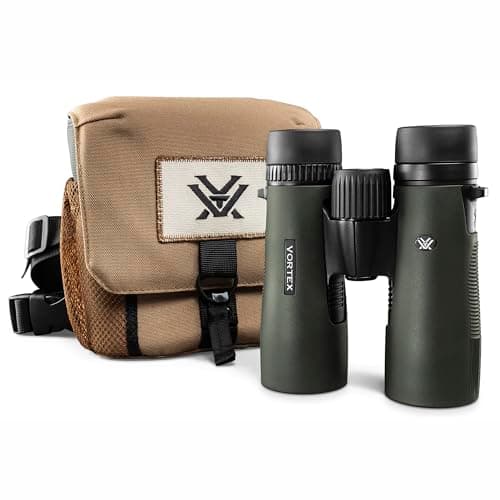
Vortex Optics Diamondback HD 8x42 Binoculars with GlassPak Harness
8.7 / 10
- 8x magnification with 42mm objective lenses — the backyard-standard format
- HD optical system with crystal-clear HD glass
- 5.5-foot close-focus distance, measured by OutdoorGearLab
- Waterproof, fogproof, shockproof body with included GlassPak chest harness
$239.00
Last Amazon read 2026-09-08
Celestron
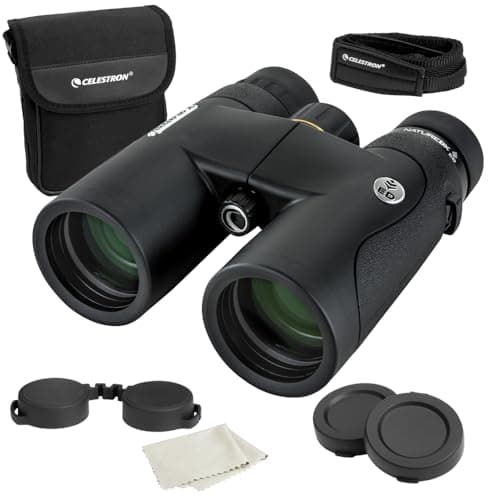
Celestron Nature DX ED 8x42 Premium Binoculars
8.1 / 10
- Extra-low dispersion (ED) objective lenses for color-fringing control
- Cheapest ED-glass pick in this lineup at $199.99
- BaK-4 prisms with fully multi-coated optics
- Waterproof and fogproof housing
$185.99
Nikon
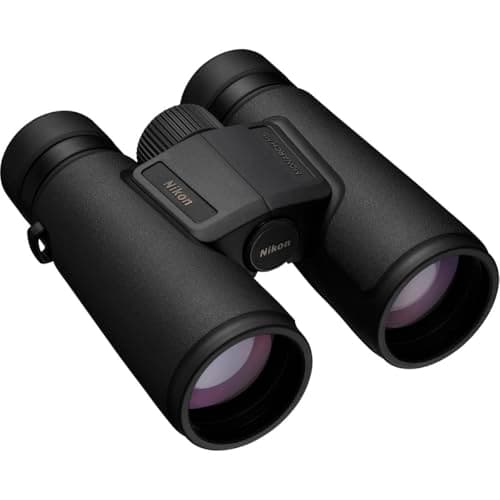
Nikon Monarch M5 8x42 Binocular with ED Glass and Long Eye Relief
8.3 / 10
- Long eye relief keeps the full image usable with eyeglasses on
- ED (extra-low dispersion) glass for color accuracy
- 6.2-foot close-focus distance, measured by OutdoorGearLab
- Waterproof, fogproof, rubber-armored body — official Nikon USA model
$296.95
Celestron
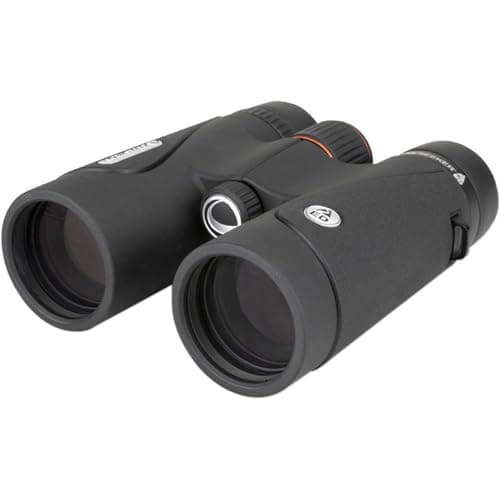
Celestron TrailSeeker ED 8x42 Binoculars
8.6 / 10
- Cornell Lab's overall top pick among 24+ affordable full-size 8x42 binoculars
- ED objective lenses with fully broadband multi-coated optics
- BaK-4 roof prisms
- Highest Audubon score in this lineup at 7.66
$339.99
The Short Answer
The Vortex Diamondback HD 8x42 at $239.00 is the pick for most backyard birders — OutdoorGearLab measured 1,163 lux of brightness and a 5.5-foot close focus, and Vortex backs it with an unlimited, unconditional lifetime warranty. The Celestron Nature DX ED at $199.99 is the cheapest route into extra-low dispersion glass for fringe-free color. Full-time eyeglass wearers should pay up for the Nikon Monarch M5 and its long eye relief. The Celestron TrailSeeker ED at $359.99 is Cornell Lab's overall top pick among affordable 8x42 models, for buyers willing to step above the $150-300 sweet spot for the strongest optics in this group.
Every product on this list has been scored against the PetPal Gear Score, a weighted composite of expert consensus, observed effectiveness, animal safety, long-term durability, and value. Review method: Editorial synthesis of the Cornell Lab of Ornithology review of more than two dozen affordable full-size 8x42 binoculars, the National Audubon Society binocular guide and its numeric scoring, OutdoorGearLab lab-tested rankings, the Birding Frontiers 2026 binocular roundup, the Backcountry Chronicles Vortex Diamondback owner review, and BirdForum owner threads on chromatic aberration. Manufacturer documentation from Vortex, Celestron, and Nikon was reviewed for warranty terms and optical specifications. Community sentiment from r/birding and r/birdwatching informed pick selection. PetPalHQ does not run an optics testing lab.. Synthesized from 7+ expert sources.
Binoculars are the highest-impact upgrade in backyard birdwatching, and the 8x42 format is where nearly all of the expert consensus lives. We read 7 expert sources for this guide — including the Cornell Lab of Ornithology's review of more than two dozen affordable full-size 8x42 models, the Audubon binocular guide, and OutdoorGearLab's measured lab testing — and synthesized them into four picks across the $199.99 to $359.99 band. PetPalHQ earns affiliate commissions from qualifying purchases; commission rates never influence which products we recommend. This is wild-bird, backyard-birdwatching gear — pet-bird and aviary equipment is a separate vertical.
The category splits into three tiers on the evidence. The budget tier tops out with the Celestron Nature DX ED, the cheapest pick here that still carries extra-low dispersion glass. The mid-range sweet spot is where the Vortex Diamondback and Nikon Monarch M5 fight it out — and the lab data says that fight is not close, with the Diamondback HD winning every OutdoorGearLab test metric at a lower price. The premium step is the Celestron TrailSeeker, Cornell Lab's overall top affordable pick, for buyers chasing the last increment of brightness and edge sharpness. A note on ordering: we rank by buyer fit — who each pick serves best — not by raw PetPal Gear Score, so a specialist pick can outscore the picks above it.
Why 8x42 Is the Backyard Standard
Every pick in this guide is an 8x42, and that is not an accident of availability — it is the format the birding establishment has converged on for good optical reasons.
The first number is magnification and the second is the objective lens diameter in millimeters. Eight-power magnification holds steady in unbraced hands, keeps a wide enough view to find a bird before it moves, and pairs with 42mm objectives to gather enough light for dawn and dusk sessions when feeders are busiest. Cornell Lab built its affordable-binocular review entirely around the full-size 8x42 format, and the spread of picks here — from the Nature DX ED to the TrailSeeker ED — shows how much optical range fits inside one set of numbers. Close focus is the spec backyard buyers should weight most heavily and trail buyers ignore: OutdoorGearLab measured the Diamondback HD at 5.5 feet and the Monarch M5 at 6.2 feet, and at feeder distances that difference is visible every single session.
What We Passed On
Two models came close to the lineup and lost on specifics, not on quality.
The Nikon Prostaff P7 8x42 scored 7.55 in Audubon's guide — exactly tied with the Vortex Diamondback HD. But the only listing that resolved live on Amazon is a third-party bundle with a lens pen and cleaning cloth rather than the bare Nikon binocular on its own, and Audubon's testers found the Vortex produced truer colors and focused better up close at a similar street price. A tied score with worse close-up behavior and a murkier listing made the Prostaff redundant here.
The Celestron Nature DX 8x42 — the non-ED version — resolved live at $159.99. That is only $40 below the Nature DX ED, which adds extra-low dispersion glass for color-fringing control. OutdoorGearLab frames the non-ED version as the entry "dip your toe" option, and at current pricing the ED version makes it very hard to justify saving the $40.
$239.00
Last Amazon read 2026-09-08
- 8x magnification with 42mm objective lenses — the backyard-standard format
- HD optical system with crystal-clear HD glass
- 5.5-foot close-focus distance, measured by OutdoorGearLab
- Waterproof, fogproof, shockproof body with included GlassPak chest harness
- Unlimited, unconditional Vortex VIP lifetime warranty
The Vortex Diamondback HD is the editorial pick for most backyard birders because the head-to-head evidence is unusually clean. OutdoorGearLab ran it directly against the very comparable Nikon Monarch M5 8x42, and the Vortex outperformed it across every test metric — the testers said it "knocked it out of the park" with relatively low-cost yet crystal-clear HD glass. In the same lab's brightness testing, the Diamondback HD recorded 1,163 lux, among the most impressive results in its price range, and it focused down to 5.5 feet. That close-focus number matters more in a backyard than on a trail: a chickadee ten feet from your window is a close-focus problem, not a magnification problem, and the Diamondback HD handles it better than anything else here.
Audubon's binocular guide scored it 7.55, neck-and-neck with the Nikon Prostaff P7 for clarity and brightness, but Audubon's testers found the Vortex produced truer colors and focused better on very close objects. OutdoorGearLab called it a fantastic choice for both experienced bird watchers and first-pair buyers — the rare both-ends endorsement in this category.
The warranty seals the value case. Vortex covers the Diamondback HD 8x42 with an unlimited, unconditional VIP lifetime warranty — no receipt required, no fault questions asked — where Celestron attaches conditions to its coverage. The included GlassPak chest harness also heads off the neck-strap fatigue most buyers discover after long sessions.
Here's the honest trade-off: the focus wheel is stiff and slow-turning, and Backcountry Chronicles' owner-perspective review reports missing birds while pulling focus. The depth of focus is shallow too, so a bird that shifts even a few inches needs a re-tweak. BirdForum owners report visible purple fringing on high-contrast edges, and Vortex acknowledges some fringing is normal for this model. Eyeglass wearers also report slight darkening at the rim of the view from marginal eye relief at the eyecup stops.
What We Love
- Outperformed the comparable Nikon Monarch M5 across every OutdoorGearLab test metric
- Measured 1,163 lux brightness — among the best in its price range
- Best close focus in this lineup at 5.5 feet for feeder-distance viewing
- Unlimited, unconditional VIP lifetime warranty with no receipt required
- GlassPak chest harness included in the box
What Could Be Better
- Stiff, slow-turning focus wheel — owners report missing birds while pulling focus
- Shallow depth of focus needs constant re-tweaking as birds shift position
- Visible purple fringing on high-contrast edges, acknowledged by Vortex as normal
- Marginal eye relief darkens the view rim for eyeglass wearers
The Verdict
The Diamondback HD won its head-to-head lab comparison outright and carries the best warranty in the category, all at $239.00. Eyeglass wearers and fast-focus birders should weigh the Monarch M5 instead.
Sources
- OutdoorGearLab: outperformed the very comparable Nikon Monarch M5 8x42 across every test metric; testers said Vortex 'knocked it out of the park' with relatively low-cost yet crystal-clear HD glass
- OutdoorGearLab: recorded 1,163 lux in brightness testing — among the most impressive in its price range — and focused down to 5.5 feet
- Audubon binocular guide: scored 7.55, neck-and-neck with the Nikon Prostaff 7S for clarity and brightness, but testers found it produced truer colors and focused better on very close objects
- OutdoorGearLab: called it a fantastic choice for both experienced bird watchers and first-pair buyers
- Amazon listing (verified live 2026-06-10): $239.00 with unlimited, unconditional warranty stated on the listing
$185.99
- Extra-low dispersion (ED) objective lenses for color-fringing control
- Cheapest ED-glass pick in this lineup at $199.99
- BaK-4 prisms with fully multi-coated optics
- Waterproof and fogproof housing
- Rubber-armored body for backyard knocks and drops
The Celestron Nature DX ED is the cheapest way into extra-low dispersion glass in this lineup at $199.99, and that one spec is why it earns the value slot. ED glass controls the color fringing that standard objectives smear across high-contrast edges — exactly the backlit-bird-against-bright-sky situation backyard birding produces all day. OutdoorGearLab says the Nature DX ED "punches far above its weight class" because it incorporates ED glass, delivering color fidelity and sharpness at an accessible price point. The same outlet recommends the Nature DX line as "the perfect way to dip your toe in the game without a huge price commitment" — precisely the first-pair buyer this pick serves.
The supporting hardware is competent for the tier: BaK-4 prisms, fully multi-coated optics, a rubber-armored body, and waterproof, fogproof housing. The Cornell Lab's review of affordable full-size 8x42 models frames this tier honestly — even fairly low price points can deliver bright, crisp images, a comfortable feel, and a generous field of view. The Nature DX ED is for buyers who want a genuine birding instrument under $200, not a department-store toy.
Here's the honest trade-off: budget-tier optics give up real things, and Cornell's tier framework names them. Mid-range models add edge-to-edge sharpness and better handling of challenging light — dawn and dusk, the exact hours backyard birds are most active — that the budget tier lacks. Expert rankings also describe the entry-level focus mechanism and ergonomics as less refined than mid-range rivals. Celestron's limited lifetime warranty is narrower than Vortex's no-fault, unconditional VIP coverage. And the price math has shifted: street price has crept to within $40 of the Vortex Diamondback HD, weakening its historical advantage. If $40 is not a deal-breaker, the Diamondback HD is the stronger buy; if $200 is the hard ceiling, the Nature DX ED is the best instrument under it.
What We Love
- Cheapest ED-glass binocular in this lineup at $199.99
- OutdoorGearLab says it punches far above its weight class on color and sharpness
- BaK-4 prisms and fully multi-coated optics at a budget price
- Waterproof, fogproof, rubber-armored housing
What Could Be Better
- Budget tier gives up edge-to-edge sharpness and low-light handling per Cornell's tier framework
- Limited lifetime warranty is narrower than Vortex's unconditional coverage
- Street price has crept to within $40 of the Diamondback HD
- Entry-level focus and ergonomics trail mid-range rivals in expert rankings
The Verdict
If $200 is the hard ceiling, the Nature DX ED buys you real ED glass and weatherproofing with no serious rival. Stretch the extra $40 to the Diamondback HD if you can.
Sources
- OutdoorGearLab: the Nature DX ED 'punches far above its weight class' because it incorporates ED glass, offering color fidelity and sharpness at an accessible price point
- OutdoorGearLab: recommends the Nature DX line as 'the perfect way to dip your toe in the game without a huge price commitment' for newcomers to binoculars
- Cornell Lab (All About Birds 8x42 review): even fairly low price points can deliver bright, crisp images, a comfortable feel, and generous field of view — the tier where the Nature DX ED competes
- Amazon listing (verified live 2026-06-10): $199.99 — the cheapest ED-glass pick in this lineup
$296.95
- Long eye relief keeps the full image usable with eyeglasses on
- ED (extra-low dispersion) glass for color accuracy
- 6.2-foot close-focus distance, measured by OutdoorGearLab
- Waterproof, fogproof, rubber-armored body — official Nikon USA model
- Highest clarity score among Audubon's Good Value contenders
The Nikon Monarch M5 is the pick for anyone who watches birds with glasses on, because eye relief is the spec the other picks compromise. Long eye relief lets the eye sit farther from the eyepiece while still seeing the full image circle — the difference between a usable view through eyeglasses and a dark, vignetted tunnel. Diamondback HD owners who wear glasses report slight darkening at the rim of the view; the Monarch M5 is built to avoid exactly that complaint.
The optics justify the price on their own terms. Audubon placed the Monarch line in its Good Value category, noting an all-around comfortable feel and a notably sharp image that earned the highest clarity score among contenders. OutdoorGearLab found it performs admirably for its price range, providing high-end optical quality and impressive brightness while avoiding astronomical prices. Birding Frontiers' 2026 roundup adds the field perspective: the Monarch M5 8x42 excels in all light conditions and requires very little adjusting, which makes it ideal when you need to be fast on your feet — a warbler that gives you four seconds does not wait for fiddling.
Here's the honest trade-off: the field of view is noticeably narrow. Reviewers describe the view as fairly constricted — a real handicap tracking birds through cluttered branches, which is most of what a mature backyard serves up. OutdoorGearLab also noted slight chromatic aberration, with magenta and cyan hues toward the extreme edges of the lens. The 6.2-foot close focus trails the Diamondback HD's 5.5 feet for feeder-distance viewing. And at $296.95 it sits at the very top of this guide's price band while losing head-to-head test metrics to a rival that costs about $58 less. Buy the Monarch M5 for the eye relief, the clarity, and the fast handling — not because it beats the Vortex on the lab bench. It does not.
What We Love
- Long eye relief delivers a full image circle for eyeglass wearers
- Highest clarity score among Audubon's Good Value contenders
- Excels in all light conditions with very little adjusting per Birding Frontiers
- ED glass in an official Nikon USA waterproof, fogproof body
What Could Be Better
- Noticeably narrow field of view — a handicap tracking birds through cluttered branches
- Slight magenta and cyan chromatic aberration at the extreme lens edges
- 6.2-foot close focus trails the Diamondback HD's 5.5 feet
- Priciest pick in the core band while losing head-to-head lab metrics to a cheaper rival
The Verdict
Full-time eyeglass wearers should pay the premium for the Monarch M5's long eye relief and class-leading clarity. Everyone else gets more binocular per dollar from the Diamondback HD.
Sources
- Audubon (Good Value category): the Nikon Monarch line had an all-around comfortable feel and notably sharp image, earning the highest score for clarity among contenders
- OutdoorGearLab: performs admirably for its price range, providing high-end optical quality and impressive brightness while avoiding astronomical prices
- OutdoorGearLab: outscored head-to-head by the Vortex Diamondback HD 8x42 across every test metric — context for why it ranks behind the Diamondback here
- Birding Frontiers (2026 roundup): the Monarch M5 8x42 excels in all light conditions and requires very little adjusting, making it ideal when you need to be fast on your feet
$339.99
- Cornell Lab's overall top pick among 24+ affordable full-size 8x42 binoculars
- ED objective lenses with fully broadband multi-coated optics
- BaK-4 roof prisms
- Highest Audubon score in this lineup at 7.66
- Street price of $359.99, below the $400 MSRP Audubon cited
The Celestron TrailSeeker ED carries the strongest expert credentials in this guide. The Cornell Lab of Ornithology named it the overall top pick in its review of more than two dozen affordable full-size 8x42 binoculars — and Cornell is the institution whose opinion on birding optics carries the most weight in North America. Audubon's guide scored it 7.66, the highest number in this lineup, with reviewers touting its fantastic light-gathering capabilities, color accuracy, and sharpness. Audubon's testers noted minimal aberration, or blurring of the image, and only at the very edge of the field of vision — the kind of edge discipline that budget ED glass does not deliver.
The spec sheet supports the scores: ED objective lenses, fully broadband multi-coated optics, and BaK-4 roof prisms in a compact, birdwatching-oriented build. At $359.99 street it sits usefully below the $400 MSRP Audubon cited, which softens the premium. For buyers who want the best image quality the affordable tier can produce — the brightest dawn feeder sessions, the truest cardinal red — the TrailSeeker ED is where this category tops out before pricing jumps to the $1,000-plus alpha brands.
Here's the honest trade-off: this pick sits above the $150-300 band where backyard birding value concentrates, at roughly $120 more than the Diamondback HD. What that $120 buys is incremental optical gain, not a transformative jump — slightly better light gathering and edge control over mid-range picks that are already strong. Audubon's testers still detected slight blurring at the extreme edge of the field of view, so the premium does not buy perfection. And Celestron's limited lifetime warranty trails Vortex's unconditional VIP coverage, which stings more as the purchase price climbs. Buy the TrailSeeker ED if optics are the priority and the budget stretches. Buy the Vortex Diamondback if you want 90 percent of the experience for two-thirds of the money.
What We Love
- Cornell Lab's overall top pick among more than two dozen affordable 8x42 models
- Highest Audubon score in this lineup at 7.66
- Minimal aberration, confined to the very edge of the field of vision
- Street price runs $40 below the cited MSRP
What Could Be Better
- Roughly $120 more than the Diamondback HD for incremental, not transformative, gains
- Slight blurring still detectable at the extreme edge of the view
- Limited lifetime warranty trails Vortex's unconditional coverage at this price
- Sits above the $150-300 band where backyard value concentrates
The Verdict
The TrailSeeker ED is the best glass in this guide and Cornell Lab's top affordable pick — worth it if the budget stretches past $350. Most backyard birders will be just as happy saving $120.
Sources
- Cornell Lab (All About Birds): overall top pick in its review of more than two dozen affordable full-size 8x42 binoculars
- Audubon binocular guide: scored 7.66 — reviewers touted its fantastic light-gathering capabilities, color accuracy, and sharpness
- Audubon: testers noted minimal aberration, or blurring of the image, and only at the very edge of the field of vision
- Amazon listing (verified live 2026-06-10): $359.99 street, below the $400 MSRP Audubon cited
How We Score
Formula
Backyard Optics Score = (Optical Clarity × 0.35) + (Birding Usability × 0.25) + (Build & Weather Protection × 0.20) + (Warranty & Value × 0.20)
Score Factors
- Optical Clarity · 35%
- How sharp, bright, and color-accurate the image is according to expert testing. We anchor this factor to published numbers wherever they exist: OutdoorGearLab's measured brightness results, Audubon's numeric scores, and Cornell Lab's tier rankings. ED glass earns credit for controlling color fringing on high-contrast edges, and documented chromatic aberration or edge blurring costs points in proportion to how prominently testers flagged it.
- Birding Usability · 25%
- How well the binocular handles actual backyard birding moments — a bird at the feeder, a fast flit through branches, a dawn session in weak light. Measured close-focus distance carries the most weight because feeder birds sit closer than trail birds. Field of view, focus-wheel speed, and eye relief round out the factor; a stiff wheel or constricted view costs points even when the glass is excellent.
- Build & Weather Protection · 20%
- Whether the housing survives years of backyard duty. Waterproof and fogproof sealing is the baseline expectation at this price; rubber armor, shockproof construction, and included carry solutions like a chest harness add credit. Backyard binoculars live by the door and get grabbed in drizzle, so sealing failures matter more than cosmetic wear.
- Warranty & Value · 20%
- What happens when something breaks, weighed against the price paid. An unconditional, no-receipt lifetime warranty scores highest because it converts a $239 purchase into a lifetime instrument. Limited lifetime coverage with conditions scores lower, and the penalty grows as the purchase price climbs. Street-price position against direct rivals completes the factor.
| Rank | Product | Score |
|---|---|---|
| #1 | Vortex Vortex Optics Diamondback HD 8x42 Binoculars with GlassPak Harness | 8.7 |
| #2 | Celestron Celestron TrailSeeker ED 8x42 Binoculars | 8.6 |
| #3 | Nikon Nikon Monarch M5 8x42 Binocular with ED Glass and Long Eye Relief | 8.3 |
| #4 | Celestron Celestron Nature DX ED 8x42 Premium Binoculars | 8.1 |
When NOT to Buy
Skip this category entirely if your birdwatching happens at one fixed feeder you can already see clearly through a window. A smart bird feeder with a camera identifies species automatically and photographs visitors at a range no binocular matches — our smart bird feeder guide covers that path, and it is the better tool for pure feeder watching.
Skip the $350-plus tier if this is your first pair. Audubon's scoring gap between the TrailSeeker ED at 7.66 and the Diamondback HD at 7.55 is real but small, and an untrained eye will not perceive it at the feeder. Spend $200 to $240 first, then upgrade with knowledge.
Skip 10x and 12x magnification for backyard duty, whatever the brand. Higher magnification narrows the field of view, amplifies hand shake, and dims the image — penalties that land hardest at backyard distances, where birds move fast and viewing is unbraced. The 8x42 format dominates expert backyard recommendations for exactly these reasons.
Skip any binocular without waterproof and fogproof sealing — every pick in this guide carries both. Backyard binoculars ride temperature swings from heated kitchen to frosty deck, and unsealed optics fog internally under those swings; internal fog is not user-fixable.
Finally, hold off if you wear glasses and the model you are considering lacks long eye relief, which shrinks the visible image into a dark-rimmed circle through eyeglasses. Among these picks, only the Monarch M5 treats eye relief as a designed-in selling point rather than a documented complaint.
Frequently Asked Questions
- Are 8x42 binoculars better than 10x42 for backyard birdwatching?
- For backyard use, yes — and the expert sources are unusually unified here. Higher magnification narrows the field of view, making birds harder to locate before they move, and it amplifies hand tremor because backyard viewing is rarely braced. A 10x image also spreads the gathered light thinner, so it looks dimmer at dawn and dusk. Cornell Lab centered its affordable-binocular review on the 8x42 format, and all four picks here follow it. Save 10x for open-country hawk watching from a fixed position.
- What does ED glass mean, and is it worth paying extra for?
- ED stands for extra-low dispersion. Standard objective lenses bend different colors of light by slightly different amounts, which smears purple or green fringes along high-contrast edges — a dark bird against bright sky is the worst case. ED elements bend colors more uniformly, so edges stay clean and plumage colors read truer. It is worth paying for at current prices: the Nature DX ED carries ED glass at $199.99, and three of our four picks include it.
- Are Vortex Diamondback HD binoculars good for people who wear glasses?
- They are workable but not the best pick. Eyeglass wearers report slight darkening at the rim of the view because the eye relief is marginal at the eyecup stops — the glasses hold your eye just far enough back that the image edge starts to vignette. If you bird with glasses on every session, the Nikon Monarch M5 is the better choice: long eye relief is a designed-in feature, and Audubon's testers gave the Monarch line the highest clarity score among its contenders. Occasional glasses wearers can usually adjust the Vortex eyecups and live with it.
- How much should I spend on a first pair of birding binoculars?
- The evidence says $200 to $240 is the rational first-pair window. Cornell Lab's review found that even fairly low price points deliver bright, crisp images, a comfortable feel, and a generous field of view — and the gap between the $239 Diamondback HD and the $359.99 TrailSeeker ED is incremental, not transformative, on Audubon's own scoring. A first-time buyer has not yet learned which spec they personally value, so buy in the sweet spot, learn your preferences, and upgrade with intent later.
- What is the difference between the Celestron Nature DX and Nature DX ED?
- One lens technology and $40. The standard Nature DX 8x42 sells for $159.99 and uses conventional objective lenses; the Nature DX ED adds extra-low dispersion objectives for $199.99, which control the color fringing that shows up on high-contrast edges like a backlit bird. The rest of the package is the Nature DX line's standard build. OutdoorGearLab positions the non-ED model as the bare-entry option, but at a $40 gap the ED version is the one worth buying.
Bottom Line
Buy the Vortex Diamondback HD 8x42 at $239.00 if you want the strongest overall package — it beat the comparable Nikon across every lab metric, focuses to 5.5 feet, and carries an unconditional lifetime warranty.
Buy the Celestron Nature DX ED at $199.99 if $200 is the hard ceiling. It is the cheapest real ED glass in the category, though the Diamondback HD is the stronger buy if you can stretch $40 more.
Buy the Nikon Monarch M5 at $296.95 if you wear glasses while birding. Long eye relief and class-leading clarity are its case; a narrow field of view is its cost.
Buy the Celestron TrailSeeker ED at $359.99 if you want Cornell Lab's overall top affordable pick and the best image in this guide — accepting that the gain over the Diamondback HD is incremental.
Whatever you pick, stay at 8x magnification for backyard use. The wider view and steadier hand-held image beat the reach of 10x at feeder distances.
Sources & Methodology
Methodology
Backyard Optics Score = (Optical Clarity × 0.35) + (Birding Usability × 0.25) + (Build & Weather Protection × 0.20) + (Warranty & Value × 0.20)
Expert review sources
- Cornell Lab of Ornithology — All About Birds review of more than two dozen affordable full-size 8x42 binoculars
- National Audubon Society — Audubon Guide to Binoculars, Good Value and Upper Mid-Range categories
- OutdoorGearLab — lab-tested binocular rankings and individual model reviews
- Birding Frontiers — 2026 birdwatching binocular roundup
- Backcountry Chronicles — Vortex Diamondback owner-perspective review
- BirdForum — Monarch 5 vs Diamondback HD and chromatic-aberration owner threads
- Manufacturer documentation — Vortex, Celestron, and Nikon warranty and optical specifications
Community sources
- r/birding and r/birdwatching community discussion on first-pair selection and 8x42 format consensus
- Amazon customer review sentiment on focus-wheel feel, eyeglass usability, and warranty experiences
Prices and specs verified June 10, 2026.
About the author
Nick Miles is the chief editor of PetPalHQ. The picks above are editorial synthesis of ornithology-institution reviews, optics-lab test data, manufacturer specifications, and verified owner sentiment. PetPalHQ does not run an optics testing lab. The Backyard Optics Score is a composite of expert opinion and documented design factors, not a measurement.
PetPalHQ is a participant in the Amazon Services LLC Associates Program. We may earn commissions from qualifying purchases — at no extra cost to you.