Aquarium
How to Protect Your Aquarium From Summer Heat (Monitoring, Fans, Chillers)
Summer heat is an oxygen problem before it is a comfort problem: as water warms, fish need more oxygen exactly as the water holds less of it — Aqueon calls it double jeopardy. So this guide is a ladder, not a shopping list. Start with a $5 thermometer, because you cannot manage heat you have not measured, add a WiFi alert if you leave the house, cool by evaporation with a clip-on fan, automate that fan with an Inkbird controller, and reach for a refrigeration chiller only when a reef tank, a hot room, or weeks of heat leave no other option. Seven rungs, priced from $5 to $760, each matched to who actually needs it.
By Nick Miles · Updated September 30, 2026 · 11 min read
PetPalHQ is reader-supported. We may earn a commission from qualifying Amazon purchases at no extra cost to you.
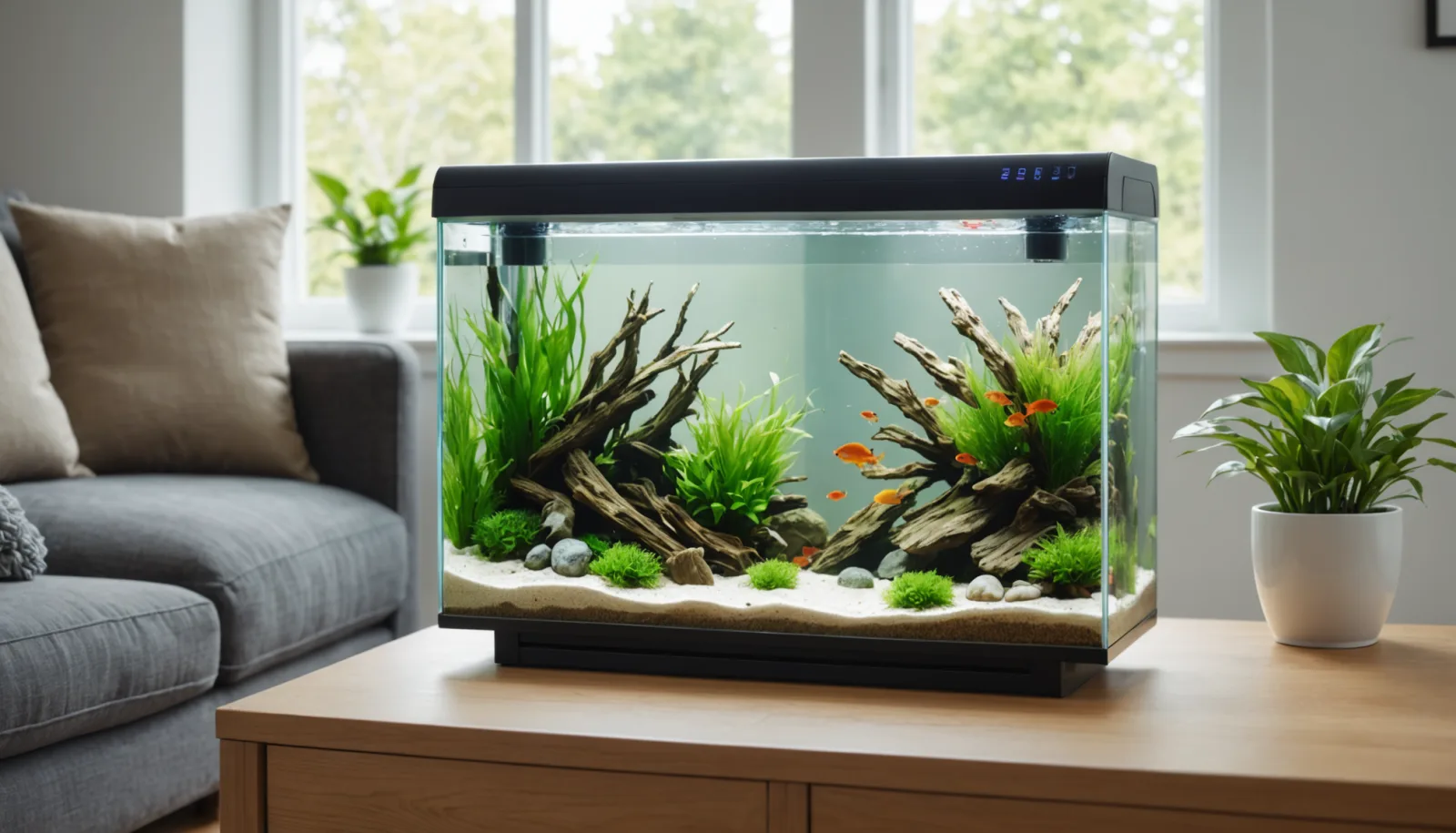
Evidence at a Glance
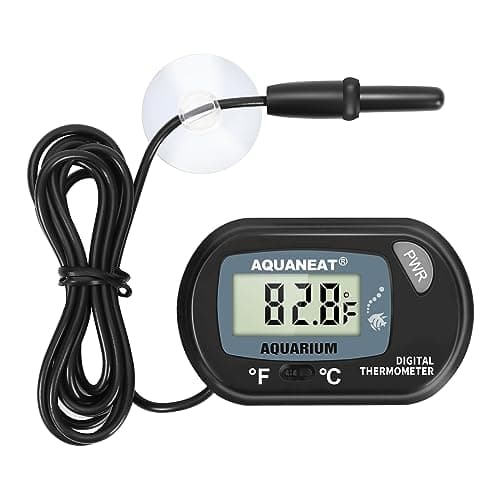
AQUANEAT Digital Aquarium Thermometer
The first rung — a $5 large-LCD digital thermometer with a submersible probe, because you cannot manage a heat problem you have not measured, and confirming the reading is the step that tells you whether you have a heat emergency or a stuck heater before you spend another dollar.
Sources: AQUANEAT (Amazon product listing), Aqueon, Rate My Fishtank
Verified Jul 16, 2026
hygger Auto-Temperature-Control Aquarium Cooling Fan
The set-and-leave evaporative rung — a clip-on fan with its own temperature probe that starts and stops itself over a 68 to 93°F range, cooling by driving evaporation across the surface the way Aqueon and Rate My Fishtank describe, without a separate controller to wire up.
Sources: hygger (Amazon product listing), Rate My Fishtank, Aqueon
Verified Jul 16, 2026
Active Aqua 0.10 HP Water Chiller
The refrigeration rung, entry price — a titanium-evaporator chiller that holds a target temperature regardless of how hot the room gets, the fix Rate My Fishtank calls the golden standard for large tanks and homes without reliable AC; it funnels into the full chiller roundup for sizing.
Sources: Active Aqua (Amazon product listing), Rate My Fishtank, Bulk Reef Supply
Verified Jul 16, 2026
Our Picks
AQUANEAT
AQUANEAT Digital Aquarium Thermometer
8.7 / 10
- Reads -58°F to +158°F, plus or minus 1°C, per AQUANEAT
- Large LCD you can check from across the room
- Submersible probe on a suction cup; body stays dry
- Works in fresh, salt, and marine water
$5.45
Current price · checked Sep 8, 2026
Inkbird
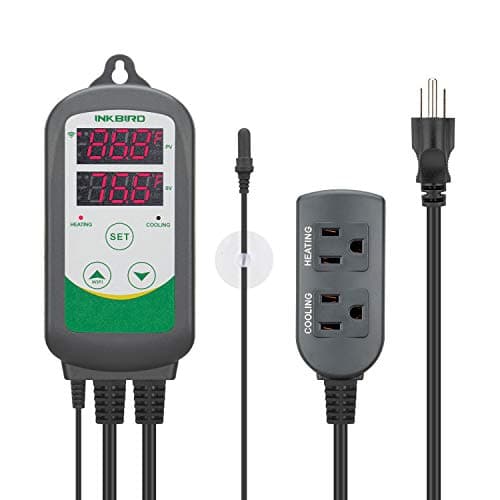
Inkbird WiFi ITC-308 Aquarium Thermostat
8.8 / 10
- WiFi app alerts on iOS and Android, per Inkbird
- High, low, and sensor-failure alarms
- Drives heating and cooling gear at once
- 1200 W output load at 110 V
$51.00
Current price · checked Sep 8, 2026
hygger
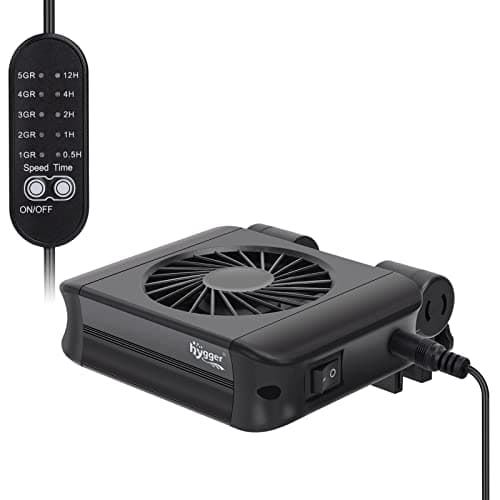
hygger Aquarium Cooling Fan (5-Speed)
8.2 / 10
- Five wind-speed levels, per hygger
- Built-in timer: 0.5H, 1H, 2H, 4H, or 12H
- Angle-adjustable head clips a thin rim
- All-copper motor, fresh and saltwater rated
$18.99
Current price · checked Sep 8, 2026
hygger
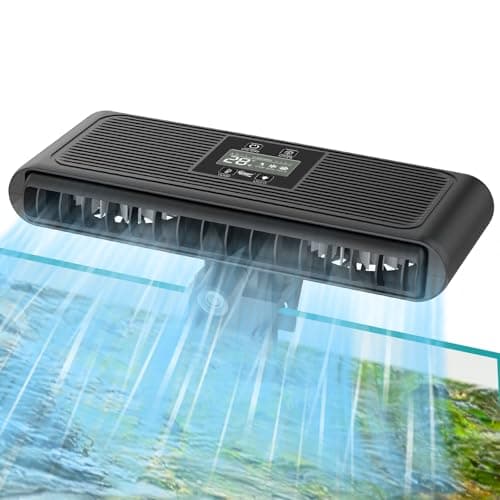
hygger Auto-Temperature-Control Cooling Fan
8.4 / 10
- Self-regulating over a 68 to 93°F target, per hygger
- Onboard probe starts and stops the fan
- Three wind-speed levels; digital display
- DC 5V low-voltage supply
$33.99
Current price · checked Sep 8, 2026
Inkbird
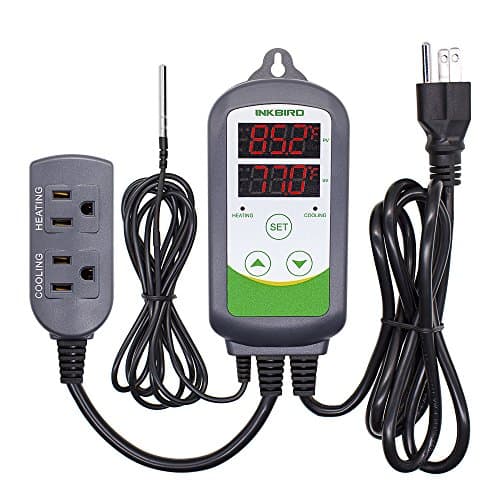
Inkbird ITC-308 Temperature Controller
8.5 / 10
- Dual relay drives cooling and heating, per Inkbird
- Dual display of measured and set temperature
- High and low temperature alarms
- 1100 W output load at 110 V
$28.80
Current price · checked Sep 8, 2026
Active Aqua
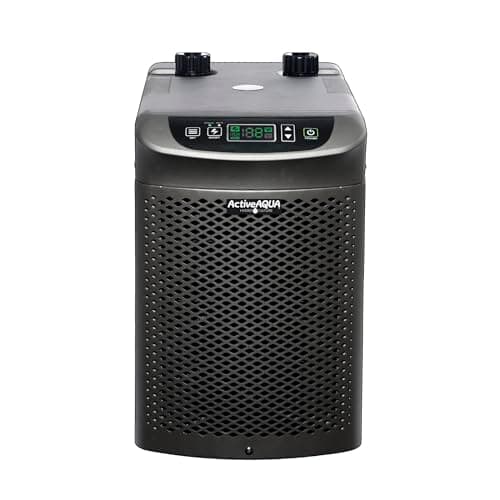
Active Aqua 0.10 HP Water Chiller
8.3 / 10
- Titanium evaporator, salt-safe, per Active Aqua
- Digital control holds a target temperature
- Boost function for a fast pull-down
- Sized for 10 to 40 gallons
$439.99
Current price · checked Sep 8, 2026
JBJ
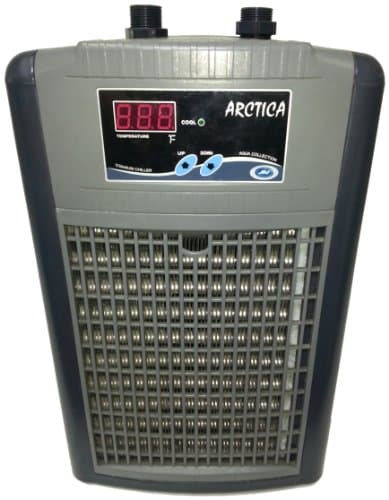
JBJ Arctica Titanium Chiller 1/10 HP
8.6 / 10
- 1/10 HP with an efficient condenser, per JBJ
- Ozone-friendly R-134A refrigerant
- Corrosion-resistant reef-ready build
- JBJ's stated low-noise design
$765.00
Current price · checked Sep 8, 2026
The Short Answer
Heat is an oxygen problem: warm water holds less of it exactly when your fish need more. Work up a ladder — thermometer first, then lid open and lights short, then a surface fan. Put that fan on an Inkbird controller so it runs on temperature and locks the heater out. Chiller only if fans lose.
Every product on this list has been scored against the PetPal Gear Score, a weighted composite of expert consensus, observed effectiveness, animal safety, long-term durability, and value. Review method: Editorial synthesis of aquarium-keeping authorities and manufacturer documentation. Temperature ranges and the dissolved-oxygen physics are attributed to Aqueon, Reef Builders (Jake Adams), Blue Fish Aquarium, and Rate My Fishtank; chiller sizing follows Bulk Reef Supply; the reef-controller ecosystem framing follows ReefBay. Product specifications come from each item's Amazon listing. No first-hand product testing — PetPalHQ does not run a testing lab.. Synthesized from 6+ expert sources.
An overheating aquarium rarely kills the way people expect. The danger is not that the water gets uncomfortable — it is that warm water and living fish want opposite things at the same moment. As the temperature climbs, a fish's metabolism speeds up and it needs more oxygen, while the water's ability to hold dissolved oxygen drops. Aqueon calls that "double jeopardy," and it is why a summer heat spike can become an oxygen crash before a tank ever looks like it is in trouble.
So this guide is deliberately a ladder, not a shopping list. You climb it only as far as your tank actually needs, and most tanks stop long before the top. The rungs go in order — measure the water, get alerted to a spike, cool by evaporation with a fan, automate that fan with a controller, and only then reach for a refrigeration chiller. Each rung names who needs it, and the whole first half costs less than a single chiller does. Where a temperature or a physics claim appears, its source is named rather than asserted; PetPalHQ does not run a testing lab, and the PetPal Heat-Defense Score is a composite of expert opinion, not a measurement.
This is an acute, seasonal protocol — the summer, too-hot problem, distinct from ongoing tank upkeep and from the winter, too-cold problem a heater solves. When the ladder reaches the chiller rung, it hands off to a dedicated roundup for the full roster and sizing rather than duplicating it here.
Head-to-Head Comparison
| Feature | AQUANEAT Digital Aquarium Thermometer | Inkbird WiFi ITC-308 Aquarium Thermostat | hygger Aquarium Cooling Fan (5-Speed) | hygger Auto-Temperature-Control Cooling Fan | Inkbird ITC-308 Temperature Controller | Active Aqua 0.10 HP Water Chiller | JBJ Arctica Titanium Chiller 1/10 HP |
|---|---|---|---|---|---|---|---|
| Ladder rung | Monitor — entry | Monitor + control | Fan — budget | Fan — auto | Controller | Chiller — entry | Chiller — premium |
| Cooling approach | None — it measures | Switches heat/cool gear | Evaporative | Evaporative | Automates a fan or heater | True refrigeration | True refrigeration |
| Automation / alert | None | WiFi phone alerts + alarms | Timer auto on/off | Built-in thermostat probe | Local buzzer alarm | Digital + remote | Digital |
| Who needs this rung | Any tank — the first step | Anyone who leaves home in summer | Small–mid tanks, a 2–4°F bump | Set-and-leave, mild reef | Any unattended fan or heater | 10–40 gal, chronic heat | Reef, hot room, wants quiet |
| Fit label | First-Look Fit | Away-From-Home Fit | Small-Tank / Mild-Bump Fit | Small-Tank / Mild-Bump Fit | Automation Fit | Hot-Room / Reef Fit | Hot-Room / Reef Fit |
| Running cost | A button cell | Outlet standby | DC low-watt | DC 5V | Outlet standby | Compressor — high | Compressor — high |
| PetPal Heat-Defense Score | 8.7 | 8.8 | 8.2 | 8.4 | 8.5 | 8.3 | 8.6 |
| Check price | Amazon | Amazon | Amazon | Amazon | Amazon | Amazon | Amazon |
$5.45
Current price · checked Sep 8, 2026
- Reads -58°F to +158°F, plus or minus 1°C, per AQUANEAT
- Large LCD you can check from across the room
- Submersible probe on a suction cup; body stays dry
- Works in fresh, salt, and marine water
- Runs on a single LR44 button cell
You cannot fix a heat problem you have not confirmed, which is why the cheapest item here is also the one the whole guide is built around. Before a fan, a controller, or a chiller makes any sense, a reliable reading has to tell you the water is actually running hot. The AQUANEAT does exactly that and nothing more: AQUANEAT documents a large-LCD digital thermometer reading -58°F to +158°F at plus or minus 1°C, with a probe you submerge on a suction cup while the display body stays dry, rated for fresh, salt, and marine water.
Where it sits on the ladder: this is rung one, the measurement that turns a vague worry into a number you can act on. Aqueon puts most tropical fish at 74° to 80° F, so a reading drifting above that band is your cue to start cooling, and a reading that is fine tells you the gasping fish you noticed is something else. A cheap thermometer also catches the opposite failure — a heater stuck on in July, which is a common and entirely preventable cause of a cooked tank. Confirm the number first; buy cooling gear second.
The honest limits are exactly what you would expect from a five-dollar tool. It reads, it does not react — there is no alarm, no app, and no way to know the temperature spiked while you were at work, which is the job of the alert rung below. The button cell will eventually die, and a probe left in a reef tank collects coralline over time and wants an occasional wipe. None of that changes its value: it is the indispensable, near-free first move, and skipping it is how people spend $500 on a chiller for a problem a $5 reading would have reframed.
What We Love
- Costs almost nothing yet gates every later decision
- Wide range and clear LCD for at-a-glance checks
- Salt-safe probe suits reef and marine tanks
- Catches a stuck-on heater, not just ambient heat
What Could Be Better
- Reads only — no alarm or phone alert
- Button cell eventually needs replacing
- Probe wants an occasional wipe in a reef tank
The Verdict
Buy this first, always, because managing summer heat starts with measuring it. It is the five-dollar reading that tells you whether you have an emergency or a false alarm, and whether the fan and chiller money below is even needed. It reads but does not warn you, so pair it with the alert rung if you leave the house in summer.
Sources
- AQUANEAT (Amazon product listing, Digital Aquarium Thermometer): measures -58°F to +158°F with accuracy of plus or minus 1°C; large LCD; submersible probe with suction cup for fresh, salt, or marine water; runs on one LR44 button cell
- Aqueon: most tropical fish prefer 74° to 80° F, and as water temperature rises a fish's metabolic rate and oxygen demand increase while the water holds less dissolved oxygen
$51.00
Current price · checked Sep 8, 2026
- WiFi app alerts on iOS and Android, per Inkbird
- High, low, and sensor-failure alarms
- Drives heating and cooling gear at once
- 1200 W output load at 110 V
- Waterproof sensor, dual measured-and-set display
The difference between a summer scare and a wiped-out tank is often a single phone notification. A thermometer tells you the temperature when you happen to look; this tells you the moment it climbs, wherever you are. Inkbird documents a WiFi thermostat that controls a heating and a cooling device at once, throws high, low, and sensor-failure alarms, handles up to 1200 W at 110 V, and reports to the InkbirdSmart app on iOS and Android. The waterproof sensor and dual display round it out.
Where it sits on the ladder: it is the alert tier, and the alert is the whole point. Rate My Fishtank notes that trouble shows up when temperatures "consistently exceed 80°F, or spike rapidly by even a few degrees" — and a rapid spike is precisely the event that happens on a hot afternoon while you are at work. Because heat and low oxygen do their worst unattended, a unit that pings your phone buys you the hours that decide whether a colony survives. It can also switch cooling gear directly, so it doubles as a controller if you own a fan or a chiller to plug into it.
Two honesty notes. First, its WiFi is 2.4GHz only, so a 5GHz-only mesh network needs its 2.4GHz band enabled — a small setup wrinkle, not a flaw. Second, do not think of this as a second controller stacked on top of the wired Inkbird below; it is the same job with alerts added. Buy this one if remote warning matters to you, and the cheaper wired unit further down if it does not. As the alert rung, it turns "I hope the tank is okay" into "my phone will tell me if it isn't."
What We Love
- Phone alerts catch a spike while you are away
- Switches heating and cooling gear directly
- Multiple alarm types, including sensor failure
- Waterproof sensor and clear dual display
What Could Be Better
- 2.4GHz WiFi only — no 5GHz band
- Overlaps the cheaper wired controller if you never leave home
- Needs a device plugged in to actually cool anything
The Verdict
Get this rung if you leave the house in summer, because an unattended heat spike is the scenario that kills fastest and a notification is what buys you time. It monitors, alerts, and controls in one box; its only real quirk is 2.4GHz-only WiFi. If remote warning is not a concern, the wired controller lower down does the switching for less.
Sources
- Inkbird (Amazon product listing, WiFi ITC-308 Aquarium Thermostat): WiFi app control on iOS and Android over 2.4GHz; high and low temperature alarms plus sensor-failure alarm; controls a heating and a cooling device at the same time; maximum output load 1200 W at 110 V; waterproof sensor
- Rate My Fishtank: when temperatures consistently exceed 80°F, or spike rapidly by even a few degrees, the consequences become visible
$18.99
Current price · checked Sep 8, 2026
- Five wind-speed levels, per hygger
- Built-in timer: 0.5H, 1H, 2H, 4H, or 12H
- Angle-adjustable head clips a thin rim
- All-copper motor, fresh and saltwater rated
- Draws little power over the surface
Evaporation is the oldest cooling trick in the hobby, and a clip-on fan is how you buy it for under twenty dollars. Rate My Fishtank explains the mechanism plainly: a fan across the surface "breaks the boundary layer of humid air and encourages rapid evaporation," and evaporation carries heat away. hygger documents a five-speed fan with a built-in timer offering 0.5H, 1H, 2H, 4H, and 12H cycles, an angle-adjustable head that clamps a rim under 0.45 inches, and an all-copper motor rated for fresh and saltwater tanks.
Where it sits on the ladder: this is the entry to evaporative cooling, the first rung that actually moves the temperature rather than just reporting it. Aqueon adds the two moves that make a fan work best — "open the aquarium cover and position a fan to blow across the surface," and combine it with an aerator, since surface agitation both cools and re-oxygenates warm water. Because heat is an oxygen problem, that aeration is not optional; if you are adding air, our roundup of the best aquarium air pumps is the place to match one to your tank. The timer lets you run the fan through the hot afternoon and idle it overnight.
The honest ceiling matters more here than anywhere. Evaporative cooling is limited by room humidity — the muggier the room, the less a fan can do — and hygger's own listing frames it as tank-cooling support, not air conditioning. It also speeds up water loss, so you will top off more often; if that becomes a daily chore, an automatic top-off system keeps the water level and salinity steady while the fan runs. And a fan raises room humidity, which a small or closed room feels. As the budget evaporative rung, it is real cooling that costs little and asks only that you keep the water topped off and the surface moving.
What We Love
- Genuine cooling for under twenty dollars
- Timer runs it through the hot hours only
- Fresh and saltwater rated, per hygger
- Pairs naturally with an aerator for oxygen
What Could Be Better
- Evaporative cooling is capped by room humidity
- Speeds evaporation, so you top off more often
- Adds humidity to a small or closed room
The Verdict
Reach for a clip-on fan when the tank runs a few degrees hot in summer and you want cheap, real cooling. Run it with the lid cracked and an aerator going, because a fan cools and agitation re-oxygenates the warm water. Just respect the ceiling: it is evaporative, so humidity limits it and it drives up top-off duty.
Sources
- hygger (Amazon product listing, Aquarium Cooling Fan): 5 levels of wind speed; built-in timer selectable at 0.5H, 1H, 2H, 4H, or 12H; angle-adjustable head; clamps a tank wall under 0.45 inches thick; all-copper motor; suitable for freshwater and saltwater tanks
- Rate My Fishtank: directing a simple clip-on household fan across the surface of the display tank or the sump breaks the boundary layer of humid air and encourages rapid evaporation
- Aqueon: open the aquarium cover and position a fan to blow across the surface of the water; this is especially effective when combined with the use of an aerator
$33.99
Current price · checked Sep 8, 2026
- Self-regulating over a 68 to 93°F target, per hygger
- Onboard probe starts and stops the fan
- Three wind-speed levels; digital display
- DC 5V low-voltage supply
- Clamps a rim up to 1 inch thick
A manual fan asks you to remember it; this one remembers for you. The step up from the budget fan is a built-in thermostat, so the fan is not a dumb blower you switch on and hope you turn off. hygger documents an onboard probe that "continuously monitors the aquarium temperature and automatically starts and stops to maintain the target," an adjustable 68 to 93°F setpoint, three wind speeds, a digital display of temperature and mode, a DC 5V supply, and a clamp for a rim up to an inch thick.
Where it sits on the ladder: it bridges the fan rung and the controller rung. Because the thermostat lives inside the fan, you get automated evaporative cooling without wiring up a separate Inkbird — set a target, and it cools only when the water crosses it. hygger claims this delivers "3°F to 7°F temperature cooling," and that is the maker's figure, not a promise this guide makes: evaporative drop depends on your room's humidity, so treat the range as hygger's estimate rather than a guaranteed number. For oxygen, pair it as Rate My Fishtank suggests — "increasing the physical surface agitation with extra powerheads also helps maximize oxygenation," and a reef wavemaker or powerhead does exactly that alongside the fan.
The honest caveats are the same evaporative limits, plus a little more gear. It still cannot beat room humidity, still speeds evaporation, and still raises room moisture — a self-driving fan does not repeal physics. It is also pricier than the manual fan and, being self-contained, it automates a fan and only a fan; it will not switch a heater or a chiller the way a standalone controller can. As the set-and-leave evaporative rung, it is the right buy for someone who wants fan cooling to run itself on a mild summer tank without a separate controller in the mix.
What We Love
- Thermostat runs the fan on its own
- Adjustable target and clear digital readout
- Low-voltage DC 5V operation
- No separate controller needed for fan automation
What Could Be Better
- Still humidity-limited like any fan
- Maker's 3-7°F cooling figure is unverified by us
- Automates a fan only — not a heater or chiller
The Verdict
Choose the auto fan when you want evaporative cooling to manage itself on a mild-summer or lightly-loaded reef tank. The onboard probe cycles it for you, so there is no controller to wire. Take hygger's 3-7°F cooling claim as the maker's estimate, not a guarantee, since humidity sets the real ceiling.
Sources
- hygger (Amazon product listing, Auto-Temperature-Control Cooling Fan): 68 to 93°F adjustable target; the temperature probe continuously monitors the water and automatically starts and stops the fan to hold the target; 3-level wind speed; digital display of temperature, speed, and mode; DC 5V; clamps a wall up to 1 inch thick; fresh and saltwater
- Rate My Fishtank: increasing the physical surface agitation with extra powerheads also helps maximize oxygenation, giving your livestock a fighting chance
$28.80
Current price · checked Sep 8, 2026
- Dual relay drives cooling and heating, per Inkbird
- Dual display of measured and set temperature
- High and low temperature alarms
- 1100 W output load at 110 V
- Compressor-delay protection for the plugged-in gear
This little box is the answer to a question the reef forums ask constantly. People shopping for automation gravitate to full controller ecosystems — ReefBay describes Apex as "a mature ecosystem with deep integration and advanced programming options" and HYDROS as "modular, beginner-friendly, and highly competitive on value" — but those flagship controllers are not the entry point, and a single-purpose temperature controller is. Inkbird documents a dual-relay ITC-308 that "powers refrigeration and heating equipment as conditions change," shows measured and set temperature on a dual display, alarms high and low, and handles 1100 W at 110 V.
Where it sits on the ladder: it is the automation rung, and its trick is coordination. Plug a fan or a chiller into the cooling outlet and a heater into the heating outlet, set your band, and the two never fight — the heater cannot warm the water while the fan is trying to cool it, because the controller hands off between them by temperature. For a summer setup, that means a fan that comes on exactly when the water climbs and a heater that locks out until it drops, with an alarm if either fails. It is the cheapest way to make "dumb" cooling gear behave, and it is why the Apex-versus-Hydros question does not need to be answered to protect a tank from heat.
The honest trade against the WiFi unit above is connectivity: this one alarms with a local buzzer only, so it will get loud in the room but it will not reach your phone. If you are home when it matters, that is fine and saves you fifteen dollars; if you are not, the WiFi rung is worth the difference. It also, sensibly, does nothing on its own — it is a switch for gear you already own, not a cooler itself. As the automation rung, it is the small, reliable brain that lets a fan and a heater share one tank without you refereeing.
What We Love
- Coordinates cooling and heating so they never fight
- Cheapest way to automate a fan or chiller
- Clear dual display and failure alarms
- Compressor-delay protection for chiller use
What Could Be Better
- Local buzzer only — no phone alerts
- Controls gear you supply; cools nothing itself
- One temperature job, not a full reef ecosystem
The Verdict
Buy the wired ITC-308 to automate a fan or chiller and lock a heater out during summer, all for about thirty-six dollars. It is the practical stand-in for the Apex-versus-Hydros debate — you do not need a flagship ecosystem to keep a tank from overheating. Its one limit is local-only alarms, so pick the WiFi version instead if you need alerts on your phone.
Sources
- Inkbird (Amazon product listing, ITC-308 Temperature Controller): dual relay powers refrigeration and heating equipment as conditions change; dual display shows measured and set temperature at once; high and low temperature alarms; maximum output load 1100 W at 110 V; adjustable compressor-delay protection; °C or °F
- ReefBay: Apex is a mature ecosystem with deep integration and advanced programming options; HYDROS is modular, beginner-friendly, and highly competitive on value
$439.99
Current price · checked Sep 8, 2026
- Titanium evaporator, salt-safe, per Active Aqua
- Digital control holds a target temperature
- Boost function for a fast pull-down
- Sized for 10 to 40 gallons
- Ships with fittings and a remote
When fans cannot hold the line, only refrigeration will, and this is the entry into that tier. A chiller is the one tool that ignores room humidity entirely — Rate My Fishtank calls a dedicated chiller "the golden standard" that gives "peace of mind regardless of how high the room temperature climbs." Active Aqua documents a 0.10 HP unit with a corrosion-resistant titanium evaporator rated for fresh or salt water, digital control to hold a target, a boost mode for a fast pull-down, and coverage for 10 to 40 gallons.
Where it sits on the ladder: it is the top rung at its lowest rung of entry, the first step into true mechanical cooling for a small-to-mid tank that runs hot for weeks rather than days. The titanium evaporator is the aquarium-relevant part, because titanium tolerates salt where lesser metals corrode, which is what makes this safe on a reef. Sizing is where this guide hands off: the honest math is Bulk Reef Supply's rule to "round up to 10 BTU per gallon for every 1°F of cooling" and to oversize slightly rather than undersize, and our roundup of the best aquarium chillers walks that sizing through for the full roster so you match horsepower to your gallons.
Two honesty notes you should hear before spending nearly five hundred dollars. First, this chiller is marketed primarily for cold-plunge and ice-bath use; the aquarium fit is real and the listing explicitly names "aquariums, reef tanks, and hydroponic systems," but the marketing lens is not aquarium-first, so read the fittings against your plumbing. Second, the chiller tier funnels to the live roundup instead of betting your setup on one listing. As the entry chiller, it is the cheapest way into refrigeration that will actually hold a reef through a heat wave.
What We Love
- True refrigeration, unbothered by room humidity
- Salt-safe titanium evaporator for reef tanks
- Boost mode pulls temperature down fast
- Lowest price into the chiller tier
What Could Be Better
- Marketed mainly for cold plunges, not aquariums
- Compressor carries a real running-cost bill
The Verdict
Step up to this entry chiller when a reef or a chronically hot tank has outrun what fans can do, and you need a target held regardless of the room. It is genuine refrigeration at the lowest price of the tier, with a salt-safe titanium coil. Note the honest catch — cold-plunge branding — and size it against the full chiller roundup before buying.
Sources
- Active Aqua (Amazon product listing, 0.10 HP Water Chiller with Boost): corrosion-resistant titanium evaporator rated for fresh or salt water; digital control maintains a target temperature; boost function activates extra cooling to reach the set point quickly; sized for 10 to 40 gallons; includes fittings and a remote
- Rate My Fishtank: for large setups or homes without reliable air conditioning, a dedicated aquarium chiller is the golden standard, offering peace of mind regardless of how high the room temperature climbs
$765.00
Current price · checked Sep 8, 2026
- 1/10 HP with an efficient condenser, per JBJ
- Ozone-friendly R-134A refrigerant
- Corrosion-resistant reef-ready build
- JBJ's stated low-noise design
- The reef keeper's common default unit
For reef keepers, one chiller name comes up more than any other. The JBJ Arctica is the unit that gets recommended by default when a saltwater tank needs mechanical cooling, and it sits at the premium end of this ladder for that reason. JBJ documents a 1/10 HP chiller with what it calls a "highly efficient condenser" that "use[s] less energy," a corrosion-resistant build, and the ozone-friendly refrigerant R-134A. JBJ also markets it as "the most quietest chiller on the market" — that is the maker's superlative, worth naming but not something this guide can independently confirm.
Where it sits on the ladder: this is the top rung, the buy for a reef tank in a hot room where a fan is never going to be enough. Everything about it points at the demanding case — the efficient condenser matters when a compressor may run for hours in July, the corrosion resistance matters in saltwater, and the noise claim matters when the chiller lives in a living room. As with the entry chiller, sizing is the decision that counts, and Bulk Reef Supply's rule of thumb applies: work out the cooling load for your gallons and target drop, and oversize slightly rather than undersize, since "an undersized unit runs longer, works harder, and may never reach the temperature you want during warmer months." The full chiller roundup carries that sizing across the roster so you match this to your gallons rather than guessing.
The honest limits are price and power draw. At roughly $760 this is the most expensive rung by a wide margin. A compressor of this size also draws real power, which is a running cost, not a one-time one. As the premium chiller, it is the reef keeper's known-good answer for chronic heat — provided you size it properly before committing.
What We Love
- Reef keepers' common default for hot tanks
- Efficient condenser for long compressor runs
- Salt-safe, ozone-friendly R-134A build
- Maker touts low-noise operation
What Could Be Better
- The most expensive rung by far
- Compressor draws real, ongoing power
The Verdict
The Arctica is the reef keeper's default when chronic summer heat calls for real refrigeration and quiet matters. It is the priciest rung here. Size it by Bulk Reef Supply's 10-BTU rule against the full chiller roundup rather than by horsepower alone.
Sources
- JBJ (Amazon product listing, Arctica Titanium Chiller 1/10 HP): highly efficient condenser designed to use less energy; corrosion-resistant build using ozone-friendly R-134A refrigerant; 1/10 HP; JBJ markets it as what it calls the most quietest chiller on the market
- Bulk Reef Supply: round up to 10 BTU per gallon for every 1°F of cooling, and slightly oversizing a chiller is generally better than undersizing it because an undersized unit runs longer and may never reach the target
How We Score
Formula
PetPal Heat-Defense Score = (Cooling Power × 0.35) + (Automation & Alerting × 0.25) + (Running Cost / Efficiency × 0.20) + (Tank-Size Fit × 0.20)
Score Factors
- Cooling Power · 35%
- How many degrees of real headroom the rung buys, scored WITHIN its rung so a $5 thermometer is not punished for not being a compressor. A monitor scores on early-warning value — knowing in time is its version of cooling power; fans score on honest, humidity-limited evaporative drop; chillers score on true refrigeration that holds a target regardless of the room. Per-product fit labels reflect this: the thermometer is a First-Look Fit, the fans are a Small-Tank / Mild-Bump Fit, and the chillers are a Hot-Room / Reef Fit.
- Automation & Alerting · 25%
- Whether the rung runs unattended and whether it warns you, ranked WiFi alert over local buzzer over none. This is where the WiFi Inkbird (Away-From-Home Fit) earns its place over the wired controller (Automation Fit), and where a bare thermometer loses ground it makes back on cost.
- Running Cost / Efficiency · 20%
- What the rung costs to run, stated plainly. Thermometers and fans are effectively free to operate; a controller draws outlet standby only; a chiller carries a genuine compressor bill that a reader should budget for before buying. No 'was $X' framing appears anywhere here — every price is a live, non-deal capture.
- Tank-Size Fit · 20%
- How well the rung matches gallons and livestock, with reef tanks held to a tighter target than freshwater. Small-to-mid freshwater and mild reef tanks are served by fans; chronic-heat, reef, and no-AC tanks are the chiller's Hot-Room / Reef Fit. The scores are a composite of expert opinion and manufacturer documentation — PetPalHQ does not run a testing lab.
| Rank | Product | Score |
|---|---|---|
| #1 | Inkbird Inkbird WiFi ITC-308 Aquarium Thermostat | 8.8 |
| #2 | AQUANEAT AQUANEAT Digital Aquarium Thermometer | 8.7 |
| #3 | JBJ JBJ Arctica Titanium Chiller 1/10 HP | 8.6 |
| #4 | Inkbird Inkbird ITC-308 Temperature Controller | 8.5 |
| #5 | hygger hygger Auto-Temperature-Control Cooling Fan | 8.4 |
| #6 | Active Aqua Active Aqua 0.10 HP Water Chiller | 8.3 |
| #7 | hygger hygger Aquarium Cooling Fan (5-Speed) | 8.2 |
When NOT to Buy
Do not buy a chiller for a 2°F summer bump. A $494-to-$760 compressor is the answer to chronic heat, reef tanks, and rooms without reliable AC — not to a tank that drifts a couple of degrees on the hottest afternoons. Bulk Reef Supply says it directly: "most modern aquariums using LED lighting and efficient pumps do not need a chiller if the surrounding room stays cool and stable." For most tanks, the free moves come first — crack the lid, cut the light hours, and run the room AC if you have one, because cooling the room is the cheapest way to cool the tank. A clip-on fan and a topped-off water level handle a great many summers on their own.
Measure before you spend. A $5-to-$10 thermometer is the first purchase, always, because a "hot tank" is sometimes a heater stuck on rather than a heat wave, and the fix for that costs nothing. Confirm the reading, watch it across a hot day, and let the number — not the panic — decide which rung you actually need. Fans defend small-to-mid and mild reef tanks with a 2-to-4°F bump; a controller earns its keep the moment a fan or heater runs unattended; the chiller tier is for tanks that run hot for weeks, not days.
A word on the controllers people ask about. Reef shoppers often want to know whether to buy a Neptune Apex or a HYDROS — ReefBay frames the two as "a mature ecosystem with deep integration" versus a "modular, beginner-friendly" alternative — but neither full controller is covered here. The temperature-control layer is the Inkbird, and for a heat problem specifically, a temperature controller is all you need to automate a fan and lock out a heater. When the ladder does reach the chiller rung, the tier hands off to the full chiller roundup for the current roster and sizing rather than betting on a single product. Confirm current prices on every item before buying, since sellers and prices move.
Frequently Asked Questions
- How hot is too hot for my tank?
- It depends on what you keep, which is why there is no single safe number. Aqueon puts most freshwater tropical fish at a comfort range of 74 to 80°F. On the reef side, Reef Builders calls 77°F "a good middle-of-the-road temperature," while Blue Fish Aquarium gives a recommended band of 76 to 84 degrees with the optimum around 78 to 79°F. The clearest danger signal comes from Rate My Fishtank: trouble shows up when temperatures "consistently exceed 80°F, or spike rapidly by even a few degrees." Watch for fish gasping at the surface, and read those as ranges from named sources rather than one hard cutoff.
- Do clip-on fans actually cool a tank, or is that a myth?
- They genuinely work, by evaporation. Rate My Fishtank explains that a fan across the surface "breaks the boundary layer of humid air and encourages rapid evaporation," and evaporation carries heat off the water. Aqueon adds that it is most effective with the cover open and an aerator running. The honest limits are three: the cooling is capped by your room's humidity, so a muggy room blunts it; it speeds up evaporation, so you top off more often; and it raises the humidity of the room it sits in. Manufacturers cite a few degrees of drop, but treat that as their estimate, not a promise.
- How do I know if I actually need a chiller, and how big?
- Most tanks do not need one. Bulk Reef Supply notes that "most modern aquariums using LED lighting and efficient pumps do not need a chiller if the surrounding room stays cool and stable" — so a chiller is for chronic heat, reef tanks, and rooms without reliable AC, after fans and free measures fall short. If you do need one, the simple sizing rule is to "round up to 10 BTU per gallon for every 1°F of cooling," and to oversize slightly rather than undersize, because an undersized unit runs longer and may never reach the target. Work the full sizing through the dedicated chiller roundup before you buy.
- Can I use frozen water bottles in an emergency?
- As a short-term stopgap, yes — floating a capped, frozen bottle in the sump or tank is a widely used emergency move while a fan or chiller is on the way. But it is a bridge, not a fix, and the risk is cooling too fast. Aqueon cautions against dropping the temperature "more than 2 or 3 degrees F in a 4-hour period," so add one bottle at a time, watch the thermometer, and add surface agitation for oxygen while you do it. Treat it as the community-consensus emergency practice it is, not a substitute for actually fixing the heat source.
- My tank is fine during the day but spikes while I'm at work — what should I do first?
- Add the alert rung before anything else. Because heat and low oxygen do their worst unattended, the single highest-value move is a WiFi thermometer or controller that pings your phone the moment the water climbs, so a mid-afternoon spike becomes a notification instead of a discovery. Pair it with surface agitation to keep oxygen up while the water is warm. Monitoring beats reacting here — knowing in time is what lets you get home, cut the lights, or switch on a fan before a warm tank becomes an oxygen-starved one.
Bottom Line
Start at rung one and measure: the AQUANEAT thermometer is a $5 reading that tells you whether you have a heat emergency or a stuck heater, and it gates every dollar you spend above it.
Add alerts if you leave home: the WiFi Inkbird ITC-308 pings your phone when the water spikes, which is the scenario — heat plus low oxygen, unattended — that kills a tank fastest.
Cool by evaporation before you refrigerate: the hygger 5-speed fan is real cooling for under twenty dollars, capped only by room humidity and a little extra top-off duty.
Automate the fan hands-off: the hygger auto fan runs its own thermostat, so a mild-summer tank cools itself without a separate controller — just take its 3-7°F claim as the maker's estimate.
Make dumb gear behave: the wired Inkbird ITC-308 switches a fan and locks out a heater by temperature, and it is the answer to the Apex-versus-Hydros question for a heat problem.
Refrigerate only when you must — entry: the Active Aqua 0.10 HP holds a target regardless of the room for a 10-to-40-gallon tank; watch the cold-plunge branding.
Refrigerate at the top end: the JBJ Arctica 1/10 HP is the reef keeper's default for chronic heat, the priciest rung, and worth sizing against the full chiller roundup first.
Sources & Methodology
Methodology
PetPal Heat-Defense Score = (Cooling Power × 0.35) + (Automation & Alerting × 0.25) + (Running Cost / Efficiency × 0.20) + (Tank-Size Fit × 0.20)
Expert review sources
- Aqueon — freshwater tropical temperature range, the dissolved-oxygen double-jeopardy physics, fan-across-the-surface method, and the 2-to-3°F-per-4-hours rate-of-change caution
- Reef Builders (Jake Adams) — reef target near 77°F and coral heat-stress behavior
- Blue Fish Aquarium — reef recommended 76-to-84°F band and stability as a basic tenet
- Rate My Fishtank — the 80°F danger line, clip-on-fan boundary-layer cooling, powerhead oxygenation, and the chiller as golden standard
- Bulk Reef Supply — chiller sizing (10 BTU per gallon per 1°F) and when a tank does not need one
- ReefBay — the Apex-versus-HYDROS reef-controller ecosystem framing
Community sources
- Aquarium-keeping community consensus on the frozen-bottle emergency stopgap, tied to Aqueon's rate-of-change caution
- Reef and freshwater community practice on surface agitation and top-off during heat
Prices and specs verified July 16, 2026.
About the author
Nick Miles is the chief editor of PetPalHQ. This acute summer-heat protocol and its seven-rung ladder are editorial synthesis of aquarium-keeping authorities — Aqueon, Reef Builders, Blue Fish Aquarium, Rate My Fishtank, Bulk Reef Supply, and ReefBay — and manufacturer documentation; product specifications come from each item's Amazon listing. PetPalHQ does not run a testing lab, and the PetPal Heat-Defense Score is a composite of expert opinion, not a measurement. Temperature ranges are attributed to their sources rather than stated as one universal safe number.
PetPalHQ is a participant in the Amazon Services LLC Associates Program. We may earn commissions from qualifying purchases — at no extra cost to you.
More Guides
Aquarium
Best Aquarium Chillers for Reef & Marine Tanks (2026)
Aquarium
Best Automatic Top-Off (ATO) Systems for Reef Tanks (2026)
Aquarium
Best Aquarium Air Pumps for Quiet, Reliable Aeration (2026)
Aquarium
Best Reef Wavemakers & Powerheads (2026)
Aquarium