Playground
Best Cat Exercise Wheels for Indoor Enrichment (2026)
The cat exercise wheels actually sized for cat biomechanics — diameter that fits the spine, a track wide enough for the stride, anchoring that survives a sprint.
By Nick Miles · Updated September 30, 2026 · 12 min
PetPalHQ is reader-supported. We may earn a commission from qualifying Amazon purchases at no extra cost to you.
Evidence at a Glance
One Fast Cat - Cat Exercise Wheel - Gen. 7 - Safe 48" Diameter
Industry-standard 48-inch diameter that fits the manufacturers' own sizing rule for most domestic shorthairs and medium-frame cats — wheel diameter roughly three times the cat's nose-to-tail-base length for natural mid-stride extension. USA-made build with felt traction pads and solid inline wheels. The editorial default for the broadest cat population.
Sources: One Fast Cat manufacturer documentation, AAFP environmental enrichment guidelines, ISFM indoor cat behavioral needs material
Verified May 11, 2026
Nordic Beast 48'' XL Cat Wheel
48-inch diameter with a 15.7-inch extra-wide running surface and 45-pound weight capacity — the editorial default for Maine Coons, Norwegian Forest Cats, Bengals, and any multi-cat household where two cats may use the wheel simultaneously. Nordic Beast rates the frame against wobbling, which is the failure mode that matters on hardwood, tile, or laminate.
Sources: Nordic Beast manufacturer documentation, AAFP guidelines on large-breed cat enrichment, ISFM multi-cat household resource guidance
Verified May 11, 2026
POLAHAKU Cat Wheel for Indoor Cats, 48 Inch Diameter
48-inch diameter at half the One Fast Cat price — the budget-tier premium-sized wheel for households that want the AAFP-aligned diameter without the brand premium. POLAHAKU documents an enhanced base, a low-entry design, a wide running surface and a safety lock, and publishes overall dimensions of 48 by 14.3 by 50.4 inches. It publishes no bearing specification, which is the honest gap against the sealed-bearing tier.
Sources: POLAHAKU Amazon listing, read 2026-09-07, AAFP environmental enrichment guidelines
Verified Sep 7, 2026
Our Picks
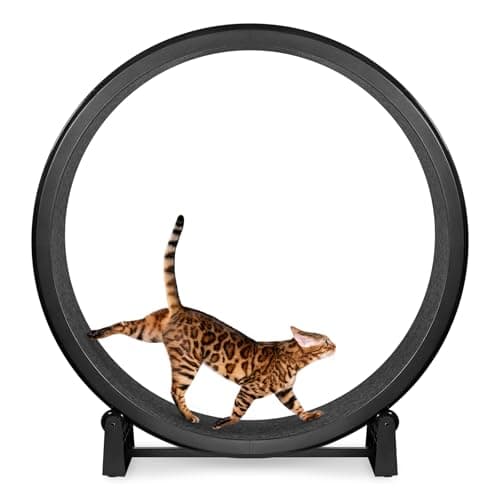
One Fast Cat
One Fast Cat - Cat Exercise Wheel - Gen. 7 - Safe 48" Diameter - Made in The USA - Black Wheel with Black Felt Traction Pads and Solid Inline Wheels
8.4 / 10
- 48-inch diameter — fits the three-times-body-length sizing rule for most domestic shorthairs and medium-frame cats
- Black felt traction pads for cat-claw grip without snagging
- Solid inline wheels carry the running surface, per One Fast Cat's own product description
- Made in the USA
$195.00
Current price · checked Sep 8, 2026
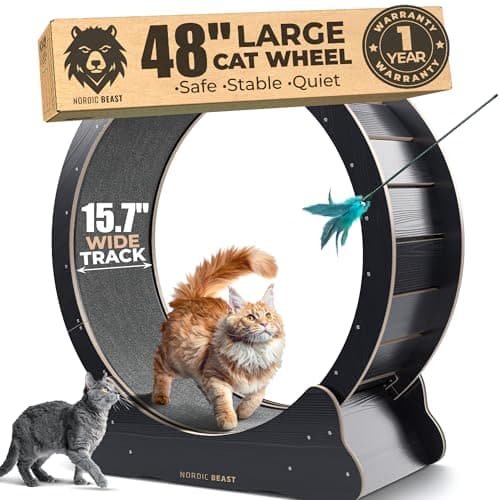
Nordic Beast
Nordic Beast 48'' XL Cat Wheel – Safe, Quiet & Stable Exercise Wheel for Large Indoor Cats up to 45 lbs – 15.7'' Extra-Wide Surface Fits 2 Cats Side by Side & Prevents Wobbling, 1-Year Warranty
8.0 / 10
- 48-inch diameter with a 15.7-inch extra-wide running surface — fits two cats side by side
- 45-pound weight capacity — supports large breeds and multi-cat simultaneous use
- Stability frame the manufacturer rates against wobbling during cat-acceleration sprints
- 1-year manufacturer warranty
$199.99
Current price · checked Sep 8, 2026
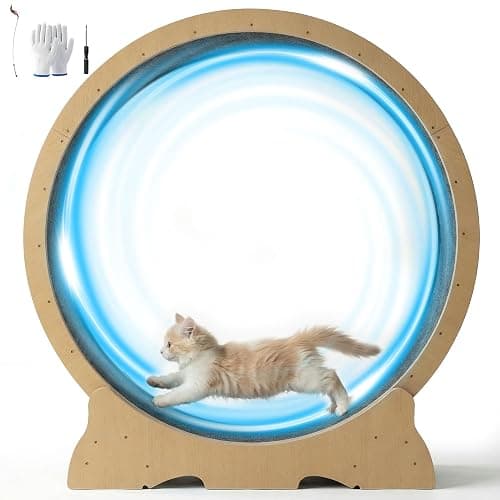
POLAHAKU
POLAHAKU Cat Wheel for Indoor Cats, 48 Inch Diameter Exercise Running Wheel
6.8 / 10
- 48-inch diameter — the same AAFP-aligned sizing as the One Fast Cat at half the price
- Enhanced base and low-entry deck, with published overall dimensions of 48 by 14.3 by 50.4 inches
- Safety lock holds the wheel still, which is what the introduction week actually needs
- POLAHAKU rates it for every size from two-month kittens to adult and senior cats
$89.99
Current price · checked Sep 8, 2026
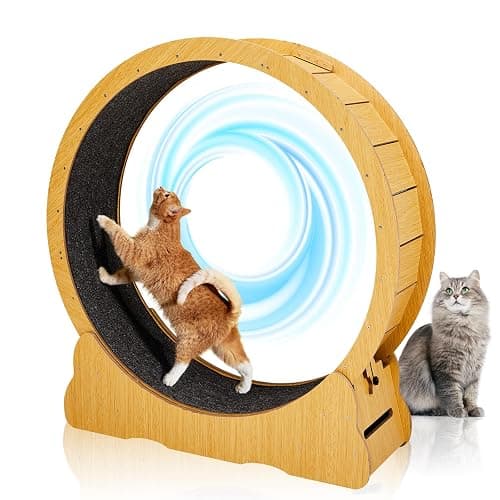
Outvita
Outvita Cat Exercise Wheel for Quiet Running Indoor Use, 39.4 Inch Cat Treadmill with Detachable Carpet, Natural Wood
6.5 / 10
- 39.4-inch diameter — a smaller footprint for apartments without 48 inches of open floor
- Built-in safety lock, which is what the novel-object introduction week needs
- Outvita documents a minimal gap between runway and base so paws are not pinched
- High-density fiberboard frame rated for cats up to 26 pounds
$69.99
Current price · checked Sep 8, 2026
The Short Answer
Cat exercise wheels are a niche enrichment tool, not a guaranteed obesity solution. The category leader for most domestic shorthairs is the One Fast Cat Gen 7 at 48 inches. That diameter fits the working rule the wheel manufacturers themselves publish: the wheel should run roughly three times the cat's nose-to-tail-base length. For Maine Coons, Norwegian Forest Cats, Bengals, and other large breeds — or multi-cat households — the Nordic Beast 48-inch XL is the editorial default, on the strength of the 15.7-inch track and 45-pound capacity it publishes. Both run the 48-inch diameter the sizing rule asks for. Survey data from manufacturer communities and r/cats suggests roughly half of introduced cats become regular users. Buy the wheel as a partial-probability bet, not a certainty.
Every product on this list has been scored against the PetPal Gear Score, a weighted composite of expert consensus, observed effectiveness, animal safety, long-term durability, and value. Review method: Editorial synthesis of AAFP environmental enrichment guidelines for indoor cats, ISFM multi-cat household and environmental needs guidance, Cornell Feline Health Center material on indoor cat obesity and behavioral enrichment, AAHA preventive-care weight-management recommendations, AVMA pet obesity statements, AVSAB humane training position on novel-object introduction and reward-based conditioning, the Merck Veterinary Manual on feline obesity and exercise contraindications in arthritic or geriatric cats, and ASPCA general indoor-cat welfare material. Manufacturer documentation from One Fast Cat, Nordic Beast, GoPet, and Penn-Plax was reviewed alongside verified customer review sentiment from Amazon, Chewy, and the r/cats and r/MaineCoons subreddits. PetPalHQ does not run a cat-wheel testing lab.. Synthesized from 8+ expert sources.
Cat exercise wheels are a niche premium enrichment category — not a mainstream cat product. The buying decision sits between two real risks. The first is sinking around two hundred dollars on a wheel that the cat ignores; survey data from manufacturer communities and the r/cats subreddit suggests roughly half of introduced cats never become regular users. The second is buying the wrong size for the cat's body length and quietly forcing suboptimal spinal curvature on every stride; AAFP environmental enrichment guidance frames running surfaces as posture-sensitive, and the manufacturer working rule is that the wheel diameter should run roughly three times the cat's nose-to-tail-base length for comfortable mid-stride extension.
The wheels that work best for cats are not the cheapest. The two premium picks here — the One Fast Cat Gen 7 at $180.00 and the Nordic Beast 48-inch XL at $199.99 — run the full 48-inch diameter the sizing rule asks for, on a low-profile base and a running surface built for cat claws rather than treadmill-style rubber. The budget POLAHAKU matches that diameter for $89.99 and gives up rotation smoothness and base weight to get there; the compact Outvita at $69.99 gives up diameter itself, which is the trade only a small cat in a small room should make. Rough rotation, a lighter base, or a shallower track all push toward use-extinction faster once the novelty wears off. AVSAB humane training position notes that startle responses during the novel-object introduction window can permanently extinguish use behavior; a wheel that tips on stride one is a wheel that becomes expensive furniture for the rest of its operational life.
This guide is for indoor-only owners of cats aged one to seven years with healthy joints and observed prey-drive play behavior. It is not for kittens under 12 months, senior cats with osteoarthritis or hip dysplasia, or sedentary cats with no observed indoor sprint behavior. The wheel is an optional enrichment layer in a broader environmental enrichment plan, not a mandatory product and not a standalone obesity solution. AVMA pet obesity guidance treats weight management as primarily caloric-intake-driven; the wheel is the supportive layer, not the answer.
Head-to-Head Comparison
| Feature | One Fast Cat - Cat Exercise Wheel - Gen. 7 - Safe 48" Diameter - Made in The USA - Black Wheel with Black Felt Traction Pads and Solid Inline Wheels | Nordic Beast 48'' XL Cat Wheel – Safe, Quiet & Stable Exercise Wheel for Large Indoor Cats up to 45 lbs – 15.7'' Extra-Wide Surface Fits 2 Cats Side by Side & Prevents Wobbling, 1-Year Warranty | POLAHAKU Cat Wheel for Indoor Cats, 48 Inch Diameter Exercise Running Wheel | Outvita Cat Exercise Wheel for Quiet Running Indoor Use, 39.4 Inch Cat Treadmill with Detachable Carpet, Natural Wood |
|---|---|---|---|---|
| Pick category | Best overall | Best for large breeds & multi-cat | Best value | Best compact |
| Indoor Athlete Score | 8.4 | 8.0 | 6.8 | 6.5 |
| Check price | Amazon | Amazon | Amazon | Amazon |
One Fast Cat One Fast Cat - Cat Exercise Wheel - Gen. 7 - Safe 48" Diameter - Made in The USA - Black Wheel with Black Felt Traction Pads and Solid Inline Wheels
$195.00
Current price · checked Sep 8, 2026
- 48-inch diameter — fits the three-times-body-length sizing rule for most domestic shorthairs and medium-frame cats
- Black felt traction pads for cat-claw grip without snagging
- Solid inline wheels carry the running surface, per One Fast Cat's own product description
- Made in the USA
- Low-profile base that sits flat on hardwood, tile, laminate, and carpet
The One Fast Cat Gen 7 is the editorial default for the broadest population of indoor cats. The 48-inch diameter fits the working rule the wheel manufacturers publish: the wheel diameter should run roughly three times the cat's nose-to-tail-base length for comfortable mid-stride extension. That sizing covers domestic shorthairs, medium-frame breeds, and most mid-large cats up to roughly 15 to 16 inches nose-to-tail-base. Anything larger (full-grown Maine Coons, Savannahs, Bengals on the bigger end) trends toward the Nordic Beast XL pick below.
The traction pads are black felt rather than carpet or rubber. AAFP notes that running-surface texture affects the early-introduction window — cats reject surfaces that grip claws too aggressively or feel slippery underfoot. Felt sits in the middle band that most cats accept. AAFP guidance flags resistance during the novel-object introduction as a use-extinction trigger, which makes rotation feel matter more than it looks like it should on a spec sheet. One Fast Cat describes the Gen 7 as running on solid inline wheels, and how it turns when you spin it by hand tells you more than any spec sheet will.
The felt traction pads are the wear part. r/cats discussion of long-running Gen 7 wheels is broadly positive on how they hold up, but we have not run one long enough to put a number on service life. The base is low-profile and sits flat on most floors; light-frame floors or thin carpets may still want a non-slip mat underneath.
What the spec sheet does not tell you: novel-object introduction is the binding constraint, not the wheel itself. AVSAB humane-training position requires patient, reward-based introduction over weeks. Survey data from manufacturer communities suggests roughly half of introduced cats become regular users. The One Fast Cat is the right wheel; whether your specific cat adopts it is a separate question.
What We Love
- 48-inch diameter fits the broadest cat population under the three-times-body-length rule
- Solid inline wheels on the rotation track, per the manufacturer's product description
- Felt traction surface that most cats accept during the introduction window
- Made in the USA
- Low-profile base sits flat on hardwood, tile, laminate, and carpet
What Could Be Better
- Premium price point compared to budget 48-inch alternatives
- Single-width track — not rated for two cats side by side the way the Nordic Beast XL is
- Felt pads are a wear item and will eventually need replacing
- Adoption is not guaranteed — roughly half of introduced cats become regular users per community survey data
The Verdict
If your cat is a domestic shorthair or medium-frame breed under 15 pounds with no mobility limitations, the One Fast Cat Gen 7 is the editorial default. It is the wheel the rest of the category is measured against.
Nordic Beast Nordic Beast 48'' XL Cat Wheel – Safe, Quiet & Stable Exercise Wheel for Large Indoor Cats up to 45 lbs – 15.7'' Extra-Wide Surface Fits 2 Cats Side by Side & Prevents Wobbling, 1-Year Warranty
$199.99
Current price · checked Sep 8, 2026
- 48-inch diameter with a 15.7-inch extra-wide running surface — fits two cats side by side
- 45-pound weight capacity — supports large breeds and multi-cat simultaneous use
- Stability frame the manufacturer rates against wobbling during cat-acceleration sprints
- 1-year manufacturer warranty
The Nordic Beast 48-inch XL is the editorial default for households that fall outside the One Fast Cat's coverage band. Two scenarios drive this pick. The first is large-breed cats — Maine Coons, Norwegian Forest Cats, Bengals, Savannahs, and any cat whose adult nose-to-tail-base length exceeds 16 inches. The 15.7-inch track is the widest running surface on this page, and the 45-pound capacity clears the One Fast Cat's stated 25 pounds by a wide margin.
The second scenario is multi-cat households. ISFM multi-cat household guidance flags resource competition as a primary anxiety driver in three-or-more-cat homes. A wheel that becomes a contested resource can backfire as an enrichment tool. The Nordic Beast's extra-wide track is explicitly rated for two cats side by side, which removes the contested-resource dynamic for most pairs and gives a third cat a comfortable sequential use window. Cornell Feline Health Center recommends one resource per cat plus one extra — for active multi-cat households with high wheel interest, the Nordic Beast handles the load that the standard 48-inch wheels cannot.
The stability framing is the underrated part of the listing. AVSAB humane-training position notes that startle responses during novel-object introduction can permanently extinguish use behavior. A wheel that wobbles or tips on stride one is a wheel that will not be used again. Nordic Beast leads its own product description with wobble prevention, which is the right thing for a manufacturer to lead with in this category — though it is a design claim, not a tested one, and we have not measured it.
What the spec sheet does not tell you: a wheel rated for two cats side by side is not the same as two cats agreeing to run together. ISFM's resource-competition point cuts both ways — the extra width removes the physical bottleneck, not the social one. Expect one cat to claim the wheel first and the second to wait its turn, and treat simultaneous use as a bonus rather than the plan.
What We Love
- 15.7-inch extra-wide track fits two cats side by side — the only pick here rated for it
- 45-pound weight capacity supports Maine Coons, Norwegian Forest Cats, and other large breeds
- Wider footprint than a standard 48-inch wheel — more floor contact under a sprint start
- 1-year manufacturer warranty
- Manufacturer rates the frame against wobble during sudden cat acceleration
What Could Be Better
- Larger physical footprint than standard 48-inch wheels — needs more open floor space
- Rated for 45 pounds total, so two large cats at once sits near the edge of that number
- Newer brand than One Fast Cat — less long-term community track record
- Premium price tier on Amazon for the category
The Verdict
If you have a large-breed cat or a multi-cat household, the Nordic Beast 48-inch XL is the editorial default. The wider track and higher weight capacity solve problems the standard 48-inch wheels cannot.
$89.99
Current price · checked Sep 8, 2026
- 48-inch diameter — the same AAFP-aligned sizing as the One Fast Cat at half the price
- Enhanced base and low-entry deck, with published overall dimensions of 48 by 14.3 by 50.4 inches
- Safety lock holds the wheel still, which is what the introduction week actually needs
- POLAHAKU rates it for every size from two-month kittens to adult and senior cats
- No published bearing specification — the honest gap against the sealed-bearing tier
The POLAHAKU 48-inch is the budget pick for households that want the right wheel diameter without the premium-brand price. The 48-inch diameter is the same AAFP-aligned sizing as the One Fast Cat Gen 7. For a domestic shorthair or medium-frame cat, the rotational sizing is identical — the cat experiences the same stride extension on each step. That matters because the diameter is the single most important factor in long-term adoption; an undersized wheel forces spinal curvature that extinguishes use behavior.
A listing note first: this guide now points at a newer POLAHAKU 48-inch listing, $89.99 on our September 7, 2026 check, sold by POLAHAKU Direct, in new condition. It is the same 48-inch wheel at the same price, now described with an enhanced base, a low-entry deck, a wide running surface and a safety lock, at published overall dimensions of 48 by 14.3 by 50.4 inches.
Where the POLAHAKU trades off is what it does not publish. There is no bearing specification anywhere on the listing, and at this price the category norm is a bushing rather than the sealed industrial bearings the One Fast Cat documents — expect more rotation noise during a sprint and periodic lubrication to keep it turning smoothly. POLAHAKU calls the base "enhanced", which is fair as a comparison to its own earlier design and is not the same claim as the weighted premium bases; on hardwood, tile, or laminate, budget an aftermarket non-slip mat. Replacement runway carpet is not sold separately, so a worn runway is a third-party fit or a whole new wheel, against the One Fast Cat's manufacturer-supported replacement pads.
What the spec sheet does not tell you: this is the right pick for owners testing the wheel category without committing to the premium price point. If the cat adopts the POLAHAKU, the wheel functions well for several years; if the cat ignores it, the budget price reduces the regret cost. For households already confident their cat is a likely wheel adopter — high prey drive, observed indoor sprint behavior, a breed disposition toward play — the One Fast Cat is the better long-term value despite the higher upfront cost.
What We Love
- Same 48-inch AAFP-aligned diameter as the One Fast Cat at half the price
- Safety lock lets you present a stationary wheel during the introduction week
- Low-entry deck and a carpeted runway most cats accept during introduction
- Lower regret cost if the cat does not adopt the wheel
What Could Be Better
- No published bearing specification — expect bushing-tier noise and periodic lubrication, not sealed-bearing smoothness
- Lighter base than the premium tier — needs an aftermarket non-slip mat on hardwood, tile, or laminate
- Replacement runway carpet is not sold separately; long-term replacement is a third-party fit or a new wheel
- Sold by POLAHAKU Direct rather than by Amazon, so returns run through the brand
The Verdict
If you want the right 48-inch wheel diameter at a budget price and accept some rotation friction and base lightness, the POLAHAKU is the editorial value pick. Plan on aftermarket anchoring.
Outvita Outvita Cat Exercise Wheel for Quiet Running Indoor Use, 39.4 Inch Cat Treadmill with Detachable Carpet, Natural Wood
$69.99
Current price · checked Sep 8, 2026
- 39.4-inch diameter — a smaller footprint for apartments without 48 inches of open floor
- Built-in safety lock, which is what the novel-object introduction week needs
- Outvita documents a minimal gap between runway and base so paws are not pinched
- High-density fiberboard frame rated for cats up to 26 pounds
- Detachable hook-and-loop scratch pad for cleaning or replacement
The Outvita 39.4-inch is the compact-footprint pick for apartments or small rooms where a 48-inch wheel cannot live in the open. It replaces the PawHut 39-inch this guide used to name here. The Outvita is $69.99, sold by Outvita, in new condition, and it does the same job at a smaller diameter and a lower price.
The safety lock is the reason a compact wheel earns a slot at all. AVSAB humane training principles emphasize voluntary engagement, and a lock lets the owner present a stationary wheel for the cat to investigate before any rotation happens — which removes the first-stride startle that extinguishes use behavior in a lot of cats. The same lock is what makes assisted use possible for a senior or anxious cat: hold the wheel still, let the cat settle, release it only when the cat is comfortable. Outvita also documents the detail that matters most on a wooden wheel, a minimal gap between the runway and the base, so paws are not pinched mid-stride.
The 39.4-inch diameter is the honest limit. It sits below the working rule of three times nose-to-tail-base length for medium and large cats, so a Maine Coon, Norwegian Forest Cat, Bengal, or Savannah will run with the spinal curvature AAFP environmental enrichment guidance flags as suboptimal. Outvita rates the frame for cats up to 26 pounds, but weight capacity and stride geometry are different questions — a heavy cat can be safely carried by the frame and still be too long for the circle. For those cats the Nordic Beast XL is the editorial default.
What the spec sheet does not tell you: the lock and the footprint are the differentiators, not the wheel itself. If your floor plan has room for 48 inches and your cat is medium-framed or larger, the POLAHAKU above gives a more AAFP-aligned diameter for $20 more. The Outvita earns this slot for the apartment that genuinely cannot fit the bigger circle, and for owners who want the stationary-introduction option.
What We Love
- Built-in safety lock supports stationary introduction and assisted use
- Compact 39.4-inch footprint fits rooms without 48 inches of open floor
- Outvita documents a paw-safe minimal gap between runway and base
- Lowest price in this guide at $69.99 for owners testing the category with a small cat
What Could Be Better
- 39.4-inch diameter is below the sizing rule for medium and large cats
- Wrong pick for Maine Coons, Norwegian Forest Cats, Bengals, or any long-bodied cat, whatever the 26-pound frame rating says
- Single-cat use — the runway is not rated for two cats side by side
- No published bearing specification, and a fiberboard frame rather than the premium tier's build
The Verdict
If you have a small cat in a compact room and want a safety lock for introduction or assisted use, the Outvita 39.4-inch is the editorial default. For any medium or large cat, pick a 48-inch wheel instead.
How We Score
Formula
Indoor Athlete Score = (Wheel Diameter Fit × 0.30) + (Rotation Smoothness × 0.25) + (Floor Anchoring × 0.25) + (Multi-Cat Tolerance × 0.20)
Score Factors
- Wheel Diameter Fit · 30%
- How well the wheel diameter matches the cat's body length. The stride should extend naturally instead of forcing a tight spinal curl. AAFP and ISFM both frame running surfaces as posture-sensitive. The working rule from manufacturer documentation: the wheel diameter should be roughly three times the cat's nose-to-tail-base length. A 48-inch wheel fits most domestic shorthairs and medium-frame cats. Large breeds need that same 48-inch class of diameter plus a wider track. Examples include the Maine Coon, Norwegian Forest, Bengal, Savannah, and Ragdoll. Undersized wheels force a tight curl. AVSAB flags that posture as suboptimal and a common reason for use-extinction after early adoption. PetPalHQ does not run a cat-wheel testing lab.
- Rotation Smoothness · 25%
- How smoothly the wheel rotates under cat weight and acceleration. Cats walk away from rotation resistance. Sticky rotation is the single most common reason a wheel becomes expensive furniture within weeks of arrival. Rotation hardware is also the part of a cat wheel that spec sheets describe least consistently, so this factor leans on owner reports of noise, drag, and hair fouling rather than on a published specification. AAFP guidance notes that resistance or unexpected mechanical feedback during the novel-object window extinguishes use behavior quickly. The rotation has to feel right on stride one.
- Floor Anchoring · 25%
- How well the wheel resists tipping or sliding under cat-weight load combined with sudden cat acceleration. AVSAB notes that startle responses during novel-stimulus introduction can permanently extinguish use behavior. A wheel that tips during the first sprint attempt will sit unused for the rest of its life. Heavier wheels with low-profile bases anchor more reliably on most floor types. Lighter wheels on tile, hardwood, or laminate need manufacturer stabilizers or aftermarket non-slip mats. Multi-cat households add playful interruptions: the second cat jumps at the runner, or bats at the wheel from outside. That load is higher than single-cat scenarios.
- Multi-Cat Tolerance · 20%
- How well the wheel handles multiple cats in the household. That includes sequential users, simultaneous attempts, and secondary cats jumping on mid-sprint. Some wheels are explicitly single-cat-rated. Running surfaces and bearings are not engineered for the secondary load. Others tolerate the real dynamics of multi-cat play. ISFM notes that resource competition is a primary anxiety driver in households with three or more cats. A contested wheel can backfire as an enrichment tool. This factor rewards designs that hold up under real multi-cat use. Cornell Feline Health Center recommends one resource per cat plus one extra. Multi-cat households with high wheel interest may need to plan for a second wheel.
| Rank | Product | Score |
|---|---|---|
| #1 | One Fast Cat One Fast Cat - Cat Exercise Wheel - Gen. 7 - Safe 48" Diameter - Made in The USA - Black Wheel with Black Felt Traction Pads and Solid Inline Wheels | 8.4 |
| #2 | Nordic Beast Nordic Beast 48'' XL Cat Wheel – Safe, Quiet & Stable Exercise Wheel for Large Indoor Cats up to 45 lbs – 15.7'' Extra-Wide Surface Fits 2 Cats Side by Side & Prevents Wobbling, 1-Year Warranty | 8.0 |
| #3 | POLAHAKU POLAHAKU Cat Wheel for Indoor Cats, 48 Inch Diameter Exercise Running Wheel | 6.8 |
| #4 | Outvita Outvita Cat Exercise Wheel for Quiet Running Indoor Use, 39.4 Inch Cat Treadmill with Detachable Carpet, Natural Wood | 6.5 |
When NOT to Buy
Skip every wheel on this page if your cat is under 12 months of age. Manufacturer guidance and AAHA material both flag developing growth plates as sensitive to repetitive high-impact exercise. Wait until the cat is at least one year old and skeletally mature.
Skip the category if your cat has osteoarthritis, hip dysplasia, recent orthopedic surgery, or any vet-flagged mobility limitation. The Merck Veterinary Manual treats forced exercise as a risk in arthritic cats. Confirm with your veterinarian before introducing a wheel to a senior cat. Same goes for any cat with prior joint diagnosis.
Skip the wheel if your cat shows no play-drive behavior. Survey data from manufacturer communities and r/cats suggests roughly half of introduced cats become regular users. Predictor variables include breed disposition, age between one and seven years, and existing prey-drive expression. A sedentary cat with no observed play drive is unlikely to adopt a wheel.
Skip the wheel if you live in a small apartment with no open floor space. The smallest cat wheels here are 48 inches in diameter with a base footprint over three square feet. The wheel needs to live in an open room where the cat can approach it from multiple directions. Tucked into a closet or against a wall, the wheel becomes furniture.
Skip the wheel as an obesity solution if your cat is significantly overweight. AVMA and AAHA both frame weight management as primarily a caloric-intake intervention. Exercise contributes, but a calorie-controlled diet and feeding-puzzle enrichment do more work pound-for-pound. Use the wheel as one enrichment layer in a broader vet-supervised plan, not as a standalone solution.
Skip the wheel if you cannot commit to a multi-week reward-based introduction. AVSAB requires that novel-stimulus introductions be patient, voluntary, and paired with positive reinforcement. A wheel forced on a startled cat will sit unused for the rest of its operational life.
Frequently Asked Questions
- How big should a cat exercise wheel be for my cat?
- The diameter should be roughly three times your cat's nose-to-tail-base length. That lets the cat run with full stride extension instead of a tight spinal curl. For most domestic shorthairs and medium-frame cats, a 48-inch wheel is the standard editorial recommendation. Large breeds need that same 48-inch class of diameter plus a wider track. Examples: Maine Coons, Norwegian Forest Cats, Bengals, Savannahs, and Ragdolls. Manufacturer documentation usually specifies maximum cat length and weight. Verify against your cat's measurements before purchase. AAFP material flags running surfaces as posture-sensitive. An undersized wheel is the single most common reason a cat stops using a wheel after a few weeks.
- How do I train my cat to use an exercise wheel?
- The training protocol is slow, voluntary, and reward-based per AVSAB principles. Place the wheel in a high-traffic room near sleeping or feeding areas. Let the cat investigate it on their own schedule over the first several days. Reward any interaction with high-value treats. That includes sniffing, touching, and paws-on. Use a wand toy to lure the cat onto the wheel deck. Then rotate the wheel manually at very slow speed so the cat feels the rotation without being startled. Most cats take two to six weeks to use the wheel voluntarily. Some never use it at all. The wheel cannot be forced. AAHA notes that introduction patience is the largest predictor of long-term use.
- Are cat exercise wheels safe for kittens or senior cats?
- Manufacturer guidance and AAHA material both restrict wheel use to cats aged at least one year with healthy joints. Kittens under 12 months have developing growth plates that high-impact running can stress. Senior cats with osteoarthritis, hip dysplasia, or any other mobility limitation should be cleared by a veterinarian first. The Merck Veterinary Manual frames forced exercise as a risk in arthritic cats. Cats with heart conditions, respiratory issues, or recent surgery should not be introduced to wheels without explicit veterinary guidance. The wheel is an optional enrichment tool, not a mandatory exercise modality. When in doubt, ask the veterinarian first.
- Will my cat actually use a wheel that costs around $200, or is this a waste of money?
- Survey data from manufacturer communities and r/cats suggests roughly half of introduced cats become regular users. The other half ignore the wheel or use it sporadically. Predictors of high use include high prey drive and indoor-only status with limited vertical territory. Breed disposition also matters: Bengals, Savannahs, Egyptian Maus, Abyssinians, and many Maine Coons tend toward higher use. Age between one and seven years and patient owner-led training are the other two strong predictors. Multi-cat households often see one cat adopt the wheel while others ignore it. The wheel is a partial-probability bet, not a guarantee. Frame the purchase that way before clicking buy.
- How do I maintain a cat exercise wheel over the long run?
- Maintenance on a cat wheel is mostly hair and surface. Vacuum the rotation hardware every few months — cat hair working into it is what turns a smooth wheel into a noisy one. Check the running surface for wear, and keep the wheel level, since an uneven floor adds drag the cat will feel before you do. We have not run one long enough to put a number on service life, so treat any specific number of years you read about this category as a guess rather than a spec. The running surface is the part that wears first; if rotation gets noisy or draggy, hair in the hardware is the first thing to rule out.
Bottom Line
Start with the One Fast Cat Gen 7 if your cat is a domestic shorthair under 15 pounds with no known mobility limitation. It is the editorial default for the broadest cat population. It is also the easiest to anchor in a normal apartment or house floor plan.
Pick the Nordic Beast 48-inch XL if you have a Maine Coon, Norwegian Forest Cat, Bengal, or any large-frame cat. Same goes for multi-cat homes where two cats may try the wheel together. The 15.7-inch extra-wide track and 45-pound capacity fit the use case that the standard 48-inch wheels cannot.
Skip the whole category if your cat is a kitten under 12 months, a senior with osteoarthritis or hip dysplasia, or a sedentary cat with no observed play drive. The Merck Veterinary Manual frames forced exercise as a risk in arthritic cats. Talk to your veterinarian first if any mobility concern exists.
Sources & Methodology
Methodology
Indoor Athlete Score = (Wheel Diameter Fit × 0.30) + (Rotation Smoothness × 0.25) + (Floor Anchoring × 0.25) + (Multi-Cat Tolerance × 0.20)
Expert review sources
- AAFP (American Association of Feline Practitioners) — Environmental Enrichment Guidelines for Indoor Cats
- ISFM (International Society of Feline Medicine) — Multi-Cat Household and Environmental Needs Guidance
- Cornell Feline Health Center — Indoor Cat Obesity and Behavioral Enrichment Material
- AAHA (American Animal Hospital Association) — Preventive Care Weight Management Recommendations
- AVMA (American Veterinary Medical Association) — Pet Obesity Position Statements
- AVSAB (American Veterinary Society of Animal Behavior) — Humane Training Position on Novel-Object Introduction
- Merck Veterinary Manual — Feline Obesity, Geriatric Mobility, and Exercise Contraindications
- ASPCA — General Indoor Cat Welfare and Enrichment Material
- Manufacturer and Amazon listing documentation — One Fast Cat, Nordic Beast, POLAHAKU, Outvita (all read 2026-09-07)
Community sources
- r/cats community threads on long-term cat-wheel adoption rates and breed-specific success
- r/MaineCoons community discussion on large-breed wheel sizing and deep-track requirements
- Amazon and Chewy customer review sentiment on bearing longevity and floor anchoring
Prices and specs verified May 11, 2026.
About the author
Nick Miles is the chief editor of PetPalHQ. The picks above are editorial synthesis of veterinary-behaviorist guidance, manufacturer specifications, and verified community sentiment. PetPalHQ does not run a cat-wheel testing lab. The Indoor Athlete Score is a composite of expert opinion and manufacturer-documented design factors, not a measurement.
PetPalHQ is a participant in the Amazon Services LLC Associates Program. We may earn commissions from qualifying purchases — at no extra cost to you.
More Guides
Cats & Dogs
Best Cat Pheromone Diffusers and Calming Products: Multi-Cat Tension, Vet Visits, Moving (2026)
Cats & Dogs
Best Cat Water Fountains for Hydration, Cleaning Ease, and Quiet Operation (2026)
Cats & Dogs
Pet Behavior, Anxiety, and Enrichment for Cats and Dogs (2026 Guide)
Playground
Best Cat Wall Shelf Systems for Vertical Territory (2026)
Playground
Best 4th of July Pet Safety Gear (2026)
Playground
Best Dog Backyard Agility Kits for Real-Yard Training (2026)
Playground