Reptile
Reptile UVB Lighting and Basking (2026 Guide): How to Choose Safe Lighting for Reptiles
How UVB, UVA, visible light, and basking heat actually work — and how to choose between T5, compact, mercury vapor, and basking bulbs for your reptile.
By Nick Miles · Updated May 5, 2026 · 16 min read
PetPalHQ is reader-supported. We may earn a commission from qualifying Amazon purchases at no extra cost to you.
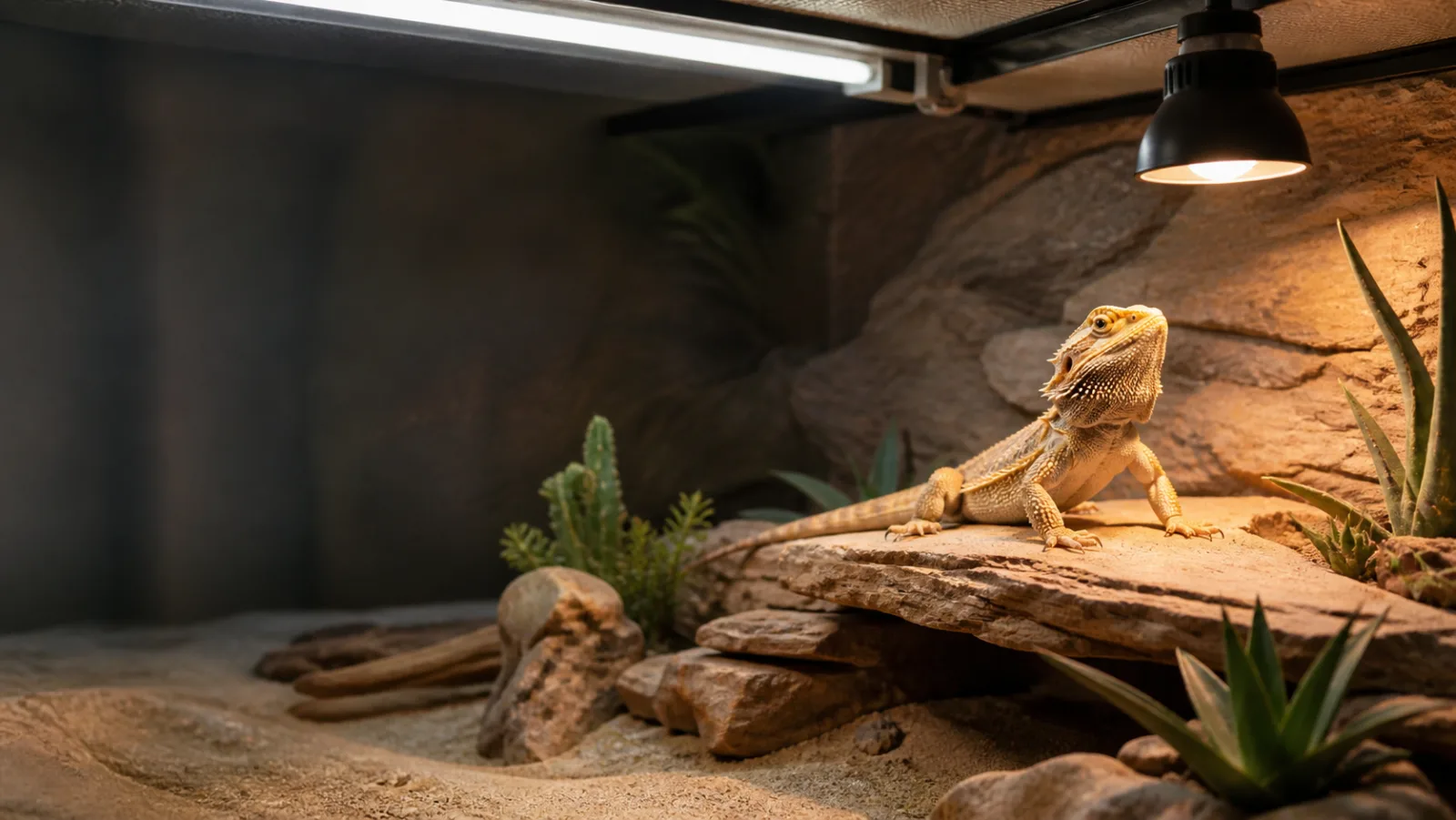
Every product on this list has been scored against the PetPal Gear Score, a weighted composite of expert consensus, observed effectiveness, animal safety, long-term durability, and value. Review method: Editorial synthesis of veterinary, university, and manufacturer-technical references — Merck Veterinary Manual, LafeberVet, VCA Animal Hospitals, Arcadia Reptile, Zoo Med Laboratories, Journal of Zoo and Aquarium Research, and peer-reviewed studies from Wageningen University & Research.. Synthesized from 9+ expert sources.
A reptile lighting setup is not just a bulb. The Merck Veterinary Manual, LafeberVet's client and technical handouts, and the Journal of Zoo and Aquarium Research paper "How much UVB does my reptile need? The UV-Tool" all converge on the same idea: reptiles need a species-appropriate patch of artificial sunlight where UVB, bright visible light, and basking heat overlap over the animal's body, while the rest of the enclosure preserves a real retreat into lower light and lower heat. Without that overlap and that retreat, the lighting fails — even when the bulbs are nominally "correct."
This guide synthesizes the consensus across veterinary, peer-reviewed, and manufacturer-technical sources for the questions every new keeper has to answer: what UVB and UVA actually do, why species need different setups, how to compare T5, compact, mercury vapor, halogen, and ceramic categories, what changes UVB exposure inside an enclosure, and how to build a basking zone that keeps the animal safe. PetPalHQ does not run a testing lab — the recommendations below are editorial synthesis of expert guidance, with sources cited by name throughout.
Why do reptiles need UVB, UVA, visible light, and heat?
Four light-related variables matter inside a reptile enclosure and they are not interchangeable. UVB drives vitamin D3 synthesis in skin, which allows calcium absorption; UVA shapes behavior and vision; bright visible light drives activity and circadian rhythm; basking heat enables thermoregulation. The VCA Animal Hospitals lighting article and LafeberVet's technical handout both treat these as distinct inputs — missing any one of them creates a different and specific deficit for the animal.
UVB in plain English. UVB is the wavelength range that lets many reptiles synthesize vitamin D3 in the skin, which is what allows them to absorb and regulate dietary calcium. The VCA Animal Hospitals lighting article and LafeberVet's client handout are aligned: without enough UVB, many reptiles cannot use the calcium in their food properly, and metabolic bone disease becomes a meaningful risk. UVB is the "calcium-use" light.
UVA in plain English. UVA does not make vitamin D3, but it still matters. The VCA lighting article and LafeberVet's handout note that reptiles use UVA for behavior and vision — they can see into the UVA range and respond to UVA cues that humans cannot perceive at all. UVA on its own is not a substitute for UVB, but it is part of what makes a properly lit enclosure feel like daytime to the animal.
Visible light in plain English. Bright visible light drives activity and circadian rhythm. The VCA article and LafeberVet's handout both treat enclosure brightness as a real husbandry input — a dim enclosure is not just cosmetically dull, it can suppress normal feeding and activity behavior in diurnal species.
Basking heat in plain English. Basking heat is not the same thing as UVB. The Arcadia Reptile halogen lamp documentation and LafeberVet's technical PDF both note that a hot bulb can warm a reptile without giving useful UVB, and a UVB bulb can deliver UV without providing proper basking heat. The two jobs are related but separate, and treating them as one is the most common beginner mistake in this category.
Why do UVB needs change by species?
A leopard gecko, a bearded dragon, and a red-eared slider do not use sunlight the same way. The Journal of Zoo and Aquarium Research UV-Tool paper makes this explicit: natural UV exposure depends on microhabitat and basking behavior — whether the animal lives in open desert, forest canopy, or shaded retreats, and whether it perches in full sun for hours or stays cryptic year-round. A single "high-UVB" or "no-UVB" default is wrong for most species.
A practical taxonomy from the source set:
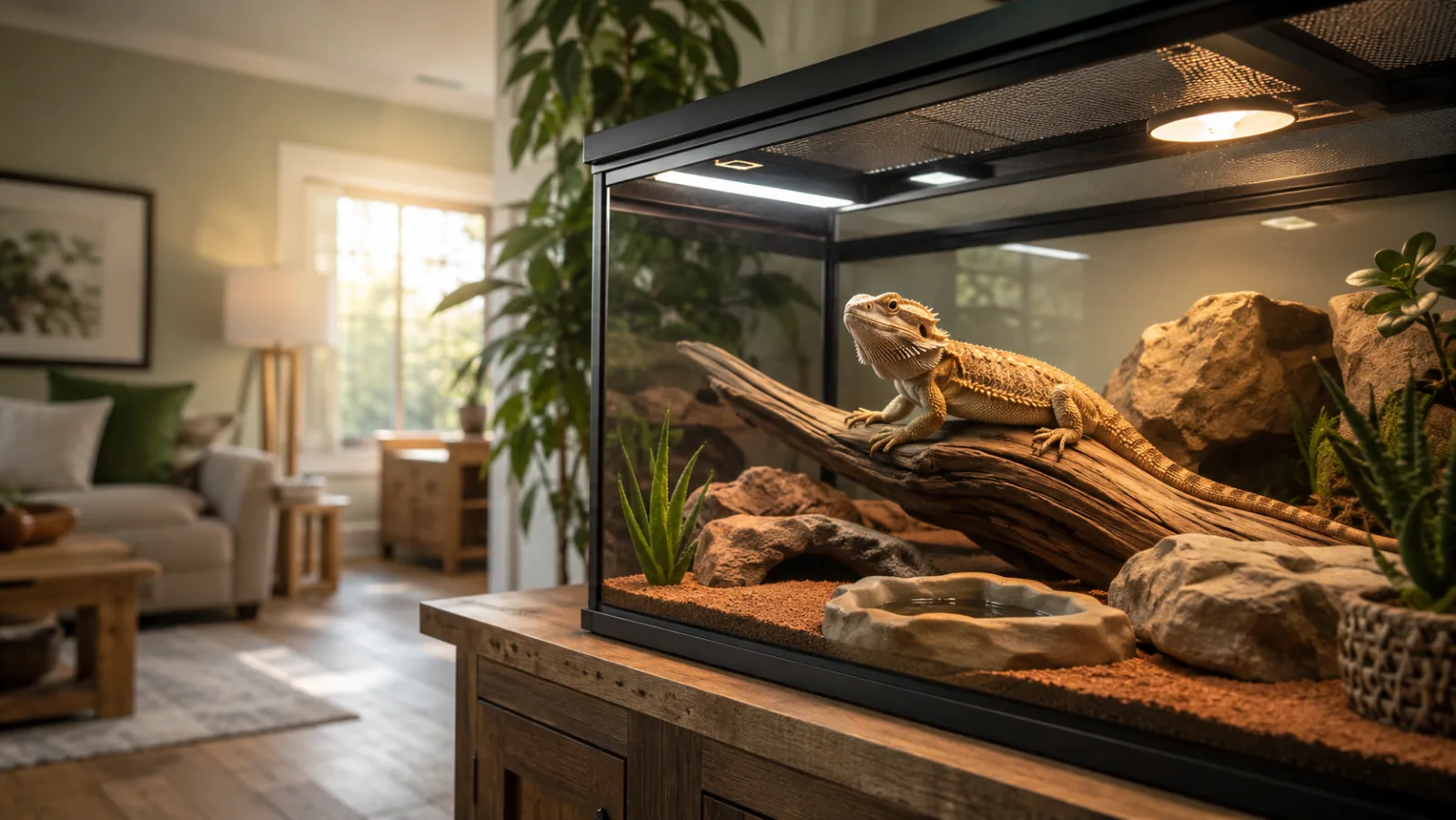
- High-UV baskers. Bearded dragons, many tortoises, aquatic basking turtles like red-eared sliders, and green iguanas all spend significant time in direct sun in the wild. They need strong UVB, broad basking coverage, and bright visible light — and they need enclosures large enough to provide a real shaded retreat as well.
- Moderate baskers. Veiled and panther chameleons sit in this band. Peer-reviewed work cited in the Journal of Zoo and Aquarium Research and a 2009 paper from the University of Chicago show that panther chameleons behaviorally regulate their UV exposure based on dietary vitamin D3 status — they are not "no-UV" species, but they are also not desert dragons.
- Lower-UV / crepuscular / nocturnal species. Leopard geckos, ball pythons, and corn snakes sit here. Wageningen University & Research's 2020 paper confirms that leopard geckos can synthesize vitamin D3 from UVB — modern husbandry increasingly uses low-level UVB gradients for them. The Merck Important Husbandry Requirements for Selected Reptiles table classifies corn snakes and ball pythons as having no special UV lighting requirements, while still noting likely health benefit from broad-spectrum lighting.
The honest editorial framing: "no UVB needed" and "blast it with a 10.0" are both wrong defaults. The right question is what intensity, over what coverage area, at what mounting distance, with what daily duration.
How do you compare T5, compact, mercury vapor, basking, LED, and ceramic lighting options?
For most commonly kept reptiles, the safest system separates the jobs: use a reflector-equipped linear T5 HO UVB fixture for UV, and a separate basking lamp for heat and brightness. LafeberVet's technical PDF and Arcadia Reptile lamp documentation both endorse this approach. Mercury vapor bulbs combine heat and UVB but cannot be thermostat-controlled; compact UVB suits only small enclosures; standard LEDs and ceramic emitters provide no UVB.
| Bulb type | What it provides | Best fit | Main drawbacks | Source |
|---|---|---|---|---|
| Linear fluorescent UVB (T5 HO) | UVB, some UVA, visible light; not meaningful basking heat | Most common pet reptiles in standard glass or PVC enclosures | Output depends heavily on reflector quality and mounting; needs a separate heat source | LafeberVet technical PDF; Arcadia ProT5 documentation |
| Older linear T8 UVB | Lower, more diffuse UVB than T5 HO | Shallow enclosures and lower-UV species | Older format; less flexible for tall enclosures or strong baskers | LafeberVet technical PDF |
| Compact fluorescent UVB | UVB in a limited area around the bulb | Very small enclosures or niche temporary use | Narrow coverage, steep gradient, potentially very high UVI close to the bulb | LafeberVet technical PDF |
| Mercury vapor bulb | UVB, UVA, visible light, and heat from one bulb | Large enclosures for basking species | Cannot be dimmed or thermostat-controlled; runs hot; less flexible than a separate-component setup | LafeberVet technical PDF; Arcadia D3 / D3 EVO documentation |
| Halogen / incandescent basking bulb | Heat, visible light, and often UVA — but not UVB | Daytime basking heat alongside a separate UVB lamp | Many beginners assume it replaces UVB; it does not | Arcadia halogen heat lamp documentation; VCA lighting article |
| Standard LED lighting | Bright visible light only | Improving enclosure brightness, plant growth, and daylight feel | Standard LEDs do not solve UVB; UVB-LED products remain a caution category in published research | LafeberVet technical PDF |
| Ceramic heat emitter (CHE) | Heat only — no visible light, no UVA, no UVB | Supplemental or nighttime heat where visible light would disrupt the day/night cycle | Cannot create a daytime basking effect or replace UVB | Arcadia Ceramic Heater documentation; VCA lighting article |
Compact UVB bulbs in particular deserve a word of warning. LafeberVet's technical PDF is direct that compact UVB creates a small coverage zone with a steep gradient — useful in genuinely small enclosures, but a poor default for the standard 40-gallon and larger setups most pet reptiles live in.
Mercury vapor bulbs have a real role in large enclosures for basking species, per LafeberVet and Arcadia's D3 / D3 EVO documentation, but they cannot be dimmed and cannot run on a heat thermostat — the same characteristic that makes them an "all-in-one" option also limits the keeper's control.
How do distance, mesh, reflectors, bulb age, and enclosure height change UVB exposure?
A bulb's package label tells you almost nothing about what the reptile actually receives. LafeberVet's technical PDF and Arcadia Reptile's lamp documentation are both explicit: distance, screen mesh, reflector quality, and bulb age all change the UVI at basking height — sometimes dramatically. A lamp strong enough on paper can fail in a real enclosure because of a screen top above it, or because the bulb has degraded past its useful UVB life while still appearing bright.
Distance. UV intensity falls off rapidly with distance. The Arcadia ProT5 documentation publishes specific UVI-vs-distance numbers for its own fixtures, and LafeberVet's technical PDF uses the same principle: a powerful lamp can be safe at a greater distance, while a weaker lamp can become uncomfortably intense if pushed too close. Always measure from the lamp face to the reptile's highest basking position — not to the floor or to the bottom of the enclosure.
Screen mesh. Standard reptile-enclosure mesh tops cut UVB output before it reaches the animal. LafeberVet's technical PDF and Arcadia's lamp documentation both warn that mesh can block a meaningful fraction of useful UV, light, and infrared. A bulb that is "strong enough" on paper can fail in a real enclosure simply because of the screen above it.
Reflector design. Reflector quality meaningfully changes delivered UVB. The Arcadia ProT5 documentation makes this point with the most detail in the source set: a reflector-equipped fixture concentrates UV downward toward the basking zone instead of letting it dissipate uselessly into the room. For linear UVB, a reflector is not optional.
Fixture quality. Cheap fixtures with poor reflector materials or no reflector at all can throw away a substantial portion of a bulb's output before it reaches the animal. LafeberVet's technical PDF treats fixture quality as part of the system, not a cosmetic choice.
Enclosure height. Tall enclosures (typical for chameleons and some arboreal lizards) need stronger lamps mounted further from the basking position; short, low enclosures need weaker lamps mounted with care to avoid overdosing the animal at close range.
Bulb age. UVB output falls with use even when the bulb still looks bright. LafeberVet's technical PDF and the VCA lighting article are aligned: visible brightness is judged by your eye, but biologically useful UVB is judged by the reptile's skin chemistry — and they don't track each other. Many quality bulbs stay usable for about a year, but real replacement timing varies by brand, fixture, and measurement.
How do you set a basking zone, shade zone, and day/night cycle?
Build one intentional sun patch and one intentional retreat. LafeberVet's technical PDF and the Journal of Zoo and Aquarium Research UV-Tool paper both drive this rule. The basking patch must be large enough for the animal's whole body, lit by overlapping UVB, visible light, and overhead heat, and paired with a shaded retreat the animal can reach without crossing the hot zone. Day/night cycles should run on a timer.
The basking patch should be:
- Large enough to fit the animal's whole body or shell, not just the head or shoulders.
- Lit by overlapping UVB, visible light, and basking heat — three jobs, often two or three bulbs.
- Mounted overhead and aimed downward, never side-mounted into the animal's face.
The retreat should be:
- A genuine shade option with much lower light and heat.
- Large enough to use comfortably, not a token corner.
- Reachable without the animal having to cross the basking zone.
For aquatic turtles, the basking zone goes over the dry dock, not over open water. Both the Merck Important Husbandry Requirements for Selected Reptiles table and the Arcadia lamp documentation are clear that the dry basking site is where lighting and heat overlap for sliders and similar species.
Day/night cycles should run on a timer. The Merck Providing a Home for a Reptile chapter and Zoo Med's ReptiSun T5 HO instructions both treat a stable photoperiod as one of the easiest beginner-friendly husbandry wins. Twelve hours on, twelve hours off is a workable maintenance default for many species; seasonal cycling is generally an advanced technique used for breeding or naturalistic simulation, not a beginner default.
When should you replace UVB bulbs and when is a UV meter worth buying?
Replace UVB bulbs on schedule unless a UV meter confirms the lamp is still delivering its target UVI range. LafeberVet and the VCA lighting article both endorse "replace yearly" as a safe default for quality T5 HO tubes, but visible brightness is not a reliable indicator — biologically useful UVB falls long before a bulb looks dim. A UV meter measures real UVI at basking height and pays for itself quickly for keepers running multiple enclosures or sensitive species.
A UV meter becomes especially valuable when:
- The enclosure is unusually tall, screened, or shallow — situations where calculated distances and published distance charts may not match real delivery.
- The keeper runs multiple enclosures and replacing all bulbs on a fixed calendar becomes wasteful.
- The species is sensitive to over- or under-exposure (some chameleons, some aquatic species).
- The fixture or reflector is not from a manufacturer that publishes UVI-vs-distance data.
For keepers who do not own a meter, the safe rule from LafeberVet's technical PDF is to label the install date on every UVB bulb, replace on the manufacturer's schedule, and pay attention to the species-level signs of under-exposure (poor appetite, reluctance to bask, slow growth, shedding problems) that may signal a problem before a meter would.
Species setup examples for common pet reptiles
| Species | UVB demand | Beginner-safe starting direction | Key nuance | Source |
|---|---|---|---|---|
| Bearded dragon | High | Strong linear T5 HO UVB plus a separate halogen basking bulb; broad basking platform | Arcadia's Dragon lamp documentation uses an upper basking UVI around 6.0 at ~35–40 cm under its reflected lamp system | Arcadia Dragon lamp docs; Wageningen 2010 bearded dragon study |
| Leopard gecko | Low to moderate | Low-level linear UVB over one end with hides and shade; modest basking zone | Arcadia's Lighting Guide cites a basking UVI of roughly 2–3 fading to 0 at the cool end — a gradient, not blanket coverage | Arcadia Lighting Guide; Wageningen 2020 leopard gecko UVB study |
| Red-eared slider (turtle) | High | UVB and basking heat over the dry dock, not over open water; clear splash zone | The basking site must be dry, usable, and hot enough to invite basking | Merck husbandry table; Arcadia / Zoo Med fixture docs |
| Mediterranean tortoise (Greek/Hermann's/Russian) | High | Broad overhead UVB field plus strong basking coverage large enough for the whole shell | Tiny spot-style UV solutions are usually wrong for tortoises; body-sized coverage matters | Merck husbandry table; Arcadia Dragon / Forest lamp docs |
| Veiled and panther chameleon | Moderate | Linear UVB from above paired with a basking and daylight zone near upper perches; planted shade lower down | Behavioral studies (University of Chicago, 2009) show panther chameleons regulate their UV exposure — provide gradient, not flood | Arcadia Forest lamp docs; Journal of Zoo and Aquarium Research UV-Tool paper |
| Green iguana | High | Strong overhead UVB in a tall enclosure with upper basking shelves and substantial visible light | Weak or tiny UVB pools are usually the wrong framing for a large arboreal herbivore; height and gradient planning matter | Merck husbandry table; VCA Iguanas problem page |
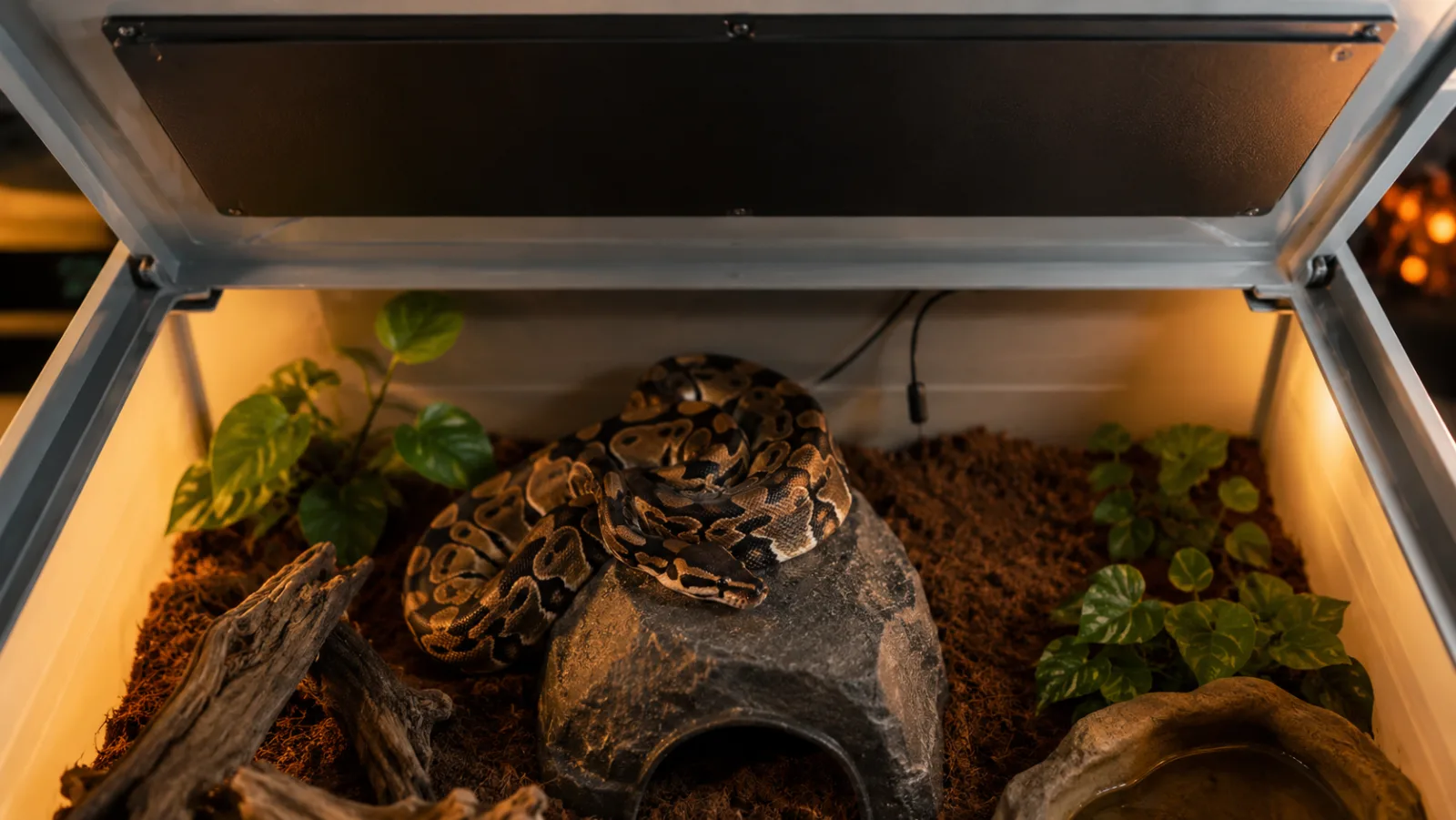
| Corn snake / ball python | Low | Lower-demand lighting logic, secure hides, retreat from the lit zone | Merck classifies these as no-special-lighting-requirements but still notes likely benefit from broad-spectrum lighting; avoid over-lighting, do not ignore lighting completely | Merck husbandry table; LafeberVet handout |
The species table is a starting map, not a substitute for measured UVI. The honest editorial framing from LafeberVet's technical PDF and the Arcadia documentation: match lamp strength and mounting height to the real enclosure, and use a UV meter when the setup is unusually tall, unusually shallow, screened, or otherwise hard to predict.
What are the most common reptile lighting mistakes and safety failures?
Most reptile lighting failures trace back to a small set of mistakes the source set names repeatedly: relying on package percentage labels instead of measuring real UVI, assuming a basking bulb provides UVB, leaving old-looking bulbs in place beyond their UVB lifespan, and using compact UVB in enclosures too large for its coverage. LafeberVet's technical PDF, the VCA lighting article, and Arcadia's documentation all identify these patterns as the source of most captive-reptile lighting deficiencies.
Buying by package percentage only. A bulb labeled 5.0, 10.0, 6%, or 12% does not tell you the UVI the reptile actually receives at basking height. LafeberVet's technical PDF and Arcadia's ProT5 documentation are both direct: distance, reflector, mesh, fixture, and enclosure height all change the result.
Using a heat bulb as if it solved UVB. Halogen and incandescent basking bulbs give heat and visible light, often with UVA, but no useful UVB. The Arcadia halogen heat lamp documentation and the VCA lighting article are aligned: pair basking heat with a real UVB source, or use a manufacturer-spec'd all-in-one mercury vapor bulb in an appropriate enclosure.
Putting UVB on top of dense mesh and assuming it still works. Mesh blocks a meaningful fraction of UV. Either compensate with measured setup changes or mount the lamp where the target UVI is actually achieved at the basking position.
Keeping an old bulb because it still looks bright. Visible light remains acceptable to your eyes long after biologically useful UVB has dropped. Replace on schedule or verify with a UV meter.
Using a compact UVB bulb over a normal-sized enclosure. Coverage is too small and the gradient too steep. Reserve compact UVB for true small-space use cases.
Creating no real basking zone. Without one defined patch of heat plus UVB plus visible light, the reptile cannot self-regulate the way it would under natural sunlight. Build one intentional basking side and one intentional retreat side.
Running visible light at night for heat. Lighted nighttime heating disrupts day/night cycles. The VCA lighting article and Arcadia's heater documentation both support using lightless heat sources (CHEs, deep heat projectors) when nighttime supplemental warmth is needed.
Mounting lamps loosely or without guards. Hot lamps can burn animals or fall into enclosures or water. Use rated holders, cages, clamps, and brackets — Arcadia's Clamp Lamp and Lamp Holder Bracket Pro documentation cover the specific failure modes.
Safety summary
The recurring message from LafeberVet, VCA, and Arcadia: better lighting is not just stronger lighting. Safer setups come from the right lamp, at the right distance, over the right basking area, with a real escape route and secure mounting hardware. Aim lamps downward; never count on UVB through ordinary glass or most plastics; never put a glass enclosure in direct sun as a shortcut to "natural UVB"; cage hot lamps to prevent direct contact; supervise outdoor sunlight sessions with shade and a temperature check; and for turtle setups, keep all fixtures dry, stable, and out of splash range.
Frequently Asked Questions
- Do all reptiles need UVB?
- Not in the same way. The Merck Important Husbandry Requirements for Selected Reptiles table and LafeberVet's client handout are aligned: many diurnal lizards and chelonians clearly need strong UVB support, while corn snakes and ball pythons are classified as no-special-lighting-requirement species. Even so, both sources note likely health benefits from broad-spectrum lighting across the board, and Wageningen University & Research's 2020 paper confirms that leopard geckos can synthesize vitamin D3 from UVB. The honest answer: more species benefit from at least some UVB than the older hobby tradition suggested.
- Is a basking bulb the same thing as a UVB bulb?
- No. The Arcadia halogen heat lamp documentation and the VCA lighting article are direct on this: a basking bulb mainly provides heat and visible light, sometimes UVA, but it does not provide biologically useful UVB. Pair basking heat with a real UVB source, or use a manufacturer-spec'd mercury vapor bulb that delivers both.
- Can I use an LED bar instead of UVB?
- Not as a default. LafeberVet's technical PDF and the VCA lighting article both treat standard LEDs as a visible-brightness solution, not a UVB substitute. UVB-LED products are an emerging category, but published research has raised safety concerns about their spectra, so they should not be presented as the beginner baseline.
- Can UVB go through glass or a window?
- No, not in a useful way for husbandry. The LafeberVet technical PDF, the Merck Providing a Home for a Reptile chapter, and the VCA lighting article are all explicit: ordinary glass and most plastics block the UVB the keeper is trying to deliver. UVB has to reach the animal directly.
- How close should the UVB bulb be?
- There is no one-size-fits-all number. The VCA lighting article, LafeberVet's technical PDF, and Arcadia's ProT5 documentation all show that distance depends on lamp type, reflector quality, mesh presence, and enclosure height. Generic rules like "9 to 15 inches" are rough references, not universal answers. For specific lamps, the Arcadia ProT5 documentation publishes UVI-vs-distance figures that beat any generic rule.
- If my UVB bulb still looks bright, is it still good?
- Not necessarily. LafeberVet's technical PDF and the VCA lighting article both note that UVB output falls with use even when the bulb still appears normal to the human eye. Replace on schedule or verify with a UV meter.
- Do leopard geckos need UVB?
- They should not be treated like bearded dragons, but the evidence supports UVB use. Wageningen University & Research's 2020 paper confirms that leopard geckos synthesize vitamin D3 from UVB exposure, and Arcadia's Lighting Guide gives example basking-UVI targets of roughly 2–3 for leopard geckos with the cool end at 0. Modern husbandry increasingly uses low-level UVB gradients for them — not the same lamp setup as a bearded dragon, but not zero either.
- Should UVB stay on at night?
- No. UVB is a daytime input. The Merck Providing a Home for a Reptile chapter and Arcadia's heater documentation both treat night heat as a separate problem solved by lightless sources (ceramic heat emitters, deep heat projectors) when supplemental warmth is needed after dark.
- When is a UV meter worth buying?
- A meter becomes especially valuable when the enclosure is tall, screened, unusually shallow, or expensive enough that replacing bulbs by guesswork wastes money. LafeberVet's technical PDF treats meter use as the cleanest way to confirm real UVI at reptile level — it can prevent both premature bulb changes and underpowered setups, and it pays for itself quickly for keepers running multiple enclosures or sensitive species.
Bottom Line
Replace UVB bulbs on schedule, not when they look dim. LafeberVet and VCA Animal Hospitals both note that UVB output falls with use even when a lamp still appears bright to the human eye.
Mesh covers cut UVB output significantly. The LafeberVet technical handout and Arcadia Reptile's lamp documentation both warn that screen tops, glass, and plastic block a meaningful fraction of useful UV before it reaches the reptile.
Package labels like 5.0, 10.0, 6%, or 12% do not tell you the UVI the reptile actually receives at basking height. Distance, reflector quality, fixture design, and mesh all change the result.
Basking bulbs are not UVB bulbs. The Arcadia Reptile halogen documentation and VCA Animal Hospitals are direct: a heat lamp can warm a reptile without delivering biologically useful UV.
Separate the jobs. For most common pet reptiles, the simplest safe system is a reflector-equipped linear UVB fixture for UV plus a separate basking bulb for daytime heat and brightness.
All articles in this guide
Sources & Methodology
Expert review sources
- Merck Veterinary Manual — Management and Husbandry of Reptiles (revised Jul 2025)
- Merck Veterinary Manual — Important Husbandry Requirements for Selected Reptiles
- Merck Veterinary Manual — Providing a Home for a Reptile (revised Aug 2020; modified Sept 2024)
- LafeberVet — UVB Lighting for Reptiles Client Education Handout (August 20, 2024)
- LafeberVet — UVB lighting for reptiles technical PDF (Baines, 2024)
- VCA Animal Hospitals — Lighting Requirements for Reptiles
- Journal of Zoo and Aquarium Research — How much UVB does my reptile need? The UV-Tool (Baines et al., 31 Jan 2016)
- Wageningen University & Research — Effects of vitamin D3 supplementation and UVb exposure on the growth and plasma concentration of vitamin D3 metabolites in juvenile bearded dragons (2010)
- Wageningen University & Research — The nocturnal leopard gecko uses UVb radiation for vitamin D3 synthesis (2020)
- PubMed — Nutritional metabolic bone disease in juvenile veiled chameleons and its prevention (2010)
- Journals of the University of Chicago — Panther chameleons behaviorally regulate optimal exposure to UV depending on dietary vitamin D3 status (2009)
Community sources
- Arcadia Reptile — Lighting Guide, ProT5, Dragon, Forest, and Natural Sunlight lamp documentation
- Arcadia Reptile — D3 Basking Lamp / D3 EVO Basking Lamp documentation
- Arcadia Reptile — Ceramic Heater, Deep Heat Projector, Halogen Infrared Heater, Clamp Lamp, and Lamp Holder Bracket Pro documentation
- Zoo Med Laboratories — UVB for Reptiles Lamp Charts PDF (2023)
- Zoo Med Laboratories — ReptiSun T5 HO instructions PDF (2024)
Prices and specs verified May 4, 2026.
About the author
Nick Miles is the chief editor of PetPalHQ. PetPalHQ does not run a testing lab — every claim on this page is synthesized from veterinary references, peer-reviewed husbandry research, and manufacturer-technical documentation. Sources are cited by name in body prose; the bibliography above lists every primary source consulted for this hub.
PetPalHQ is a participant in the Amazon Services LLC Associates Program. We may earn commissions from qualifying purchases — at no extra cost to you.
More Guides
Reptile
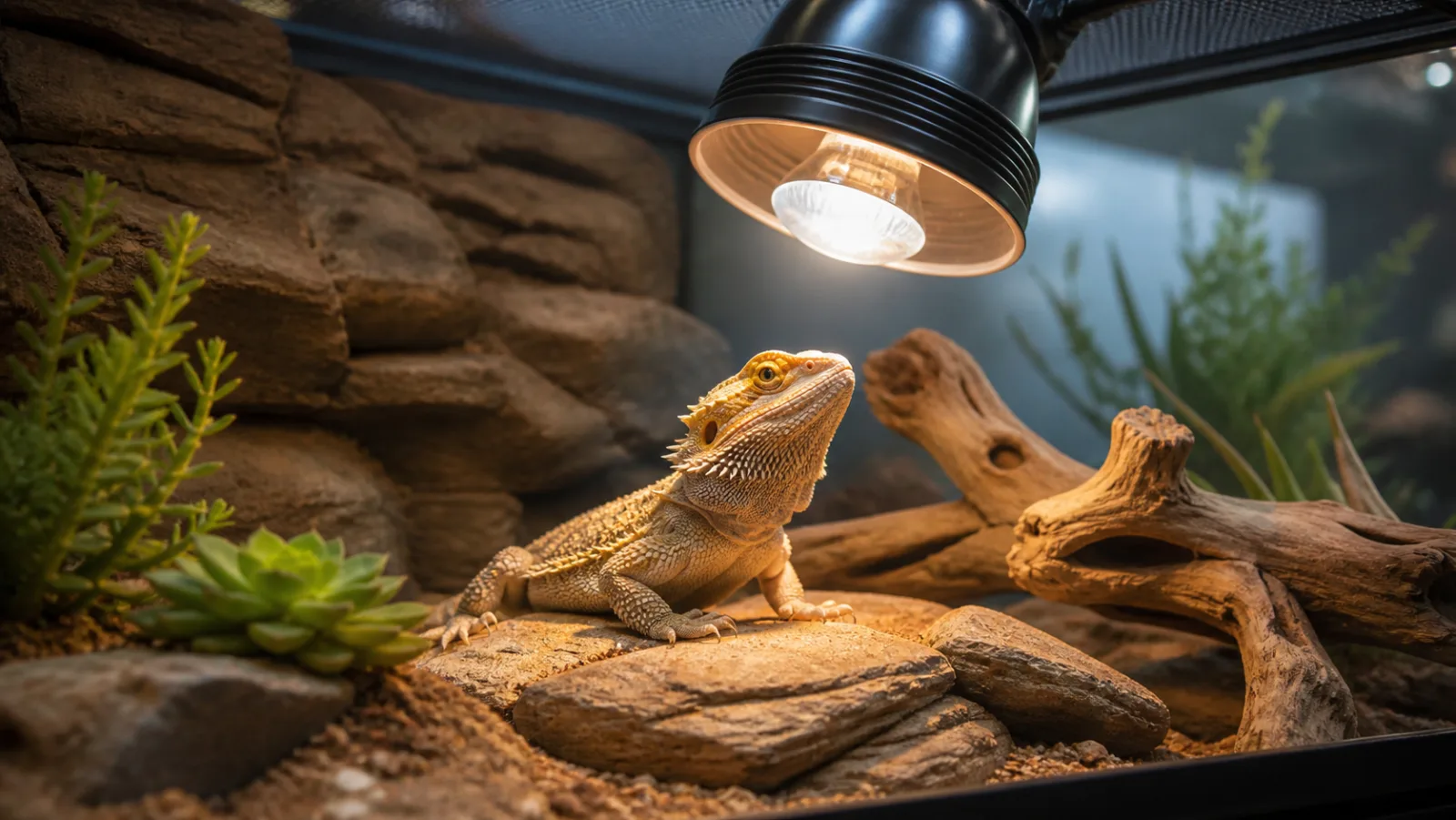
Best Reptile UVB Bulbs for Safe Lighting (2026)
Reptile
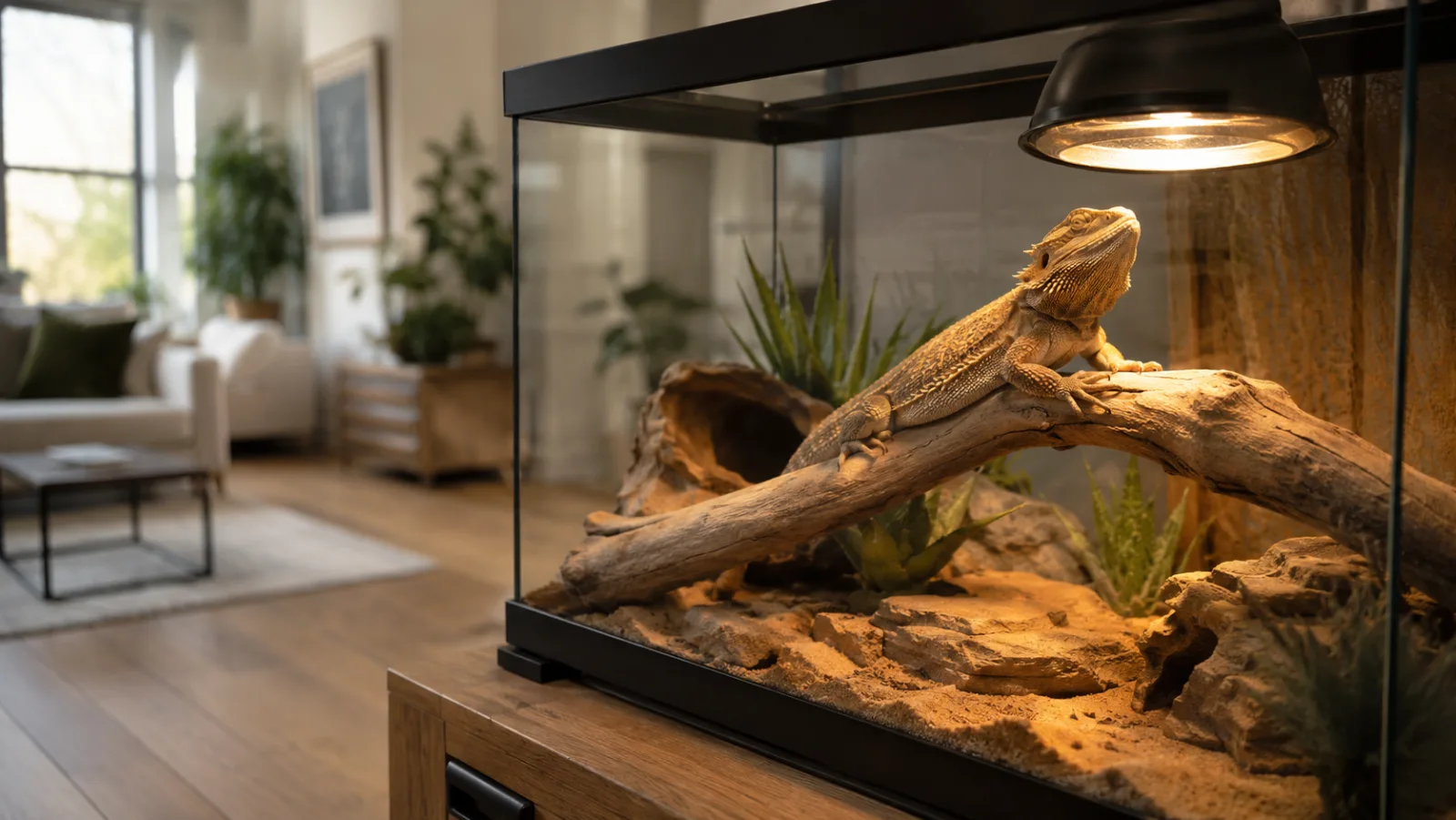
Best Reptile Heat Lamps & Basking Fixtures (2026)
Reptile
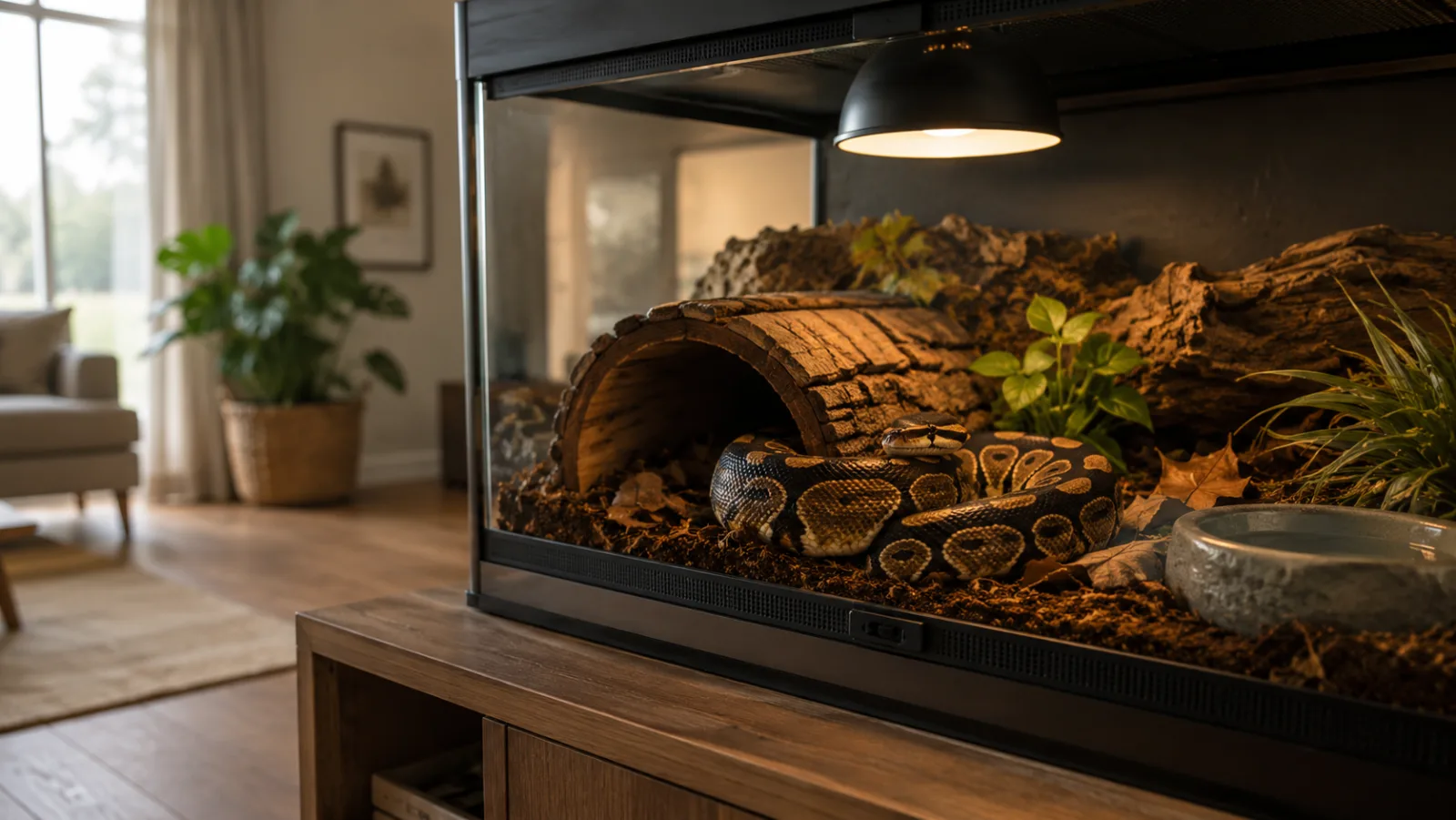
Best Ball Python Starter Kits (2026)
Reptile
Best Bearded Dragon Starter Kits (2026)
Reptile
Best PVC Reptile Enclosures for Bioactive Setups (2026)
Reptile